
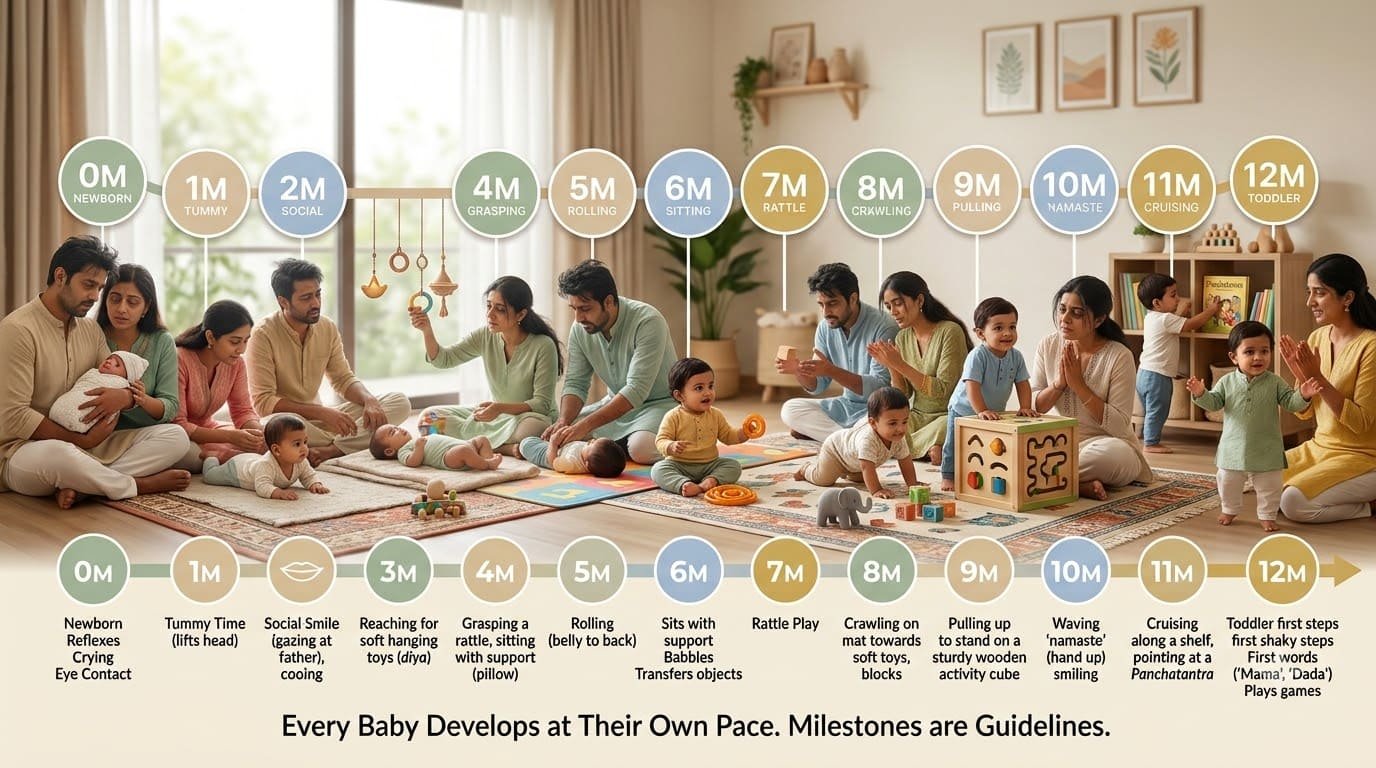
Medical Disclaimer: This article is for informational purposes only. Every baby develops at their own pace. Milestones are ranges, not deadlines. Always consult your paediatrician if you have concerns about your baby’s development.
Baby development month by month is the story parents obsess over most, and this guide walks through exactly what to expect, one month at a time.
My son’s paediatrician said something at the two-month check that I’ve thought about every month since.
“Stop comparing him to the chart. Watch him. Is he doing more today than he was doing last week? That’s what matters.”
It took me three months to actually believe this. I kept looking at milestone charts, reading forums, comparing notes with other mothers in my building. One child was rolling at four months. Another was babbling constantly at three. Mine was doing neither on schedule and I was quietly convinced something was wrong.
He was fine. He rolled at five months. He babbled at four. He walked at thirteen months. He’s four now and will not stop talking.
The first year of a baby’s development is one of the most extraordinary things that happens in human biology. In twelve months, a person goes from being unable to hold their own head up to standing, walking, pointing, communicating, and developing a personality that is distinctly, unmistakably their own. This guide covers all of it — what to watch for each month, what supports development, what the Indian-specific context looks like, and the red flags that genuinely warrant a paediatrician conversation.
Before the months — how to read this guide
Milestones are ranges, not deadlines. A milestone listed at “month 4” means most babies achieve it somewhere in a window around that time — not that your baby failed if they’re doing it at month 5.
According to the World Health Organization’s child development standards, development is best assessed by looking at the overall pattern and trajectory — not by whether a single skill arrived on a specific date. The Indian Academy of Pediatrics similarly emphasises that consistent progress across domains — motor, language, social, cognitive — matters more than hitting individual markers at exact ages.
Development happens in four areas simultaneously:
Motor development — gross motor (large movements: rolling, sitting, crawling, standing, walking) and fine motor (small movements: grasping, pinching, pointing).
Language and communication — from crying and cooing through babbling to first words and simple understanding.
Social and emotional — bonding, recognising faces, smiling, attachment, separation awareness.
Cognitive — how the baby understands the world: cause and effect, object permanence, problem-solving.
One more thing: Indian baby weight averages follow WHO standards — approximately 2.8–3.5 kg at birth, doubling by 5–6 months, tripling by twelve months. Your baby’s growth curve matters more than where they sit on any percentile chart.
Month 1 — The whole world is new
Your baby has arrived from a warm, dark, continuously nourishing environment and is now processing light, temperature, hunger, faces, and sound simultaneously. Month one is almost entirely about adjustment — for the baby and for you.
What most babies do
Motor: Movements are reflexive. The Moro reflex — arms flung wide in response to sudden movement or sound — is strong. Head flops forward when unsupported. During tummy time, the head turns to one side.
Language: Crying is the primary communication. Different cries for different needs begin — hunger, discomfort, tiredness. Cooing sounds start toward the end of this month.
Social: Focuses on faces at 20–30cm — exactly the distance from your face during feeding. Briefly tracks a moving face with the eyes.
Cognitive: Recognises the mother’s voice from the womb. Calms when held and spoken to.
What supports development this month
Talk while you do everything. Narrate nappy changes, feeds, baths. Your voice is the most powerful developmental tool available to you right now. Eye contact during feeding. Tummy time — even 2-3 minutes several times a day — from the very first week.
Indian baby care note: The traditional practice of baby massage — maalish — is genuinely beneficial from this age. Use a light, fragrance-free oil. Keep the room warm. Gentle, firm strokes support body awareness and bonding.
Month 2 — The smile that changes everything
Around six to eight weeks, the social smile appears. This is not the reflex smile of the first weeks — this is a real, reciprocal, eye-contact smile that responds to you. It is one of the most significant moments of the first year. Watch for it. It often arrives around the hardest weeks of new parenthood, and it helps.
What most babies do
Motor: Head control improving. During tummy time, lifts head for a few seconds. Holds head steadier when carried upright.
Language: Cooing sounds multiply. Responds to familiar voices with sounds. Making sounds back when you make sounds.
Social: The social smile. Recognises familiar faces. Tracks a moving object with the eyes for longer periods.
Cognitive: Shows preference — prefers faces over objects, prefers high-contrast patterns.
What supports development this month
Respond to every sound your baby makes as if it’s a conversation. Pause. Let them “respond.” Reply. This turn-taking pattern is the foundation of all future communication. High-contrast objects — black and white patterns — are particularly engaging for visual development this month.
Month 3 — Personality starts arriving
By three months, your baby has opinions. About who holds them. About which position they prefer. About the car seat. Month three is when parents start catching glimpses of who this person is going to be.
What most babies do
Motor: Head lifts to 45 degrees during tummy time. Pushes up on forearms. Hands becoming fascinating — stares at own hands, begins intentional swiping at objects.
Language: Laughing begins — soft, surprised-sounding. Cooing is more varied and more clearly communicative. Reacts to sounds by turning toward them.
Social: Smiles broadly and spontaneously at familiar faces. Recognises parents across a room. Enjoys social interaction.
Cognitive: Begins to anticipate — shows excitement when recognises the breast or bottle approaching.
What supports development this month
Singing. Any language. Hindi lullabies, Tamil songs, English nursery rhymes — the phonological richness of language input at this age supports language development across all languages the baby hears. Carrying facing outward — now that head control is improving — gives rich visual stimulation.
Month 4 — Rolling and the sleep regression
Month four brings two things that are related in ways that aren’t immediately obvious: rolling (a motor milestone) and the sleep regression (a neurological development). Both happen because the brain is maturing rapidly.
What most babies do
Motor: Rolling from tummy to back often arrives this month — usually accidentally at first, with that characteristic look of surprised delight. Reaches for and grasps objects intentionally. Brings objects to mouth.
Language: Babbling begins — consonant-vowel combinations. “Ba.” “Da.” “Ma.” Not words yet. Laughing is more frequent and more robust.
Social: Recognises and prefers familiar people. May show first signs of stranger wariness.
Cognitive: Object tracking is smooth and sustained. Shows excitement at familiar objects and routines.
The four-month sleep regression
Sleep architecture matures at this age — sleep cycles shift toward the adult pattern, with more light sleep stages and more transitions between cycles. Babies who were sleeping in longer stretches suddenly wake more frequently. This is neurological progress, not regression. For detailed guidance, our 4-month sleep regression guide covers what’s happening and what helps.
Month 5 — Reaching, grabbing, everything in the mouth
Five months is when babies become genuinely interactive — responding, initiating, reaching with clear intention for specific things that interest them.
What most babies do
Motor: Sitting with significant support. Rolling both directions in many babies. Reaches for objects across the midline of the body — a significant bilateral coordination milestone. Everything goes in the mouth — this is information-gathering, not a habit to break.
Language: Babbling more varied. Responds to own name turning. Recognises familiar words in context.
Social: Laughs easily and often. Shows clear preference for familiar people. May begin to show upset when a favourite person leaves.
Cognitive: Cause and effect is emerging — deliberately drops objects to watch them fall.
Month 6 — Sitting, solids, a turning point
Six months is a genuine milestone month — not just in what the baby can do, but in what changes for the whole family.
What most babies do
Motor: Many babies sit independently for brief periods — and then increasingly longer ones. Head control is complete. Transfers objects from hand to hand.
Language: Babbling is rich and varied. Responds to “no” and simple familiar phrases. Begins to show understanding that words mean things.
Social: Stranger anxiety often arrives or intensifies. Clear attachment to primary caregivers. Shows emotions — frustration, delight, discomfort — more expressively.
Cognitive: Object permanence begins — the baby now knows that objects continue to exist when out of sight.
Starting solids at 6 months
Both WHO and IAP recommend exclusive breastfeeding or formula feeding until six months, then introducing solids alongside continued milk. Signs of readiness: sitting with minimal support, good head control, showing interest in food, losing the tongue-thrust reflex.
First foods: single-ingredient purees — sweet potato, carrot, apple, moong dal — introduced one at a time. For a complete guide, our starting baby solid foods guide has a week-one plan and first food ideas.
Indian weight average at 6 months: Boys approximately 7.5-8 kg, girls approximately 6.9-7.3 kg. Birth weight has typically doubled by this point.
Month 7 — On the move
Movement is coming. The exact form varies enormously — and all forms are normal.
What most babies do
Motor: Sitting independently and steadily. Beginning to move — pushing up on hands and knees, rocking, attempting crawling in whatever form suits this baby. May crawl classically, bottom-shuffle, commando-crawl, or not crawl at all. All are normal.
Language: Babbling has consonant variety — “mama,” “baba,” “dada” — not yet used with meaning but getting there. Responds to name consistently.
Social: Strong attachment to specific caregivers. Separation anxiety peaks for many babies around this time. Stranger wariness is pronounced.
Cognitive: Object permanence is robust — will look for a toy that has been hidden. Cause and effect is well-established.
Month 8 — The world gets bigger (and more frightening)
Eight months is often the peak of separation anxiety — which makes complete developmental sense. The baby now understands you exist when you leave (object permanence) but doesn’t yet fully understand that you’ll come back. The distress is the price of cognitive advancement.
What most babies do
Motor: Crawling — in whatever form. Pulling to stand, often on furniture, sometimes on unsuspecting adults. Cruising along furniture in some babies.
Language: Babbling becoming more varied and more clearly intentional. May use specific sounds consistently for specific things — the beginning of words.
Social: Peek-a-boo becomes genuinely funny — because object permanence means the disappearance is now surprising and meaningful.
Cognitive: Imitation of actions becomes more sophisticated. Watches what adults do with objects and tries to replicate.
Fine motor: Pincer grasp developing — picking up small objects between thumb and forefinger. This means everything small on the floor is now at risk of going in the mouth.
Month 9 — Pulling to stand, pointing, communicating
Month nine is when the physical and communicative development really accelerate together.
What most babies do
Motor: Pulling to stand from the floor. Standing while holding on. Cruising along furniture. Some babies take first independent steps — early but normal.
Language: Pointing appears — first receptive (following when you point), then expressive (pointing to communicate). This is a major communication milestone. First recognisable words in some babies — “mama,” “dada” used with meaning.
Social: Very clear preferences. Will go toward preferred people and away from unfamiliar ones. Begins to understand social rules — wave bye-bye.
Cognitive: Beginning to understand that objects have purposes. Uses objects appropriately — holds phone to ear, puts spoon toward mouth.
Vaccination check at 9 months
The 9-month visit in the IAP schedule includes Measles/MMR and Vitamin A. Don’t miss this appointment. For our complete vaccination guide, our baby vaccination schedule guide covers the full IAP schedule.
Month 10 — Everything faster, everything more intentional
By ten months, babies are purposeful in a way that’s unmistakable. Whatever they’re doing, they mean to do it.
What most babies do
Motor: Faster and more confident in whatever locomotion form they’ve chosen. Standing alone briefly — often accidentally, then intentionally.
Language: Two or three words with consistent meaning in many babies. Understands several familiar instructions. Imitates sounds and words heard.
Social: Affection expressed more actively — reaching for favourite people, showing toys, sharing experiences. Frustration expressed more clearly too.
Cognitive: Object permanence is now complete. Imitates sequences of actions. Solves simple problems — moves one object to reach another.
Month 11 — Consolidation before the first birthday
Eleven months is often a month of consolidation — skills that were emerging become reliable, and the baby is preparing for the developmental leap of the first birthday.
What most babies do
Motor: Standing alone steadily. First independent steps in many babies — though walking anywhere from 9 to 18 months is completely normal.
Language: Vocabulary building. Three to five words in many babies. Understanding of language is significantly ahead of expression.
Social: Social games — give and take, peek-a-boo, clapping — are enjoyed and initiated. Shows off for familiar people.
Cognitive: Object permanence is solid. Can follow two-step simple instructions. Understands cause and effect at a sophisticated level.
Month 12 — The first birthday
A baby who weighed around 3 kg twelve months ago is now three times that weight. They can probably stand. They may be walking. They have words.
What most babies do at 12 months
Motor: Standing alone. Walking — anywhere from nine months (early normal) to eighteen months (later normal). Climbing — on everything.
Language: Two to five clear words with meaning. Understands significantly more than they can say. Points to communicate desire and interest.
Social: Shows affection. Shows off achievements. Shows frustration clearly. Has a developing sense of humour.
Cognitive: Sophisticated cause and effect. Early pretend play — feeding a doll, pretending to drink from an empty cup.
Indian weight average at 12 months: Boys approximately 9.5-10 kg, girls approximately 8.9-9.3 kg.
The first birthday milestone check
At the 12-month well-baby visit, your paediatrician will assess: walking progress, language, social communication (pointing, waving, showing), and overall development. Come with any questions you’ve accumulated. This is one of the most important check-ups of the first year.
Supporting development throughout the first year — what actually works
The research on what drives development in the first year is remarkably consistent: it’s responsive human interaction. Not toys, not apps, not programmes. You.
Talk constantly. The quantity of words a child hears in the first three years is one of the strongest predictors of language and cognitive development. Narrate everything — what you’re doing, what you’re seeing, what’s happening.
Follow their lead. When the baby shows interest in something, comment on it. Joint attention — both of you focused on the same thing — is one of the most powerful developmental contexts that exists.
Tummy time every day. From the first week. It builds the neck, shoulder, and core strength that underlies rolling, sitting, crawling, and walking. Most babies dislike it initially. Persist — it gets easier.
Respond to their communication. Crying, cooing, babbling, pointing — respond to all of it. Responsive caregiving is the foundation of secure attachment, which underlies almost every positive developmental outcome.
Read together. From any age. The books don’t need to be read — they can be chewed, torn, looked at. The interaction around the book — pointing, commenting, making sounds — is what drives development.
Limit screens. No passive screen time before 18 months except video calls with family. The developing brain needs human interaction, not content. For more on this, our screen-free childhood challenge guide covers why it matters and how to manage it.
Red flags — when to talk to your paediatrician
One missed milestone in isolation is almost never a concern. These patterns — across multiple areas, or involving lost skills — warrant prompt assessment:
| Age | Talk to your doctor if |
|---|---|
| 3 months | No social smile, no response to sound, no eye contact |
| 6 months | No laughing or squealing, not reaching for objects |
| 9 months | No babbling, no pointing or waving, not responding to name |
| 12 months | No single words, no pointing, no gesture, not standing with support |
| Any age | Lost a skill they previously had — always warrants prompt assessment |
The last row is the most important. Skill regression — losing something the baby was previously doing — is always worth a same-week paediatrician appointment.
FAQ — Baby Development Month by Month
Q: My baby is behind on one milestone but ahead on others. Is this normal?
A: Yes — development is uneven. Babies often advance rapidly in one area while another lags. A baby who is crawling early may walk later. A baby with many words may be later to walk. What matters is the overall trajectory across areas, not synchrony between them. If multiple areas are lagging simultaneously — speak to your paediatrician.
Q: My second baby is developing differently from my first. Why?
A: Every baby has their own developmental timeline within normal ranges. Sibling comparisons are almost always unhelpful — normal variation within the range is the most common explanation for any difference.
Q: Does baby massage (maalish) actually help development?
A: Yes — infant massage has genuine evidence behind it. It supports weight gain in premature babies, improves sleep quality, reduces cortisol (stress hormone), and supports the bonding that underlies all development. The traditional Indian practice of daily baby massage is developmentally sound. Use gentle, firm strokes with a light, fragrance-free oil.
Q: My baby was premature. How do I use this guide?
A: Use your baby’s corrected age — not their chronological age — until age two. A baby born eight weeks early would be assessed at the milestones of eight weeks behind their calendar age. Your paediatrician will guide this specifically. Premature babies often catch up to their full-term peers by age two, though the trajectory varies.
Q: When should my baby’s birth weight double and triple?
A: Most babies double their birth weight by 4-6 months. By twelve months, most babies have tripled their birth weight. These are averages — your baby’s individual growth curve is more meaningful than comparison to averages. What matters is consistent progress along whatever curve the baby has established.
Q: At what age should I worry if my baby isn’t walking?
A: Walking anywhere between 9 and 18 months is within the normal range. If your baby is not walking by 18 months, that’s when a paediatrician assessment is appropriate. Before then — unless there are other concerns — walking timing alone is not a reason for worry.
More from MumPappaHub — Read These Next:
- Baby First Year Milestones: Month-by-Month
- 4 Month Sleep Regression: What’s Happening
- Newborn Sleep Tips: What Actually Works
- Starting Baby on Solid Foods
- Child Development Milestones
- Toddler Language Development
- Newborn Care Tips
- Baby Fever Guide
- Sensory Play for Toddlers India
- How to Increase Breast Milk Supply
- Screen-Free Childhood Challenge
- Baby Blues vs Postpartum Depression
About This Article
Written by the MumPappaHub editorial team — including a mother whose paediatrician told her to stop comparing her son to the chart and watch him instead. She watched. He was fine. He still won’t stop talking.
Reviewed for accuracy against WHO child development standards, Indian Academy of Pediatrics developmental guidelines, and current paediatric research on infant development. This content is for general informational purposes only and does not constitute medical advice. Always consult your paediatrician with specific concerns about your baby’s development.
MumPappaHub — Real talk for real parents. mumpappahub.com

34 Comments