
Medical Disclaimer: This article is for informational purposes only and reviewed against WHO, IAP, and ICMR guidelines. If your toddler has specific nutritional concerns, poor growth, or dietary restrictions, consult your paediatrician.
Toddler nutrition India is one of the most anxious topics in Indian parenting — because toddlers are famously unpredictable eaters, because Indian families have strong opinions about what and how children should eat, and because the gap between what a toddler is willing to eat and what a parent wants them to eat is one of the most reliably frustrating daily experiences of early parenthood.
My friend’s daughter ate only curd rice and banana for three weeks at age two. Three weeks. Nothing else. My friend consulted our paediatrician friend who said: “She won’t starve. Toddlers have a self-regulatory mechanism. Keep offering variety. Don’t make mealtimes a battle. She’ll expand her range.”
She did. By Week 5 she was back to eating reasonable variety. The curd rice phase passed.
This guide covers toddler nutrition in India — what toddlers actually need, why they eat the way they eat, and the ten most practical approaches that work in Indian households.
Toddler Nutrition India — What Toddlers Actually Need
Toddler nutrition India must begin with honest nutritional guidance — because the gap between what Indian parents think toddlers need and what they actually need drives much of the mealtime conflict.
According to the World Health Organization’s guidelines on complementary feeding, toddlers aged 1-3 years need a varied diet that covers energy, protein, iron, calcium, zinc, and vitamins — achievable through traditional Indian family food without special products. The Indian Academy of Pediatrics and the Indian Council of Medical Research (ICMR) provide specific Indian toddler nutrition guidance that accounts for traditional Indian food practices.
ICMR daily nutritional targets for Indian toddlers (1-3 years):
| Nutrient | Daily Requirement |
|---|---|
| Calories | 1000-1200 kcal |
| Protein | 12-16g |
| Calcium | 600mg |
| Iron | 9mg |
| Vitamin C | 40mg |
The practical reality: These targets are achievable through a typical Indian family diet that includes dal, roti/rice, sabzi, curd, and some fruit — without supplements, without special products, and without forcing the toddler to eat things they refuse.
Why Toddlers Eat the Way They Do
Understanding toddler eating behaviour is as important as knowing what to feed them — because much of Indian mealtime conflict comes from misunderstanding normal toddler eating patterns.
Neophobia (food fear): Between 18 months and 3 years, most toddlers develop strong food neophobia — resistance to trying new foods. This is evolutionary (historically, it prevented toddlers from eating unfamiliar potentially toxic plants when they began to explore independently). It is not stubbornness or bad behaviour — it is neurologically programmed.
Small, variable appetite: Toddlers have small stomachs and genuinely variable appetite — driven by growth spurts, illness, activity level, and developmental phase. A toddler who ate well last week may barely eat this week — this is normal variation, not a problem.
Texture sensitivity: Many toddlers are sensitive to specific textures. A toddler who gags on certain textures is not being difficult — their sensory processing is genuinely different from adults.
The growth slowdown: After the rapid growth of the first year (when birth weight triples), toddler growth slows significantly. Appetite naturally reduces in proportion. The Indian expectation that a 2-year-old should eat as enthusiastically as they did at 8 months is not realistic.
Self-regulation: Research consistently shows that toddlers have reliable hunger and satiety signals — they stop eating when full. The Indian parenting pressure to “finish the plate” overrides this self-regulation and is associated with later overeating and weight issues.
10 Best Toddler Nutrition Tips India
1. Division of Responsibility — The Golden Rule
The most important principle in toddler feeding is the division of responsibility, developed by dietitian Ellyn Satter and supported by the IAP:
The parent’s job: WHAT food is offered, WHEN it is offered, and WHERE eating happens.
The toddler’s job: WHETHER to eat and HOW MUCH to eat.
When parents take over the toddler’s job — forcing, cajoling, tricking, or rewarding eating — it creates power struggles that worsen eating behaviour. When parents consistently offer appropriate food at regular times and trust the toddler to decide whether and how much to eat, most toddler eating problems resolve over time.
Practical application in Indian households: The parent cooks and serves nutritious food. The toddler decides what they eat from what is served and how much. No separate “toddler food” — the family meal, appropriately prepared (less spicy, appropriate texture), is the toddler’s meal too.
2. Structured Meals and Snack Times — No Grazing
Toddlers eat better at meals when they come to the table with genuine appetite. Constant grazing — small amounts of food or milk throughout the day — suppresses appetite at mealtimes and leads to inadequate nutrition at structured meals.
The schedule: 3 meals + 2 snacks daily, at consistent times. Nothing between scheduled eating times except water.
Typical Indian toddler eating schedule: Breakfast: 7:30-8 AM Mid-morning snack: 10:30-11 AM Lunch: 12:30-1 PM Afternoon snack: 3:30-4 PM Dinner: 7-7:30 PM
Milk: If the toddler still has milk, offer it after meals or with snacks — not before meals (milk fills the stomach and reduces appetite for solid food).
3. Offer Variety — The Same Food Multiple Times
Toddlers need to see a food many times before accepting it. Research suggests that on average, a new food needs to be offered 10-15 times before a toddler will accept it. Indian parents who offer something once, receive a refusal, and never offer it again have removed the learning opportunity.
The no-pressure repeated exposure approach: Put the refused food on the plate alongside accepted foods at every relevant meal. Do not comment on whether it is eaten. Over weeks and months, most toddlers will eventually taste, then accept, then enjoy foods that were initially refused.
Indian practical examples: Toddler refuses palak — put a small amount on the plate at every meal that includes dal or sabzi. For weeks. Without comment. It may take 12 servings before the first bite.
4. Family Meals — The Most Powerful Nutrition Intervention
Toddlers learn to eat by watching others eat. A toddler who eats at the table with the family, watching parents and grandparents eat the same food, is significantly more likely to accept a wider range of foods than a toddler who is fed separately.
What family meals provide: Modelling — seeing adults eat and enjoy foods signals to the toddler that the food is safe and pleasant. Social learning — mealtimes as connection and conversation, not just nutrition delivery. Reduced pressure — when everyone is eating and conversation flows, the spotlight is not on the toddler’s plate.
The Indian joint family advantage: A toddler who eats with grandparents, parents, and older siblings has maximum modelling opportunity. The joint family mealtime is genuinely one of the best toddler nutrition environments available — when it is warm rather than pressured.
5. The Toddler Thali — Variety in Small Amounts
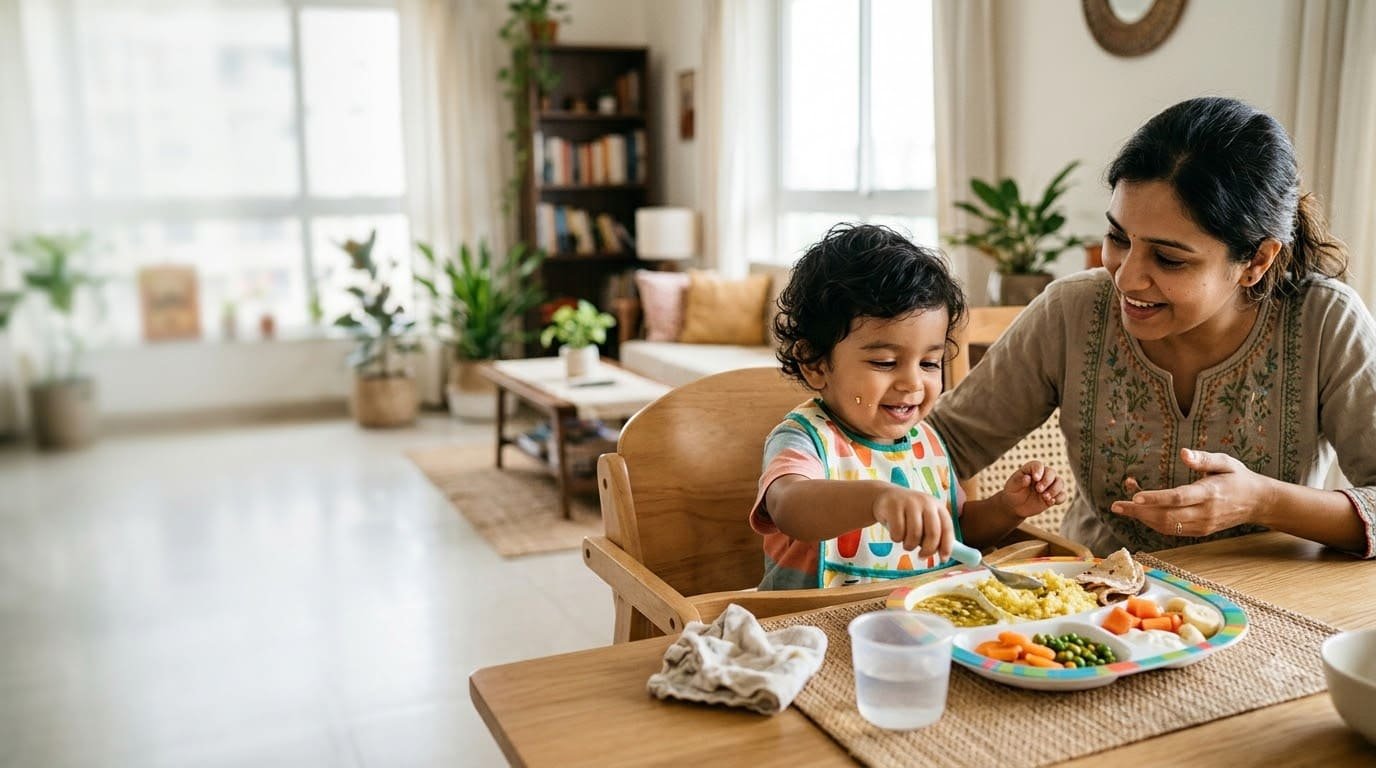
The Indian thali format — multiple small portions of different foods on one plate — is actually ideal for toddler nutrition. It provides variety, allows the toddler to choose what to eat from the plate, and removes the anxiety of “she didn’t eat the sabzi.”
A toddler-appropriate thali:
- 1-2 tablespoons of dal
- 1-2 tablespoons of soft sabzi
- Small piece of roti or small amount of rice
- 1 tablespoon of curd
- Small portion of fruit
Portion sizes: Indian parents almost universally over-estimate how much a toddler needs at a meal. A toddler’s stomach is approximately the size of their fist. A tablespoon of each component is genuinely appropriate for a 1-2 year old.
6. Iron — The Most Critical Nutrient for Indian Toddlers
Iron deficiency is the most common nutritional deficiency in Indian toddlers — affecting a significant proportion of children aged 1-3 years. Iron deficiency affects cognitive development, immune function, and energy — making it the highest-priority nutritional concern.
Iron-rich Indian foods for toddlers:
- Dal — all varieties, at every meal
- Ragi — significantly higher in iron than rice or wheat
- Palak and other dark leafy greens
- Rajma and chana
- Jaggery instead of sugar
Iron absorption tip: Combine iron-rich foods with Vitamin C — dal with a squeeze of nimbu, palak sabzi with tomato, ragi with amla. This dramatically improves iron absorption.
Avoid with iron-rich meals: Tea (chai) given around meal times — the tannins in tea are among the strongest inhibitors of iron absorption. This single change — no tea during or within an hour of iron-rich meals — can meaningfully improve iron status.
7. Limit Ultra-Processed Foods — Protect the Palate
Ultra-processed foods — packaged biscuits, flavoured snacks, instant noodles, flavoured milk drinks, commercial baby foods — are high in sodium, sugar, and artificial flavours that recalibrate the toddler’s palate toward extreme flavours and away from the subtler tastes of whole foods.
The taste calibration problem: A toddler who regularly eats heavily salted packaged snacks finds the natural taste of plain dal or sabzi bland and uninteresting by comparison. The more ultra-processed food a toddler eats, the harder it becomes to get them to eat whole food.
Practical approach: Use packaged snacks rarely — for emergencies and outings. Keep them out of the house as much as possible. When the toddler asks for biscuits and there are none, they will eat what is available. Toddlers do not have purchasing power — the foods they eat are the foods that appear in front of them.
Indian ultra-processed to reduce: Parle-G and similar glucose biscuits (very high sugar), flavoured milk drinks (Horlicks, Bournvita — very high sugar), packaged namkeen (very high sodium), commercial fruit juices (extremely high sugar).
8. Never Use Food as Reward or Punishment
The most common Indian parenting food mistake — using food (particularly sweets, biscuits, or junk food) as a reward for eating vegetables or good behaviour — creates exactly the problem it attempts to solve.
What rewarding with food does: Makes the reward food more desirable. Makes the “healthy” food feel like a burden to be endured for the reward. Teaches the toddler to eat beyond satiety (finishing the plate to get the reward). Establishes emotional eating patterns.
What to use instead of food rewards: Sticker charts. Extra play time. A special activity. Verbal praise — “I saw you trying the palak today, well done.” Physical affection. These reward effort and exploration, not intake.
9. Manage Joint Family Food Dynamics
Indian joint family toddler nutrition is complicated by well-intentioned family members who may:
Give unhealthy snacks between meals (reducing appetite for nutritious food) Override parents’ food decisions in front of the toddler Indulge refusals by providing alternative foods Use food to express love in ways that conflict with nutritional goals
Practical approaches:
With grandparents: “We’re working on expanding [child’s name]’s food range. The approach is offering variety without pressure. It would really help if [snack food] wasn’t given between meals — it affects her appetite.”
On special occasions: Allow flexibility. A festival with special sweets is not going to derail nutrition. The pattern over weeks and months matters, not individual meals.
10. Be Patient — The Long View
Toddler eating is developmental — it changes. The child who ate only curd rice for three weeks at age two will not eat only curd rice at age five. The picky eater at 2.5 years will expand their range through the preschool years if parents continue offering variety without pressure.
Research says: Most toddler food refusal and neophobia resolves by school age — around 5-7 years — when social exposure to peers eating different foods becomes a powerful influence.
The single most predictive factor of a child’s adult food variety is consistent parental offering of variety without pressure during the toddler years — regardless of how much the toddler actually ate.
The patience framing: You are planting seeds that will grow on their own timeline. The toddler who has seen palak on her plate 30 times without pressure is far more likely to eat it at 4 or 5 than the toddler whose parents gave up after 3 refusals.
FAQ — Toddler Nutrition India
Q: My 2-year-old eats only roti and dal. Is this enough nutritionally?
Roti and dal together provide carbohydrates, protein, and some iron. It is not ideal variety — but it is not a nutritional emergency if it continues for a few weeks. Add curd if accepted (calcium, protein). Keep offering other foods at every meal without pressure. Most toddlers expand their range within weeks to months if parents continue offering variety without conflict. If the restriction is very severe and prolonged, discuss with your paediatrician.
Q: My toddler refuses all vegetables. How do I manage?
Continue offering without pressure. “Hiding” vegetables works for a while but doesn’t develop acceptance of the food. Serving vegetables alongside accepted foods — even when rejected — gradually builds familiarity. Offer the same vegetable in different forms — palak in dal tastes different from palak sabzi. Offer raw vegetables (carrot sticks, cucumber) — some toddlers prefer raw to cooked. Involve the toddler in food preparation — children are more likely to eat what they helped make.
Q: Should I give my toddler Horlicks or Bournvita for nutrition?
No — these products are very high in added sugar and are not nutritionally superior to whole foods. The milk they are added to provides the nutritional benefit — the malt powder adds primarily sugar. A toddler who drinks plain full-fat milk and eats a varied diet does not need these supplements. If you are concerned about nutritional gaps, discuss specific supplementation with your paediatrician.
Q: My mother-in-law force-feeds my toddler because “she needs to eat more.” How do I address this?
This is a common and important conflict in Indian households. The evidence is clear: force-feeding leads to food aversion, power struggles, and longer-term eating problems. Frame it medically: “Our paediatrician has said that force-feeding can actually make toddlers eat less over time — it makes them associate mealtimes with stress. We need to let her decide how much she eats.” Most grandparents respond to medical authority even when they resist parental authority.
Q: Is it normal for my toddler to eat a lot one day and barely anything the next?
Completely normal. Toddler appetite varies significantly with growth spurts (eating more), illness (eating less), activity level, developmental phases, and simply day-to-day variation. Judge nutrition over a week rather than a day. A week with generally varied food intake meeting broad nutritional targets is fine, even if individual days look inconsistent.
More from MumPappaHub — Read These Next:
- Iron Rich Foods Babies Toddlers India
- Protein Rich Foods for Toddlers India
- Calcium Rich Foods for Baby India
- Healthy Snacks for Toddlers India
- Picky Eater Tips India
- Toddler Weight Gain Foods India
- Superfoods for Toddler Brain Development
- Toddler Behavior Problems India
- Discipline Toddler India
- 2 Year Old Milestones India
- Baby Development Month by Month
- Indian Baby Weight Chart
About This Article
Written by the MumPappaHub Research Team — including a researcher whose friend’s daughter ate only curd rice and banana for three weeks at age two. The paediatrician said she won’t starve, keep offering variety, don’t make mealtimes a battle. By Week 5 she was back to reasonable variety. The curd rice phase passed. This guide is what helped.
Reviewed for accuracy against WHO complementary feeding guidelines, Indian Academy of Pediatrics nutritional recommendations, and ICMR dietary guidelines for Indian toddlers. This content is for general informational purposes only. Always consult your paediatrician for specific nutritional concerns.
MumPappaHub — Real talk for real Indian parents. mumpappahub.com
