
Medical Disclaimer: This article is for informational purposes only. If your baby’s rash is severe, spreading, or not improving after 3 days, consult your paediatrician immediately.
Diaper rash treatment India is something every parent searches at some point — usually at midnight, looking at an unhappy baby with a red, sore bottom and no idea what to put on it.
My daughter got her first diaper rash at six weeks. It appeared overnight — one day nothing, next morning bright red and clearly uncomfortable. I had no diaper cream in the house, it was midnight, and my mother-in-law was on the phone suggesting I apply ghee, my neighbour had texted to recommend coconut oil, and one WhatsApp group was debating the merits of Himalaya nappy rash cream versus Sudocrem.
By morning I had applied three different things and was no clearer on which one had helped.
This guide sorts it out properly. What diaper rash actually is, why Indian babies get it, which home remedies genuinely work — with the science behind them — and which ones to avoid. Plus the clear signs that mean stop home treatment and call the doctor.
What Diaper Rash Treatment India Needs to Address First
Diaper rash treatment India works best when you understand what’s causing the rash. Not all nappy rashes are the same — and the treatment depends on the type.
According to the World Health Organization’s newborn skin care guidelines, infant skin has a thinner barrier than adult skin and is significantly more vulnerable to moisture, friction, and irritants. The Indian Academy of Pediatrics recommends that diaper area care in Indian infants account for the specific climate — heat and humidity significantly worsen diaper rash compared to cooler climates.
Approximately 50% of all babies experience diaper rash at some point in their first year. It is one of the most common infant skin conditions — and in most cases, one of the most manageable.
Types of Diaper Rash — Know Which One You’re Dealing With
1. Irritant contact dermatitis — the most common type
This is the classic diaper rash — caused by prolonged contact of the skin with urine and stool. The enzymes in stool are particularly irritating to the skin barrier. Urine by itself is less irritating, but in combination with stool bacteria, it creates ammonia compounds that damage the skin.
What it looks like: Red, shiny skin in the diaper area. Affects the areas that are in contact with the diaper — inner thighs, buttocks, genitals. The skin folds are usually spared (this is an important distinction from fungal rash).
What causes it in India specifically: Hot and humid weather means more sweating in the diaper area. Frequent loose stools during monsoon season. Prolonged diaper use due to travel or festival events where changing is difficult.
2. Fungal (yeast/candida) rash
When irritant dermatitis goes untreated or when a baby has been on antibiotics, the warm moist environment of the diaper can allow candida (yeast) to overgrow.
What it looks like: Bright red rash with distinct edges. Satellite spots — small red spots or pustules outside the main rash area. Specifically affects the skin folds — the creases of the groin and inner thighs. Does not clear with standard diaper rash treatment.
Treatment: Antifungal cream — clotrimazole or miconazole — is needed. This requires a paediatrician visit. Home remedies alone won’t resolve a fungal rash.
3. Bacterial rash
Less common but more serious. Usually caused by Staphylococcus or Streptococcus bacteria entering through broken skin.
What it looks like: Yellowish crusting, blisters, skin that looks wet or weeping. May have fever alongside. Needs medical treatment — oral antibiotics.
Key rule: If the rash looks infected — yellow discharge, blisters, skin that won’t stop weeping — see your paediatrician the same day. Don’t treat at home.
10 Best Diaper Rash Treatment India — Home Remedies That Work
1. Air Time — The Most Effective Treatment of All
Diaper rash treatment India starts with this — and it costs nothing.
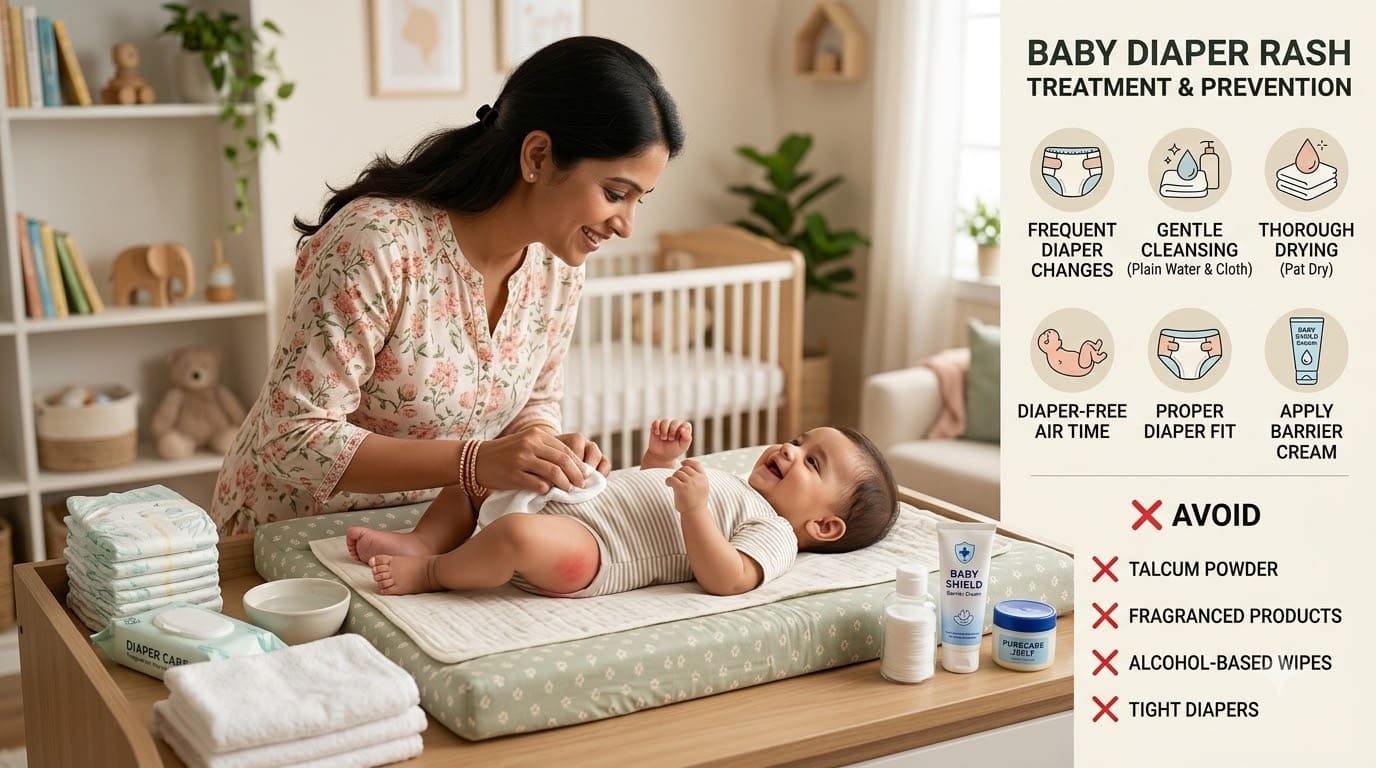
Lay your baby on a waterproof mat or a clean cotton sheet — no diaper — for 10 to 15 minutes several times a day. Expose the rash to open air. The skin dries, the irritants are removed, and healing begins.
This is the single most consistently effective diaper rash treatment. It works because the fundamental cause of most diaper rash is moisture. Remove the moisture source and the skin heals.
In the Indian context: The heat makes this easier in many ways — the baby is comfortable without a diaper in warm weather. Lay a few layers of old cotton cloth underneath and let them kick freely.
How often: At every diaper change if possible — even five minutes of air time makes a difference.
2. Coconut Oil — The Indian Household Standard
Virgin coconut oil has genuine evidence behind it for diaper rash. It has antifungal properties, anti-inflammatory effects, and creates a mild barrier against moisture. Clinical studies have shown it reduces the severity of diaper rash.
It’s also readily available in most Indian households, inexpensive, and safe from birth.
How to use: After cleaning and drying the area thoroughly, apply a thin layer of virgin coconut oil — not refined coconut oil — to the affected area at every diaper change.
What it does: Moisturises the irritated skin, provides mild antifungal protection, creates a light barrier against further moisture exposure.
3. Zinc Oxide Cream — The Clinical Gold Standard
Zinc oxide is the most well-researched diaper rash treatment available. It works by creating a physical barrier between the skin and moisture, allowing the skin underneath to heal. It’s in most branded diaper creams including Sudocrem, Himalaya Nappy Rash Cream, and Chicco products.
For moderate to significant rash — more than mild redness — zinc oxide cream is more effective than home remedies alone.
How to use: Apply a thick layer at every diaper change. Don’t rub it in — lay it on generously so it forms a visible white barrier. Remove only what’s necessary at the next change — you don’t need to scrub it off entirely each time.
Important: You need a thick application, not a thin smear. Many parents under-apply zinc oxide cream and then wonder why it’s not working.
4. Petroleum Jelly (Vaseline) — Simple and Effective
Plain petroleum jelly — Vaseline — is an effective barrier cream that prevents urine and stool from reaching the irritated skin. It’s inexpensive, fragrance-free, and available everywhere in India.
It doesn’t have the antifungal or anti-inflammatory properties of coconut oil, but as a barrier it’s highly effective and very gentle.
Best use: As prevention — applied at every change when the skin is healthy to prevent rash forming. Also useful for mild rash when the skin isn’t broken.
Caution: If using cloth diapers, petroleum jelly can be difficult to wash off and may reduce absorbency.
5. Breast Milk — The Research-Supported Remedy
A clinical study published in a paediatric journal compared breast milk applied to diaper rash with 1% hydrocortisone ointment — and found breast milk was equally effective.
Breast milk contains immunoglobulins, lactoferrin, and other compounds with anti-inflammatory and antimicrobial properties. Applied topically, these work directly on the irritated skin.
How to use: Express a small amount of breast milk. Apply with a clean finger or cotton to the rash. Allow to air dry before putting the diaper back on. Use at every change if the baby is breastfed.
This is particularly useful for newborns where you may be cautious about applying products.
6. Aloe Vera Gel — Clinically Shown to Help
Fresh aloe vera gel has documented anti-inflammatory effects and has been shown in clinical studies to reduce the severity of diaper rash. It soothes irritated skin and supports healing.
How to use: Use fresh aloe vera gel from the leaf — not packaged aloe gel with added ingredients. Apply a thin layer to clean, dry skin. Allow to dry slightly before applying diaper.
Indian advantage: Aloe vera plants are common in Indian homes and gardens. Fresh gel from your own plant is the most effective version.
7. Oatmeal Bath — For Significant Irritation
Colloidal oatmeal has documented anti-inflammatory and skin-soothing properties. A warm oatmeal bath helps reduce inflammation and soothes irritated skin across the diaper area.
How to make it: Blend plain uncooked oats to a fine powder in a mixie. Add two tablespoons to a baby bath of warm water. Stir until the water looks milky. Bathe the baby in this for 5-10 minutes. Pat dry gently.
When to use it: For moderate to significant rash where the skin is inflamed but not infected. Once daily alongside other treatments.
8. Frequent Diaper Changes — Non-Negotiable
This is not a remedy in the traditional sense — it is the foundation of both treatment and prevention.
Paediatricians recommend changing diapers every 2-3 hours, and immediately after every bowel movement regardless of timing. A newborn needs 10-12 changes per day.
Leaving a soiled diaper on longer — to save diapers, because it’s convenient, because the baby is asleep — is the single most common cause of persistent diaper rash. The stool enzymes begin damaging the skin within minutes.
Indian monsoon context: During monsoon season, when loose stools from gut infections are more common, change frequency may need to increase further. Our waterborne diseases in children guide covers protecting babies from the gut infections that worsen diaper rash during monsoon.
9. Gentle Cleaning — How You Clean Matters as Much as What You Apply
Many parents scrub the diaper area vigorously when changing — which damages the already-irritated skin further.
The correct technique: Use lukewarm water and a soft muslin cloth. Wipe front to back. Pat dry — don’t rub. Allow to air dry for a minute before applying any cream or putting the diaper back on.
Avoid: Fragrant wipes, alcohol-containing wipes, harsh soaps, and anything with dyes or perfumes in the diaper area when there’s a rash.
Indian option: Clean cotton cloth dampened with plain warm water is gentler than most commercial wipes and perfectly effective.
10. Loose-Fitting Diapers — Let the Skin Breathe
A diaper fastened too tightly creates more friction, traps more heat, and reduces air circulation — all of which worsen rash.
When there’s a rash, fasten the diaper one notch looser than usual. Allow some air movement. This alone can speed healing significantly.
Cloth vs disposable during rash: Both can be used. Cloth diapers allow more air circulation but need more frequent changing. Modern disposables are highly absorbent and keep the surface drier. Neither is definitively better — frequency of change matters more than type.
What NOT to Use — Dangerous Remedies to Avoid
Talcum powder: Once a standard recommendation in India, talcum powder is now discouraged by paediatric guidelines. The powder can be inhaled by babies and cause lung damage. Don’t use on the diaper area or anywhere near the baby’s face.
Baking soda: Disrupts the skin’s natural pH and can worsen irritation. Not recommended for baby skin.
Dettol or antiseptic liquids: Too harsh for baby skin. Can cause chemical burns on irritated skin. Never dilute antiseptics for use on baby skin.
Strong perfumed products: Fragrances are among the most common causes of contact dermatitis in babies. Avoid perfumed creams, scented wipes, and fragranced oils on irritated skin.
Cornstarch: Provides food for candida yeast and can worsen fungal rash. Avoid.
Prevention — Stop Rash Before It Starts
The most effective diaper rash treatment India is preventing it from happening.
Apply a barrier cream — zinc oxide or petroleum jelly — at every change, even when skin is healthy. Change diapers frequently. Allow air time daily. Use fragrance-free products. During loose stool episodes — from illness or new foods — increase change frequency and barrier cream application.
For more on keeping baby skin healthy overall, our monsoon baby care tips cover skin protection specifically during the season when diaper rash peaks.
When to See a Doctor — Don’t Delay These
Go to the paediatrician if:
The rash has not improved after 3-4 days of consistent home treatment.
The rash is spreading rather than improving.
There are satellite spots — small pustules outside the main rash area — suggesting fungal infection.
The skin is weeping, has yellow crust, or looks infected.
Your baby has a fever alongside the rash.
The rash is in the skin folds specifically — creases of the groin — which suggests fungal rather than irritant rash.
Your baby is under 6 weeks old with any significant rash — always see the doctor for young newborns.
The rash looks like blisters.
FAQ — Diaper Rash Treatment India
Q: How long does diaper rash take to clear with home treatment?
Mild irritant diaper rash typically improves within 2-3 days of consistent treatment — frequent changes, air time, and barrier cream at every change. If there’s no improvement after 3-4 days, the rash may be fungal and needs antifungal cream from your paediatrician.
Q: Can I use ghee on diaper rash?
Ghee is used traditionally in Indian households for diaper rash and is not harmful — it has mild moisturising properties. However, it doesn’t provide a strong barrier against moisture and doesn’t have the documented antifungal properties of coconut oil. Zinc oxide cream is more effective. If ghee is what you have available at midnight, it won’t make things worse — but follow up with proper treatment.
Q: My baby’s rash is only in the skin folds. Is this different?
Yes — rash that’s specifically in the skin creases rather than on the flat skin surface is more likely to be fungal (candida) rather than irritant dermatitis. Fungal rash needs antifungal cream, not just barrier cream. See your paediatrician for assessment rather than treating at home alone.
Q: Can I use Sudocrem or Himalaya nappy cream on a newborn?
Both are generally considered safe from birth. Sudocrem contains zinc oxide and is a well-established nappy rash treatment. Himalaya nappy rash cream contains zinc oxide alongside herbal ingredients. Both are appropriate for newborns — check the packaging and your paediatrician’s guidance for your specific baby.
Q: My baby gets diaper rash every time they have loose stools. What do I do?
Loose stools are the most aggressive cause of diaper rash because stool enzymes are highly irritating to skin. During any episode of loose stools — from illness or dietary changes — increase diaper change frequency, apply a thick layer of zinc oxide cream at every change as a barrier, increase air time, and clean very gently with warm water rather than wipes. This preventive approach significantly reduces the severity of rash during loose stool episodes.
Q: Is cloth diaper or disposable better when there’s a rash?
Neither is definitively better. Modern disposables keep the surface drier because of their absorbent core. Cloth diapers allow more air circulation but need more frequent changing when wet. The most important factor is how frequently you change — whichever type you use, change it every 2 hours and immediately after bowel movements.
More from MumPappaHub — Read These Next:
- Baby Fever Guide: When to Worry
- Baby Teething Signs & Home Remedies
- Baby Vaccination Schedule India 2026
- Monsoon Baby Care Tips
- Waterborne Diseases Children Monsoon
- Baby Development Month by Month
- Indian Baby Weight Chart 0-12 Months
- Newborn Sleep Tips
- Newborn Care Tips
- How to Increase Breast Milk Supply
- Baby Blues vs Postpartum Depression
- Baby First Year Milestones
About This Article
Written by the MumPappaHub editorial team — including a mother who had three different remedies applied to her daughter’s diaper rash at midnight while a WhatsApp group debated and her mother-in-law suggested ghee. The zinc oxide cream worked. The ghee was also fine. The debate continues.
Reviewed for accuracy against WHO newborn skin care guidelines and Indian Academy of Pediatrics recommendations. This content is for general informational purposes only. Always consult your paediatrician for persistent, severe, or infected rash.
MumPappaHub — Real talk for real parents. mumpappahub.com

6 Comments