
Medical Disclaimer: This article is for informational purposes only. If your child’s behaviour is severely affecting their or your family’s wellbeing, consult your paediatrician or child psychologist.
Discipline toddler India is something every Indian parent struggles with — because we were almost all raised in households where physical punishment was normal, where a sharp slap on the hand or a shout that filled the room was considered effective parenting, and where “discipline” and “hitting” were often the same word.
My father was not a cruel man. He was a loving, involved father who smacked my brother once, hard, when he was three and ran into traffic. My brother remembers the smack. My father remembers the terror that preceded it. Neither of them remembers it as discipline — they remember it as fear.
The research on physical punishment is now clear enough that it cannot be reasonably argued with: hitting children does not produce the outcomes parents want. It produces compliance through fear in the short term and resentment, reduced trust, and — in many cases — more aggressive behaviour in the long term.
This guide is not a judgement of parents who were raised with physical punishment and have used it with their own children. It is an honest guide to what actually works — and why it works better.
Discipline Toddler India — What Discipline Actually Means
Discipline toddler India must begin with what discipline actually is — because the word has been so thoroughly conflated with punishment that many parents have lost sight of the original meaning.
Discipline comes from the Latin “disciplina” — meaning teaching, instruction, learning. Discipline is teaching a child how to behave — not punishing them for failing to already know.
According to the World Health Organization’s guidelines on violence against children, physical punishment — hitting, slapping, spanking, smacking — is a form of violence that is harmful to children’s development regardless of cultural context. The Indian Academy of Pediatrics has issued a clear position statement against corporal punishment in any form, recommending positive discipline approaches for all Indian families.
What effective discipline does: ✅ Teaches the child what behaviour is expected ✅ Builds the child’s capacity to regulate their own behaviour ✅ Maintains the parent-child relationship while holding limits ✅ Produces children who behave well because they understand why, not because they fear punishment
What physical punishment does: ❌ Teaches the child that physical force is how problems are solved ❌ Damages the parent-child relationship over time ❌ Produces compliance through fear — which disappears when the fear is absent ❌ Models aggression as a response to frustration
The Indian Context — Why This Is Harder Here
Several factors make positive discipline more challenging in Indian households:
Generational patterns: Most Indian parents were physically disciplined themselves. “I was hit and I turned out fine” is the most common defence of physical punishment — but it ignores both the harm caused and the question of whether different parenting would have produced better outcomes.
Joint family pressure: Grandparents who used physical punishment may actively encourage or model it. A parent trying to discipline differently may face direct opposition from elders.
Cultural expectations of obedience: Indian culture places high value on children’s obedience to elders — and when a toddler fails to meet this standard, physical punishment may be seen as an appropriate correction.
Public embarrassment: A toddler melting down in public, in front of relatives, in a temple or at a wedding — the social pressure to “control” the child immediately creates conditions where physical punishment feels like the only fast option.
10 Best Ways to Discipline a Toddler Without Hitting or Shouting
1. Prevention First — Reduce the Situations Where Discipline Is Needed
The most underused discipline tool is prevention — managing the environment and the child’s state to reduce the frequency of behaviour that needs correction.
HALT before every challenging situation: Is the child Hungry? Tired? Overstimulated? Needs connection?
A well-rested, recently fed toddler who has had quality time with a parent handles challenges significantly better. The meltdown at the family wedding at 10 PM is not a discipline problem — it is an overtired child in an overstimulating environment.
Practical prevention:
- Keep snacks available during outings
- Protect nap times — even at the cost of social events
- Brief the child before challenging situations: “We’re going to the doctor. We’ll sit and wait. You can bring one toy.”
- Remove hazards rather than repeatedly saying no — childproofing reduces conflict
2. Connect Before You Correct
The single most effective change most Indian parents can make is building in a moment of connection before attempting correction.
A toddler who feels disconnected, overlooked, or emotionally flooded cannot process instruction. A toddler who feels seen and connected can.
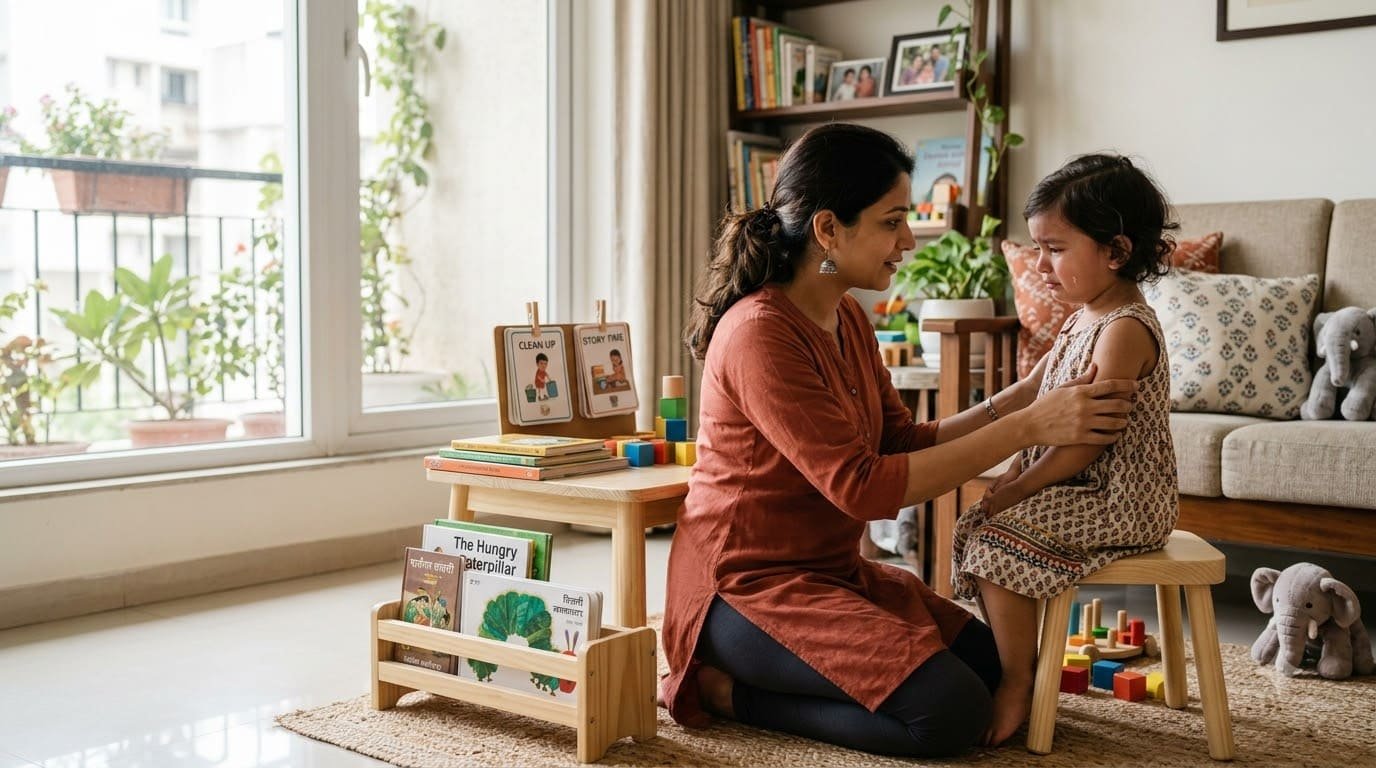
In practice: Get down to the child’s level — physically. Make eye contact. Name what you see: “You’re really frustrated right now.” Then address the behaviour: “Hitting is not okay. Let’s find another way.”
This sequence — connect, then correct — takes thirty seconds longer than shouting across the room. It is dramatically more effective.
3. Natural and Logical Consequences
For toddlers aged 2.5+, natural and logical consequences teach more effectively than punishment because they have a direct relationship to the behaviour.
Natural consequence: The child threw their food on the floor — the food is gone. Meal is over.
Logical consequence: The child refuses to put toys away — the toys are put away by the parent and not available tomorrow.
The rule: The consequence must be related, respectful, and reasonable. “Because you hit your cousin, you can’t watch cartoons for a week” — the connection is too abstract for a toddler to process. “Because you hit your cousin, playtime with her is over for today” — direct, immediate, logical.
4. Redirection — Change the Channel
Redirection is the most practical toddler discipline tool for young toddlers (12-24 months) who cannot yet respond to reasoning.
When a toddler is doing something inappropriate — redirect them to an appropriate alternative before the behaviour escalates.
Examples:
- Drawing on the wall → “Walls are not for drawing. Here is your paper.”
- Hitting the baby → “Hands are for gentle touches. Show me gentle.” (Guide their hand)
- Grabbing another child’s toy → “That’s Priya’s toy. Here is your car.”
Redirection works because toddlers have genuinely short attention spans — a new option presented immediately and enthusiastically often works.
5. Clear, Simple, Positive Instructions
How you phrase an instruction dramatically affects whether a toddler complies.
What doesn’t work:
- Complex instructions: “How many times have I told you not to do that? You know better than that!”
- Negative instructions: “Don’t run! Don’t touch! Don’t hit!”
- Questions when you mean instructions: “Can you please stop?”
What works:
- Simple, direct, positive: “Walk please.” “Hands down.” “Gentle.”
- One instruction at a time
- State what you want — not what you don’t want
- Get close, make eye contact, say it once calmly
The toddler brain processes “Walk” faster than “Don’t run” — because “Don’t run” requires the brain to process the action (running) before processing the negation.
6. Offer Choices — Real Ones
Many toddler behaviour problems are about autonomy — the intense need of a 2-year-old to have some control in a world controlled entirely by adults.
Offering genuine choices within acceptable limits gives the toddler real control without giving up parental authority.
Examples:
- “Do you want to brush teeth before or after pyjamas?”
- “Do you want to hold my hand or should I carry you?”
- “Do you want the red plate or the blue one?”
The parent sets the limit (teeth will be brushed, hand will be held, food will be eaten). The child has genuine choice within that limit. Power struggles reduce dramatically.
7. Time-In — Instead of Time-Out
Traditional time-out — sending the child alone to a corner or room — is not developmentally appropriate for children under 3 and has limited evidence for older toddlers.
A more effective alternative is time-in: staying with the child during a calm-down period rather than isolating them.
How time-in works: When the child’s behaviour has escalated — calmly move with them to a quieter space. Stay present. Don’t lecture or explain while emotions are high. Simply be a calm presence. “We’re going to sit here until you feel calmer.” After calm returns — brief discussion. “What happened? What could you do differently?”
This approach teaches emotional regulation — the actual skill the child needs — rather than simply removing them from the situation.
8. Acknowledge the Feeling — Then Hold the Limit
The most powerful sentence in toddler discipline is: “I understand you’re [feeling]. AND [the limit].”
Not “but” — AND. “But” cancels everything before it. “And” holds both.
Examples:
- “I understand you’re angry that we have to leave. AND we are leaving now.”
- “I see you really want that biscuit. AND biscuits are not before dinner.”
- “You’re so frustrated that the block fell down. AND throwing blocks is not safe.”
Acknowledging the feeling does not mean agreeing with the behaviour. It means the child feels heard — which reduces the emotional intensity — while the limit remains clear and consistent.
9. Manage the Joint Family Dynamics
In Indian joint families, discipline is often complicated by multiple adults with different approaches and different authority in the child’s life.
The specific challenges:
- Grandparents who use or permit what parents don’t
- The child learning quickly which adult will give in
- Parents feeling undermined in front of the child
- Public disagreements between adults about discipline
What works: A brief, private conversation with primary caregivers about the few most important rules — held firmly and consistently. Not every battle needs to be fought. Choose the three or four non-negotiables (hitting, safety, food) and be consistent on those. Let go of smaller things.
Never contradict another adult’s discipline decision in front of the child — address it privately.
10. Repair After Conflict
This is the most overlooked element of effective discipline — and one of the most powerful.
When a discipline interaction goes badly — when the parent shouts, loses patience, or handles something poorly — repair matters enormously.
The repair conversation: “I shouted at you earlier and I shouldn’t have. I was frustrated, but shouting is not okay. I’m sorry.”
This teaches several things simultaneously:
- Adults make mistakes and acknowledge them
- Relationships can survive conflict
- Apology is what you do when you hurt someone
- The parent-child relationship is strong enough to hold difficulty
In Indian families, apologising to a child is often seen as undermining parental authority. It does the opposite — it builds trust and teaches the child exactly the behaviour you want from them.
What About When Nothing Works?
Every parent has moments where nothing works. The toddler is beyond reason, the parent is at the end of their patience, and the situation feels out of control.
In that moment:
- If the child is safe — it is acceptable to take a brief parent time-out. “I need a minute.” And step away.
- Lower the bar for what “success” looks like. Getting through the moment without escalating is success.
- Address the behaviour later, after calm — not in the heat of the moment.
And if you do shout, or handle something in a way you later regret — repair it. The repair matters as much as the original interaction.
FAQ — Discipline Toddler India
Q: My in-laws think I’m too soft. How do I handle this?
Frame it in terms of effectiveness: “We’ve found that this approach works better for him — he actually listens more.” Most grandparents care primarily about outcomes. If you can show that your approach is working — the child is well-behaved, respectful, and listening — the criticism typically reduces. If the in-laws are directly contradicting your approach with the child, a private conversation is necessary.
Q: I smacked my child and now I feel terrible. What do I do?
Repair it. Get down to the child’s level and say: “I hit you and I shouldn’t have. Hitting is not okay and I’m sorry.” Then work on alternative strategies for the specific situations that led to that moment. One incident, repaired, does not cause lasting harm. The pattern matters more than any single moment.
Q: My toddler hits me when angry. How do I stop it?
Firm, calm, immediate response every time: “Hitting hurts. I won’t let you hit me.” Remove yourself from arm’s reach briefly. After calm: “When you’re angry, you can stomp your feet or say ‘I’m angry’.” This needs many repetitions. The behaviour will not stop immediately — consistency over weeks is what produces change.
Q: Is it okay to raise my voice occasionally?
Parents are human — occasional raised voices happen. The key word is “occasionally” — not as a primary discipline tool, not in a way that frightens the child. A calm, clear voice is more effective than shouting for toddlers — shouting escalates emotional arousal in the child and makes cooperation less likely.
Q: My 3-year-old is completely defiant. Should I be stricter?
Defiance at 3 is developmentally normal — it peaks at this age. “Stricter” in the sense of harsher punishment typically increases defiance rather than reducing it, because it intensifies the power struggle. More effective: reduce power struggles by offering choices, acknowledge feelings before holding limits, and ensure the child has adequate connection and one-on-one time daily.
More from MumPappaHub — Read These Next:
- Positive Parenting Tips India
- Toddler Tantrums Tips India
- Toddler Behavior Problems India
- Sibling Rivalry Tips India
- Toddler Sleep Problems India
- Screen Time Guidelines Children India
- Bedtime Routine for Baby India
- Toddler Language Development
- Cognitive Development Activities India
- Baby First Year Milestones
- Baby Development Month by Month
- Baby Blues vs Postpartum Depression
About This Article
Written by the MumPappaHub Research Team — including a researcher whose father smacked her brother once, hard, when he ran into traffic at age three. Her brother remembers the smack. Her father remembers the terror that preceded it. Neither remembers it as discipline.
Reviewed for accuracy against WHO guidelines on violence against children and Indian Academy of Pediatrics position statement on corporal punishment. This content is for general informational purposes only and does not constitute medical advice.
MumPappaHub — Real talk for real Indian parents. mumpappahub.com

2 Comments