
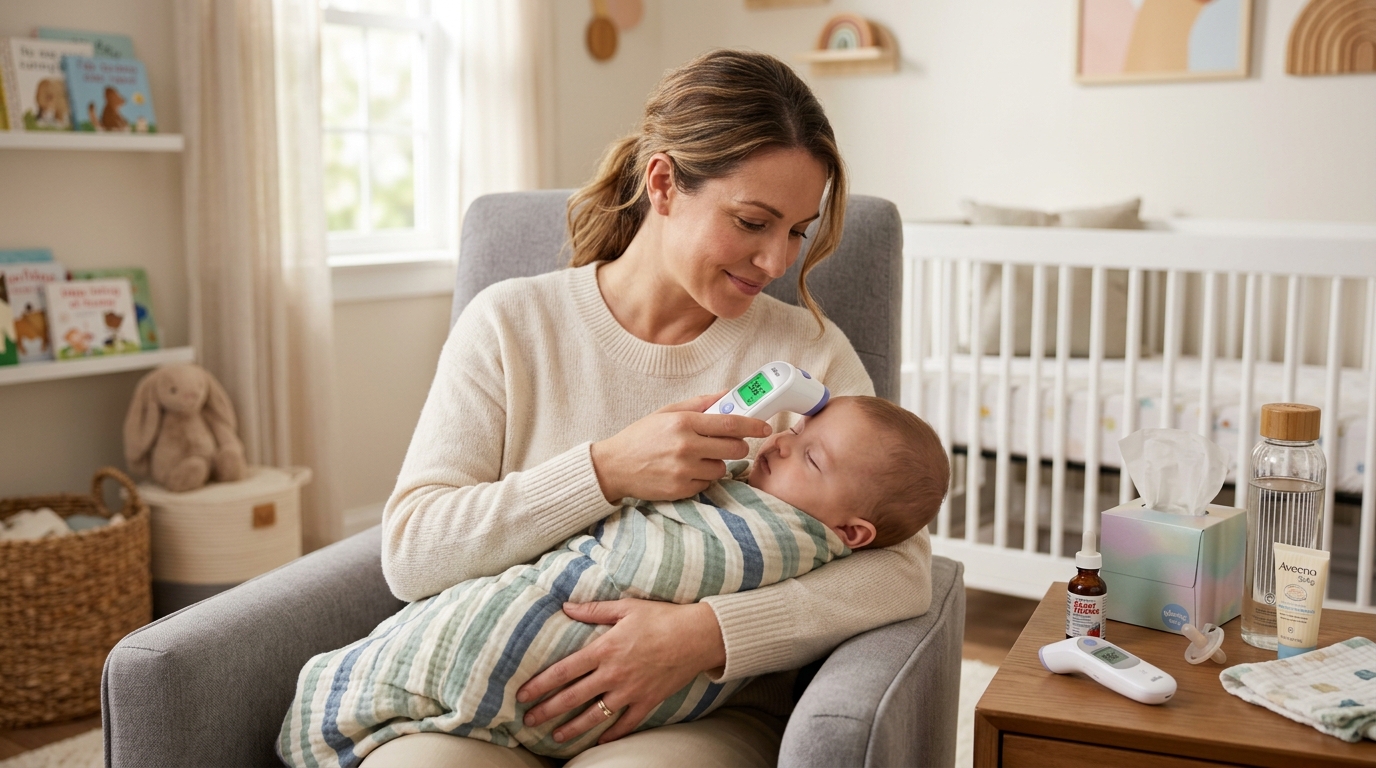
Medical Disclaimer: This article is for informational purposes only and does not replace professional medical advice. Always consult your paediatrician for guidance specific to your baby. If your baby is under 3 months with any fever — go to the doctor immediately, do not manage at home.
This baby fever guide exists because at 11 PM on a Saturday, nobody wants to be Googling. My son spiked 39.2°C at 11 PM on a Saturday.
The paediatrician’s clinic was closed. The hospital nearest to us had a two-hour wait at that hour. My mother-in-law was on the phone telling me to cover him in blankets and put onion slices on his feet. WhatsApp was producing seven different opinions simultaneously. And I was standing over my baby’s cot trying to remember everything I’d ever read about fever and coming up with absolutely nothing useful.
If you’re reading this in the middle of the night with a hot baby and a racing heart — I wrote this for you.
This guide tells you what fever actually is, when it’s serious and when it isn’t, how to use a thermometer properly, what paracetamol dose to give and how, which traditional remedies work and which are dangerous, and exactly when to stop managing at home and get in the car.
First — take a breath. Most fevers are okay.
Fever is not an illness. It’s the immune system responding to one.
When your baby’s body detects an infection — bacterial, viral, or otherwise — it raises its core temperature deliberately. Higher temperatures make it harder for pathogens to reproduce and activate immune cells more effectively. A fever, in most cases, is evidence that the immune system is working correctly.
According to the World Health Organization’s integrated management of childhood illness guidelines, fever in children is one of the most common reasons parents seek medical care — and in the vast majority of cases, it resolves safely with appropriate home management and monitoring.
The Indian Academy of Pediatrics is clear in its fever management guidance: the height of the fever alone is less important than how the baby is behaving. A baby with a temperature of 38.5°C who is alert, feeding, and making eye contact is less concerning than a baby with 38°C who is unusually limp and unresponsive.
Number on thermometer. Behaviour of baby. You need both.
What temperature is actually a fever?
This is the first place parents get confused — and the confusion comes from a real problem, which is that different thermometers give different readings depending on where you measure.
| Method | Fever threshold | Accuracy |
|---|---|---|
| Rectal | 38°C (100.4°F) or above | Most accurate — gold standard for under 3 months |
| Axillary (armpit) | 37.5°C (99.5°F) or above | Least accurate — reads 0.5°C lower than actual |
| Ear (tympanic) | 38°C (100.4°F) or above | Accurate from 6 months, less reliable in young babies |
| Forehead (temporal) | 38°C (100.4°F) or above | Good screening tool, not definitive |
The bottom line on thermometers:
For babies under 3 months — rectal temperature is most accurate and most important. Yes, it’s uncomfortable. Yes, it’s the most reliable reading.
For babies over 3 months — an ear thermometer or digital axillary thermometer is fine for monitoring. If you get a reading you’re worried about, confirm with a different method or a rectal reading.
Your hand on the forehead tells you something is wrong. It does not tell you how wrong.
🛒 Thermometers worth having:
Age-specific fever rules — this is the most important section
The age of your baby changes everything about how seriously to take a fever. A temperature that’s watchable in a four-month-old is a medical emergency in a four-week-old.
Under 3 months — always call the doctor
Any temperature of 38°C or above in a baby under three months is an emergency. Not a “wait and see.” Not “give paracetamol and monitor.” Call your paediatrician or go to hospital immediately.
Why is this age group different? Newborns have immature immune systems and very limited ability to fight serious infection. They can deteriorate quickly. And — crucially — they often don’t show the classic signs of serious illness that older babies and children show. A newborn with meningitis may just seem “off” or feed poorly. The fever is often the only early warning sign.
Do not give paracetamol to a baby under 3 months without a doctor’s instruction. Do not wait until morning. Do not try home remedies first. Go.
3–6 months — call your doctor same day
At this age, a fever of 38°C or above that lasts more than a few hours warrants a same-day call to your paediatrician. They will assess whether examination is needed.
Paracetamol can be given at this age — always by weight, not by age (see dosing section below). But a medical conversation should happen alongside medication, not instead of it.
6 months and older — watchful management at home is often appropriate
By six months, babies can usually have fever managed at home with paracetamol, fluids, and monitoring — provided there are no red flag symptoms (see below).
A fever of up to 38.5°C in an alert, feeding, reasonably comfortable baby over six months can typically be watched at home. A fever above 39°C warrants paracetamol and close monitoring. A fever above 40°C needs same-day medical assessment regardless of how the baby seems.
How to manage fever at home — what actually works
Keep them hydrated — this is the priority
Fever causes fluid loss through sweating and faster breathing. Dehydration worsens fever and makes everything harder.
Breastfed babies: offer the breast more frequently than usual. Even if the baby doesn’t seem hungry, offer. Breast milk provides hydration and immune factors simultaneously.
Formula-fed babies: offer formula more frequently. Small amounts more often is better than large amounts less often if the baby is unsettled.
Babies over six months who are on solids: water, diluted juice, oral rehydration solution if the baby is also vomiting or has loose stools.
Signs of adequate hydration: wet nappies at the usual frequency, tears when crying, moist mouth. Signs of dehydration: fewer wet nappies, no tears, dry mouth, unusual lethargy, sunken fontanelle (the soft spot on top of the head). Dehydration alongside fever is a reason to seek medical attention promptly.
Dress lightly
The instinct to wrap a feverish baby in blankets is understandable. It is also counterproductive. The body is trying to lose heat. Wrapping it in layers prevents this.
One layer of light, breathable cotton clothing. Keep the room comfortable — not cold, not warm. A small fan on a low setting to circulate air is fine.
If your baby is shivering — this is the body raising its temperature, which is counterintuitive but normal. Don’t add layers in response to shivering. If the baby seems cold despite fever, a very light single layer is appropriate.
Paracetamol — the right way to give it
Paracetamol (found in brands like Calpol, Crocin, Febrex) is safe and effective for fever management in babies from 3 months old. It must be dosed by weight, not by age.
Standard dosing: 10–15 mg/kg per dose, every 4–6 hours, maximum 4 doses in 24 hours.
| Baby’s weight | Dose (at 120mg/5ml concentration) |
|---|---|
| 4–5 kg | 2.5 ml |
| 5–6 kg | 3 ml |
| 6–7 kg | 3.5–4 ml |
| 7–8 kg | 4–4.5 ml |
| 8–10 kg | 5–6 ml |
Critical things about paracetamol dosing:
Check the concentration on your bottle. Indian brands come in different concentrations — 120mg/5ml and 250mg/5ml are both common. The dose in ml will be different for each. Do not use the same ml dose if you switch brands.
Use the measuring syringe that comes with the medicine. Kitchen spoons are not accurate enough.
Write down the time of each dose. At 2 AM with a sick baby, you will not reliably remember when you last gave medicine. Write it on your phone, on paper, on anything.
Paracetamol takes 30–60 minutes to start working. It reduces temperature by about 1–1.5°C. It does not bring fever to normal. A baby with 39.5°C who comes down to 38°C after paracetamol is responding appropriately.
Ibuprofen: Can be used from 6 months. 5–10mg/kg per dose, every 6–8 hours. Can be alternated with paracetamol for high fevers — discuss this with your paediatrician first. Never give ibuprofen to a baby under 6 months or to a baby who is dehydrated or not urinating.
Aspirin: Never. Not for children. It can cause a serious condition called Reye’s syndrome.
🛒 Useful to have at home:
The lukewarm sponge bath — when and how
A lukewarm sponge bath can help bring temperature down temporarily if the baby is very uncomfortable and paracetamol hasn’t yet had time to work. It is not essential, but it’s not harmful if done correctly.
How: Use water that’s comfortably warm — not cold, not cool. Around body temperature. Sponge the baby’s face, neck, armpits, and groin gently. Keep the room warm enough that the baby doesn’t shiver.
What not to do: Cold water bath — causes shivering, which raises temperature. Ice bath — dangerous. Alcohol rub — alcohol is absorbed through baby’s skin and can cause poisoning. This is still used in some households and it is genuinely dangerous.
What’s causing the fever — common reasons in India
Knowing the likely cause helps you know what to watch for and how long to expect it to last.
Viral upper respiratory infection (most common): Cold and cough with fever. Usually resolves in 5–7 days. Antibiotics don’t help — it’s viral. Manage with paracetamol, fluids, and saline nasal drops.
Vaccination fever: Expected after most vaccinations — particularly at 6 weeks, 10 weeks, and 14 weeks. Fever usually appears within 24 hours of vaccination and resolves within 48 hours. Give paracetamol as directed by your paediatrician at the time of vaccination.
Ear infection (otitis media): Often follows a cold. Signs: fever that returns after seeming to improve, baby pulling at one ear, unusual crying, disturbed sleep. Needs medical assessment — may require antibiotics.
Urinary tract infection: More common in girls, but occurs in boys too. Signs: fever without obvious cause, unusual smell to urine, crying during urination, or in young babies — just unexplained fever. Needs medical assessment and urine test.
Gastroenteritis: Fever alongside vomiting and diarrhoea. Manage dehydration carefully. Our waterborne diseases in children monsoon guide covers managing these illnesses during peak season.
Dengue or malaria: In monsoon season, fever that doesn’t respond normally to paracetamol, or fever that comes back after seeming to improve, warrants investigation for mosquito-borne illness. Our dengue and malaria in children guide covers what to watch for.
Teething: Teething may cause a slight temperature rise — but not a true fever of 38°C or above. If your teething baby has a high fever, look for another cause.
Traditional Indian remedies — what’s fine, what’s harmful
There will be advice from your mother, your mother-in-law, your neighbour, and at least three people on WhatsApp. Some of it is harmless. Some of it is genuinely dangerous. Here’s the honest breakdown:
Generally harmless
Tulsi (holy basil) kadha: Warm water with tulsi leaves has mild antimicrobial properties and provides hydration. Fine for babies over 6 months on solids. Will not cure fever but causes no harm.
Ginger and honey water: For babies over 12 months (honey is not safe before 12 months). Ginger has mild anti-inflammatory properties. No evidence it reduces fever but harmless.
Ajwain potli near the chest: The warmth and aroma can provide comfort. Doesn’t treat fever but causes no harm if not placed directly on the skin.
Extra breastfeeding: Always helpful. The immune factors in breast milk are actively useful when a baby is ill.
Avoid these completely
Alcohol rub on the skin: Still used in some households. Alcohol absorbs through baby’s skin, can cause hypoglycaemia and toxicity. Genuinely dangerous.
Bundling in blankets to “sweat it out”: Traps heat. Worsens fever. Increases risk of febrile seizure at high temperatures.
Cold water bath or ice: Causes shivering, which raises body temperature further. The shock of cold water on a feverish baby is also distressing.
Onion on feet or forehead: No evidence of effect either way. Not dangerous, but not useful.
Adult paracetamol in smaller doses: Adult paracetamol tablets are a very different dose and formulation. Never give adult medicine to a baby.
Expired or improperly stored medication: Check expiry dates on all baby medicines now, before you need them in an emergency.
When to go to hospital — the clear list
This is the most important section. Print it if that helps. Know it before you need it.
Go immediately — don’t wait, don’t give medicine and watch:
Baby under 3 months with any fever at all. Temperature 38°C or above. Go now.
Fever above 40°C in any baby, regardless of how they seem. Go.
Febrile seizure: If your baby has a seizure — stiffening, jerking, eyes rolling back — during a fever, call an ambulance or go to emergency immediately. After a febrile seizure, the baby usually recovers quickly and may seem normal within minutes. Go to hospital anyway. Our toddler fever guide covers febrile seizures in more detail.
Signs of serious illness alongside fever:
- Stiff neck — can’t move head normally
- Persistent vomiting — can’t keep any fluids down
- Difficulty breathing — breathing fast, nostrils flaring, skin pulling in between ribs
- Purple or red spots that don’t fade when you press a glass against them
- Unusual limpness — won’t respond to you, can’t be roused normally
- Bulging fontanelle (the soft spot on top of the head, if it’s bulging when the baby is upright and calm)
Significant decrease in baby’s movements — if your baby is much less active and responsive than normal.
Call your paediatrician same-day:
Fever lasting more than 48 hours in a baby 3–6 months old.
Fever lasting more than 72 hours in a baby over 6 months.
Fever that came down and then returned after 24 fever-free hours — this pattern can indicate secondary infection or dengue.
Fever with no obvious cause (no runny nose, no cough, no diarrhoea) — particularly warrants investigation for UTI in young babies.
Your gut telling you something is wrong — this is always a valid reason to call.
What to have in your baby first aid kit
Getting these things before you need them means you’re making calm decisions in a crisis rather than panicked ones.
🛒 Baby fever first aid kit:
Also write down and keep accessible: Your paediatrician’s direct number and after-hours number. The nearest hospital with a 24-hour paediatric emergency. Your baby’s current weight (for dosing calculations).
The post-fever period — what to expect
Fever resolution doesn’t mean instant recovery. Expect:
One to two days of residual tiredness. The immune system has done significant work. Your baby will need more sleep and more comfort than usual. Let them have it.
Reduced appetite. Completely normal for several days after fever. Prioritise fluids over solids.
Clinginess and disrupted sleep. Being ill is frightening and disorienting for a baby. Extra feeding, extra holding, disrupted night sleep — all normal post-fever.
A temporary developmental regression. Sometimes babies who were sleep-trained or doing well with solids take a step backward after illness. This is temporary. Don’t try to push forward with new skills until they’ve fully recovered.
FAQ — Baby Fever Guide India
About when to worry
Q: My baby has a fever of 38.2°C but seems fine and is playing. Do I need to go to hospital?
A: If your baby is over 6 months, alert, feeding, and has no red flag symptoms — a fever of 38.2°C can be managed at home with paracetamol, fluids, and monitoring. Check the temperature again in an hour. If it’s rising, if behaviour changes, or if it reaches 39°C — reassess. If your baby is under 3 months — go to the paediatrician regardless of how they seem.
Q: The fever came down with paracetamol but came back. Is this serious?
A: Fever returning after paracetamol wears off (4–6 hours) is completely normal — the medication’s effect is temporary. What’s more concerning is fever that returns after being genuinely gone for 24 hours or more. That pattern can indicate secondary infection or, in monsoon season, dengue. Call your paediatrician if fever returns after a fever-free day.
Q: How do I know if it’s dengue and not just a normal fever?
A: Early dengue can look like a normal viral fever. Warning signs that suggest dengue rather than a simple virus: fever that doesn’t respond normally to paracetamol, severe body pain, pain behind the eyes (in older children who can describe it), a rash appearing around day 3-5, fever that improves then worsens. In monsoon season, any unexplained fever lasting more than 2 days warrants a blood test. Our dengue and malaria in children guide covers this in detail.
About medication
Q: Can I give paracetamol to bring the fever down before it reaches 38°C?
A: Paracetamol is for comfort, not for hitting a target temperature. If your baby has a temperature below 38°C but is clearly uncomfortable — crying, not feeding, very unsettled — paracetamol from 3 months is appropriate. If the baby seems fine at 37.8°C, monitoring without medication is also fine. The baby’s behaviour guides the decision more than the number.
Q: I gave paracetamol and the temperature only went down by 0.5°C. Has it worked?
A: Paracetamol reduces temperature by about 1–1.5°C and takes 30–60 minutes to work. It brings comfort — it doesn’t bring fever to zero. A baby with 39.5°C who comes to 38°C after paracetamol has responded well. If there’s no reduction at all after an hour, call your paediatrician.
Q: My baby spat out half the medicine. Do I give more?
A: If the baby vomits within 1–2 minutes of taking the medicine, you can give the dose again. If more than 15–20 minutes have passed, or you’re unsure how much they absorbed — don’t repeat. Wait for the next dose time. Giving too much paracetamol can damage the liver.
About traditional remedies
Q: My mother-in-law insists on rubbing the baby with alcohol. Is this okay?
A: No. Alcohol rub on a baby’s skin is genuinely dangerous — alcohol absorbs through baby skin and can cause hypoglycaemia (dangerous drop in blood sugar) and toxicity. This is a traditional practice that is now well-documented to be harmful. The conversation with the mother-in-law may be difficult, but the position is clear: alcohol rubs for babies are not safe.
Q: Does teething really cause fever?
A: Teething can cause a slight rise in temperature — but not a true fever of 38°C or above. If your teething baby has a high fever, look for another cause. A study of over 100 teething episodes found that temperatures during teething averaged around 37.2°C — not enough to meet the fever threshold. If the baby has a high temperature and is teething — treat them as feverish, not as teething.
More from MumPappaHub — Read These Next:
- Toddler Fever Guide
- Dengue & Malaria in Children: Symptoms & Care
- Waterborne Diseases in Children Monsoon
- Baby Cold and Cough Home Remedies
- Monsoon Baby Care Tips
- Baby Blues vs Postpartum Depression
- Newborn Care Tips
- Newborn Sleep Tips
- Child Development Milestones
- Baby First Year Milestones
- Immunity Boosting Foods for Kids in Monsoon
- Baby Sleep Training Guide
About This Article
Written by the MumPappaHub editorial team — including a parent who stood over a cot at 11 PM on a Saturday with a 39.2°C baby, a ringing phone, and seven simultaneous WhatsApp opinions. She wishes she’d had this article then.
Reviewed for accuracy against WHO integrated management of childhood illness guidelines, Indian Academy of Pediatrics fever management guidance, and current paediatric dosing recommendations. This content is for general informational purposes only. Always consult your paediatrician for guidance specific to your baby — especially for babies under 3 months where any fever is a medical emergency.
MumPappaHub — Real talk for real parents. mumpappahub.com

35 Comments