
Medical Disclaimer: This article is for informational purposes only. For newborns under 3 months with constipation — always consult your paediatrician before trying any home remedy.
Baby constipation remedies India became my most searched topic at three in the morning when my son was seven months old, hadn’t pooped in four days, and was clearly uncomfortable.
He was straining. His tummy felt hard. He was crying more than usual. And I had no idea whether this was an emergency, something I could fix at home, or just normal baby behaviour that I was panicking about unnecessarily.
The answer, as it turned out, was the third one — with some home remedies that genuinely helped. But getting to that answer required sorting through a lot of conflicting advice, some of which was helpful, some of which was irrelevant to a seven-month-old specifically, and some of which — like the suggestion to give hing directly — I’m very glad I checked with a doctor before trying.
This guide covers baby constipation remedies India properly. What constipation actually is in babies, how to tell the difference between normal variation and an actual problem, which remedies are safe and at which ages, and when to stop managing at home and call the doctor.
Baby Constipation Remedies India — Understanding the Problem First
Baby constipation remedies India work best when you understand what constipation actually means for a baby — because it’s different from what most parents expect.
According to the World Health Organization’s infant feeding and care guidelines, constipation in infants is defined by stool consistency and discomfort — not by frequency alone. The Indian Academy of Pediatrics is clear that bowel movement frequency varies enormously between babies, and infrequent stools alone are not constipation if the stool is soft when it comes.
What constipation IS: Hard, dry, pellet-like stools that are difficult or painful to pass. Straining that causes real distress. Stool that is so hard it causes anal fissures — small tears that make the baby cry when passing stool.
What constipation is NOT: A breastfed baby who poops once a week but passes soft yellow stool without distress. A baby who grunts and goes red in the face during passing — this is normal effort, not constipation. A baby who skips a day or two but then passes soft stool.
The key question: Is the stool hard when it comes? If yes — that’s constipation. If no — the frequency is just variation.
Normal Poop Frequency — Age-wise Guide
| Age | Breastfed | Formula-fed |
|---|---|---|
| 0–6 weeks | After every feed — or once a week. Both normal | Once a day or every 2 days |
| 6 weeks–6 months | Can go 7-10 days without pooping — normal if soft | Once every 1-3 days |
| 6–12 months | Once or twice a day typically | Once a day typically |
| 1–3 years | Once or twice a day | Once or twice a day |
The most important note: A breastfed baby going 7-10 days without a bowel movement is NOT constipated if the stool is soft when it finally comes. Breast milk is almost completely absorbed — very little waste is produced. This is one of the most common sources of unnecessary anxiety in new Indian mothers.
What Causes Baby Constipation in India
Formula feeding: Formula is harder to digest than breast milk and consistently produces firmer stools. Formula-fed babies are significantly more likely to experience constipation.
Switching formula brands: A change in formula can temporarily cause constipation as the digestive system adjusts.
Starting solid foods: The most common trigger for constipation in Indian babies. Introducing rice cereal, banana, and boiled dal without adequate fluid is a very common pattern. The digestive system needs time to adjust.
Low fluid intake: After six months when solids are introduced, babies need water alongside food. Without adequate hydration, stools become harder.
Indian-specific foods that cause constipation: Banana (especially raw banana), rice in large amounts, bread, biscuits, processed foods, boiled potato without skin.
Illness or fever: Dehydration from fever reduces water in the bowel and hardens stools.
Formula concentration: Too much formula powder in the bottle — a common mistake — produces harder stools.
10 Safe Baby Constipation Remedies India — By Age
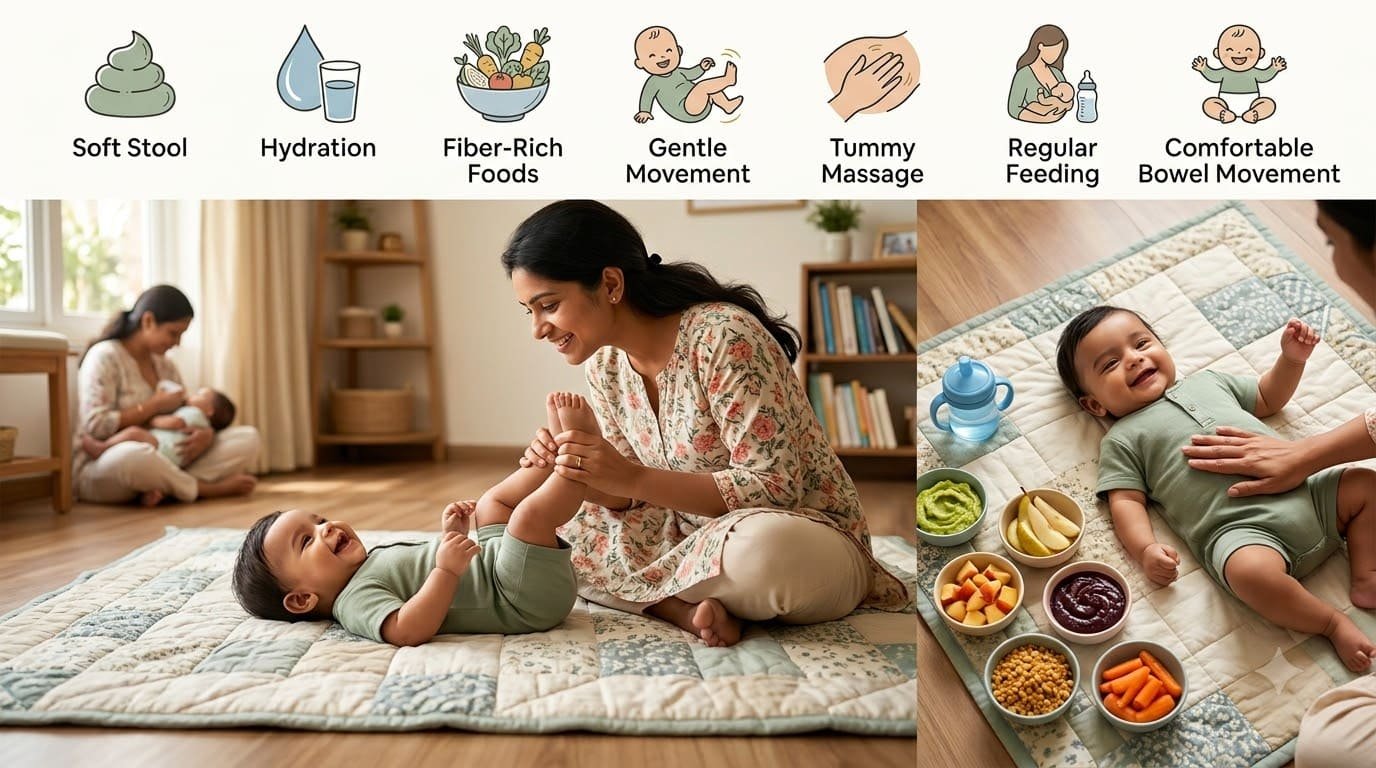
1. Bicycle Legs — Works at Any Age
Bicycle legs is the most consistently effective and immediately available constipation remedy for babies of any age.
Lay your baby on their back. Hold their legs gently and move them in a cycling motion — alternating legs forward and back, as if pedalling a bicycle. Do this for 2–3 minutes, several times a day.
The movement stimulates the intestinal muscles and helps move stool along. It also releases trapped gas, which often accompanies constipation.
Safe from: Birth When to do it: Between feeds, before a nappy change, whenever the baby seems uncomfortable.
2. Tummy Massage — Gentle and Effective
A gentle abdominal massage stimulates the colon and can help move stool toward the rectum.
How to do it correctly: Warm your hands first. Place fingertips just below the navel. Apply gentle, firm pressure in a clockwise circular motion — clockwise because this follows the direction of the colon. Start small circles and gradually work outward. Do for 2–3 minutes.
The key is clockwise. Anticlockwise massage works against the natural movement of stool through the colon.
Safe from: Birth — with very gentle pressure Frequency: 2–3 times a day when constipated
The Indian maalish connection: The traditional Indian baby massage (maalish) already does much of this. If you’re doing daily maalish, include abdominal circles in the routine — it’s one of the most practical preventive measures available.
3. Warm Bath — Relaxes the Muscles
A warm bath relaxes the muscles of the abdomen and anus, making it easier for the baby to pass stool. Many parents find their baby passes stool during or immediately after a warm bath — the relaxation and warmth work together.
How to use it: When constipation is causing discomfort, give a warm bath. Keep the water comfortably warm. Gently massage the tummy during the bath. Have a nappy ready.
Safe from: Birth Effect timing: Often works within 20–30 minutes of the bath
4. Extra Water — From 6 Months
For babies under 6 months who are exclusively breastfed — no water is needed and should not be given. Breast milk provides adequate hydration.
For formula-fed babies over 1 month — a few sips of cooled boiled water between feeds may help soften stools. Discuss with your paediatrician.
For babies over 6 months who have started solids — adequate water is essential and insufficient water is a very common cause of constipation. Offer cooled boiled water in a small cup or bottle throughout the day alongside solid food meals.
Amounts for 6–12 months: 4–8 ounces (120–240ml) of water per day alongside breast milk or formula.
5. Prune or Pear Juice — From 4 Months
Prunes and pears contain sorbitol — a natural sugar that draws water into the bowel and softens stools. Both are safe and effective for babies from 4 months.
How to give it: Dilute 1 part juice with 2–3 parts water. Start with 30ml of diluted juice per day. Increase to 60–90ml if no effect after a day.
In India: Prune juice is available in supermarkets in larger cities. Pear juice can be made at home — blend a ripe pear, strain, and dilute with cooled boiled water. Much more accessible than imported prune juice.
Safe from: 4 months — discuss with paediatrician for younger babies Note: Don’t give undiluted juice. Juice should supplement remedies, not replace feeds.
6. Prune or Pear Puree — From 6 Months
Once solids have started (from 6 months), offering prune or pear puree directly is more effective than juice — it provides fibre alongside the sorbitol.
Mash a ripe pear or cooked prunes to a smooth puree. Offer 1–2 teaspoons with other food.
Indian options: Papaya (paka hua — fully ripe) is an excellent laxative fruit for babies from 6 months. Kiwi is also effective. Sweet potato with skin has more fibre than without.
7. Hing (Asafoetida) — The Traditional Indian Remedy
Hing is used in Indian households as a digestive aid and carminative — it reduces gas and is believed to help with constipation. The traditional application is to dissolve a tiny pinch of hing in water and apply it around — not on — the baby’s navel, then massage gently.
The honest assessment: There is limited formal research on hing for infant constipation, but it has generations of traditional use in India. Applied externally around the navel in very small amounts, it is not harmful. Giving hing orally to babies is not recommended and can irritate the digestive tract.
If you use it: External application around the navel only. A pinch dissolved in a few drops of warm water. Gentle massage. Not on the navel opening itself.
8. High-Fibre Foods — Prevention and Treatment From 6 Months
Once solids begin, food choices significantly affect bowel regularity.
Foods that help — high fibre, stool-softening: Pear, plum, prune, papaya (ripe), mango, kiwi, broccoli, peas, beans, dal, oats, ragi.
Foods that cause constipation — reduce during episodes: Banana (especially raw banana — a very common constipation cause in Indian babies), rice in large amounts, bread, biscuits, boiled potato without skin, cheese.
The banana note: This is India-specific and important. Banana is one of the most commonly given first foods in Indian households — it’s also one of the most common causes of constipation in babies. Ripe banana in small amounts is usually fine. Unripe or semi-ripe banana is significantly more constipating. During a constipation episode — avoid banana.
For more on the right foods for babies at each stage, our starting baby solid foods guide covers the complete introduction schedule.
9. Formula Adjustment — For Formula-Fed Babies
If a formula-fed baby is consistently constipated, the formula itself may be a factor.
Check: Are you making the formula correctly? Too much powder produces stiffer stools. Follow the instructions exactly — level scoops, not heaped.
Consider: Discussing with your paediatrician whether a different formula type might suit your baby better. Some formulas are easier to digest than others.
Add water: A few sips of cooled boiled water between formula feeds — particularly after 3 months — can help soften stools.
10. Breastfeeding More Frequently — For Breastfed Babies Under 6 Months
For breastfed babies who are genuinely constipated (hard stools, not just infrequent stools), offering the breast more frequently increases the baby’s total fluid intake and can help soften stools.
This is specific to babies who may not be feeding frequently enough — cluster feeding phases, growth spurts where supply is catching up, or any period where feeds may have become shorter or less frequent.
For more on ensuring adequate milk supply and feeding frequency, our how to increase breast milk supply guide covers this comprehensively.
What NOT to Give — Dangerous Remedies
Castor oil orally: Castor oil given by mouth to babies can cause severe cramping and is not safe. External application around the anal area in tiny amounts is sometimes used — but oral castor oil for babies is dangerous.
Adult laxatives: Never. Senna, bisacodyl, lactulose — none of these should be given to babies without a doctor’s prescription and specific dosing instruction.
Corn syrup/Karo syrup: Previously used as a home remedy — no longer recommended. Does not draw water into the bowel effectively and poses a botulism risk in young babies.
Glycerine suppositories without doctor advice: Can be used occasionally but should not become routine. Habitual use can reduce the bowel’s natural reflex.
Forceful rectal stimulation: Using a thermometer or cotton bud to stimulate the rectum — if done at all, must be very gentle and infrequent. Routine use disrupts normal bowel reflex development.
When to Call the Doctor
Call your paediatrician if:
Your baby is under 3 months and hasn’t passed stool for more than 3 days with hard, uncomfortable stools.
Blood in the stool — even a small streak of red — always needs same-day assessment. It may indicate an anal fissure from straining, which is common and treatable, but needs to be confirmed.
The baby is refusing feeds alongside constipation.
The tummy is hard and distended and the baby seems in significant pain.
Home remedies have not helped after 3-4 days of consistent trying.
The baby is losing weight alongside constipation.
Constipation has been present since birth — this can indicate rare conditions that need assessment.
FAQ — Baby Constipation Remedies India
Q: My breastfed baby hasn’t pooped in 8 days. Is this constipation?
Almost certainly not — if the stool is soft when it comes. Breastfed babies can go up to 10 days without a bowel movement in the 6-week to 6-month period because breast milk is so completely absorbed. This is not constipation. If the stool is hard when it finally comes, or the baby is clearly uncomfortable — then assess. If the stool is soft and the baby is otherwise well — this is normal variation.
Q: My 7-month-old got constipated when I started solids. What should I do?
This is extremely common. The digestive system needs time to adapt to solids. Ensure adequate water alongside solid food. Offer high-fibre fruits — pear, papaya, prune puree. Reduce banana and rice temporarily. Add bicycle legs and tummy massage to the daily routine. Most babies regulate within 1-2 weeks of starting solids as the gut adapts.
Q: Can I give hing to my baby for constipation?
Hing applied externally around the navel in a tiny diluted amount is a traditional practice and not harmful. Hing given orally to babies is not recommended — it can irritate the digestive tract. Stick to external application if you choose to use it.
Q: My baby’s poop is hard and pellet-like. How quickly will home remedies work?
Bicycle legs and warm bath can help within hours. Prune or pear juice typically works within 24 hours. Dietary changes take several days to make a difference. If there’s no improvement after 3-4 days of consistent home remedies — call your paediatrician.
Q: Is banana causing my baby’s constipation?
Very possibly. Banana — particularly unripe or semi-ripe banana — is one of the most common constipation triggers in Indian babies given solids. During any constipation episode, reduce or eliminate banana and see if the pattern improves. Fully ripe banana in small amounts is less constipating than underripe banana.
Q: My baby is straining and going red. Is this constipation?
Not necessarily. Straining and going red in the face during a bowel movement is normal for babies — they have weak abdominal muscles and are lying flat, which makes passing stool genuinely effortful. The question is whether the stool that comes is hard or soft. Soft stool with straining — normal effort. Hard, pellet-like stool with straining — constipation.
More from MumPappaHub — Read These Next:
- Baby Fever Guide
- Diaper Rash Treatment India
- Baby Teething Signs & Remedies India
- Baby Vaccination Schedule India 2026
- Starting Baby on Solid Foods
- How to Increase Breast Milk Supply
- Baby Development Month by Month
- Indian Baby Weight Chart 0-12 Months
- Newborn Sleep Tips
- Newborn Care Tips
- Superfoods for Toddler Brain Development
- Baby First Year Milestones
About This Article
Written by the MumPappaHub editorial team — including a mother who googled baby constipation remedies at 3 AM when her seven-month-old hadn’t pooped in four days. It was normal variation with some genuine constipation starting. The bicycle legs helped. So did the warm bath. The hing suggestion she checked with a doctor first — sensible.
Reviewed for accuracy against WHO infant feeding guidelines and Indian Academy of Pediatrics guidance on infant bowel habits and constipation management. This content is for general informational purposes only and does not constitute medical advice. Always consult your paediatrician for persistent constipation or any concerning symptoms.
MumPappaHub — Real talk for real parents. mumpappahub.com

3 Comments