
Note: Always supervise toddlers during sensory play. Check all materials for choking hazards. Activities marked with 🌾 use taste-safe materials.
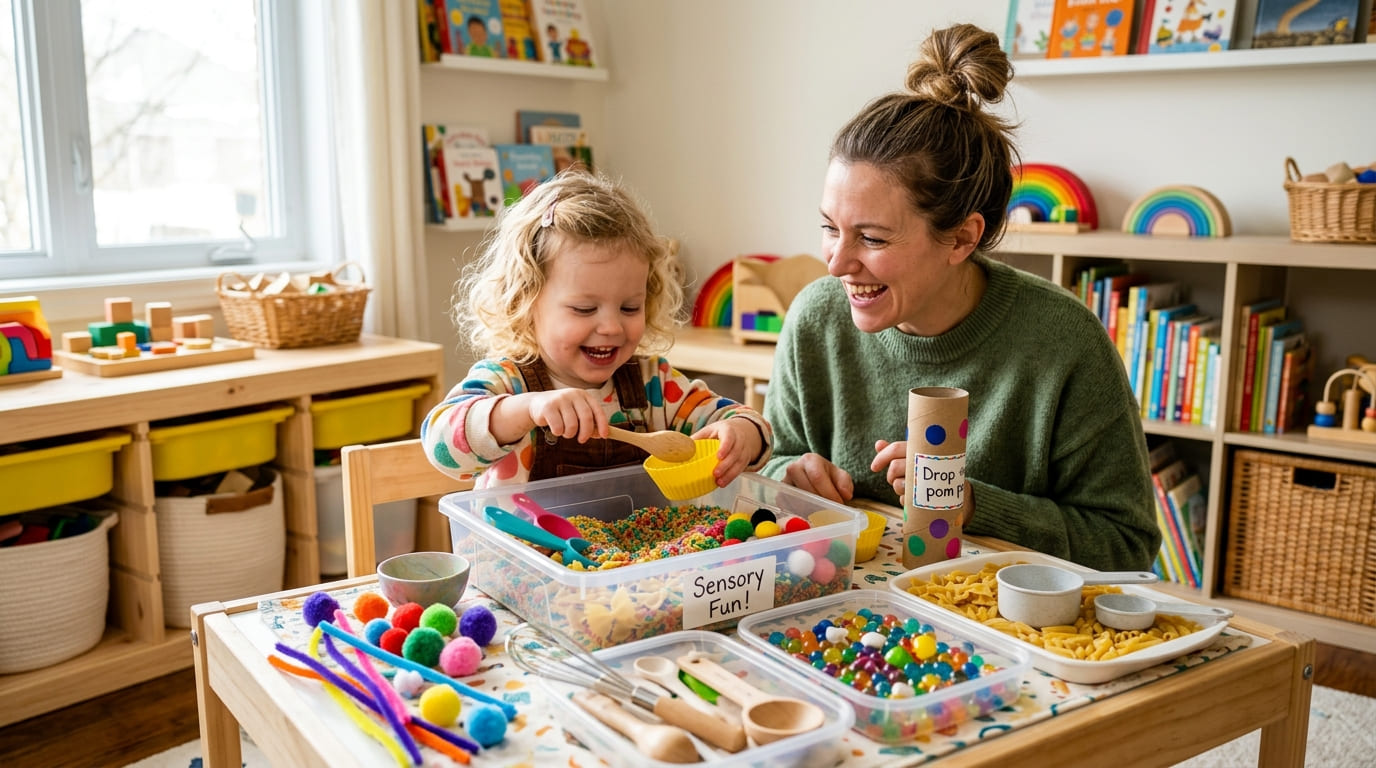
Sensory play for toddlers India doesn’t need imported kits — the best activities are already in your kitchen. My son was eighteen months old when I realised I had been dramatically overthinking play.
I’d bought three activity kits from an online store, each promising to develop fine motor skills and spatial reasoning and creative thinking. He opened each one, looked at the contents with polite disinterest, and went directly to the kitchen where he spent forty-five minutes transferring rice from one steel katori to another using a spoon, making a sound I can only describe as deeply, personally satisfied.
The rice cost nothing. The katoris were already there. The forty-five minutes of focused, independent play — genuinely independent, not me sitting next to him waiting for something to go wrong — were priceless.
Sensory play doesn’t need to come from a kit or a craft store. The best sensory play for Indian toddlers is already sitting in your kitchen. This guide covers fifteen activities, all using household items most Indian families already have, organised by age and sense, with the developmental science behind why each one works.
Why sensory play actually matters — not just “fun learning”
The brain builds itself through experience. In the first three years of life, a child forms approximately one million new neural connections every second. Sensory experiences — touching, smelling, hearing, seeing, tasting, moving — are what drive this formation.
According to the World Health Organization’s early childhood development framework, play-based, sensory-rich experiences are essential for cognitive, motor, social, and language development in the first five years. The Indian Academy of Pediatrics similarly emphasises hands-on, exploration-based play as a critical component of healthy development — specifically noting it as preferable to passive screen time for this age group.
Sensory play specifically:
Builds neural connections. When a child presses their fingers into atta dough, the brain is processing texture, temperature, resistance, smell, and proprioception (body awareness) simultaneously — creating and reinforcing multiple neural pathways at once.
Develops fine motor skills. Pinching, pouring, scooping, squeezing, tearing — all of these are strengthening the small muscles in the hands that will later hold a pencil, fasten buttons, and manage countless daily tasks.
Supports emotional regulation. There’s genuine research behind the idea that sensory play calms children. The repetitive, predictable nature of activities like pouring rice or squeezing dough provides a kind of regulation that toddlers — who are frequently overwhelmed by the intensity of their own emotions — genuinely need.
Develops language. Every texture, smell, and sound is a vocabulary lesson. “Rough,” “smooth,” “sticky,” “cold,” “grainy,” “squishy” — these words are attached to actual sensory experience, which is how language is most effectively learned.
Encourages problem-solving. How do I get this rice from this bowl into that bowl without spilling? What happens when I add water to this? Why does this float and this sinks? Toddlers are scientists. Sensory play is their laboratory.
Age guide — sensory play by developmental stage
6–12 months — introduce gently with full supervision
At this age, everything goes in the mouth. This is not a bad habit to break — it’s the primary way babies gather information about objects. Every sensory activity for this age must be taste-safe.
Suitable: soft textured fabrics and objects to touch, simple water play with supervision, gentle sound exploration, face-to-face interaction with different expressions.
Not suitable: any small items, anything with choking risk, anything toxic if ingested.
12–18 months — increasing independence with close supervision
Purposeful exploration begins. The baby now tries to do things — pour, stack, fill, dump. Activities should support these emerging intentions.
All dry grain activities need close supervision. Water play is excellent. Soft doughs with adult present.
18 months–3 years — the golden sensory play age
This is peak sensory play territory. Children this age have enough physical coordination to manage most activities independently, enough cognitive development to engage purposefully, and enough language to benefit from the vocabulary-building aspect.
Activities can be more complex. Independent play periods of 15–30 minutes are realistic.
3–5 years — adding complexity and imagination
Older toddlers and preschoolers bring imaginative play to sensory bins. The rice bin becomes a “restaurant kitchen.” The dough becomes characters in a story. Activities can include more steps and more materials.
15 Indian Household Sensory Activities
1. Rice Sensory Bin — the classic for good reason
Age: 12 months+ | Time to set up: 2 minutes | Time they’ll play: 20–45 minutes
Take a deep tray or shallow box — a storage dabbaa works perfectly. Fill with 2–3 cups of raw rice. Add steel katoris, a ladle, a small strainer, measuring cups, and any small objects you want to hide in the rice.
That’s it. That’s the whole setup.
Your toddler will pour, scoop, bury, find, sift, and transfer for a genuinely impressive amount of time. The sound of rice on steel, the feeling of grains running through fingers, the resistance when they scoop — it’s hitting every sensory note simultaneously.
What it develops: Fine motor skills, hand-eye coordination, cause and effect, concentration, early math concepts (volume, more/less).
The India advantage: Raw rice is in every Indian kitchen, costs almost nothing, can be dried and reused for weeks, and is taste-safe in small amounts for older toddlers.
Variation: Add a few drops of food colouring to the rice (spread on a tray and dry overnight) for coloured rice. Add marigold petals from yesterday’s puja for texture and colour. Add dried dal alongside for a texture comparison bin.
🛒 Helpful:
2. Atta Dough — better than playdough
Age: 18 months+ | Time to set up: 5 minutes | Time they’ll play: 30–60 minutes
Mix 2 cups of atta with enough water to make a pliable, non-sticky dough. Add a pinch of salt to preserve it. That’s it — completely taste-safe, softer than shop-bought playdough, and entirely free.
Give them a rolling pin (a small belan is perfect), some katori lids as cutters, and leave them to it.
Add food colouring to the water before mixing for coloured dough. Add jeera or saunf to the dry atta before mixing for sensory smell interest. Add a few drops of oil for a smoother texture.
What it develops: Hand strength (directly preparatory for writing), creative thinking, fine motor control, cause and effect.
The India advantage: Atta is always there. A batch takes five minutes and lasts three to four days in the fridge. No need to buy playdough.
3. Water Pouring Station
Age: 15 months+ | Time to set up: 3 minutes | Time they’ll play: 20–40 minutes
A large tray, a selection of containers of different sizes (steel glasses, bowls, bottles), and water. Add a few drops of food colouring to make it visually interesting.
Let them pour. Freely. Without interrupting.
Place a towel underneath. Accept that some water will leave the tray. The mess is proportional to the learning.
What it develops: Physics concepts (volume, gravity, flow), hand-eye coordination, concentration, early math (full/empty, more/less).
Variation — bubble water: Add a drop of dish soap. The bubbles add tactile and visual interest.
Variation — temperature: Warm water one week, cooler the next. The contrast is interesting.
4. Marigold Petal Sensory Bin
Age: 12 months+ | Time to set up: 2 minutes | Time they’ll play: 15–25 minutes
After any puja, the marigold garlands left over are sensory play gold. Strip the petals from the stems into a tray. Add a few bowls for transferring.
The colour, the texture of petals between fingers, and the distinct marigold smell create a genuinely multi-sensory experience with zero expense.
What it develops: Tactile processing, smell awareness, fine motor skills (small petals require pincer grasp), colour recognition.
The India advantage: Marigold petals are freely available from puja, from festivals, from neighbours — and they’re completely safe.
5. Dal Sorting Tray
Age: 18 months+ | Time to set up: 3 minutes | Time they’ll play: 20–30 minutes
Mix two or three types of dry dal — moong, masoor, chana — in a tray. Provide small bowls. Ask your toddler to sort them by type.
They won’t sort them correctly at first. They’ll mix them more enthusiastically. That’s fine — the point is the exploration, not the outcome.
What it develops: Fine motor skills, early classification and categorisation, concentration, sustained attention.
Variation: Add a strainer. Some dal will go through, some won’t — early physics.
6. Shaving Foam Finger Painting
Age: 18 months+ | Time to set up: 1 minute | Time they’ll play: 20–30 minutes
Spray a small amount of shaving foam onto a tray (or directly on the high chair tray). Let them spread it, draw in it with fingers, mix food colouring into it.
The texture — cold, light, foamy, completely unlike anything else — is genuinely captivating.
What it develops: Tactile processing, creative expression, cause and effect, fine motor skills.
Note: Shaving foam is not taste-safe. Use with older toddlers who are past the mouthing stage, or substitute with whipped cream for taste-safe version.
7. Frozen Peas and Warm Water
Age: 18 months+ | Time to set up: 2 minutes | Time they’ll play: 15–20 minutes
Take a packet of frozen peas straight from the freezer into a bowl. Add a bowl of warm water alongside. Let them transfer the peas from cold to warm using a spoon, their fingers, or a small strainer.
The temperature contrast, the round smooth texture, the way peas behave in water — it’s a lot of sensory input in a very simple setup.
What it develops: Temperature awareness, fine motor skills, cause and effect, scientific observation.
Taste-safe: Frozen peas are completely safe if eaten.
8. Cornflour Oobleck
Age: 2 years+ | Time to set up: 5 minutes | Time they’ll play: 30–45 minutes
Mix 2 parts cornflour (cornstarch/makai ka atta) with 1 part water. Add food colouring if desired. Stir until combined.
The result — oobleck — is a non-Newtonian fluid. It behaves like a solid when pressed and like a liquid when touched gently. This is genuinely fascinating to adults too, and toddlers experience it as magic.
Press into it with a fist — it’s hard. Let it drip from fingers — it’s liquid.
What it develops: Scientific thinking, sensory processing, cause and effect, fine motor skills.
Note: Cornflour is taste-safe in small amounts. Not fully edible but not harmful if a small amount is ingested.
🛒 Helpful:
9. Garden / Balcony Mud Play
Age: 18 months+ | Time to set up: 0 minutes | Time they’ll play: 30–60 minutes
If you have access to a balcony with a pot, a small garden, or a park — mud play is one of the most developmentally rich sensory experiences available.
Digging, patting, poking, smelling, making shapes — mud engages every sense simultaneously. Research also suggests that exposure to soil microbiome in early childhood is associated with better immune development.
Give them an old spoon, an old katori, a watering can. That’s all they need.
What it develops: Everything — fine motor, gross motor, creative thinking, scientific observation, sensory processing.
Note: Check that soil doesn’t contain chemicals or fertilisers. Wash hands thoroughly after. Ensure no small hazardous objects are in the soil.
10. Texture Touch Board — Indian materials
Age: 6 months+ | Time to set up: 20 minutes (one-time) | Time they’ll play: 10–15 minutes per session
Glue different textures onto a piece of thick card or wood: a piece of dupatta fabric, sandpaper, bubble wrap, cotton wool, jute twine, a piece of the plastic from a milk packet, dried pasta.
Label each texture as you hold their hand to it: “smooth,” “rough,” “bumpy,” “soft,” “scratchy.”
This board can be used from 6 months and continues to be useful for years as vocabulary develops alongside the sensory exploration.
What it develops: Tactile awareness, vocabulary (texture words), sensory processing, early classification.
11. Sound Shakers
Age: 6 months+ | Time to set up: 10 minutes | Time they’ll play: 10–20 minutes**
Fill small plastic bottles or steel dabbaas with different materials — rice, dal, pebbles, bells, paper clips (too small if the container can be opened). Seal securely with strong tape. Make three or four.
Each shaker makes a different sound. Let the baby explore — shake, tap, roll.
For older toddlers: make two matching pairs and play a “which ones sound the same?” matching game.
What it develops: Auditory discrimination, cause and effect, fine motor skills, early music concepts.
India advantage: Empty oil tins, dabbaas, small plastic bottles — perfect shaker materials.
12. Ice Play
Age: 18 months+ | Time to set up: Freeze overnight | Time they’ll play: 20–30 minutes
Freeze small toys, flowers, or coloured water in an ice tray or silicone moulds. Turn out into a tray. Give a small bowl of warm water and a dropper.
The child “rescues” the frozen items by melting the ice with warm water.
What it develops: Scientific observation (solid to liquid), cause and effect, fine motor skills, temperature awareness, patience.
Variation: Freeze different coloured waters. When they melt into the same container, colours mix — very simple colour theory.
13. Spice Smell Exploration
Age: 12 months+ | Time to set up: 3 minutes | Time they’ll play: 10–15 minutes
Set out small bowls with different common Indian spices: jeera, dalchini (cinnamon), elaichi (cardamom), haldi (turmeric), fresh mint or tulsi leaves.
Let the child smell each one. Name it. Describe it — “spicy,” “sweet,” “strong,” “fresh.”
What it develops: Olfactory (smell) processing, vocabulary, categorisation, cultural connection to food.
The India advantage: This activity uses the spice collection every Indian kitchen has. No purchases necessary.
14. Wet Sand / Kinetic Sand Alternative
Age: 18 months+ | Time to set up: 5 minutes | Time they’ll play: 30–45 minutes
Mix fine sand with a small amount of water — just enough to make it moldable without being wet. The texture — cool, compact, holds shape briefly — is very satisfying for toddlers.
Provide small cups, spoons, and a mould (even a katori works as a mould).
What it develops: Creative play, fine motor skills, tactile processing, cause and effect.
Sourcing: Clean, fine sand from a hardware store or garden centre. Avoid beach sand from unknown sources.
15. Cereal / Poha Bin
Age: 15 months+ | Time to set up: 2 minutes | Time they’ll play: 20–30 minutes
Thick poha (flattened rice flakes) makes an excellent sensory bin material — different texture from rice, light, makes a different sound, and is completely taste-safe.
Add a few katoris, a small spoon, and some small plastic animals or blocks to find.
What it develops: Tactile processing, fine motor skills, creative play, sensory processing.
Managing the mess — practical strategies
The mess is real. The question is not whether there will be mess, but how to contain it enough to make the activity feel worth it.
Containment first. A large plastic storage tray costs a few hundred rupees and lasts years. Place all activities inside it. Whatever falls in the tray, not on the floor.
Old bedsheet on the floor. Shake it out after, wash when needed. A designated “sensory play sheet” takes the pressure off the floor completely.
Involve them in cleanup. “Now let’s put the rice back together” becomes part of the activity. A small handheld brush and dustpan (or even an old paintbrush) that’s theirs for cleanup purposes makes this feel like more play.
Time it right. Just before a bath is the perfect time for messy sensory play. The mess goes directly into the bath — no intermediate cleanup step needed.
Accept imperfection. A toddler who poured rice on the floor was exploring physics. The floor cleans. The neural connections they built in that moment do not undo themselves.
🛒 Sensory play kit basics:
When your toddler doesn’t seem interested
Not every child takes to sensory play immediately. Some children are sensory-avoidant — they find certain textures or sensations uncomfortable rather than enjoyable — and this is a legitimate difference, not a problem to fix.
If your toddler consistently pulls away from textures, refuses to touch certain materials, or is very distressed by sensory experiences that seem harmless — don’t force it. Exposure over time, without pressure, is more effective than insisting they engage.
Start with the least threatening sense for your child. A child who hates wet textures might love the rice bin. A child who hates noise might enjoy the texture board. Meet them where they are.
If sensory avoidance is significant and affecting daily life — mealtimes, getting dressed, bathing — mention it to your paediatrician. Sensory processing differences can be supported with appropriate guidance.
For more on child development and the activities that support it, our child development milestones guide and toddler language development guide cover the broader developmental picture these activities fit into.
FAQ — Sensory Play for Toddlers India
About safety
Q: How do I know if a material is safe for my toddler?
A: The key questions: Is it a choking hazard? (Small items — anything that fits through a toilet paper roll — are choking hazards for children under three.) Is it toxic if ingested? Is it an allergen for your child? For children still mouthing everything, stick to taste-safe materials — atta dough, rice, poha, water, food colouring. For children past the mouthing stage, more options open up.
Q: My toddler eats the rice/atta/dal. Should I stop the activity?
A: For 12–18 month olds, mouthing and tasting sensory materials is normal and expected. Design the activity around taste-safe materials at this age. As they get older, the mouthing reduces naturally. A few grains of rice eaten during play are harmless.
Q: Is it okay if the activity is messy every single day?
A: Yes. The containment strategies above make daily sensory play manageable. The developmental benefit is worth the daily cleanup — which, with good containment, takes about five minutes.
About the activities
Q: How long should a sensory play session last?
A: Follow the child’s lead rather than a clock. Most toddlers naturally engage for 15–45 minutes before losing interest. Stop before they’re frustrated — ending while they’re still enjoying it creates a positive association that makes them want to do it again. Don’t push to extend an activity past the child’s interest.
Q: My toddler just dumps everything out immediately. Is that sensory play?
A: Yes — dumping is how toddlers explore physics and cause and effect. The dump is the experiment. Let them dump, then offer to help fill it back up and dump again. Over weeks, the play around the dumping becomes more elaborate.
Q: Which activity do you recommend starting with for a toddler who has never done sensory play?
A: The rice bin is the best starting point for most toddlers — familiar material, taste-safe, easy to contain, endlessly variable. Start with just rice and two katoris. Add complexity once they’re comfortable.
About development
Q: Does sensory play really help with language development?
A: Yes, through two mechanisms. First, the activity creates a shared focus between parent and child — joint attention — which is one of the most powerful contexts for language learning. Second, the sensory experiences create vocabulary — “grainy,” “cold,” “heavy,” “full” — attached to direct experience, which is how language is best acquired. Talking about what you’re doing during sensory play is as important as the sensory experience itself.
Q: My toddler prefers screens to sensory play. How do I make the switch?
A: Start by doing sensory play yourself where they can see you. Toddlers are intensely interested in what adults do. Sit on the floor with the rice bin and start playing — they’ll usually join within a few minutes. Don’t make it a confrontation with the screen; make it an alternative that seems more interesting. Once they’ve experienced the engagement of sensory play, it competes effectively.
More from MumPappaHub — Read These Next:
- Screen-Free Play Ideas for Toddlers
- Screen-Free Childhood Challenge
- Child Development Milestones
- Toddler Language Development
- Potty Training Guide
- Toddler Tantrums Tips
- Baby First Year Milestones
- Superfoods for Toddler Brain Development
- Baby Fever Guide
- Baby Sleep Training Guide
- Independence Day Craft Ideas for Kids
- Newborn Care Tips
About This Article
Written by the MumPappaHub editorial team — including a mother who bought three activity kits and watched her son spend forty-five minutes with a katori of rice and a spoon instead. The rice cost nothing. The lesson was priceless.
Reviewed against WHO early childhood development guidelines and Indian Academy of Pediatrics recommendations on play-based learning. This content is for general informational purposes only. Always supervise toddlers during sensory play and check all materials for age-appropriateness.
MumPappaHub — Real talk for real parents. mumpappahub.com

7 Comments