
Medical Disclaimer: This article is for informational purposes only. If you have concerns about your child’s speech or language development, always consult a paediatrician or certified speech-language pathologist.
My daughter said her Toddler language development doesn’t always follow the books — my daughter proved that on day one.
first clear word at fourteen months.
“Aam.”
Not mama. Not dada. Aam — mango — while pointing at the fruit bowl with complete authority, as if she’d been saying it all along and was simply now allowing us to hear it.
She was surrounded by three languages from birth. My husband speaks Hindi with her. My mother speaks Tamil when she visits. I speak a combination of both plus English that can most charitably be described as “creative.” Our building’s watchman, who she adores, speaks Marathi. Her first words were in four different languages and in no particular order.
I spent the months before “aam” reading milestone charts that told me she should have words by twelve months, feeling increasingly worried about a child who was clearly engaged, clearly understanding everything — she would go to her shoes when we said “bahar chalein” or “let’s go” — but not yet speaking.
What I didn’t know: she was doing exactly what bilingual and multilingual children do. Her brain was sorting three language systems simultaneously. Her total vocabulary, across all languages, was exactly where it should be.
This guide has the age-wise milestones, the India-specific context that most guides don’t cover, the techniques that genuinely work, and the clear signs that warrant professional assessment rather than watching and waiting.
How language actually develops — the process parents don’t see
Language development begins long before the first word. The months of apparent silence are not waiting — they’re processing.
From birth, your baby is recording speech. Every word you say, every conversation around them, every rhyme and song and running commentary — it’s all being filed. The brain is building what linguists call a phonological map — an internal representation of the sounds that exist in the language or languages around them.
By six months, babies have already begun narrowing their phonological focus to the sounds of their specific language environment. An infant in a Hindi-speaking home becomes more sensitive to Hindi phonemes. An infant in a Tamil-speaking home to Tamil. A baby in both simultaneously — to both simultaneously.
According to the World Health Organization’s early childhood development framework, responsive caregiving — where adults respond to a child’s vocalisations and cues — is the most evidence-supported driver of language development in the first three years. Not apps, not flashcards, not specialised programmes. Responsive human interaction.
The Indian Academy of Pediatrics developmental guidelines are consistent with international research: language develops through connection, conversation, and exposure — not instruction.
Age-wise milestones — the realistic ranges
Birth to 3 months
Crying is communication. Different cries for different needs — some parents learn to distinguish hunger cries from discomfort cries from tiredness cries. This is real communication.
Cooing begins — soft, round vowel sounds. The baby is experimenting with what their mouth can do. Respond to these sounds as if they’re conversation. Because they are.
What supports development: Talking to your baby during caregiving. Narrating what you’re doing. Eye contact during feeds. Singing.
4–6 months
Babbling begins — consonant-vowel combinations. “Ba.” “Da.” “Ma.” Not words yet — experimentation. The baby is discovering that different mouth positions make different sounds.
They’re also showing clear preferences — turning toward familiar voices, becoming quiet when spoken to, startling at sudden sounds. All hearing and attention signs worth noticing.
What supports development: Responding to babbling as if it’s a conversation — pause, let them “respond,” reply. This turn-taking pattern is the foundation of conversation.
7–12 months
Babbling becomes more varied and more clearly intentional. The baby uses specific sounds in specific contexts — a particular sound when they want something, another when they’re happy. These are proto-words — not yet the conventional words of any language, but functional communication.
Understanding develops before expression. By nine months, most babies respond to their name consistently. By twelve months, they understand several common words and simple phrases — “no,” “bye-bye,” “where’s dada?” — even if they can’t say them.
Pointing appears — a huge milestone. Pointing to communicate interest or desire is one of the most significant early communication achievements. It demonstrates understanding that another person can share your focus.
First words typically arrive between ten and fourteen months. A “word” at this stage means any consistent sound used to mean a specific thing — including sounds in any language spoken at home.
The India context: In multilingual homes, a child’s first words may be in any of the languages they hear. “Aam” or “paani” or “nahi” are first words. Count words across all languages — not just English.
12–18 months
Vocabulary grows, but unevenly. Most children have 5–20 words by fifteen months. By eighteen months, most have around 20–50 words, though the range is wide.
Understanding continues to significantly outpace expression. A child who understands “go get your shoes” and “where’s your nose?” and “come here” has robust receptive language even if they’re only saying five words.
The milestone to watch: Gestures plus some words plus clear understanding of simple instructions. A child with good understanding who isn’t yet talking much is very different from a child with limited understanding.
18–24 months
Vocabulary typically expands significantly between 18 and 24 months — sometimes called the “vocabulary explosion.” New words arrive daily. Toddlers begin combining two words: “more milk,” “bye dada,” “ball there.”
By two years, most children have 50+ words and are starting to put two words together consistently.
The milestone marker at 24 months: Two-word combinations consistently. If a child is not putting any words together by 24 months, a paediatrician or speech-language pathologist assessment is worthwhile.
2–3 years
Sentences arrive. Three-word, then four-word phrases. Grammar begins to appear — imperfectly, beautifully. “Me want juice.” “Where daddy go?” The logic is there even when the grammar is creative.
By age three, most children can be understood by familiar adults most of the time. Strangers understand about 75% of what they say.
Questions multiply. “Why?” arrives, and doesn’t stop. This is not annoying — or rather, it is annoying and it’s also a sign of perfectly normal cognitive and language development.
3–4 years
Conversation becomes genuinely reciprocal. Stories appear — simple ones, with a beginning and something that happened. Concepts of time develop — “yesterday,” “tomorrow,” “after lunch.”
Rhymes and wordplay become possible and deeply enjoyable. Children this age are experimenting with language as a creative tool, not just a communication tool.
By age four, most children should be understood by unfamiliar adults most of the time.
The India-specific context — what most language guides miss
Multilingual homes are the norm in India, not the exception
Most children in India grow up hearing multiple languages simultaneously — Hindi and a regional language, English and Hindi, multiple regional languages plus English across different family members. The concern that this confuses children or delays language development is one of the most persistent and most thoroughly debunked myths in child development research.
Bilingual and multilingual children develop language within the same timeframe as monolingual children. They may have smaller vocabularies in each individual language, but their total vocabulary across all languages is equivalent to monolingual norms.
Research consistently shows: bilingualism does not cause language delay. If a child has a genuine delay, it shows up across all their languages — not in just one.
The practical implication for Indian parents: When counting your child’s vocabulary, count words in all languages. “Ball,” “gend,” and “bola” count as three words for a child who uses all three appropriately. Don’t compare your bilingual child’s English vocabulary to a monolingual English-speaking child’s English vocabulary — the comparison is meaningless.
Code-switching is not confusion. When a child says “Mujhe water chahiye” — mixing Hindi and English in a single sentence — this is not evidence of confusion. It’s evidence of a brain that has access to two lexicons and is using whichever word came to mind. Adult bilinguals do this too. It’s normal.
The grandparent-speaks-different-language situation
Very common in India — a child’s parents speak one language, grandparents speak another. This is actually an excellent situation for language development. Children handle multiple language sources well, particularly when each source is consistent — grandparents speak this language, parents speak that one.
If grandparents speak primarily a regional language, that’s not a disadvantage. That regional language will become one of the child’s languages. The brain accommodates this without difficulty.
What genuinely supports language development — techniques that work
1. Talk more than you think you need to
The research on this is remarkably consistent. The sheer quantity of child-directed speech a child receives in the first three years is one of the strongest predictors of vocabulary size and language development. Talk while you cook, while you dress them, while you walk to the park.
Narrate: “I’m putting your left shoe on first. Now the right one. They have little dinosaurs on them, your favourite.” This feels slightly strange at first. It becomes natural quickly.
2. Follow their lead — not your agenda
When a toddler points at something or shows interest in something, comment on it. Don’t redirect to what you want to talk about. Don’t ask questions with obvious answers (“Is that a dog? What does a dog say?”) while they’re clearly interested in something else.
Genuine conversation follows the child’s attention. Joint attention — both of you interested in the same thing — is one of the most powerful language-learning contexts that exists.
3. Expand, don’t correct
When a toddler says “doggy run” — don’t correct the grammar. Expand the thought: “Yes, the doggy is running fast! He’s running to his home.” You’ve given them the correct grammatical form without making them feel wrong.
Correction at this stage causes children to take fewer risks with language. Expansion encourages more attempts.
4. The pause — hardest and most important
After asking a question or making a comment, pause. A full five to ten seconds. Toddlers need time to process, formulate, and respond. Most adults jump in before this has happened.
The pause is where the child’s turn is. Give it space.
5. Read together — as conversation, not performance
The research on reading aloud to children is extensive and consistent — it’s one of the most powerful things parents can do for language development. But reading as a performance — getting through the story — is less effective than reading as conversation.
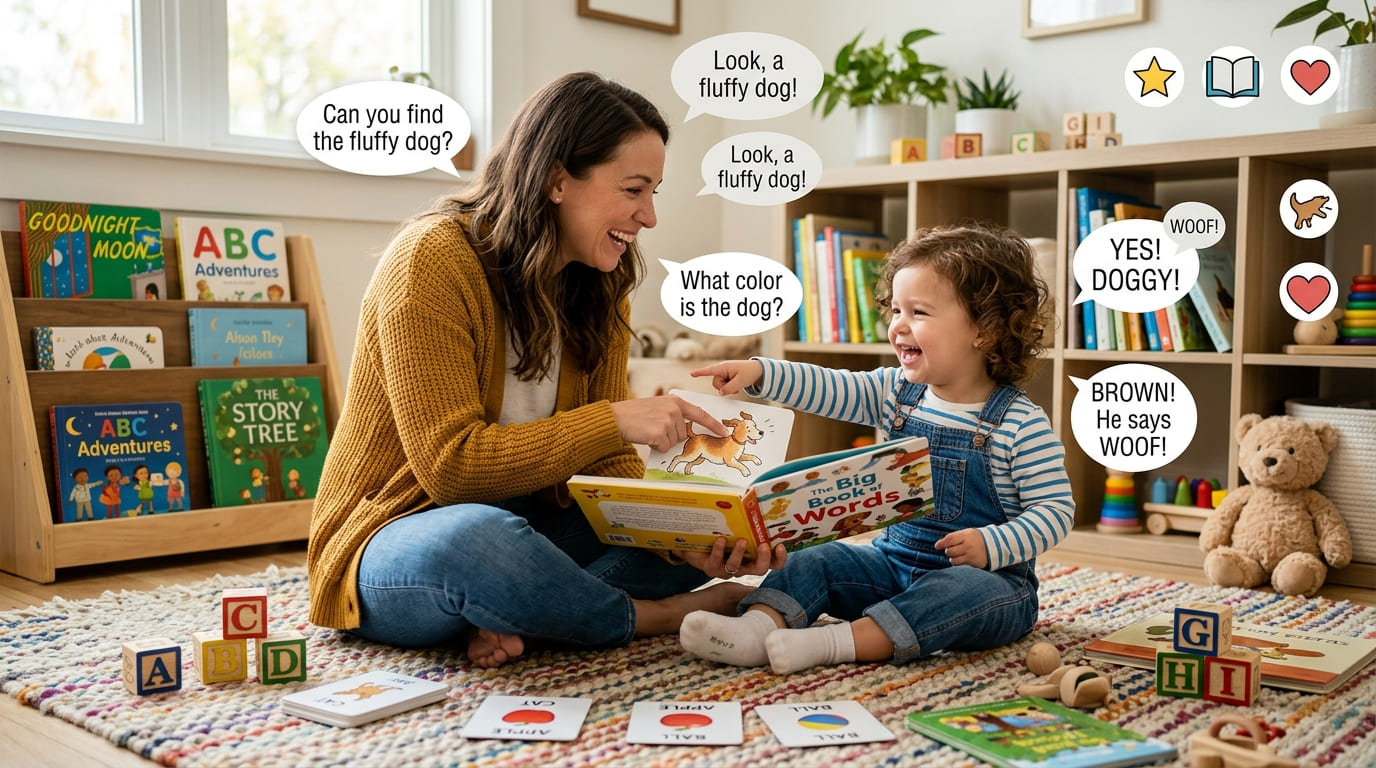
Pause on pages. Ask what they see. Comment on pictures. Let the child turn pages, point at things, digress. A single page that sparks five minutes of conversation about the dog on it is a better language experience than a book read from cover to cover without stopping.
🛒 Books for language development:
6. Songs, rhymes, and repetition
Repetition is how children learn language — not repetition of drills, but repetition of meaningful, enjoyable experiences. The same rhyme ten times in a day. The same song every bath time for six months. The same book read until you can recite it in your sleep.
Rhyme specifically trains the ear to hear phonological patterns — which supports reading readiness alongside speech.
Hindi nursery rhymes, Tamil lullabies, regional language songs — these are language-learning tools. Don’t worry about the language they’re in. The phonological richness of any language supports overall language development.
7. Limit passive screen time — actively
This one has clear evidence behind it. Research links excessive passive screen time — watching shows without interaction — to expressive language delays, with the risk rising with each additional 30 minutes of daily screen time in children under two.
The mechanism makes sense: screen time replaces the responsive human interaction that drives language development. The screen doesn’t pause for the child. It doesn’t respond to their attempts. It doesn’t adjust to what they’re interested in.
Active screen time — where an adult watches with the child, comments, discusses what’s happening — is significantly less harmful than passive screen time. But it still replaces interaction time.
The guidance from most paediatric bodies is: no screen time under 18–24 months (except video calls with family), and limited, high-quality, co-watched content after that.
The speech delay question — when to watch and when to act
This is where parents most need clear guidance, because the anxiety around “is my child delayed?” is genuinely distressing and often unnecessary — but sometimes delay is real and early intervention makes a significant difference.
Signs that are concerning — seek assessment
By 12 months: No babbling. Not responding to their name consistently. No pointing or waving. Not making eye contact.
By 15 months: No words in any language. Not using gestures to communicate.
By 18 months: Fewer than 5–10 words across all languages. Not pointing to show you things.
By 24 months: Fewer than 50 words across all languages. Not putting any two words together. Strangers cannot understand anything they say.
By 36 months: Not using simple sentences. Less than 75% of speech understandable to familiar adults.
At any age: Losing skills they previously had. Any skill that disappears after being present is always worth prompt assessment — this is the most important signal in all of child development.
Signs that are NOT concerning on their own
A bilingual child with a smaller vocabulary in one language but good total vocabulary across both.
A child who understands well but speaks less — comprehension developing ahead of expression is common and generally positive.
A child who started talking “late” but is making steady progress.
A child who mixes languages in a single sentence.
A child who has a “word explosion” at 18–22 months rather than at 12–14 months.
What to do if you’re worried
Start with your paediatrician — they can screen for hearing issues (a very common and very treatable cause of language delay), assess overall development, and refer to a speech-language pathologist if needed.
A speech-language pathologist (SLP) assessment is valuable even if nothing turns out to be wrong — it gives you a clear picture and specific guidance. Early intervention, if needed, is significantly more effective than later intervention.
In India, speech therapy is available in most cities. Look for an SLP who has experience with multilingual children — important in the Indian context.
For more detailed information on speech delay specifically — signs, causes, and the assessment process — our speech delay in toddlers guide covers this comprehensively.
Screen time and language — the honest conversation
Most parents know the guidance (limited screen time) and also know their reality (some screen time happens). Here’s the honest version:
What’s actually harmful: Leaving a toddler alone with a tablet or TV for extended periods consistently. This replaces interaction time and the effect is measurable.
What’s less harmful: Watching together and talking about what you see. Video calls with grandparents (which are actually valuable for language). Educational content watched with a parent who comments, pauses, and engages.
What helps after screen time: Immediately returning to conversation, play, and interaction. The effect of passive screen time is largely about what it replaces — if it replaces conversation, that’s the problem. If it’s twenty minutes while you cook and it’s followed by dinner together with conversation, the effect is minimal.
FAQ — Toddler Language Development
About milestones and timing
Q: My toddler understands everything but won’t talk. Is this a delay?
A: Strong understanding is a good sign — receptive language developing ahead of expressive language is common. However, a significant gap between understanding and speaking is still worth mentioning to your paediatrician, particularly if expressive language hasn’t started developing by 18 months. The gap itself can be assessed by a speech-language pathologist who can identify what’s driving it.
Q: My child had words and then stopped using them. Is this normal?
A: No — loss of skills previously present is not normal and always warrants prompt assessment. A child who was using words and has stopped, or who was babbling and has gone quiet, needs to be seen by a paediatrician as soon as possible. This is one of the most important developmental red flags.
Q: My son is two and still only saying a few words. The family says “Einstein didn’t talk until he was three.” Should I wait?
A: The “Einstein also didn’t talk early” reassurance is common and well-meant, but it’s not a reliable basis for clinical decision-making. If your son has fewer than 50 words and is not putting two words together at age two — have him assessed. Early assessment costs nothing if everything is fine and saves significant time if intervention is helpful. Don’t wait to see if it resolves on its own past the 24-month point.
About bilingual and multilingual development
Q: We speak Hindi at home and English at school. Will this confuse my child?
A: No. Bilingual children develop language within normal timeframes. Mixing languages in one sentence — “Mujhe that wala chahiye” — is normal and not a sign of confusion. Count words across both languages when assessing vocabulary. A bilingual child with 25 Hindi words and 25 English words has a total vocabulary of 50 words — not 25.
Q: My in-laws speak Gujarati, we speak Hindi, and the school teaches English. Is three languages too many?
A: Research shows children can handle multiple languages without confusion or delay. The brain is particularly efficient at this in early childhood. Each language source adds vocabulary and phonological richness. The key is that each language is used consistently and with genuine interaction — not just passively heard.
Q: My child’s Hindi is much better than English. Should I be worried?
A: Only if there’s a concern in both languages. Strong development in one language with weaker development in another is usually a reflection of exposure — the child hears more Hindi, uses it more, it develops more. A genuine delay shows up across all languages, not just one. If Hindi is on track — total words, two-word combinations, comprehension — the child is developing typically.
About specific concerns
Q: My daughter talks a lot at home but goes completely silent in new places or with new people. Is this normal?
A: Very common. Selective mutism — where a child speaks in some contexts but not others — exists on a spectrum. Some silence with strangers at two to three years is completely typical. If it’s extreme and persistent — consistently unable to speak at all outside the home past age four — mention it to your paediatrician. Mild social reticence at this age is not concerning.
Q: How much should I worry about screen time and language?
A: The concern is real and research-supported, particularly for passive screen time replacing interaction in the first two years. Active, co-watched content with a parent who talks about it is significantly less problematic than solo passive viewing. For children already talking and developing typically — the occasional episode of something is not going to cause lasting harm. The pattern over time matters more than any single day.
More from MumPappaHub — Read These Next:
- Speech Delay in Toddlers: Signs, Causes & When to Worry
- Child Development Milestones: Complete Guide
- Potty Training Guide
- Baby First Year Milestones
- Toddler Tantrums Tips: What Actually Works
- Screen-Free Childhood Challenge
- Screen-Free Play Ideas for Toddlers
- Sensory Play for Toddlers
- Superfoods for Toddler Brain Development
- Baby Sleep Training Guide
- Baby Fever Guide
- Newborn Care Tips
About This Article
Written by the MumPappaHub editorial team — including a mother whose daughter’s first word was “aam” at fourteen months, surrounded by Hindi, Tamil, English, and Marathi simultaneously, right on schedule once you count across all four.
Reviewed for accuracy against WHO early childhood development guidelines, Indian Academy of Pediatrics developmental guidance, and current research on bilingual language development. This content is for general informational purposes and does not constitute medical advice. If you have concerns about your child’s speech or language development, please consult your paediatrician or a certified speech-language pathologist.
MumPappaHub — Real talk for real parents. mumpappahub.com

14 Comments