
Medical Disclaimer: This article is for informational purposes only. If you have concerns about your baby’s sleep or health, consult your paediatrician.
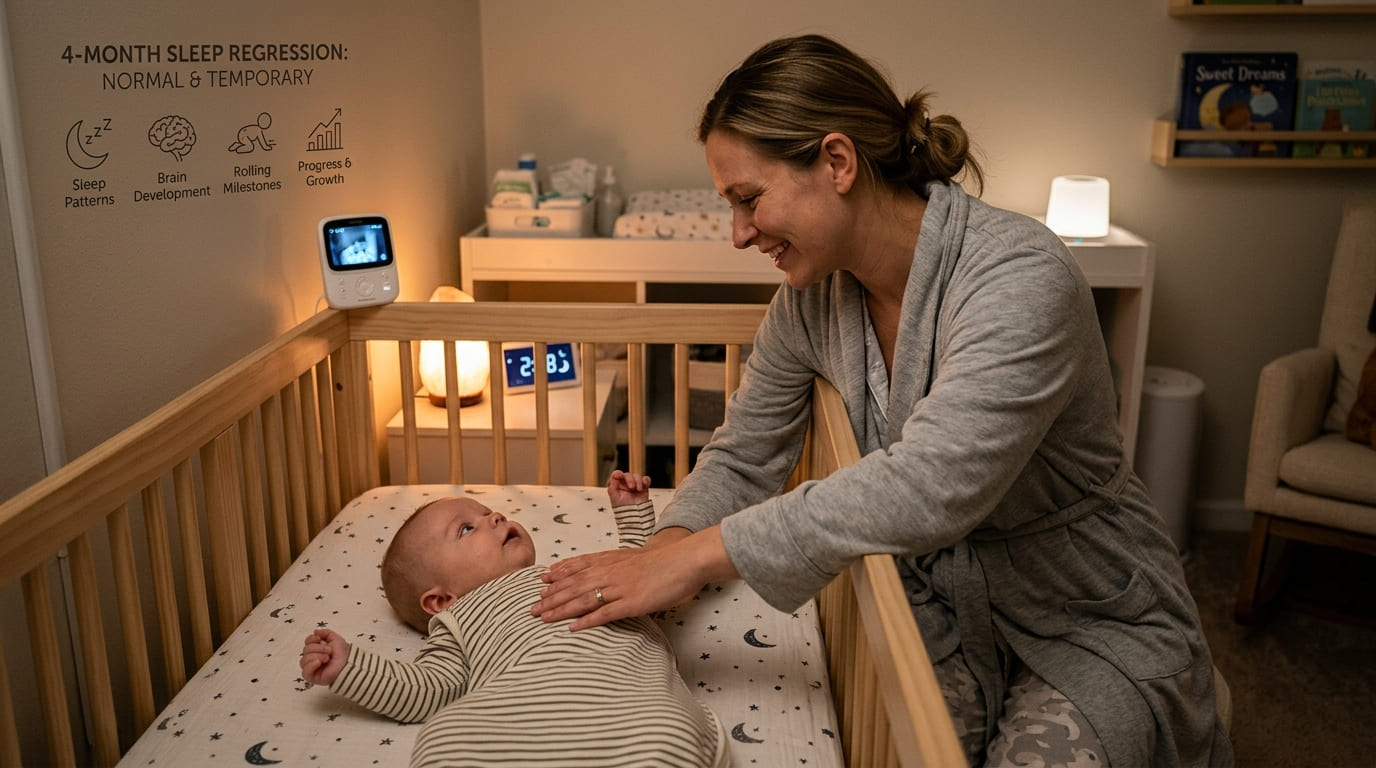
4 month sleep regression doesn’t ease in gradually — ours hit like a switch flipped overnight.
My daughter had been sleeping in four-hour stretches. Not perfect, but survivable. My husband and I had started having whispered conversations about whether we were “through the hard part.” We had started cooking actual dinners again.
Then week fourteen arrived and she stopped sleeping.
Not gradually. Not a little less. She just — stopped. Forty-five-minute naps. Up every ninety minutes at night. Screaming when put down awake. Happy when held, furious when placed in the cot even microseconds after falling asleep. I called my mother. I called three friends who had babies. I posted at midnight in a parenting group.
“It’s the four-month sleep regression,” said approximately everyone, simultaneously.
The thing is, knowing the name helped — but only slightly. What I actually needed to know was why it was happening, what was normal inside it, what to do, and how long it was going to last. Not a list of five tips. The actual information.
This is that article.
Why “regression” is the wrong word for what’s happening
The four-month sleep regression is not your baby going backward. Nothing is broken. Nothing went wrong. What’s happening is one of the most significant neurological developments of the first year.
Newborns have a simplified sleep architecture — they cycle primarily between active sleep and deep sleep, and they transition between these states fairly smoothly. Around three to four months, the brain matures and sleep architecture reorganises into something that looks much more like adult sleep — multiple stages including light sleep, deep sleep, and REM, cycling in roughly 45-minute intervals.
The problem isn’t the new sleep architecture. The problem is that your baby doesn’t yet know how to move through the transitions between cycles. Adult sleepers shift from light to deep to light to deep without fully waking — we’re semi-conscious for a moment and then go back under. Babies at four months haven’t developed this skill yet. They reach the light sleep stage at the end of a cycle, partially rouse, can’t get themselves back down, and fully wake. And then they’re awake and confused and want you.
According to the World Health Organization’s early childhood development guidelines, sleep development in the first year is a continuous neurological maturation process — with the four-month mark representing a significant transition point that is universal across healthy infants.
The Indian Academy of Pediatrics notes in its developmental guidance that sleep pattern changes at this age are an expected and healthy developmental milestone — not a sign of illness, feeding problems, or parenting errors.
A sleep progression is a better name than a sleep regression. The brain is advancing. The temporary chaos is the side effect.
What the 4-month regression actually looks like
It can start earlier or later than “4 months”
The name is slightly misleading. The neurological shift happens somewhere between 12 and 19 weeks in most babies — so it might arrive at three and a half months or closer to five months. If your baby is suddenly sleeping worse in this window and you can’t find another reason (illness, travel, vaccination), the regression is the most likely explanation.
What changes
Night waking frequency increases dramatically. A baby who was doing four or five-hour stretches may suddenly be waking every 60–90 minutes. This is disorienting precisely because you’d already adjusted to the longer stretches.
Naps shorten. The 45-minute nap is the characteristic nap of this phase — the baby completes one sleep cycle and wakes fully at the transition. Nap resistance also increases.
Going down becomes harder. A baby who was relatively easy to put down may now snap fully awake the moment you try to transfer them — the “back arching as you lower them” experience that is the universal symbol of this phase.
Feeding frequency may increase. Some babies feed more during the regression — sometimes genuinely hungry from increased calorie needs during a growth phase that often accompanies this neurological leap, sometimes using feeding as a settling mechanism. Both are real.
Increased fussiness overall. An overtired, overstimulated baby who is also going through significant neurological development is a baby who has a lot of feelings. This is normal and exhausting.
What the regression is NOT
Not your baby becoming unwell — though illness can happen during this period. If fever, unusual lethargy, or other symptoms appear, see your paediatrician.
Not a sign that something you did caused a problem. Parents frequently search their recent choices — did I start the bottle too early? Did we go out too much? Nothing you did caused this.
Not permanent. This is the most important thing to understand and the hardest to feel when you’re in week three of it.
How long does it last?
The honest answer is: two to six weeks for most families, with the majority seeing real improvement at the four-to-six-week mark.
Some babies move through it faster — one to two weeks of disruption and then a noticeable improvement. Some take longer — particularly if the regression coincides with a growth spurt, a developmental leap, teething starting early, or external disruption.
The regression doesn’t end with a clear moment of “back to normal.” It tends to gradually improve — naps extend slightly, night stretches get slightly longer, the going-down process gets slightly easier. One day you realise things are better and you’re not sure exactly when it shifted.
What makes it longer: creating new sleep associations during the regression that the baby then expects every time they rouse. If the response to every waking is feeding, rocking, or replacing a pacifier, the baby learns that those things are part of sleep — and continues to need them at every cycle transition.
What makes it shorter: beginning to build independent sleep skills during or immediately after the regression, so the baby gradually learns to navigate cycle transitions without help.
What actually helps — the honest version
1. Know what you’re dealing with — expectation management is real help
The four-month regression is harder when you don’t know it’s happening. You think something is wrong. You try to fix something that isn’t broken. You change things that were working. You feel like a failure.
Knowing it’s happening — and knowing it ends — genuinely changes the experience. You’re not fixing a problem. You’re surviving a phase.
2. Full daytime feeds — the distracted feeding problem
Around three to four months, babies become dramatically more aware of their environment. They pull off the breast or bottle to look at everything — a shadow on the wall, a sound outside, your face. They take shorter feeds. They make up the calorie deficit at night.
Feed in a quiet, dark room. Close the curtains. Remove distractions. Some mothers nurse under a muslin cover not for modesty but to help the baby focus. A baby who feeds well during the day is more likely to sleep in longer stretches at night.
3. Watch the wake windows — overtiredness makes everything worse
At four months, wake windows — the time between sleeps — are approximately 1.5 to 2 hours. An overtired baby is harder to settle, sleeps more lightly, and wakes more frequently. Keeping to these windows and watching for sleep cues — eye rubbing, looking away, a slightly glazed expression — prevents the overtiredness spiral.
Put the baby down before they’re crying. Crying at the point of being put down is late overtiredness — it makes the whole process harder.
4. The drowsy-but-awake practice — start now
This is the skill that makes the difference. A baby who falls asleep in your arms, on the breast, or with a pacifier learns that those things are required to get back to sleep. When they rouse at the end of a sleep cycle, they look for the same conditions they fell asleep in — and those conditions require you.
A baby who falls asleep in the cot, slightly awake, learns to get themselves back to sleep from that drowsy state. When they rouse at a cycle transition, they have the skill to go back down without you.
Practice this from four months — for some naps, not necessarily all. Put the baby down when drowsy — eyes getting heavy, slow blinking, relaxed — rather than fully asleep. It doesn’t work every time at first. Over days and weeks, it gets more reliable.
This is not the same as leaving a baby to cry. A baby put down drowsy but awake may fuss briefly. That’s different from a baby left alone to cry until exhausted.
5. Sleep environment — optimise it now
At four months, the sleep environment matters more than it did before, because light sleep is now part of every cycle.
Darkness: The room should be dark for naps and night sleep. Proper darkness — not just curtains drawn, but blackout. Light triggers cortisol, suppresses melatonin, and promotes waking. A room dark enough that you can’t see your hand in front of your face is the right level.
White noise: At a consistent 50–60 decibels — similar to a shower. Not too loud, not too quiet. White noise masks the household sounds that now wake a baby in light sleep. It also provides a continuous sleep cue — the same sound the baby falls asleep to is present at every cycle transition.
Temperature: 16–20°C. Cooler than most people keep their homes. A baby who is too warm sleeps more lightly.
🛒 Sleep environment products:
6. Swaddle transition — timing matters
Many babies are still being swaddled at four months. The four-month regression often coincides with the time to stop swaddling — because babies are beginning to roll, and a swaddled baby who can roll onto their stomach cannot push themselves back.
The transition from swaddle to arms-free sleep is often disruptive. The Moro reflex — the startle — that swaddling suppresses is still active, and the baby now experiences it fully. Some families use a transitional swaddle (one arm in, one arm out) or a sleep sack as an intermediate step.
If your baby is showing any signs of rolling — pushing up during tummy time, rocking from side to side — stop the swaddle now, regardless of whether they’ve rolled yet. The regression will be harder without the swaddle, but it’s significantly safer.
7. Survival for parents — because this matters too
The four-month regression is one of the most exhausting points of early parenthood. You’re recovering from birth, you’re four months into disrupted sleep, and now the brief improvement you’d experienced is gone.
The shift system — one parent responsible until 2 AM, the other from 2 AM onward — gives each person one uninterrupted stretch. Even one 3-4 hour uninterrupted sleep significantly improves functioning the next day.
If you’re breastfeeding: your partner cannot feed the baby, but they can do every other part of the settling process when it’s their shift. Some feeding is unavoidable but not all the overnight waking requires feeding.
Lower the bar. Significantly. The house doesn’t need to be clean. Dinner doesn’t need to be cooked. The developmental milestone photos don’t need to be organised. Sleep is the priority — everything else can wait.
For more on managing the emotional weight of this period, our baby blues vs postpartum depression guide covers what’s normal emotionally at this stage and when to seek support.
🛒 Helpful for parents during regression:
The feeding question — is the baby waking from hunger?
At four months, many babies genuinely need night feeds. They’re growing rapidly. Their stomach capacity is still limited. One to three night feeds is completely normal for a breastfed baby at this age.
What’s not hunger: waking every 60–90 minutes, nursing for two minutes, and falling back asleep. This is comfort nursing — using the breast as a pacifier at each cycle transition. It’s not harmful, but it does mean the baby needs you at every transition, which is sustainable for some families and not for others.
If you want to reduce comfort nursing: work on the drowsy-but-awake practice so the baby doesn’t fall asleep on the breast. Gradually reduce the length of comfort feeds. These things take time and are not emergency measures.
Full feeds at every feeding — day and night — are more important than reducing feed frequency at this age. Don’t reduce total feeding. Reduce sleep associations if that’s the goal.
When to talk to your paediatrician
The four-month regression is normal and doesn’t usually require medical assessment. Talk to your paediatrician if:
Your baby seems unwell alongside the sleep changes — fever, unusual lethargy, changes in feeding beyond what’s described above, significant weight loss.
The regression seems to extend significantly beyond six weeks with no improvement at all.
You have concerns about your baby’s overall development alongside the sleep changes.
You are struggling with your own mental health to a point where it’s significantly affecting daily functioning — this is worth mentioning at any appointment.
For complete guidance on baby sleep in the months before and after this regression, our newborn sleep tips guide covers the early months and our baby sleep training guide covers what comes next when you’re ready to work on sleep more actively.
FAQ — 4 Month Sleep Regression
About timing and identification
Q: My baby is only 3 months old but this sounds exactly like what’s happening. Is it too early?
A: No — the neurological change that causes the four-month regression can happen anywhere between 12 and 19 weeks. If your three-and-a-half-month-old is suddenly sleeping worse with no other obvious cause, this is likely what’s happening. The name is a simplification.
Q: How do I know this is the regression and not my baby being unwell?
A: The regression is characterised by disrupted sleep without other symptoms — no fever, no unusual lethargy, feeding is otherwise normal, the baby is alert and engaged when awake. If other symptoms are present alongside the sleep disruption, see your paediatrician.
Q: My baby never slept well to begin with. Will I even notice the regression?
A: Parents of babies who were already poor sleepers sometimes notice less dramatic change — the baseline was already low. But the neurological change still happens. You may notice increased nap resistance, more difficulty going down, or shorter nap cycles even if the night waking doesn’t dramatically worsen.
About what to do
Q: Should I start sleep training during the regression?
A: Most sleep consultants and paediatricians recommend waiting until the regression has passed before beginning formal sleep training — typically after 5-6 months. During the regression the baby’s sleep system is in active transition, which makes this a difficult time to establish new patterns. Working on drowsy-but-awake practice is appropriate during the regression. Full sleep training methods are better started after.
Q: The drowsy-but-awake method doesn’t work — my baby always fully wakes when I put them down. What do I do?
A: It takes practice — often weeks of practice — before it works reliably. Start with the first nap of the day when the baby is most rested and receptive. It won’t work every time at first. Try, and if the baby fully wakes and is distressed, settle them by your usual method and try again next time. Gradual progress over days and weeks is the realistic expectation.
Q: My baby only sleeps on me. Is this creating permanent habits?
A: At four months, responsive settling — feeding to sleep, holding, contact napping — is not creating permanent damage. The drowsy-but-awake practice is worth introducing, but some families choose to contact nap through this phase and transition to the cot afterward. Both approaches are workable. The habit question is more relevant from 6+ months.
About the family
Q: My partner sleeps through every waking and I’m exhausted. How do I handle this?
A: This is one of the most common sources of conflict in the postpartum period. A direct, specific conversation before everyone is exhausted works better than addressing it at 3 AM. “I need you to take from 2 AM to 6 AM three nights a week” is more actionable than “you never help.” If your partner is physically capable of settling the baby — which takes a few nights to establish — both of you will sleep better.
Q: I’m so exhausted I feel like I can’t cope. Is this normal?
A: Significant sleep deprivation is genuinely brutal. Feeling like you can’t cope is a normal response to insufficient sleep — it’s not a character flaw or a sign of depression by itself. If you’re also feeling low, disconnected from your baby, experiencing intrusive thoughts, or struggling in ways that go beyond tiredness — that’s worth mentioning to your doctor. The four-month period is when postpartum depression often peaks.
More from MumPappaHub — Read These Next:
- Newborn Sleep Tips: What Actually Works
- Baby Sleep Training Guide
- Baby First Year Milestones
- Baby Blues vs Postpartum Depression
- Newborn Care Tips
- How to Increase Breast Milk Supply
- Child Development Milestones
- Baby Fever Guide
- Hospital Bag Checklist India
- Postpartum Yoga Poses for New Moms
- Postpartum Recovery Guide
- Pregnancy Insomnia: What Actually Helps
About This Article
Written by the MumPappaHub editorial team — including a mother whose daughter stopped sleeping at week fourteen, right when the whispered conversations about being “through the hard part” had started. She was not through the hard part. She got through it anyway.
Reviewed for accuracy against WHO early childhood development guidelines and Indian Academy of Pediatrics sleep guidance. This content is for general informational purposes and does not constitute medical advice. Always consult your paediatrician with specific concerns about your baby’s sleep or development.
MumPappaHub — Real talk for real parents. mumpappahub.com

8 Comments