
Medical Disclaimer: This article is for informational purposes only. If you suspect your child has iron deficiency anaemia, consult your paediatrician for a blood test and proper treatment. Do not self-prescribe iron supplements.
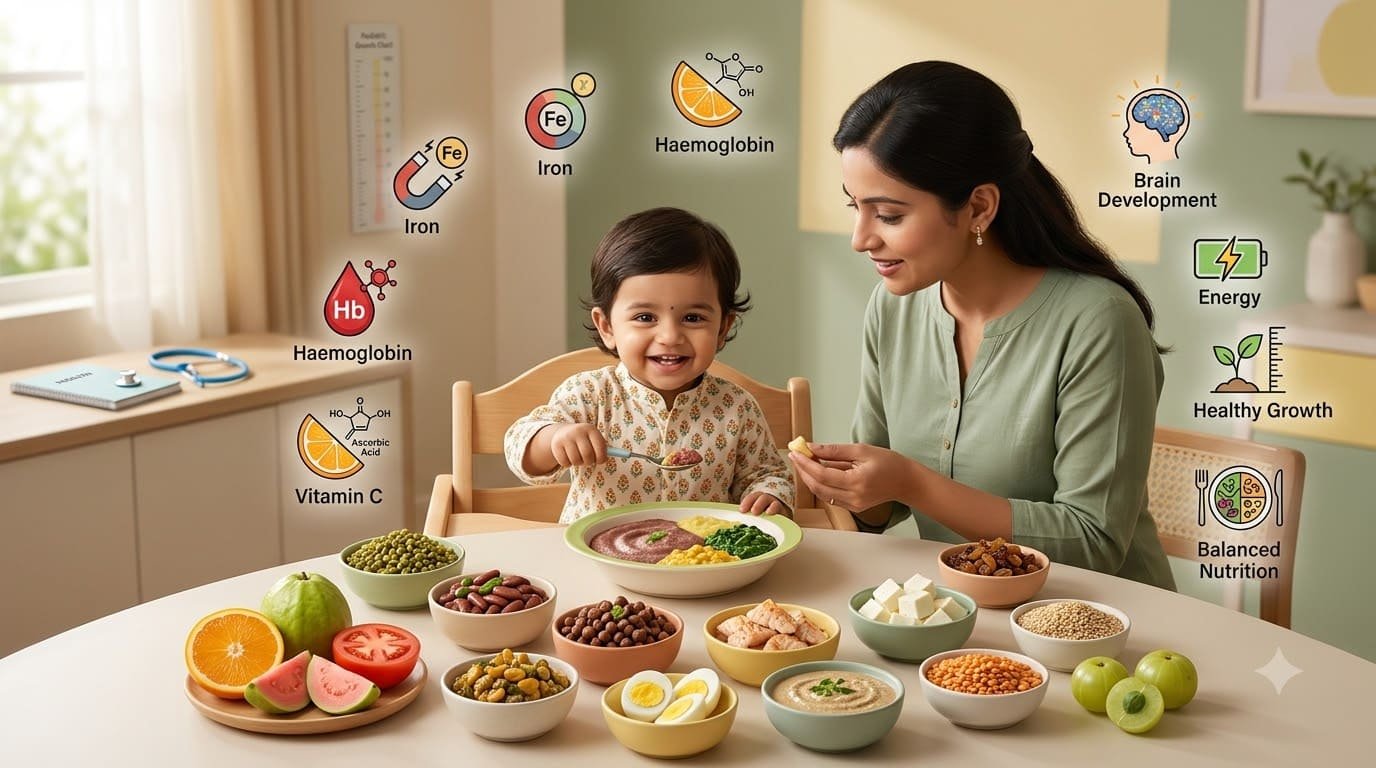
Iron rich foods babies toddlers India is a topic that most parents only start thinking about after a paediatrician flags low haemoglobin at a routine check. Getting iron rich foods babies toddlers India right from six months is one of the most important nutritional steps in the first two years.
My niece’s haemoglobin came back at 9.2 at her twelve-month visit. She looked fine. She was active, eating reasonably well, gaining weight. Nobody would have known anything was wrong without the blood test. The paediatrician prescribed an iron supplement and sent her mother home with a handwritten list of iron-rich foods to add to her diet.
Her mother called me immediately. “What is iron-rich food? What do I give her? She doesn’t eat dal — what do I do?”
Iron deficiency is the most common nutritional deficiency in Indian children. It affects approximately 50–70% of children under five in India. The reason it’s so prevalent isn’t that good iron-rich foods are unavailable in Indian cooking — Indian food is actually full of them. The reason is that the connection between everyday Indian foods and iron doesn’t always get made clearly, and that some food combinations actively block iron absorption while others dramatically improve it.
This guide covers the 15 best iron rich foods for babies and toddlers India, how to maximise absorption, what blocks absorption, the daily iron requirements by age, and the signs of iron deficiency to watch for.
Why Iron Rich Foods for Babies and Toddlers India Matter So Much
Iron rich foods for babies and toddlers India are critical because the consequences of iron deficiency go far beyond tiredness.
Iron is essential for haemoglobin — the protein in red blood cells that carries oxygen from the lungs to every cell in the body, including the brain. In rapidly growing babies and toddlers, the brain has an extraordinarily high demand for oxygen. Iron deficiency deprives the developing brain of the oxygen it needs precisely during the period of most rapid neural development.
According to the World Health Organization’s nutrition guidelines for infant and young child feeding, iron deficiency anaemia in the first two years of life is associated with measurable delays in cognitive development, motor development, and language acquisition — some of which may persist even after the anaemia is treated. The Indian Academy of Pediatrics identifies iron deficiency as the most common nutritional deficiency in Indian children and specifically recommends that iron-rich foods be prioritised from the introduction of complementary feeding at six months.
The iron stores a baby is born with last approximately six months — which is exactly why the WHO and IAP both recommend introducing iron-rich complementary foods beginning at six months. After six months, the baby’s diet must supply the iron the growing body needs.
Iron Requirements — Age-wise Daily Needs
| Age | Daily Iron Requirement |
|---|---|
| 0–6 months | 0.27 mg (supplied by breast milk + birth stores) |
| 6–12 months | 11 mg/day |
| 1–3 years | 9 mg/day |
| 4–8 years | 10 mg/day |
The jump from 0.27 mg to 11 mg between six and seven months is dramatic — and explains why iron-rich solid foods are not optional from six months, particularly for breastfed babies. Breast milk contains very little iron after six months, and the birth iron stores are depleted. Formula-fed babies receive iron-fortified formula which helps bridge the gap — breastfed babies must get iron from solid food.
Two Types of Iron — This Is the Key Difference
Heme iron: Found in animal foods — meat, poultry, fish, eggs. Absorbed at 15–35% efficiency by the body regardless of what else is eaten. This is the most bioavailable form of iron.
Non-heme iron: Found in plant foods — dal, leafy greens, ragi, jaggery, dried fruits. Absorbed at only 2–20% efficiency. Absorption is significantly affected by what else is eaten at the same meal — vitamin C dramatically increases it, while milk, tea, and certain compounds decrease it.
This distinction matters enormously for the large proportion of Indian families who are vegetarian. Plant-based iron is available in Indian food — but it requires specific pairing with vitamin C sources to maximise absorption. This one habit — adding a squeeze of lemon or a small piece of amla to iron-rich meals — can double the iron absorbed from the same food.
15 Best Iron Rich Foods for Babies & Toddlers India
1. Dal (Lentils) — The Everyday Iron Source
Dal is the most accessible and consistently available iron-rich food in the Indian kitchen. Different dals provide different amounts of iron, but all are significant sources.
| Dal Type | Iron per 100g (cooked) |
|---|---|
| Masoor dal | 3.3 mg |
| Moong dal | 1.4 mg |
| Chana dal | 2.9 mg |
| Rajma (kidney beans) | 2.9 mg |
| Chole (chickpeas) | 2.9 mg |
How to give it: Moong dal is the most easily digestible and the best starting dal for babies beginning solids. Progress to toor dal, masoor, and chana as the baby’s digestion matures.
The absorption trick: Add a squeeze of lemon juice to cooked dal. The vitamin C increases iron absorption from the same dal by up to 2-3 times. Tomato-based dal also improves absorption. This one habit makes an enormous difference for vegetarian families.
What reduces absorption from dal: Having milk or chai within an hour of eating dal significantly reduces iron absorption. Keep these separate.
2. Ragi (Finger Millet) — South India’s Iron Powerhouse
Ragi contains approximately 3.9 mg of iron per 100g — making it one of the most iron-rich grains available in India. It’s also rich in calcium, making it doubly valuable for growing babies.
South Indian families have used ragi as a first food for generations. North Indian families are increasingly incorporating it — with excellent reason.
How to give it: Ragi kanji (porridge) with a small amount of lemon juice or served alongside a tomato-based food for vitamin C pairing. Ragi dosa. Ragi ladoo. Mixed into wheat atta for paratha.
Age: From 6 months as a first food puree.
For more on ragi and other brain-supporting foods, our superfoods for toddler brain development guide covers the complete picture.
3. Palak (Spinach) — Classic Iron Vegetable
Palak contains 2.7 mg of iron per 100g. It also contains vitamin C — which means it partly self-pairs for iron absorption. However, palak also contains oxalates which slightly inhibit absorption, so pairing with additional vitamin C is still beneficial.
How to give it: Blended into moong dal for babies — the classic palak dal is one of the most nutritionally complete baby foods available. Palak paratha for toddlers. Added to khichdi. Palak soup.
The spinach myth to bust: Many parents think spinach is extremely high in iron — it is good, but not exceptional. The dal and ragi in your kitchen are comparable or better sources and are easier to serve in larger quantities.
4. Chicken Liver — Highest Iron Density Available
Chicken liver contains approximately 13 mg of iron per 100g — the highest concentration of any commonly available food in India. It contains heme iron, which means absorption is excellent regardless of what else is on the plate.
For non-vegetarian families, this is the most powerful iron source available.
How to give it: Well-cooked liver blended smooth into khichdi or dal for babies. Very small amounts — 30–40g once a week is adequate. The taste is strong — blend with mild dal or potato to moderate it for young babies.
Age: From 8 months, well-cooked and blended smooth.
Caution: Liver is very high in Vitamin A. Limit to once a week — daily consumption is not appropriate.
5. Eggs — Accessible Iron Plus Complete Protein
A whole egg contains approximately 1 mg of iron, along with complete protein, choline, and vitamin D. While not the highest iron source, eggs are consumed daily in many Indian households and contribute meaningfully to overall iron intake.
How to give it: Scrambled with ghee. Egg bhurji. Boiled and mashed. Egg paratha. Hidden in dosa batter.
Age: From 6 months. Early introduction reduces allergy risk.
6. Moringa (Drumstick Leaves / Murungai) — Extraordinary Iron Density
Moringa leaves contain approximately 4 mg of iron per 100g — alongside very high vitamin C content, which means they self-pair for absorption. They also contain calcium, protein, and antioxidants.
Moringa is extraordinarily nutrient-dense and has been used in South Indian cooking for generations. Moringa powder is now available across India and can be added to any food.
How to give it: Fresh moringa leaves in sambar, dal, or sabzi. Moringa powder — a pinch stirred into khichdi, porridge, or soup. The taste is mild enough that small amounts go undetected in strongly flavoured food.
Age: From 8 months in small quantities.
7. Jaggery (Gud) — Traditional Iron Sweetener
Jaggery contains approximately 2.8–11 mg of iron per 100g depending on the type and preparation — with darker, less refined jaggery generally containing more iron. It has been used in Indian cooking as a nutritive sweetener for centuries.
Replacing refined sugar with jaggery in a baby’s or toddler’s food is a simple way to add iron without changing the diet significantly.
How to use it: In porridge instead of sugar. In ragi kanji. In laddoos. As a sweetener in sweet dishes.
Age: From 8–9 months in small amounts. Not before 12 months in large quantities.
Caution: Jaggery is still a sugar — use in moderation. The goal is replacing refined sugar, not adding to total sugar intake.
8. Poha (Flattened Rice) — Underrated Iron Source
Poha contains approximately 2.5–3 mg of iron per 100g and is already a staple breakfast in many Indian households. It’s easily digestible, mild in flavour, and accepted readily by most babies transitioning to solids.
How to give it: Soft poha cooked with vegetables and a squeeze of lemon juice. For babies — cook until very soft and mash slightly.
The lemon is essential here: Poha iron is non-heme iron. A squeeze of lemon can significantly increase the iron absorbed from the same serving.
9. Rajma and Chole — Toddler Iron Sources
Rajma (kidney beans) and chole (chickpeas) both contain approximately 2.9 mg of iron per 100g cooked. They’re protein-rich alongside the iron content.
How to give it: Well-cooked rajma mashed into dal or rice for babies from 8 months. Rajma curry for toddlers from 12 months. Chole for toddlers from 12 months — ensure well-cooked and soft.
Pairing: Tomatoes in the gravy provide vitamin C — rajma cooked with tomatoes is already reasonably well-paired for iron absorption.
10. Sesame Seeds (Til) — Concentrated Iron
Sesame seeds contain approximately 14.5 mg of iron per 100g — one of the highest plant-based iron concentrations available. In Indian cooking, til is used in laddoos, chutneys, and as a garnish.
How to give it: Ground sesame powder (tahini-style) stirred into food. Til laddoo as a toddler snack. Sesame chutney alongside food. Ground into a smooth paste for babies.
Age: Ground from 8 months. Whole seeds only from 4–5 years (choking risk).
11. Dates (Khajoor) — Natural Iron-Rich Sweetener
Dates contain approximately 0.9 mg of iron per date, along with natural sugars, fibre, and potassium. They make an excellent iron-rich snack for toddlers.
How to give it: Pitted and mashed into porridge for babies from 8 months. Soft whole dates for toddlers from 18 months. Date paste mixed into milk or porridge. Dates in laddoo recipes.
12. Meat (Chicken, Mutton) — For Non-Vegetarian Families
Chicken provides approximately 1.3 mg per 100g cooked. Mutton provides approximately 2.7 mg per 100g cooked. Both contain heme iron — the highly bioavailable form.
How to give it: Well-cooked and shredded chicken blended into dal or khichdi for babies from 8 months. Soft pieces for toddlers from 12 months.
13. Amla (Indian Gooseberry) — The Vitamin C Booster
Amla deserves a place on this list not for its own iron content, but because it contains more vitamin C per gram than almost any other food available in India. Having amla alongside iron-rich meals significantly increases the iron absorbed from those foods.
One small amla provides enough vitamin C to significantly enhance iron absorption from an entire meal.
How to use it: Amla murabba alongside dal-chawal. Amla powder added to food. A small piece of fresh amla alongside meals.
For more on amla and other Indian superfoods, our superfoods for toddler brain development guide has detailed information.
14. Fish — For Non-Vegetarian Families
Small fish — sardines, mackerel, pomfret, rohu — provide heme iron alongside excellent omega-3 fatty acids. Fish iron is absorbed very efficiently.
How to give it: Well-cooked fish in curry for babies from 8 months — the curry sauce often helps mask the texture. Fish cutlets for toddlers.
15. Fortified Foods — A Practical Supplement
Iron-fortified infant cereals are available in India and provide a reliable supplemental iron source for babies who are not getting adequate iron from food alone. They’re particularly useful in the 6–12 month period when iron needs are highest.
Note: Fortified foods are a supplement to a good diet, not a replacement for it. The iron in home-cooked Indian food is better absorbed than the iron in most fortified cereals.
What Blocks Iron Absorption — Important for Indian Families
Milk and dairy at mealtimes
Calcium in milk inhibits iron absorption significantly. Giving large amounts of milk at the same meal as iron-rich food reduces the iron absorbed from that meal.
The practical rule: Don’t serve milk within an hour of an iron-rich meal. This is particularly important for toddlers who drink a lot of milk — excessive milk (more than 400–500ml per day) is one of the most common causes of iron deficiency in Indian toddlers. The milk fills them up so they eat fewer iron-rich solids, and the calcium blocks what iron they do consume.
Chai (tea) and coffee
Tannins in tea and coffee bind to iron and prevent absorption. Tea given to young children — a practice in some Indian households — significantly reduces iron absorption if given around mealtimes.
The practical rule: Never give chai to babies or toddlers. If older children drink chai — keep it well away from iron-rich meals. Not within two hours.
Phytates in unprocessed grains
Whole grains and unprocessed legumes contain phytates which reduce iron absorption. Soaking dals overnight before cooking and fermenting grains (as in idli/dosa batter) reduces phytate content and improves iron absorption.
Iron Rich Foods Babies Toddlers India — Signs of Deficiency to Watch
These signs warrant a haemoglobin and ferritin blood test:
Pale skin, especially inside the lower eyelid (pull down gently — the inner surface should be pink-red, not pale) Unusual tiredness and lack of energy Reduced appetite Frequent infections Delayed milestones — particularly motor and language Unusual irritability Poor attention and concentration in older toddlers
The critical point: Iron deficiency often has no visible symptoms until it’s significant. Routine screening at 12 months is recommended by IAP precisely because many iron-deficient children look entirely well. If your baby hasn’t had a haemoglobin check at 12 months — ask for one.
Sample Iron-Rich Day — Indian Style
| Meal | Food | Iron Content |
|---|---|---|
| Breakfast | Ragi porridge + lemon drops | ~3 mg |
| Mid-morning | Egg bhurji + tomato | ~1.5 mg |
| Lunch | Palak dal + rice + lemon | ~4 mg |
| Snack | Date + amla murabba | ~1 mg |
| Dinner | Moong dal khichdi + moringa + ghee | ~3 mg |
| Total | ~12.5 mg |
This meets the 11 mg daily requirement for 6–12 months — from entirely normal Indian food.
FAQ — Iron Rich Foods Babies Toddlers India
Q: My baby’s haemoglobin is 9. Do I need supplements or just food?
At haemoglobin 9, food alone is unlikely to correct the deficiency fast enough — iron stores are significantly depleted. Your paediatrician will likely prescribe an iron supplement for a period. Iron-rich food and vitamin C pairing support recovery and prevention of relapse — but the supplement is needed to treat established deficiency. Do not self-prescribe iron supplements — the dose and duration must be prescribed by your doctor.
Q: My toddler drinks 600ml of milk a day. Could this be causing iron deficiency?
Very possibly. Excessive milk intake — more than 400–500ml per day — is one of the most common causes of iron deficiency in Indian toddlers. It fills them up so they eat fewer iron-rich solids, and the calcium blocks iron absorption. Reducing milk to the recommended amount and prioritising iron-rich meals often significantly improves iron levels.
Q: My child is vegetarian. Can they get enough iron without meat?
Yes — with planning. The keys are: eating iron-rich plant foods daily (dal, ragi, leafy greens, rajma), always pairing with vitamin C (lemon, amla, tomato), soaking and fermenting legumes where possible, and keeping milk and tea away from iron-rich meals. A well-planned vegetarian Indian diet can meet iron needs — the pairing with vitamin C is the most important habit.
Q: How quickly does adding iron-rich food improve iron levels?
Food changes alone take several months to meaningfully raise haemoglobin. If iron deficiency is confirmed on a blood test, your paediatrician will prescribe a supplement for 3–6 months and then recheck. Food changes support maintenance and prevention — supplements treat the deficiency.
Q: Which iron rich foods babies toddlers India should have every day?
Dal is the most practical daily iron food — it’s already in most Indian meals. Serve moong dal or toor dal once daily with a squeeze of lemon. Add ragi twice a week, leafy greens three times a week, and eggs or meat if non-vegetarian. This simple pattern covers iron needs for most babies from six months onwards.
Q: At what age should I start worrying about iron in my baby’s diet?
From 6 months — when solid food begins. Before 6 months, breast milk and birth iron stores cover the baby’s needs (assuming a full-term healthy birth). From 6 months, iron-rich solid foods need to be a priority from the very first weeks of solids introduction.
More from MumPappaHub — Read These Next:
- Superfoods for Toddler Brain Development
- Starting Baby on Solid Foods
- Toddler Nutrition and Picky Eating
- Foods to Help Toddler Gain Weight India
- Picky Eater Strategies That Work
- How to Increase Breast Milk Supply
- Baby Development Month by Month
- Indian Baby Weight Chart 0-12 Months
- Baby Vaccination Schedule India 2026
- Baby Fever Guide
- Newborn Care Tips
- Baby First Year Milestones
About This Article
Written by the MumPappaHub editorial team — including a mother whose niece’s haemoglobin came back at 9.2 at twelve months while she looked entirely well. The paediatrician’s handwritten food list became this article. The niece is fine. The lemon-on-dal habit stuck.
Reviewed for accuracy against WHO infant and young child feeding nutrition guidelines and Indian Academy of Pediatrics recommendations on iron deficiency prevention in Indian children. This content is for general informational purposes only and does not constitute medical advice. Always consult your paediatrician about your child’s specific iron requirements and any supplementation needs.
MumPappaHub — Real talk for real parents. mumpappahub.com

10 Comments