
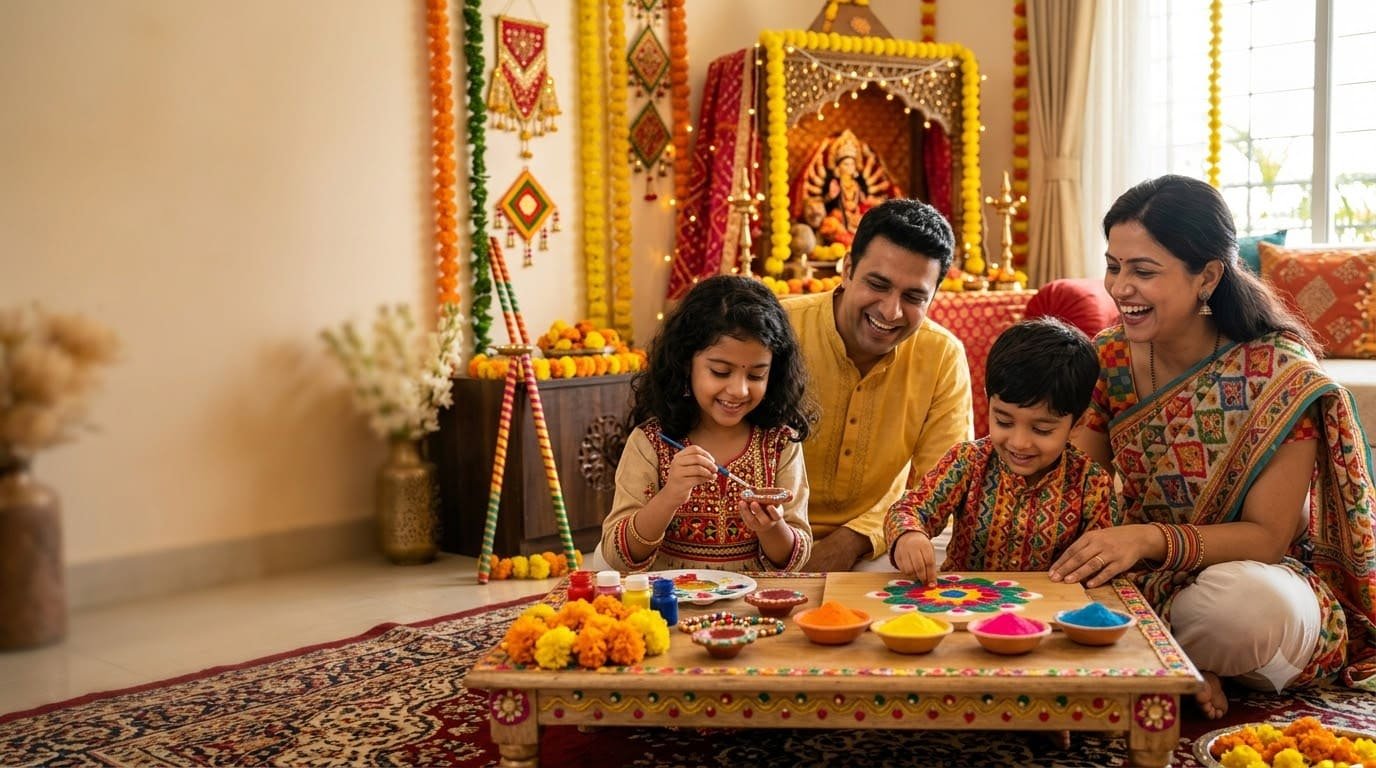
Navratri activities for kids India is something every Indian parent starts planning in the week before the festival — trying to find ways to make the nine nights meaningful, memorable, and genuinely engaging for children who are at the age where a story about Goddess Durga needs to compete with a screen for attention.
My mother never competed with a screen. She had a different strategy — she made us part of the preparation. We helped arrange the garba circle in the courtyard. We were responsible for one small diya each evening. We helped make the prasad on certain days. And on the seventh day, we did the Kanjak puja ourselves — my sister and I were the little girls who sat and received the tilak and the prasad.
We didn’t just watch Navratri. We were in it.
That is the principle behind this guide — Navratri activities for kids that make children participants rather than spectators, and that connect them to the meaning of the festival alongside the fun.
Why Navratri Is Perfect for Kids
Navratri — nine nights celebrating the nine forms of Goddess Durga — is one of the most child-friendly festivals in the Indian calendar. It has:
Music and dance: Garba and dandiya are participatory, joyful, and physically engaging. Children love them naturally.
Colour and decoration: The nine colours of Navratri, the diyas, the flowers, the rangoli — all of these are visually stimulating and invite creative participation.
Story: The story of Durga defeating Mahishasura, of good overcoming evil, is a powerful narrative that children understand and respond to.
Community: Navratri is celebrated collectively — with neighbours, family, the wider community. Children experience genuine belonging through participation.
Ritual: The predictable ritual structure of Navratri — specific activities on specific days, the same sequence year after year — provides children with a sense of security and cultural rootedness.
10 Best Navratri Activities for Kids India
Activity 1 — Nine Colours of Navratri Dress-Up Chart
Each of the nine days of Navratri has a traditional colour associated with it. Creating a visual chart of these colours and planning outfits for each day is a wonderful pre-Navratri activity that builds anticipation and teaches the significance of each colour.
The nine colours (2026): Day 1 — Yellow (Pratipada) Day 2 — Green (Dwitiya) Day 3 — Grey (Tritiya) Day 4 — Orange (Chaturthi) Day 5 — White (Panchami) Day 6 — Red (Shashthi) Day 7 — Royal Blue (Saptami) Day 8 — Pink (Ashtami) Day 9 — Purple (Navami)
How to do it: Draw or print a simple nine-square chart. Let the child colour each square in the day’s colour. Discuss what to wear each day. Let the child have input in choosing their outfit for each day.
Age: 3+ (colouring the chart), 2+ (choosing clothes with help) Learning: Colours, sequencing, festival significance, planning
Activity 2 — Diya Decoration
Decorating clay diyas is one of the most satisfying hands-on Navratri activities for children — and clay diyas are available at markets across India for minimal cost.
Materials: Plain clay diyas (mitti ke diye) — available at local markets Poster colours or acrylic paints Glitter glue (optional) Paintbrushes
How to do it: Let the child paint the diya however they like. Abstract designs, dots, stripes — whatever they choose. Allow to dry completely. That evening, light the diya together.
The connection: The child painted this diya. The child lights this diya. It is theirs in a way that a bought-decorated diya is not.
Age: 2+ (with parent guidance on holding the diya and brush), 4+ (more independent) Safety: Adult supervision when painting. Adult manages the lighting.
Activity 3 — Rangoli Making for Kids
Traditional rangoli requires precision that young children don’t yet have — but child-friendly rangoli adaptations are fully accessible and deeply satisfying.
Simple rangoli for young children:
Rice/dal rangoli: Draw a simple outline in chalk on the floor. Fill sections with coloured rice (rice dyed with food colour) or different types of dry dal. No fine motor precision needed — just filling.
Flower petal rangoli: Collect flowers from the garden or buy loose petals at the market. Arrange them in concentric circles or simple patterns on the floor.
Chalk rangoli: On the outdoor floor or courtyard — draw freely with coloured chalk. No permanence, no pressure.
Stamped rangoli: Cut a potato in half. Carve a simple shape (circle, leaf, triangle). Dip in poster paint. Stamp a repeating pattern.
Age: 2+ (supervised, simple versions), 5+ (more complex patterns)
Activity 4 — Goddess Durga Storytelling and Craft
The story of Navratri is one of the most powerful mythological narratives in Hindu tradition — and children respond to it powerfully when it is told well.
Telling the story: Navratri celebrates the nine nights during which Goddess Durga fought and ultimately defeated the demon Mahishasura. Each night she took a different form — nine forms, nine nights, nine colours. On the tenth day (Dussehra), good triumphed over evil.
Tell this story in simple, age-appropriate language. Emphasise the central message — that goodness is stronger than evil, even when evil seems very powerful.
The paper Durga craft: Draw a simple outline of Goddess Durga on thick paper or card. Let the child colour her outfit in the Navratri colours. Decorate with stickers, glitter, or sequins available at any craft shop. Display at the home puja or on the child’s bedroom wall.
Age: 3+ for the story (simplified), 4+ for colouring the craft
Activity 5 — Learn Basic Garba Steps
Garba is the dance of Navratri — circular, joyful, and deeply rooted in the festival’s spirit of devotion and community. Teaching children even the most basic garba steps is one of the most direct ways to connect them to the festival.
Basic garba for children:
Three-step garba: Three steps to the right, clap — three steps to the left, clap. Repeat in a circle. This is the simplest form and children as young as 3 can learn it.
Circle garba: Children hold hands in a circle and step around together. Simple, inclusive, joyful.
Music: Any traditional garba song works — “Jai Jai Ambe Jai Jagdambe” or any of the well-known garba songs familiar to your family and region.
Practice: 10-15 minutes of garba practice before the evening celebrations builds skill and excitement. By the actual evening event, the child is confident and engaged rather than watching from the sidelines.
Age: 3+ (simple steps), 5+ (more complex patterns)
Activity 6 — Dandiya Craft — Make Your Own Sticks
Dandiya raas — the stick dance — is one of the most exciting parts of Navratri for children. Making simple dandiya sticks before the festival creates anticipation and gives the child their own personalised sticks.
Materials: Wooden dowels (30-40 cm) — available at hardware stores Ribbon — multiple colours Glitter tape or coloured tape Foam stickers
How to make: Wrap the wooden dowel in coloured ribbon — wind it tightly from one end to the other. Secure with tape at each end. Decorate with glitter tape, foam stickers, or additional ribbon. Add a ribbon tassel at one end.
The result: A dandiya stick that is entirely the child’s creation — which makes the dancing that much more meaningful.
Age: 5+ (with parent help for wrapping), 8+ (more independently)
Activity 7 — Navratri Prasad Cooking Together
Involving children in making the Navratri prasad — the offering that becomes the sweet — is one of the most meaningful festival activities available. It connects food, ritual, and family in a way that stays with children.
Child-friendly Navratri prasad recipes:
Panjiri: Whole wheat flour roasted in ghee with dry fruits and sugar. Child can: measure the ingredients, add the dry fruits, stir (supervised for the roasting).
Sabudana khichdi: Soaked sabudana (sago) cooked with peanuts. Child can: wash the sabudana, add the peanuts, stir gently.
Fruit chaat: No cooking required. Child can wash, peel (banana, soft fruits), and assemble.
The ritual connection: The child helped make this. The child offers it. The child receives it as prasad. This sequence — making, offering, receiving — is a complete ritual experience that even young children can participate in meaningfully.
Age: 3+ (supervised, simple tasks), 5+ (more involved preparation)
Activity 8 — Kanjak/Kanya Puja Participation
On Ashtami or Navami — the eighth or ninth day — many Hindu families perform Kanjak puja, inviting young girls (typically under 10) to represent the nine forms of Durga and offering them a meal of puri, kala chana, and halwa.
For the child who participates as Kanjak: Explain what the puja means — “You represent the Goddess today. When people do your tilak and give you prasad, they are honouring Shakti through you.” This is a profound experience for a child — being seen as sacred, being treated with reverence, receiving a special meal.
For the child who helps prepare: Involve children in making the puri and halwa. In laying out the meal. In welcoming the Kanjak girls when they arrive.
Age: Any age — with age-appropriate explanation
Activity 9 — Navratri Photo Journal
A simple daily photo journal of the nine days creates a memory that can be revisited year after year — and involves the child in documenting their own festival experience.
How to do it: Each day of Navratri, take one photo of the child in their day’s colour. One photo of the day’s activity. One photo of the diya being lit.
At the end of nine days — print the photos (phone printing services are available at most photo shops in India) or create a digital album. Review them together. “Look — this was Day 1 in yellow. This was the diya you painted. This was when you danced garba.”
The value: Children who see photographic evidence of their own participation in the festival develop a stronger sense of cultural identity and belonging.
Age: All ages — parents do the photographing for younger children
Activity 10 — Navratri Dussehra Story and Craft
Navratri culminates in Dussehra — the celebration of Ram’s victory over Ravana, and the symbol of good over evil. Connecting the Navratri celebration to the Dussehra story gives children the complete narrative arc.
The Dussehra story simplified: Ram needed the blessing of Goddess Durga before his battle with Ravana. He prayed to her for nine nights — these are the nine nights of Navratri. On the tenth day, with her blessing, good triumphed. This is Dussehra.
Simple Ravana craft: Draw a simple ten-headed figure on paper. Let the child decorate each head differently — the ten heads represent ten forms of evil (ego, anger, greed, attachment, pride, jealousy, selfishness, injustice, cruelty, fear). Name each one simply. “This head is anger. This one is greed.”
On Dussehra day — symbolically burn the paper Ravana (safely, with a candle, with adult supervision) or tear it up — as an act of releasing what you want to overcome.
Age: 4+ for the story, 5+ for the craft and discussion
Navratri Safety for Young Children
Diyas: Never leave lit diyas near children unsupervised. Keep diyas on stable surfaces. Loose clothing near diyas is a fire risk — tie back any flowing fabric.
Dandiya: Wooden dandiya sticks can injure if swung too hard near other children. Foam-covered or soft dandiya sticks are available and more appropriate for young children. Supervise dandiya play.
Crowd events: Large garba events at night are not appropriate for very young babies and toddlers — the noise, crowd, and late hours are too much. Enjoy garba at home or in smaller family settings for young children.
Fasting: Children should not fast during Navratri. The traditional Navratri fasting diet (kuttu atta, sabudana, fruits) can be enjoyed as festival food without strict fasting. Never restrict a growing child’s nutrition for religious fasting.
FAQ — Navratri Activities for Kids India
Q: My 18-month-old is too young for most of these activities. What can she do?
At 18 months: diya decoration with finger paints (supervised), clapping along to garba music, being part of the circle even if not dancing, tasting the prasad, wearing the day’s colour. Presence and inclusion matters more than active participation at this age.
Q: My child has no interest in the religious aspects. How do I engage them?
Start with what interests them — the music, the dancing, the colours, the food. The meaning attaches itself to the experience over time. A child who dances garba every Navratri will gradually absorb the significance through the repeated, embodied experience. Don’t force the meaning — create the experience.
Q: How do I explain Navratri to a 3-year-old?
“For nine nights, we celebrate a very powerful Goddess called Durga. She is strong and brave and she protects everyone. We dance and light diyas and wear colours to celebrate her. Tonight we’re wearing yellow — yellow is today’s special colour.” Simple, sensory, and true.
Q: We’re not very religious. Can we still celebrate Navratri with our kids?
Absolutely. Navratri can be celebrated at whatever level of religious observance feels authentic to your family — from deeply devotional to cultural and social. The dancing, the colours, the community gathering, the special foods, the stories — all of these have value regardless of the level of religious practice.
More from MumPappaHub — Read These Next:
- Ganesh Chaturthi Craft Ideas for Kids
- Independence Day Craft Ideas for Kids
- Sensory Play for Toddlers India
- Cognitive Development Activities India
- Screen Time Guidelines Children India
- Positive Parenting Tips India
- Sibling Rivalry Tips India
- Baby Development Month by Month
- Child Development Milestones
- Toddler Behavior Problems India
- Discipline Toddler India
- Baby Fever Guide India
About This Article
Written by the MumPappaHub Research Team — including a researcher whose mother never competed with a screen during Navratri. She made her children part of the preparation instead. They arranged the garba circle. They lit their own diya. They helped with the prasad. On Saptami, they were the Kanjak girls who sat and received the tilak. They didn’t watch Navratri. They were in it.
This content is for general informational and cultural purposes. Festival craft activities should be done with appropriate adult supervision. Diya safety guidelines apply.
MumPappaHub — Real talk for real Indian parents. mumpappahub.com

1 Comment