
Medical Disclaimer: This article is for informational purposes only. Weight charts are guides, not verdicts. Always consult your paediatrician for your baby’s specific growth assessment.
Every baby weight chart India parents get handed at the paediatrician’s clinic looks the same — neat little curves that say nothing about the real panic of watching your own baby fall below them.
The first time my daughter’s weight dropped below the chart average, I cried in the parking lot of the clinic.
Not inside. I held it together inside. But sitting in the car afterwards, reading the number on the little booklet they gave me, comparing it to the chart on the back page — she was below the 50th percentile and I had immediately decided this meant something was wrong.
The paediatrician had said nothing was wrong. She was following her own curve, steadily, which is all that matters. I heard that. I just didn’t believe it yet.
If you’re reading this at any hour because you’ve been comparing your baby’s weight to a chart and feeling worried — this guide is for you. The actual numbers, the actual WHO and IAP standards, what percentiles really mean, and the questions that matter much more than whether your baby hits a specific number on a specific date.
The Complete Indian Baby Weight Chart — Boys & Girls
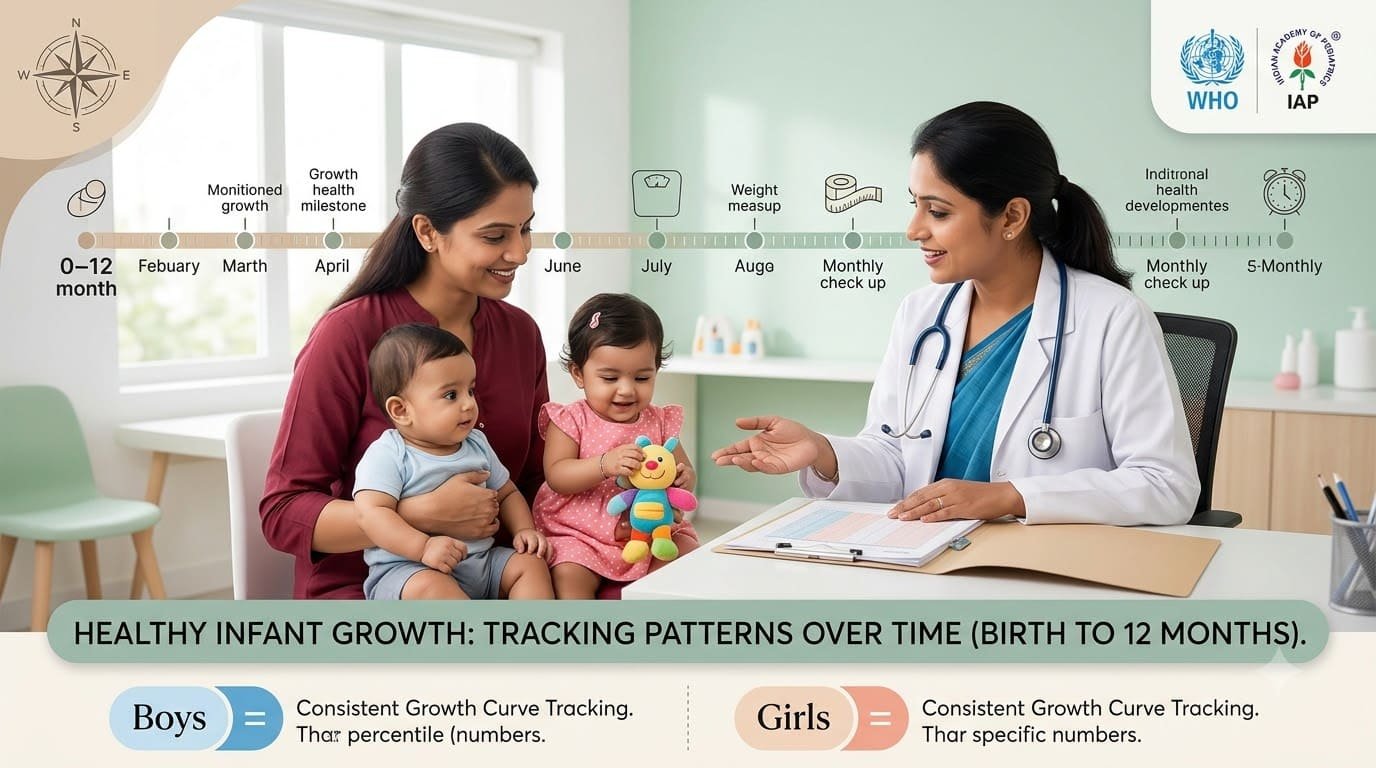
These figures are based on WHO Child Growth Standards — the same standards recommended by the Indian Academy of Pediatrics for all Indian children under five years of age.
Baby Boy Weight Chart India (0–12 Months)
| Age | Low (3rd %) | Average (50th %) | High (97th %) |
|---|---|---|---|
| Birth | 2.5 kg | 3.3 kg | 4.3 kg |
| 1 Month | 3.2 kg | 4.5 kg | 5.7 kg |
| 2 Months | 4.0 kg | 5.6 kg | 7.1 kg |
| 3 Months | 4.7 kg | 6.4 kg | 8.0 kg |
| 4 Months | 5.3 kg | 7.0 kg | 8.7 kg |
| 5 Months | 5.7 kg | 7.5 kg | 9.3 kg |
| 6 Months | 6.1 kg | 7.9 kg | 9.7 kg |
| 7 Months | 6.4 kg | 8.3 kg | 10.2 kg |
| 8 Months | 6.7 kg | 8.6 kg | 10.5 kg |
| 9 Months | 7.0 kg | 8.9 kg | 10.9 kg |
| 10 Months | 7.2 kg | 9.2 kg | 11.2 kg |
| 11 Months | 7.4 kg | 9.4 kg | 11.5 kg |
| 12 Months | 7.8 kg | 9.7 kg | 11.8 kg |
Baby Girl Weight Chart India (0–12 Months)
| Age | Low (3rd %) | Average (50th %) | High (97th %) |
|---|---|---|---|
| Birth | 2.4 kg | 3.2 kg | 4.2 kg |
| 1 Month | 3.0 kg | 4.2 kg | 5.5 kg |
| 2 Months | 3.8 kg | 5.1 kg | 6.6 kg |
| 3 Months | 4.4 kg | 5.8 kg | 7.5 kg |
| 4 Months | 4.8 kg | 6.4 kg | 8.1 kg |
| 5 Months | 5.3 kg | 6.9 kg | 8.8 kg |
| 6 Months | 5.7 kg | 7.3 kg | 9.3 kg |
| 7 Months | 6.0 kg | 7.6 kg | 9.6 kg |
| 8 Months | 6.3 kg | 7.9 kg | 10.0 kg |
| 9 Months | 6.5 kg | 8.2 kg | 10.4 kg |
| 10 Months | 6.7 kg | 8.5 kg | 10.7 kg |
| 11 Months | 7.0 kg | 8.7 kg | 11.0 kg |
| 12 Months | 7.1 kg | 9.0 kg | 11.3 kg |
The Complete Indian Baby Height Chart — Boys & Girls
Baby Boy Height Chart India (0–12 Months)
| Age | Low (3rd %) | Average (50th %) | High (97th %) |
|---|---|---|---|
| Birth | 46.1 cm | 49.9 cm | 53.7 cm |
| 1 Month | 50.8 cm | 54.7 cm | 58.6 cm |
| 2 Months | 54.4 cm | 58.4 cm | 62.4 cm |
| 3 Months | 57.3 cm | 61.4 cm | 65.5 cm |
| 4 Months | 59.7 cm | 63.9 cm | 68.0 cm |
| 5 Months | 61.7 cm | 65.9 cm | 70.1 cm |
| 6 Months | 63.3 cm | 67.6 cm | 71.9 cm |
| 7 Months | 64.8 cm | 69.2 cm | 73.5 cm |
| 8 Months | 66.2 cm | 70.6 cm | 75.0 cm |
| 9 Months | 67.5 cm | 72.0 cm | 76.5 cm |
| 10 Months | 68.7 cm | 73.3 cm | 77.9 cm |
| 11 Months | 69.9 cm | 74.5 cm | 79.2 cm |
| 12 Months | 71.0 cm | 75.7 cm | 80.5 cm |
Baby Girl Height Chart India (0–12 Months)
| Age | Low (3rd %) | Average (50th %) | High (97th %) |
|---|---|---|---|
| Birth | 45.4 cm | 49.1 cm | 52.9 cm |
| 1 Month | 49.8 cm | 53.7 cm | 57.6 cm |
| 2 Months | 53.0 cm | 57.1 cm | 61.1 cm |
| 3 Months | 55.6 cm | 59.8 cm | 64.0 cm |
| 4 Months | 57.8 cm | 62.1 cm | 66.4 cm |
| 5 Months | 59.6 cm | 64.0 cm | 68.5 cm |
| 6 Months | 61.2 cm | 65.7 cm | 70.3 cm |
| 7 Months | 62.7 cm | 67.3 cm | 71.9 cm |
| 8 Months | 64.0 cm | 68.7 cm | 73.5 cm |
| 9 Months | 65.3 cm | 70.1 cm | 75.0 cm |
| 10 Months | 66.5 cm | 71.5 cm | 76.4 cm |
| 11 Months | 67.7 cm | 72.8 cm | 77.8 cm |
| 12 Months | 68.9 cm | 74.0 cm | 79.2 cm |
What Percentiles Actually Mean — Not What Most Parents Think
The 50th percentile does not mean “normal” and anything below it does not mean “underweight.” This misunderstanding causes a significant amount of unnecessary anxiety.
Percentile means: out of 100 babies of the same age, how many weigh less than your baby.
A baby at the 25th percentile weighs more than 25 out of 100 babies their age. This is completely healthy.
A baby at the 10th percentile has weighed around the 10th percentile since birth — and if they’re still tracking along that same line at every visit, they’re growing perfectly normally. They’re just built lean.
A baby who was at the 50th percentile at 3 months and is now at the 25th percentile at 6 months — that’s the pattern that gets a paediatrician’s attention. Not the number, but the drop across lines.
The question your paediatrician is really asking: Is this baby following their own consistent growth curve? Not: is this baby at the 50th percentile?
Month-by-Month Weight Gain — What’s Normal
Understanding how much weight babies gain each month helps you know what to watch for.
First 3 months — fastest growth of their life
Babies typically gain 150–200 grams per week in the first three months. This is the fastest rate of weight gain they will ever experience. A baby who was 3 kg at birth is usually around 5.5–6 kg by three months.
This rapid gain requires frequent feeding — every 2–3 hours for breastfed babies is completely normal in the first weeks. A baby who isn’t gaining adequately in this period needs a feeding assessment promptly.
Months 3–6 — steady growth
Weight gain slows slightly to approximately 100–150 grams per week. Still significant, but the dramatic early pace moderates.
Months 6–12 — slower but steady
After six months, weight gain slows further to approximately 60–80 grams per week or roughly 500–600 grams per month. By the time solid foods are established, breast milk or formula remains the primary source of nutrition and calories.
Indian context: The introduction of solids at six months often prompts some temporary weight plateaus as the baby’s digestive system adjusts. This is normal and usually self-corrects within two to four weeks.
Why Your Baby’s Weight Might Be Different From the Chart — And Why That’s Fine
Genetics matters enormously
A baby born to two small parents will likely be a small baby — and that’s exactly right for that baby. Charts are built from population averages. If your family runs lean, your baby running lean is not underweight — it’s expected.
Birth weight sets the trajectory
A baby born at 2.8 kg starts their growth journey from a different point than a baby born at 3.5 kg. Both follow their own curves. The chart accommodates both.
Breastfed vs formula-fed patterns differ
Breastfed babies often gain weight faster in the first three to four months and then slightly more slowly than formula-fed babies from four months onward. This is normal and not a sign that breastfeeding isn’t working. WHO growth charts were developed with breastfed babies as the reference standard — so they account for this.
Boys and girls grow differently
Boys are generally slightly heavier and taller than girls from birth. This is why there are separate charts — using the wrong chart gives misleading readings.
Premature babies use corrected age
A baby born six weeks early should be assessed against the milestones and weight ranges of a baby six weeks younger than their calendar age, until age two. Your paediatrician will guide this specifically.
For more on baby development stages alongside growth, our baby development month by month guide covers what’s happening developmentally at each stage.
How to Weigh Your Baby at Home Accurately
If you’re weighing at home between paediatrician visits — which is fine and often reassuring — here’s how to get an accurate reading:
Use the same scale every time. Different scales give different readings. Consistency matters more than precision.
Weigh at the same time of day. Before a feed is most consistent — babies weigh slightly more after feeding.
Naked or same clothes. Clothing adds weight. If you’re tracking over time, weigh with the same conditions each time.
Don’t weigh too frequently. Daily weighing of a healthy baby creates anxiety without adding useful information. Once a week is plenty for reassurance at home. Once a month is what the paediatrician’s schedule is designed around.
The number that matters: Not today’s weight in isolation. The difference between two readings, two to four weeks apart.
Signs Your Baby Is Getting Enough to Eat — More Reliable Than the Scale
The scale is one indicator of adequate nutrition. These signs are more reliable indicators that feeding is going well day-to-day:
Wet nappies: Six or more wet nappies per day after day four is the most reliable sign of adequate milk intake in a breastfed baby.
Regular stool output: Varies widely but should be present and appropriate for the feeding type.
Contentment after feeds: A baby who finishes a feed and seems settled has generally fed adequately. A baby who finishes every feed immediately distressed may not be getting enough.
Alert and engaged when awake: A baby who is active, curious, and engaged during their awake periods is not a malnourished baby.
Steady weight gain on their own curve: Not hitting the 50th percentile — following their own consistent line at whatever percentile that happens to be.
For guidance on feeding and ensuring adequate nutrition at each stage, our how to increase breast milk supply guide covers feeding concerns in the early months, and our starting baby solid foods guide covers the transition to solids at six months.
When to Actually Talk to Your Paediatrician About Weight
Most weight concerns in healthy babies resolve without intervention. These situations genuinely warrant a conversation:
Birth weight not regained by two weeks. Most babies lose 5–7% of birth weight in the first days and regain it by 10–14 days. If this hasn’t happened, feeding assessment is needed.
Consistent weight loss after the first two weeks — not a plateau, actual loss.
Baby dropping significantly across percentile lines — from the 50th to the 25th to the 10th over several visits. A single drop at one visit may be scale variation. A consistent downward trend needs assessment.
Baby below the 3rd percentile consistently — not a one-time reading, but consistent below-3rd-percentile weight.
Baby significantly above the 97th percentile — while a heavy baby is not usually a medical concern in infancy, it’s worth discussing feeding patterns.
Your baby seems unwell alongside poor weight gain — not feeding normally, unusually lethargic, fewer wet nappies. These together warrant prompt assessment.
Your instinct says something is wrong. This is always a valid reason to call.
Baby Weight FAQ — Questions Indian Parents Actually Ask
Q: My 3 month old baby weight is 5 kg. Is this normal?
For a baby boy at 3 months, 5 kg is between the 10th and 25th percentile — completely healthy for a baby who has been consistently around that range. For a baby girl, 5 kg at 3 months is around the 25th percentile — also completely healthy. What matters is whether this baby has been gaining steadily since birth and is alert, feeding, and producing adequate wet nappies.
Q: My 6 month baby weight is 6.5 kg. Is that too low?
For a baby girl at 6 months, 6.5 kg is between the 25th and 50th percentile — healthy and normal. For a baby boy, 6.5 kg at 6 months is just above the 10th percentile — still in the healthy range, though your paediatrician will want to confirm the baby is following a consistent curve rather than dropping from a higher percentile.
Q: My 9 month old baby weight is 7 kg. Should I be worried?
For a baby boy at 9 months, 7 kg is at the 3rd percentile — the lowest edge of the normal range. This is worth discussing with your paediatrician, particularly if the baby was higher on the chart at earlier visits. If the baby has consistently been around the 3rd to 5th percentile since birth and is otherwise well — feeding, developing normally, alert — it’s less concerning than a baby who has dropped from higher percentiles.
Q: My 12 month baby weight is 8 kg. Is that normal?
For a baby boy at 12 months, 8 kg is just above the 3rd percentile — technically within the normal range but at the lower end. For a baby girl, 8 kg at 12 months is between the 10th and 25th percentile — healthy and normal. Whether this is concerning depends entirely on the growth trajectory over the preceding months.
Q: My baby was born small (2.3 kg). How do I use this chart?
A baby born small may follow a curve below the 3rd percentile initially and catch up over the first year — or may continue on a lower curve. Premature babies should use corrected age. Your paediatrician will track your specific baby’s trajectory rather than applying the population chart directly.
Q: How much weight should my baby gain per month?
A: In the first three months: approximately 600–900 grams per month. Months 3–6: approximately 450–600 grams per month. Months 6–9: approximately 300–400 grams per month. Months 9–12: approximately 200–300 grams per month. These are averages — individual variation is normal.
Q: My breastfed baby is gaining weight slowly. Should I supplement with formula?
A: Not necessarily — breastfed babies do follow slightly different curves and may gain more slowly from four months onward than formula-fed babies. The question is whether the baby is following their own consistent curve and showing signs of adequate feeding (wet nappies, alertness, contentment). If weight gain is genuinely inadequate, a lactation consultant assessment of the feeding rather than immediate formula supplementation is usually the first step. For more support on milk supply, our how to increase breast milk supply guide covers evidence-based approaches.
Q: My baby is above the 97th percentile. Is this a problem?
A: In infancy, a baby above the 97th percentile who is breastfed and otherwise healthy is not usually a medical concern — breastfed babies self-regulate their intake and rarely become truly overweight in infancy. Your paediatrician will monitor the trajectory. Formula-fed babies above the 97th percentile may warrant a feeding volume review. Either way, it’s worth mentioning at the next visit.
The Only Number That Actually Matters
After all the charts, all the percentiles, all the month-by-month comparisons — the number that matters is not your baby’s weight today.
It’s your baby’s weight today compared to your baby’s weight four weeks ago.
Is there a consistent, steady increase along a line that is their own? That’s a healthy baby. Whether that line runs along the 10th percentile or the 90th percentile is almost entirely beside the point.
I spent weeks comparing my daughter to the 50th percentile line on that chart. She was never the 50th percentile baby. She was a healthy, thriving, steadily-growing baby on her own lower curve. She still is.
More from MumPappaHub — Read These Next:
- Baby Development Month by Month: Complete Guide
- Baby First Year Milestones
- How to Increase Breast Milk Supply
- Starting Baby on Solid Foods
- Superfoods for Toddler Brain Development
- Newborn Sleep Tips
- 4 Month Sleep Regression
- Baby Fever Guide
- Newborn Care Tips
- Toddler Language Development
- Sensory Play for Toddlers India
- Baby Blues vs Postpartum Depression
About This Article
Written by the MumPappaHub editorial team — including a mother who cried in a clinic parking lot because her daughter was below the 50th percentile. The daughter is healthy. The paediatrician was right. The chart was just a chart.
Weight data sourced from WHO Child Growth Standards 2006 — the reference standard recommended by the Indian Academy of Pediatrics for all Indian children under five. This content is for general informational purposes only and does not constitute medical advice. Always consult your paediatrician with specific concerns about your baby’s growth.
MumPappaHub — Real talk for real parents. mumpappahub.com

18 Comments