
Medical Disclaimer: This article is for informational purposes only. If you have concerns about your baby’s speech development, always consult a paediatrician or certified speech-language pathologist.
When do babies start talking India — this question hit me hardest at a family lunch when my son was fourteen months old and hadn’t said a clear word yet.
My niece, three weeks younger, was already saying “mama,” “dada,” and something that her parents confidently translated as “biscuit.” My son was communicating exclusively through pointing, grunting, and an extremely expressive eyebrow raise that left no doubt about his opinions.
Every aunt at that table had a theory. He’s too comfortable. He doesn’t need to talk because you understand his gestures. You’re speaking too many languages at home. You should play him more Bollywood songs. Give him more ghee.
His paediatrician, when I described all of this, was unimpressed by the aunts. “He’s pointing, understanding instructions, making eye contact, and babbling. His receptive language is excellent. He’ll talk when he’s ready.” He said his first clear word at sixteen months. By twenty months, he wouldn’t stop.
This guide covers when do babies start talking India — the real milestones, what multilingual Indian families need to know, the difference between a late talker and a speech delay, and exactly when to stop waiting and seek assessment.
When Do Babies Start Talking India — The Real Timeline
When do babies start talking India follows the same developmental trajectory as anywhere else — because the human brain develops according to biology, not geography. What differs is the linguistic environment, and India’s multilingual context creates specific considerations that most guides don’t address.
According to the World Health Organization’s early childhood development guidelines, speech and language development follows a predictable sequence from birth through the toddler years — with significant individual variation in timing within a normal range. The Indian Academy of Pediatrics emphasises that in multilingual households, total vocabulary across all languages — not vocabulary in any single language — is the relevant measure for developmental assessment.
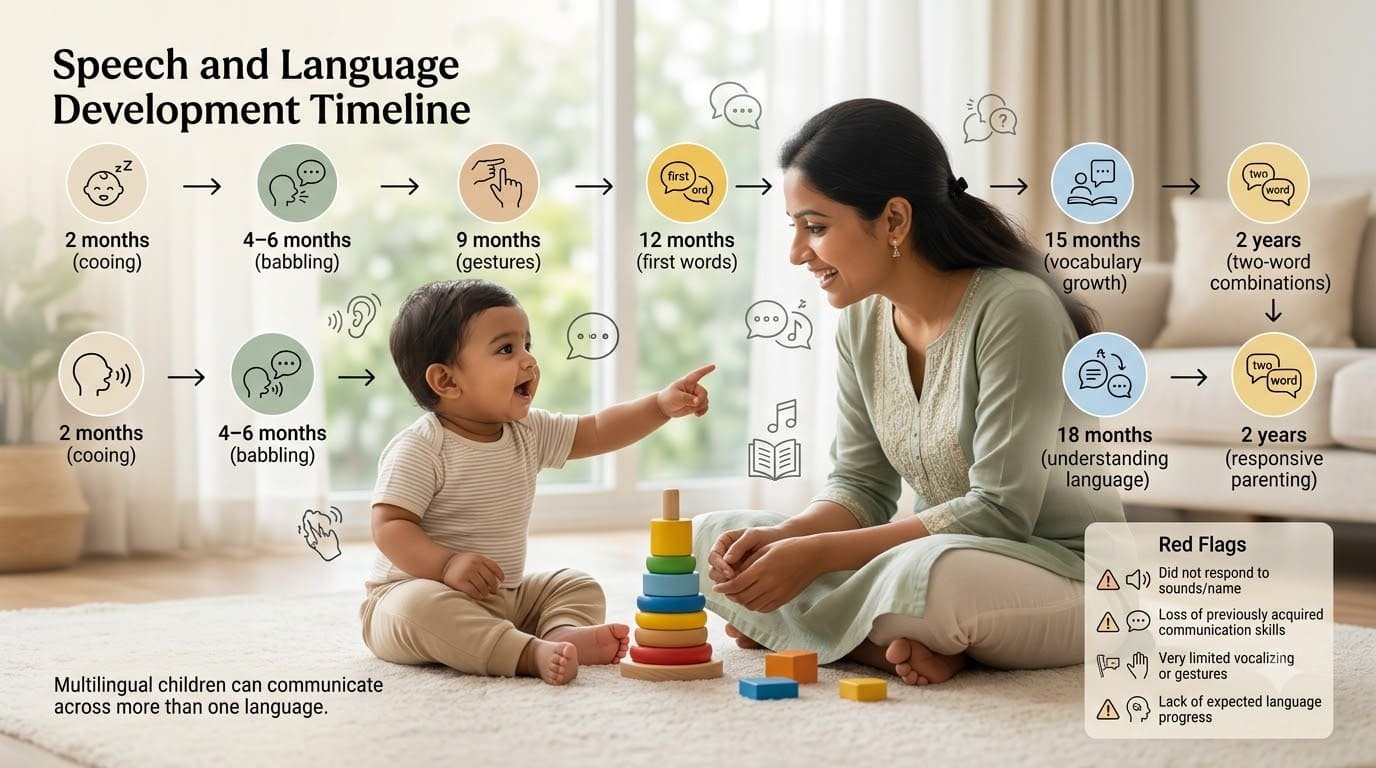
Complete Speech Milestone Chart — 0 to 3 Years
| Age | What Most Babies Do |
|---|---|
| Birth–3 months | Cries, coos, reacts to sounds, startles at loud noises |
| 3–6 months | Babbles with vowel sounds — “aah,” “ooh.” Laughs. Responds to familiar voices |
| 6–9 months | Consonant babbling — “ba-ba,” “da-da,” “ma-ma.” Responds to own name |
| 9–12 months | Proto-words — consistent sounds for specific things. Points. Waves. Understands “no” |
| 12 months | First clear word in many babies — anywhere from 10–14 months is typical |
| 12–18 months | 5–20 words. Points to show interest. Follows simple instructions |
| 18–24 months | 20–50+ words. Two-word combinations begin — “more milk,” “dada go” |
| 24 months | 50+ words. Two-word phrases consistently. Strangers understand ~50% of speech |
| 24–36 months | Three-word sentences. Questions begin. Vocabulary expands rapidly |
| 36 months | 200–1000 words. Simple conversations. Strangers understand ~75% |
The most important thing about this chart: These are ranges, not deadlines. A baby who says their first word at ten months and one who says it at fifteen months are both developing within the normal range.
Month-by-Month Speech Development — What to Actually Watch For
Birth to 3 Months
Long before your baby says anything, they are already communicating — and already learning language.
Crying is communication. A newborn who cries differently for hunger versus discomfort is already using sound to convey meaning. Cooing — those soft, gentle vowel sounds that begin around six to eight weeks — is the first deliberate sound production. Your baby is discovering what their mouth and throat can do.
What you’ll notice: Baby stills and listens when you speak. Turns toward familiar voices. Shows different facial expressions in response to yours.
What to do: Talk constantly. Narrate everything. Your voice is the primary input for the language-learning system that is running at full capacity right now.
3–6 Months
Cooing gives way to more varied sounds. Laughter appears — soft at first, then more robust. Your baby is having conversations with you even if neither of you is using words.
The turn-taking pattern of these early “conversations” — you say something, baby responds with sounds, you respond, baby responds again — is not just adorable. It is directly building the conversational structure that underlies all future language.
Indian context: Babies in multilingual households are hearing multiple phonetic systems simultaneously at this stage. Their brains are building the phonological maps for all the languages around them. This is not confusing — it is an extraordinary cognitive feat that is happening effortlessly.
6–9 Months
Babbling begins in earnest — consonant-vowel combinations that sound like words without meaning yet. “Ba-ba-ba.” “Ma-ma-ma.” “Da-da-da.”
Parents in every language get excited when they hear “mama” and “dada” in this babbling — but at this stage, these sounds are not yet used with meaning. The baby is practising sounds, not naming people. The meaningful use comes later.
By seven to eight months: responds consistently to own name. By eight to nine months: understands “no” and a few common words.
9–12 Months
This is the bridge between babbling and words. Proto-words appear — consistent sounds used for specific things that aren’t yet the conventional words of any language. A baby who says “buh” every time they see a ball and nowhere else has a proto-word for ball. This counts as early word use.
Pointing appears — typically around nine to ten months. Pointing to share experience (look at that!) rather than just to get things is one of the most significant pre-speech milestones. It demonstrates understanding that another person has a mind that can share your attention.
12 Months — The First Word
The first clear word typically arrives somewhere between ten and fourteen months, with twelve months being the commonly cited average. But the range of normal is wide — some babies say first words at nine months, some not until sixteen months. Both can be entirely normal.
What counts as a “word”: Any sound used consistently to mean a specific thing — in any language. “Amma” for mother in Tamil. “Dada” for father in Hindi. “Buh” for ball. “Nah” for no. All of these count.
What doesn’t count: Random babbling sounds that the baby uses for everything.
Indian context: In multilingual families, the first word may be in any of the languages the baby hears. Count words across all languages. A baby who says “aam” (mango in Hindi) is just as much on track as one who says “mango.” Don’t count only English words.
12–18 Months — Vocabulary Building
Vocabulary grows from the first word to approximately 10–20 words by fifteen months and 20–50 words by eighteen months — though individual variation is significant.
Understanding continues to significantly outpace expression at this age. A baby who understands “go get your shoes,” “where’s papa,” and “let’s eat” but is only saying five words has excellent receptive language — and that is what matters most for predicting later development.
The vocabulary explosion: Many babies experience a “word explosion” somewhere between fifteen and twenty-two months — a period of rapid vocabulary acquisition where new words appear daily. This happens when the vocabulary reaches a threshold — typically around fifty words — and the child makes the connection that everything has a name.
18–24 Months — Two Words Together
By eighteen months, most children have ten or more words. The milestone to watch between eighteen and twenty-four months is the emergence of two-word combinations — “more milk,” “mama go,” “big dog.”
Two-word combinations are the beginning of grammar — the understanding that words can be combined according to rules to create meaning. This is a significant cognitive milestone.
If two-word combinations haven’t appeared by twenty-four months — this warrants a paediatrician assessment and possibly a speech-language pathologist referral. Not because something is definitely wrong, but because early assessment and intervention, if needed, produces significantly better outcomes than waiting.
24–36 Months — Sentences and Conversations
Three-word sentences appear. Then four. Questions multiply — “where dada?” “what is?” “why?” The “why” phase, which arrives around age three and continues indefinitely, is a sign of normal cognitive and language development, even when it is exhausting.
By thirty-six months, most children can have simple conversations, tell simple stories, and be understood by unfamiliar adults most of the time.
When Do Babies Start Talking India — The Multilingual Question
This is the question that is most specific to the Indian context and most frequently answered incorrectly.
Myth: Speaking multiple languages at home delays speech development.
Fact: Bilingual and multilingual children develop language on the same timeline as monolingual children. Their total vocabulary — across all languages — matches monolingual norms. They may have smaller vocabularies in each individual language but their combined linguistic competence is equivalent.
Research on bilingual development is consistent on this point. Exposing children to multiple languages from birth does not cause speech delay. It produces bilingual children — which is an asset, not a deficit.
What multilingual families need to do differently:
Count words across all languages. A child who knows twenty words in Hindi and fifteen in Tamil and ten in English has forty-five words — not ten.
Don’t interpret smaller English vocabulary as a delay. Compare total vocabulary to norms, not English-only vocabulary to English-only norms.
Code-switching — using words from multiple languages in a single sentence — is normal and not a sign of confusion. Adults do it too. It reflects a brain with access to multiple lexicons.
Each family member speaking their own language consistently is a sound approach. Children handle multiple language sources well, particularly when each source is consistent.
For more on bilingual language development specifically, our toddler language development guide covers the multilingual context in detail.
What Helps Babies Talk — The Evidence
Talk more than you think you need to. The quantity of words a child hears in the first three years is one of the strongest predictors of vocabulary size and language development. Narrate everything — what you’re cooking, what you’re seeing on the way to the market, what you’re thinking about the weather. It feels odd. Do it anyway.
Respond to every sound. When your baby babbles, respond as if they’ve said something interesting. This isn’t pretending — they have said something. They’re practising language. Your response validates the communication and encourages more.
Follow their attention. When the baby is looking at something, talk about that thing — not what you want to talk about. Shared attention is the most powerful language-learning context.
Read together — as conversation. Pause on pictures. Point and name. Let the baby turn pages, point at things, respond. A single page that generates five minutes of interaction is more valuable than a book read cover-to-cover without stopping.
Expand, don’t correct. When the baby says “doggy run” — don’t correct the grammar. Expand: “Yes, the doggy is running fast!” You’ve provided correct grammar without making the child feel wrong.
Limit passive screen time. Passive screen time replaces responsive human interaction — the thing that actually drives language development. It doesn’t teach language to babies under eighteen months. For guidance on screen time and its effects on language, our screen-free childhood challenge guide has detailed information.
Red Flags — When to Stop Waiting and Seek Assessment
When do babies start talking India sometimes gets delayed by waiting too long when assessment would help. Early intervention produces significantly better outcomes than late intervention — regardless of the cause of delay.
Seek assessment if:
| Age | Red Flag |
|---|---|
| 6 months | Not babbling. Not responding to sounds. Not making eye contact |
| 9 months | Not responding to own name consistently |
| 12 months | No babbling. No pointing or waving. No words in any language |
| 15 months | Fewer than 5 words across all languages |
| 18 months | Fewer than 10 words. Not pointing to show things |
| 24 months | Fewer than 50 words total. No two-word combinations |
| 36 months | Not using sentences. Less than 75% understood by familiar adults |
| Any age | Lost a skill previously present — always assess promptly |
The last row is the most important. Skill regression — a baby who was babbling and has stopped, a toddler who had words and is losing them — always warrants prompt assessment, not watchful waiting.
Late Talker vs Speech Delay — The Difference Matters
Late talker: A child with fewer words than expected for their age but who has good understanding, good social connection, and is making progress — just more slowly. Many late talkers catch up without intervention by age three.
Speech delay with underlying cause: A child whose delay is associated with hearing loss, autism spectrum disorder, oral-motor difficulties, or other conditions. These children benefit significantly from early assessment and targeted intervention.
The distinction cannot be made by parents waiting at home. It requires assessment by a speech-language pathologist who can evaluate both the quantity and quality of communication, not just word count.
When to seek assessment rather than waiting:
If your child is below the milestones above. If understanding seems limited as well as expression. If social connection seems reduced. If any skill has been lost. If your instinct says something is not right — always a valid reason to call.
Getting Help in India — Speech Therapy
Speech-language pathologists (SLPs) are available in most Indian cities. Look for an SLP with experience in:
- Paediatric speech and language development
- Multilingual/bilingual development (important in the Indian context)
- Early intervention
Government hospitals in India with paediatric departments often have speech therapy services. Private paediatric speech therapists are available in most cities. Your paediatrician can refer.
FAQ — When Do Babies Start Talking India
Q: My 15-month-old has no words. Should I be worried?
Yes — at fifteen months, most children have at least a few words. No words at fifteen months across all languages warrants a call to your paediatrician. They will assess hearing, overall development, and likely refer to a speech-language pathologist. Early assessment is always better than waiting, regardless of what relatives say about Einstein.
Q: We speak Hindi at home and English at school. Will this confuse my baby?
No — bilingualism does not confuse babies. It produces bilingual children. Count words across both languages when assessing vocabulary. A child with twenty Hindi words and fifteen English words has thirty-five words — not fifteen. Code-switching between languages is normal and not a sign of confusion.
Q: My son is 18 months and only points — no words. Is this okay?
Pointing is positive — it indicates good social communication and understanding that communication can direct another person’s attention. But no words at eighteen months across any language is below typical development. Mention this to your paediatrician rather than waiting for it to resolve on its own.
Q: My daughter said “mama” at 8 months. Does this mean she’s advanced?
“Mama” at eight months is most likely babbling — the sound without the meaning. True first words — sounds used consistently to refer to specific things — typically appear from ten to fourteen months. Babbling that happens to sound like “mama” earlier than this is a normal part of speech development, not an early word.
Q: Everyone says “Einstein didn’t talk until he was three.” Should I wait?
The Einstein anecdote is frequently used to reassure parents about late talkers. But Einstein’s developmental history is not a reliable basis for clinical decisions. If your child is not talking within the normal range, assessment is warranted — not because something is definitely wrong, but because early assessment and intervention, if needed, produces better outcomes than late intervention. Waiting is not neutral.
Q: My toddler talks at home but goes silent outside. Is this a delay?
This could be shyness, social reticence, or selective mutism — a condition where a child speaks in some contexts but not others. Mild social reticence at one to two years is common. Consistently not speaking at all in any context outside the home past age four is worth mentioning to your paediatrician. In the meantime, don’t force speech in uncomfortable situations — pressure tends to worsen this pattern.
More from MumPappaHub — Read These Next:
- Toddler Language Development: Complete Guide
- Child Development Milestones
- Baby Development Month by Month
- Signs of Intelligent Baby India
- Sensory Play for Toddlers India
- Screen-Free Childhood Challenge
- Baby First Year Milestones
- Indian Baby Weight Chart 0-12 Months
- Baby Teething: Signs & Home Remedies
- Newborn Sleep Tips
- Baby Fever Guide
- Baby Vaccination Schedule India 2026
About This Article
Written by the MumPappaHub editorial team — including a mother whose son communicated exclusively through pointing and eyebrow raises until sixteen months while every aunt at family lunch offered theories. His paediatrician was right. He talked when he was ready. He now doesn’t stop.
Reviewed for accuracy against WHO early childhood development guidelines and Indian Academy of Pediatrics speech and language guidance. This content is for general informational purposes and does not constitute medical advice. Always consult a paediatrician or speech-language pathologist with specific concerns about your child’s speech development.
MumPappaHub — Real talk for real parents. mumpappahub.com
