
Medical Disclaimer: This article is for informational purposes only. Eye infections in babies under 3 months require same-day paediatrician assessment. Never put any drops in a baby’s eyes without medical advice.
Baby eye infection India is something Indian parents encounter frequently — the sticky, crusty eyes that appear overnight, the discharge that seals the eyelid shut by morning, and the immediate family debate about whether it is serious or whether it will resolve with home remedies.
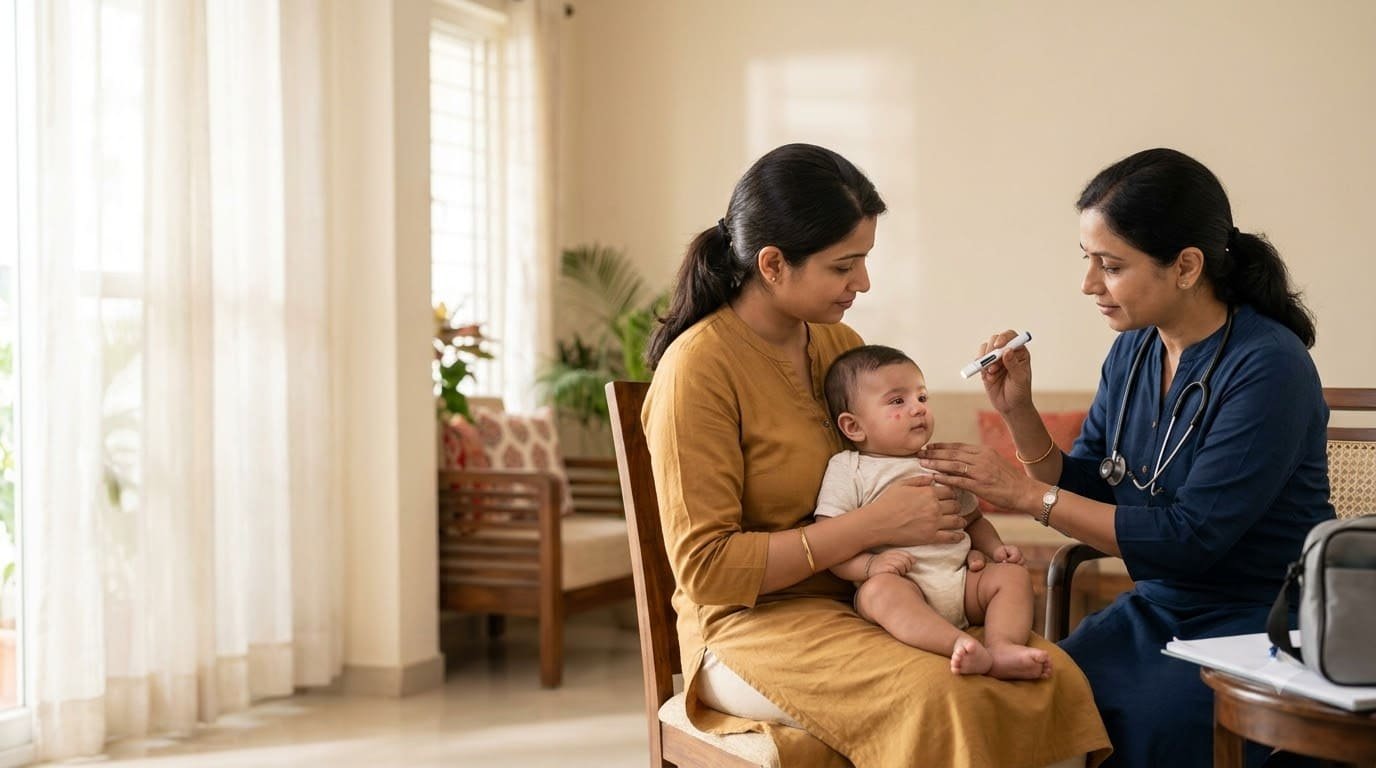
My son had his first eye discharge at six weeks. I woke up to find his right eye completely sealed with yellow crust. My mother-in-law said it was normal — “aankhon ka meel” — and to wipe it with breast milk. My paediatrician, when I called, asked one question: “Does the white of his eye look red or pink?” No, I said — the eye itself looked clear. “Then wipe gently with clean cotton and warm water. Come in if it doesn’t improve in 3 days or if the eye becomes red.”
It resolved in two days. But knowing which situations require the paediatrician immediately and which can be managed at home is exactly what Indian parents need.
Types of Baby Eye Infection India
Baby eye infection India covers several distinct conditions — and the treatment differs significantly depending on the cause.
According to the World Health Organization’s guidelines on newborn eye care, eye infections are among the most common conditions in newborns and young infants globally. The Indian Academy of Pediatrics provides specific guidance on managing conjunctivitis and nasolacrimal duct obstruction — the two most common causes of eye discharge in Indian babies.
1. Nasolacrimal Duct Obstruction (Blocked Tear Duct)
The most common cause of eye discharge in Indian babies in the first year — NOT an infection, but frequently mistaken for one.
What it is: The nasolacrimal duct (the channel draining tears from the eye into the nose) is narrow or blocked at birth. Tears cannot drain normally, pool in the eye, and become a medium for bacterial growth — causing discharge without true infection.
How to identify:
- Discharge is usually yellowish, crusty — worse in the morning
- The white of the eye (sclera) is WHITE — not red or pink
- The eyelid itself is not swollen
- The baby is not distressed by the eye
- Usually in one eye (sometimes both)
Timeline: Usually resolves spontaneously by 6-12 months as the duct matures.
2. Bacterial Conjunctivitis (Pink Eye)
A true infection of the conjunctiva (the membrane covering the white of the eye and inner eyelids).
How to identify:
- Yellow or green discharge — often significant
- The white of the eye is PINK or RED
- Eyelids may be swollen
- Baby rubs the eye
- Often starts in one eye, spreads to the other
3. Viral Conjunctivitis
Usually part of a cold — the same virus affecting the nose also affects the eyes.
How to identify:
- Watery rather than thick discharge
- Pink/red eye
- Accompanied by runny nose, mild fever
- Both eyes usually affected
4. Chemical/Irritant Conjunctivitis
In Indian context — kajal (surma/kohl) applied to babies’ eyes is a significant cause of eye irritation and secondary infection. Traditional practice of applying kajal to newborn eyes is not recommended by the IAP and can introduce lead, bacteria, and particulates into the eye.
5. Neonatal Conjunctivitis (Ophthalmia Neonatorum)
A serious bacterial infection in newborns (under 28 days) — can be caused by gonorrhoea or chlamydia transmitted during birth. Requires urgent antibiotic treatment. Any significant eye discharge in a baby under 4 weeks is a medical emergency.
10 Best Safe Treatments and Management Tips
1. Warm Water Cleaning — For All Types
Regardless of the cause, gentle cleaning of eye discharge with warm, clean water and soft cotton is the foundation of home management.
How to do it correctly: Boil water and allow to cool to comfortably warm. Dip a clean cotton ball or soft clean cloth. Wipe from the inner corner of the eye (near the nose) outward — never inward. Use a fresh cotton ball for each wipe. Use a separate cotton ball for each eye — never cross-contaminate.
Frequency: Before every feed in the morning when discharge is worst. 3-4 times daily for active discharge.
Why direction matters: Wiping inward pushes discharge toward the tear duct — the opposite of what you want. Always wipe outward.
2. Tear Duct Massage — For Blocked Tear Duct
For nasolacrimal duct obstruction (blocked tear duct) — gentle massage of the tear duct area helps open the blocked duct and is the primary treatment.
How to do it: Wash hands thoroughly. Place one fingertip at the inner corner of the eye — where the small pink bump (lacrimal punctum) is visible. Apply gentle downward pressure and stroke firmly down toward the nose. 6-10 strokes. Do 3-4 times daily.
The mechanism: The downward pressure creates hydrostatic pressure in the nasolacrimal duct that gradually opens the membrane blocking it.
When to expect results: Consistent massage 3-4 times daily typically resolves blocked tear duct within 2-6 months. If not resolved by 12 months, a minor procedure (probing of the duct) may be needed — discuss with your paediatrician.
3. Breast Milk — Traditional Indian Remedy With Evidence
The Indian practice of using breast milk to clean infected baby eyes has scientific basis — breast milk contains immunoglobulins (IgA), lactoferrin, and lysozyme that have antimicrobial properties.
How to use: Express a few drops of breast milk. Drop directly into the corner of the eye. Allow to flow across the eye naturally. Wipe gently outward with clean cotton.
Evidence: Studies have shown breast milk is as effective as antibiotic eye drops for mild conjunctivitis and blocked tear duct discharge in some cases. It is safe, readily available, and free.
Limitation: For significant bacterial conjunctivitis with red eye and heavy discharge — breast milk may help but is not a substitute for prescribed antibiotic drops when the paediatrician recommends them.
4. Prescribed Antibiotic Eye Drops — Use Correctly
When the paediatrician prescribes antibiotic eye drops (typically chloramphenicol or tobramycin) — using them correctly is essential.
How to instil eye drops in a baby: Lay the baby on their back. Gently pull down the lower eyelid to create a small pocket. Hold the dropper above (not touching) the eye. Place one drop in the lower eyelid pocket. Release the eyelid. The baby will blink — the drop spreads across the eye.
Common errors: Dropping into the corner rather than the lower eyelid pocket — ineffective. Touching the dropper to the eye — risks contaminating the bottle. Stopping drops as soon as the eye looks better — always complete the full course.
Duration: Typically 5-7 days. Complete the full course even if the eye looks clear.
5. Kajal/Kohl Removal — Critical for Indian Babies
For Indian babies whose eyes are regularly treated with kajal (kohl/surma) — removing this practice is a medical recommendation.
Why kajal is harmful for babies: Traditional kajal often contains lead compounds — a neurotoxin. It introduces bacteria directly into the eye. The particles cause physical irritation. It can block the tear ducts.
IAP recommendation: Do not apply kajal, surma, or kohl to any baby’s eyes. This practice is associated with lead poisoning, eye infections, and tear duct problems.
The cultural conversation: “The paediatrician has specifically said no kajal for babies — it can cause eye infections and is harmful to the baby’s health.” Medical authority is the most effective approach in Indian households.
6. Hygiene — Preventing Spread
Conjunctivitis is highly contagious — bacterial and viral conjunctivitis spreads easily within the household.
Prevent spread: Wash hands before and after touching the baby’s eyes. Use separate towels and pillowcases for the baby. Do not share eye drops between eyes or between family members. Change pillowcase daily during active infection. Keep older siblings from rubbing their eyes after touching the baby.
7. Saline Drops — Safe Flushing
Commercially available saline (salt water) eye drops — available at any pharmacy without prescription — are safe for babies and help flush discharge from the eye.
Use: 1-2 drops in each eye before cleaning. Softens crusting and makes wiping easier.
Available brands: Simply Saline, Systane, or any preservative-free saline eye drops. Check “preservative-free” — preservatives can irritate baby eyes.
8. Cool or Warm Compress — For Swollen Eyelids
For swollen, puffy eyelids associated with bacterial conjunctivitis:
Cool compress: A clean cloth wrung out in cool water, placed gently over the closed eye for 5 minutes. Reduces swelling and discomfort.
Warm compress: A clean cloth wrung out in warm (not hot) water. Helps loosen crusting and is soothing.
Use whichever the baby tolerates better — both are safe.
9. Feeding Frequency — Immune Support
Breast milk provides immunological support — maintaining breastfeeding frequency during eye infection supports the baby’s own immune response. This is not a direct eye treatment but contributes to overall recovery.
10. Monitor for Spread — Know When Home Management Ends
Home management is appropriate for mild discharge with white (not pink/red) sclera in a baby over 1 month. Monitoring for the signs that end home management and require paediatrician assessment is the most important part of home management.
Daily check: Look at the white of the eye. Is it staying white? Or getting pink/red?
If the white stays white: Continue home management. If the white becomes pink or red: Paediatrician same day.
Warning Signs — When to See the Paediatrician
Same Day — Don’t Wait:
🚨 Any eye discharge in a baby under 4 weeks (28 days) — always urgent 🚨 White of the eye is pink or red (conjunctivitis) 🚨 Significant eyelid swelling — particularly if hot and red (may indicate periorbital cellulitis — serious) 🚨 Baby is clearly in pain — rubbing eye persistently, crying when eye is touched 🚨 Heavy yellow or green discharge that returns immediately after cleaning 🚨 No improvement after 3 days of home management 🚨 Discharge in both eyes that appeared suddenly 🚨 Any discharge after kajal application
Emergency — Go Immediately:
🚨 Eyelid swollen shut and hot and red and baby has fever — periorbital or orbital cellulitis, serious infection 🚨 Baby cannot open eye at all even after cleaning 🚨 Pus visible inside the eye 🚨 Eye appears to bulge or look different
Common Indian Mistakes to Avoid
❌ Kajal to “treat” eye infection: Worsens it — adds bacteria and irritants.
❌ Breast milk as the only treatment for red-eye conjunctivitis: Breast milk helps mild discharge. For bacterial conjunctivitis with red eye — antibiotic drops are needed.
❌ Using someone else’s leftover eye drops: Never use previously prescribed drops from an older sibling or family member. Eye drops from a previous prescription may be contaminated, expired, or the wrong antibiotic.
❌ Stopping antibiotic drops early: Stopping when the eye looks better leaves infection incompletely treated. Complete the full prescribed course.
❌ Applying home remedies without cleaning first: Rose water, breast milk, and other remedies all work better on a clean eye. Always clean first.
FAQ — Baby Eye Infection India
Q: My 2-month-old has yellow eye crust every morning but the eye itself looks clear. What is this?
This is most likely blocked tear duct (nasolacrimal duct obstruction) — the most common cause of eye discharge in babies under 12 months. The key sign is that the white of the eye stays white (not pink or red). Clean with warm water and cotton, start tear duct massage 3-4 times daily, and the problem typically resolves by 6-12 months. See your paediatrician to confirm the diagnosis.
Q: Can I use rose water to clean my baby’s eyes?
Commercial rose water often contains preservatives and fragrance that can irritate baby eyes. Plain cooled boiled water or preservative-free saline is safer. Traditional Indian home-made rose water (distilled from fresh petals, no additives) is gentler — but still not as reliably sterile as boiled water.
Q: My baby’s conjunctivitis has spread to me. What should I do?
Viral and bacterial conjunctivitis are highly contagious. Wash your hands very frequently. Avoid touching your eyes. See your own doctor — you may need antibiotic drops too. Continue treating your baby as prescribed and maintain strict hygiene to prevent further spread within the household.
Q: My paediatrician prescribed eye drops but the baby cries so much during instillation. What can I do?
Swaddle the baby first — this prevents the arms flailing and knocking the dropper. Have a second adult hold the baby’s head gently. Work quickly — one drop, then comfort immediately. The crying at instillation is normal and does not mean the drop is harmful. Some babies accept drops better when nearly asleep.
Q: Can blocked tear duct cause permanent eye damage?
In the vast majority of cases — no. Nasolacrimal duct obstruction resolves spontaneously by 12 months in 90%+ of cases with simple massage. If it does not resolve by 12 months, a minor in-office probing procedure (done under brief sedation) opens the duct with excellent results. Permanent eye damage from simple blocked tear duct is rare.
More from MumPappaHub — Read These Next:
- Baby Eye Care India
- Conjunctivitis in Children India
- Baby Fever Guide India
- Baby Rash Types India
- Newborn Care Tips
- Baby Cold and Cough Home Remedies
- Baby Cold Season Change India
- Baby Vaccination Schedule India 2026
- Baby Development Month by Month
- Baby Eczema Treatment India
- Indian Baby Weight Chart
- Baby Constipation Remedies India
About This Article
Written by the MumPappaHub Research Team — including a researcher whose son had his first eye discharge at six weeks — right eye sealed shut with yellow crust. Mother-in-law said aankhon ka meel, apply breast milk. Paediatrician asked one question: is the white of the eye red? No. “Wipe with warm water. Come in if it’s red or doesn’t improve in 3 days.” It resolved in two days. This guide is that one question — and everything around it.
Reviewed for accuracy against WHO newborn eye care guidelines and Indian Academy of Pediatrics guidance on conjunctivitis and nasolacrimal duct obstruction in Indian infants. This content is for general informational purposes only. Always consult your paediatrician for eye infections in babies under 3 months or when the white of the eye is red.
MumPappaHub — Real talk for real Indian parents. mumpappahub.com
