
Medical Disclaimer: This article is for informational purposes only. For babies under 3 months with any fever, or any baby with breathing difficulty, go to your paediatrician immediately. Never give over-the-counter cough and cold medicines to babies under 2 years without a doctor’s prescription.
Baby cold season change India is one of the most common parenting challenges of September and October — the weeks when monsoon ends, temperatures start to drop at night while days stay warm, and babies suddenly develop runny noses, mild coughs, and low-grade fevers that seem to come from nowhere.
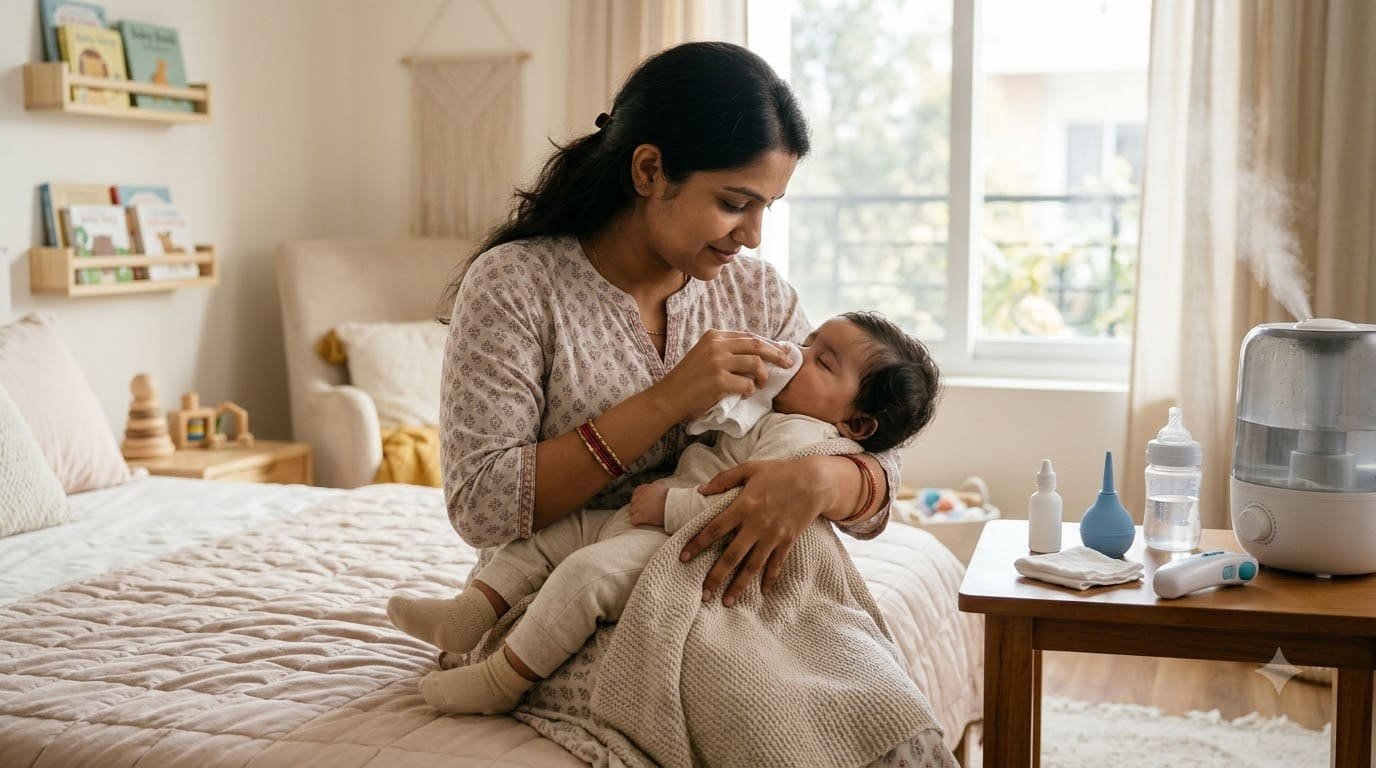
My daughter got her first season-change cold at four months. Monday she was fine. Tuesday she woke up with a blocked nose that made feeding difficult — she couldn’t suck and breathe at the same time, which meant feeds were short and frequent and distressed. By Wednesday she had a mild fever and a rattling cough that scared me considerably more than it should have.
I called the paediatrician at 7 AM. He asked four questions: Was she feeding? Was she making tears when she cried? Was she breathing normally without effort? Was the fever below 38°C? Four yes answers. He said: “Saline drops, steam, skin-to-skin, continue feeding. Come in if breathing changes or fever goes above 38°C.” She was better in five days.
This guide is those four questions, those remedies, and everything else Indian parents need to know about managing baby colds during India’s season change.
Why Season Change Causes Baby Colds in India
Baby cold season change India is not a coincidence — there are specific reasons why babies get sick at this time of year.
According to the World Health Organization’s guidelines on acute respiratory infections in children, respiratory infections are the leading cause of illness in children under five globally. The Indian Academy of Pediatrics specifically identifies the monsoon-to-winter transition (September-November) and the winter-to-summer transition (February-April) as peak periods for respiratory illness in Indian children.
Why season change triggers illness:
Temperature fluctuations: The September-October transition brings warm days and cool nights. Babies struggle to regulate body temperature in rapidly changing conditions, and the nasal passages — which are the first line of defence against respiratory viruses — function less effectively when exposed to temperature swings.
Humidity changes: As monsoon ends, indoor humidity drops. Dry air irritates and dries nasal passages, reducing the effectiveness of the mucus that traps viruses before they can cause infection.
Viral circulation: Certain viruses — particularly rhinovirus (the most common cold virus) and Respiratory Syncytial Virus (RSV) — peak specifically during the September-January period in India. RSV in particular causes infections that look like a cold in older children and adults but can become serious lower respiratory illness in babies under 12 months.
Indoor crowding: As temperatures drop, windows close and families spend more time indoors — increasing the transmission of respiratory viruses between household members.
Immune system: Babies’ immune systems are still developing. A season change that an adult barely notices is enough to tip a baby’s immune response into a full cold.
Cold vs RSV — Important Distinction for Indian Parents
Most season-change illness in babies is a simple viral cold — caused by rhinovirus or similar viruses. It resolves on its own in 5-10 days.
RSV (Respiratory Syncytial Virus) is different — and Indian parents need to know the distinction:
Simple cold:
- Runny nose, mild cough, low-grade fever
- Baby feeds reasonably well
- No breathing difficulty
- Improves within 5-10 days
RSV/Bronchiolitis — see paediatrician:
- Starts like a cold but gets worse after day 2-3
- Wheezing — a high-pitched whistling sound when breathing out
- Rapid breathing — more than 60 breaths per minute in babies under 2 months
- Chest retractions — the chest sinks inward between the ribs with each breath
- Feeding significantly reduced — less than half normal feeds
- Baby appears to be working hard to breathe
RSV season in India runs from August to January — overlapping directly with the monsoon-to-winter transition. If your baby’s cold is getting worse rather than better after day 3, particularly with any breathing changes — see your paediatrician the same day.
10 Best Safe Home Remedies — Baby Cold Season Change India
1. Saline Nasal Drops — The Single Most Useful Intervention
A blocked nose is the most distressing cold symptom for babies — particularly for young babies who haven’t yet learned to breathe through their mouth. Saline nasal drops are the safest, most effective intervention for a blocked baby nose.
How to use: Lay the baby on their back. Tilt the head slightly back. Put 1-2 drops of saline into each nostril. Wait 30 seconds. Use a nasal aspirator (nasal bulb syringe) to gently suction out the loosened mucus. Repeat before each feed and before sleep.
What saline to use: Ready-made isotonic saline nasal drops — Nasivion Saline, Otrivin Baby, or simply make your own: 1/4 teaspoon of salt in 250ml of cooled boiled water.
What not to use: Medicated nasal drops (oxymetazoline, xylometazoline) without a doctor’s prescription. These decongestant drops are not safe for babies.
Age: From birth
2. Steam — Traditional and Evidence-Supported
Steam helps loosen mucus and relieve nasal congestion. For babies, direct steam is not safe — but indirect steam is effective and widely used in Indian households.
Safe methods:
Bathroom steam: Run a hot shower in the bathroom. Bring the baby into the steamy bathroom — not into the shower — and sit with them for 10-15 minutes. The steam loosens congestion naturally.
Warm water vapour: A bowl of hot water in the room — out of reach of the baby — creates gentle ambient humidity. Never position the baby’s face directly over hot water.
Humidifier: A cool-mist humidifier in the baby’s room adds moisture to the dry air of the season change and prevents mucus from drying and hardening in the nasal passages.
Indian winters: As temperatures drop from October onward, indoor air becomes significantly drier. A humidifier in the baby’s room is one of the most useful seasonal investments for Indian parents.
3. Continue Breastfeeding — More Frequently
For breastfed babies, continuing and increasing feeding frequency during a cold is one of the most important things a parent can do.
Why: Breast milk contains specific antibodies against the viruses causing the current illness — because the mother is exposed to the same environment as the baby and produces tailored immune factors. Breast milk also provides hydration and nutrition essential for recovery.
The feeding challenge: A blocked nose makes nursing difficult — the baby can’t breathe and suck simultaneously. This leads to shorter, more frequent feeds. This is appropriate — feed more often, for shorter periods.
After saline drops: Clearing the nose with saline drops before feeding makes nursing significantly easier for both mother and baby.
4. Ajwain and Garlic Potli — Traditional Indian Remedy
The traditional Indian remedy of an ajwain-garlic potli (a small cloth pouch of roasted ajwain and garlic) placed near the baby — not on the baby — is widely used in Indian households and has mild decongestant properties.
How to make: Dry roast 2 tablespoons of ajwain (carom seeds) and 2-3 cloves of garlic together in a pan for 3-4 minutes until fragrant. Tie in a small muslin cloth. Let it cool to warm — not hot.
How to use: Place the warm potli near the baby’s chest — not on the skin. Or tie it loosely near the baby’s pillow or cot. The volatile compounds in ajwain and garlic are mild natural decongestants.
Safety: Never place directly on baby’s skin — can cause burns or irritation. Never put inside the baby’s clothing. Keep it warm, not hot.
5. Tulsi and Ginger Decoction — For Babies Over 6 Months
Tulsi (holy basil) and ginger have documented antibacterial and antiviral properties and have been used in Indian Ayurvedic medicine for respiratory illness for centuries.
For babies 6+ months: Boil 4-5 fresh tulsi leaves and a small piece of fresh ginger in 1 cup of water for 5 minutes. Strain. Cool to room temperature. Give 1-2 teaspoons 2-3 times daily.
For toddlers 1+ year: Add a small amount of honey (only after 12 months — never before). A few drops of lemon juice. Give as a warm decoction.
Note: Tulsi and ginger decoction is supportive — it relieves symptoms. It is not a replacement for medical treatment if the baby is not improving.
6. Coconut Oil and Ajwain Chest Rub — Gentle Massage
Warm coconut oil with a tiny amount of ajwain — used as a very gentle chest massage — is a traditional Indian practice that provides warmth and mild decongestant benefit.
How to make: Warm 1 tablespoon of virgin coconut oil. Add a tiny pinch of ajwain powder. Stir. Test on your inner wrist — should be comfortably warm, not hot.
How to use: Gently massage a thin layer onto the baby’s chest and upper back. Use very light pressure. Keep the baby warm after application.
What to avoid: Commercial vaporubs (Vicks and similar) are not recommended for babies under 2 years — the menthol can cause breathing difficulty in young babies. The IAP specifically advises against Vicks and similar products in babies under 2.
7. Elevation — For Nighttime Comfort
A slightly elevated head position can significantly improve a congested baby’s sleep — gravity helps mucus drain rather than pooling in the nasal passages.
Safe elevation for babies: For babies under 12 months — never use a pillow (suffocation risk). Instead, elevate the head of the mattress slightly by placing a folded towel under one end of the mattress. The baby lies on a flat surface that is very slightly angled.
For toddlers: A firm, flat pillow is appropriate. A slightly elevated head position helps significantly with nighttime congestion.
8. Warm Fluids — For Babies Over 6 Months
After 6 months, warm clear fluids help thin mucus, soothe irritated throats, and maintain hydration during illness.
Appropriate options:
- Warm water — offered from a cup or spoon
- Diluted warm dal water (without salt for babies under 12 months)
- Warm rice water (maad) — thin and easily digestible
- Warm coconut water — natural electrolytes
For toddlers:
- Warm jeera water (cumin water)
- Warm adrak-tulsi chai (very diluted, no sugar, mild)
- Clear vegetable soups — well strained
What not to give: Cold fluids — these constrict blood vessels and worsen congestion. Packaged fruit juices — sugar reduces immune function. Honey before 12 months — botulism risk.
9. Skin-to-Skin and Warmth
Skin-to-skin contact — the baby held against the parent’s chest — provides warmth, comfort, and documented immune benefit. Oxytocin released during skin contact has measurable effects on immune function.
For a sick, uncomfortable baby — being held, particularly skin-to-skin, is genuinely therapeutic, not just comforting.
Season change warmth: As temperatures drop at night from October onward, ensure the baby is adequately warm for sleep — an extra cotton layer, or light blanket for older babies in a safe sleep arrangement. A baby who is cold at night will not sleep well and will recover more slowly from illness.
10. Rest and Routine — Let the Body Heal
The immune response to a viral infection requires significant energy. A baby who is fighting a cold needs:
More sleep: Babies typically sleep more when ill — this is appropriate and should be allowed. Don’t try to keep a sick baby awake to “maintain schedule.”
Reduced stimulation: Outings, visitors, and excitement should be minimised during active illness. A sick baby recovers faster with quiet, warmth, and parental closeness than with maintained activity schedules.
Normal feeds: Appetite typically reduces during illness. Continue offering feeds — breast milk for breastfed babies, formula for formula-fed, and age-appropriate foods for babies on solids. Don’t force feeding but keep offering.
When to Go to the Paediatrician
Go Same Day:
Any baby under 3 months with fever (even 37.5°C)
Breathing that looks laboured — chest retracting, rapid breathing, nostrils flaring
Wheezing — high-pitched sound when breathing out
Baby refuses all feeds — not just reduced feeding but complete refusal
Fever above 38°C in a baby under 6 months
Fever lasting more than 3 days at any age
Baby seems significantly worse after the first 3 days rather than better
Blue or pale lips or face — emergency, go immediately
Manage at Home (with monitoring):
Mild runny nose, mild cough, no fever
Low-grade fever under 38°C in a baby over 3 months who is feeding
Baby making tears when crying
Baby urinating regularly
Symptoms improving or stable after day 3
FAQ — Baby Cold Season Change India
Q: Can I give my 8-month-old Vicks/Vapour Rub?
No — the IAP specifically advises against Vicks and similar menthol-containing products in babies under 2 years. Menthol can cause breathing difficulty in young babies. Use the ajwain-coconut oil chest massage described in this guide instead, which is safe and has a mild decongestant effect.
Q: My baby’s nose is so blocked she can’t feed. What do I do?
Saline drops before every feed — 1-2 drops each side, wait 30 seconds, suction gently with a nasal bulb syringe. Then feed immediately. This dramatically improves feeding for congested babies. Shorter, more frequent feeds are appropriate during a cold — don’t try to maintain normal feed length.
Q: My 5-month-old has had a cold for 7 days. When should I worry?
A cold that is not improving after 7 days, or that gets significantly worse after day 3-4, needs paediatrician assessment. A bacterial secondary infection — ear infection, chest infection — can follow a viral cold and requires treatment. At 5 months, any breathing changes or significant reduction in feeding warrants same-day assessment regardless of duration.
Q: Is it normal for babies to get sick with every season change?
Yes — entirely normal. Young babies are encountering viruses for the first time, and each exposure builds immune memory. It is normal for babies in the first 1-2 years to have 6-10 respiratory illnesses per year. Frequent illnesses in this age group build the immune system. If illnesses are very frequent, very severe, or the baby is not recovering normally — discuss with your paediatrician.
Q: My mother-in-law says to give the baby diluted haldi milk (golden milk). Is this safe?
Haldi (turmeric) has documented anti-inflammatory and antimicrobial properties. Diluted haldi milk — very small amount of turmeric in warm milk — is appropriate for babies over 12 months as a traditional supportive remedy. For babies under 12 months, give very diluted haldi in warm water (no milk as a drink for babies under 12 months). Use only a tiny pinch — haldi in large quantities can irritate a baby’s stomach.
More from MumPappaHub — Read These Next:
- Baby Fever Guide India
- Baby Cold and Cough Home Remedies
- Baby Vaccination Schedule India 2026
- Monsoon Baby Care Tips
- Baby Diarrhea Treatment India
- Newborn Care Tips
- How to Increase Breast Milk Supply
- Baby Development Month by Month
- Dengue and Malaria in Children
- Newborn Sleep Tips
- Indian Baby Weight Chart
- Baby Eczema Treatment India
About This Article
Written by the MumPappaHub Research Team — including a researcher whose four-month-old daughter got her first season-change cold on a Tuesday, couldn’t feed properly because of a blocked nose, and scared her mother considerably more than necessary. The paediatrician asked four questions, gave four instructions. She was better in five days. This is that guide.
Reviewed for accuracy against WHO guidelines on acute respiratory infections in children and Indian Academy of Pediatrics recommendations on cold and respiratory illness management in Indian infants. This content is for general informational purposes only and does not constitute medical advice. Always consult your paediatrician if you have concerns about your baby’s breathing or feeding during illness.
MumPappaHub — Real talk for real Indian parents. mumpappahub.com

1 Comment