
Medical Disclaimer: This article is for informational purposes only and reviewed against WHO and IAP screen time guidelines. Always consult your paediatrician for guidance specific to your child.
Screen time guidelines children India is a topic I avoided researching for the first eight months of my daughter’s life — because I already knew the answer was going to make me feel guilty.
My mother-in-law would hand her the phone to watch rhymes the moment she got fussy. My husband would prop her in front of the TV during morning news. I was often on my own phone while feeding her. By the time she was seven months old, she would reach for any phone within arm’s length with the focused determination of someone who knew exactly what they wanted.
When I finally read the IAP guidelines properly, I felt that specific dread of learning something you can’t unlearn. Then I read more carefully — about what actually matters, what the real risks are, and what genuinely helps. It was more nuanced than I expected, and more actionable than I feared.
This guide covers screen time guidelines children India properly — the IAP and WHO numbers, what the research actually shows, what’s specifically relevant to Indian families, and ten practical rules that work in real households with real grandparents and real pressures.
Screen Time Guidelines Children India — What IAP and WHO Actually Say
Screen time guidelines children India are set by two authoritative bodies that Indian parents should know:
The World Health Organization’s guidelines on physical activity, sedentary behaviour, and sleep for children under 5 are clear and specific. The Indian Academy of Pediatrics has published its own screen time and digital wellness guidelines — the most India-specific guidance available — which largely align with WHO but add important India-specific context.
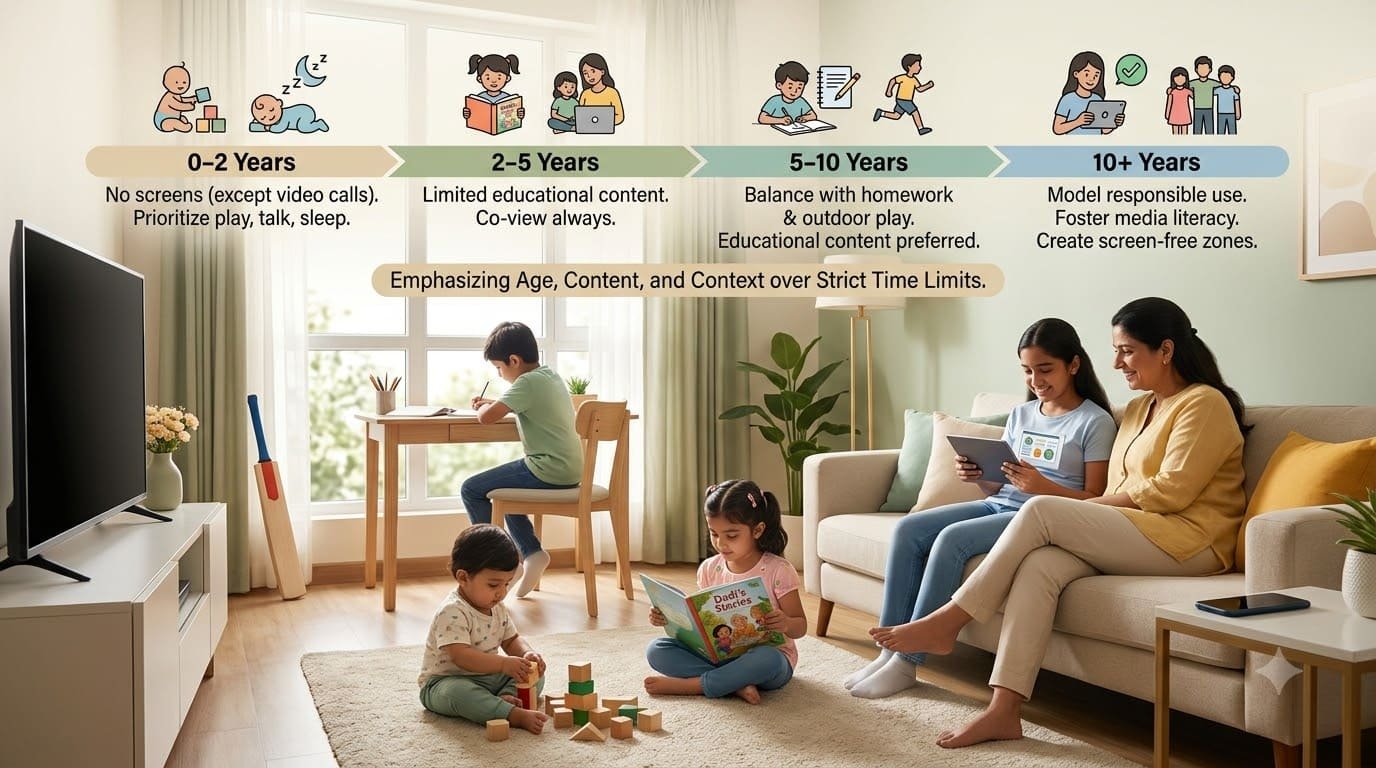
Official IAP + WHO Guidelines by Age:
| Age | Screen Time | Notes |
|---|---|---|
| Under 2 years | Zero screen time | Video calls with family only — exception |
| 2–5 years | Max 1 hour/day | High quality, co-viewed with parent |
| 5–10 years | Under 2 hours/day | Educational content prioritised |
| 10+ years | Mindful use | Quality over quantity |
The most important line in the IAP guidelines: The concern is not just quantity — it’s what screen time replaces. Screen time that replaces sleep, physical activity, face-to-face interaction, and outdoor play causes measurable harm. Screen time that supplements these activities causes far less.
The India Reality — How Much Screen Time Indian Children Actually Get
The gap between the guidelines and reality in India is significant.
A 2025 report from India’s National Commission for Protection of Child Rights found that 65% of Indian children aged 8–16 use the internet daily. A 2026 survey of Indian cities found school-age children averaging 2.7 hours of recreational screen time daily — with a jump on weekends. After the pandemic, many Indian families never returned to pre-2020 screen limits.
In the specific context of Indian households, several patterns are common that international guidelines don’t specifically address:
The grandparent phone pattern: Grandparent gives phone or switches on TV to keep baby quiet while parent is occupied. This is the most common screen exposure pattern in Indian joint families — and it’s worth addressing specifically rather than ignoring it.
Background television: Many Indian households keep the TV running throughout the day as background noise. Research shows background television — even when the child isn’t watching — suppresses parent-child conversation, reduces play quality, and affects sleep.
Mealtimes and screens: Giving the phone during mealtimes to keep the child seated and eating is extremely common in India. Research specifically shows this is counterproductive — it disrupts the child’s awareness of hunger and fullness, which affects self-regulation of eating long-term.
Evening use before sleep: Many children in India use screens in the hour before bedtime. Blue light from screens suppresses melatonin — the sleep hormone — making it harder to fall asleep and reducing sleep quality.
What Screen Time Actually Does — The Evidence
What excessive passive screen time causes:
Language delay: The most consistently documented effect of excessive screen time in children under 2. Passive screen time replaces the responsive human interaction that drives language development. The screen doesn’t respond to the child, adjust to what they’re looking at, or pause for their reaction. Every hour of passive screen time in the first two years is an hour of lost interaction.
Attention difficulties: Children who exceed 3 hours of daily recreational screen time show measurably higher rates of attention difficulties. The fast-paced, constantly shifting stimulation of most screen content creates expectations for rapid novelty that the slower pace of school and conversation can’t meet.
Sleep disruption: Blue light from screens suppresses melatonin. Stimulating content raises arousal. Both make falling asleep harder and reduce sleep quality. Sleep disruption in young children affects growth, immunity, and cognitive development.
Reduced physical activity: Time on screens replaces time moving. Indian children already have limited access to safe outdoor spaces in many urban environments — screen time compounds this problem.
Behavioural difficulties: Several Indian studies have found associations between heavy screen time and increased irritability, aggression, and reduced frustration tolerance — particularly when screens are removed.
What video calls DON’T cause:
Video calls with grandparents and family are explicitly excluded from the zero-screen-time recommendation for children under 2. They are interactive — the other person responds, adjusts, reacts. This is categorically different from passive viewing. Let your baby video call their grandparents without guilt.
10 Best Screen Time Guidelines Children India — Practical Rules
1. Zero Before 18 Months — The Non-Negotiable
Zero passive screen time before 18 months. Not “minimal.” Zero. This is the IAP and WHO recommendation and it is the one with the strongest evidence behind it.
The 0–18 month window is the period of most rapid brain development. Language acquisition, attachment, sensory integration, and neural architecture are all being built. The brain learns through responsive human interaction — not through screens.
What to do when family pressure comes: “Our paediatrician has told us no screens before 18 months” ends most conversations in Indian families where medical authority is respected. Have this conversation once, clearly, and revisit it when needed.
The video call exception: Video calls with family are fine — interactive, responsive, and emotionally valuable. Let nani and dadi see the baby via video call. Keep it interactive, not passive.
2. Co-View Always — Never Solo Viewing
The IAP guideline for 2–5 years is not just 1 hour per day — it’s 1 hour per day of co-viewed, high-quality content. The co-viewing part is as important as the time limit.
Co-viewing means: you are sitting with the child, watching together, commenting on what you see, asking questions, connecting what’s on screen to real life.
Research consistently shows that co-viewed content has significantly better outcomes than solo viewing — because the parent mediates the experience, slows it down, adds language, and maintains the interactive quality that passive viewing lacks.
In the Indian joint family context: Grandparents watching with the child and talking about the content is co-viewing. Grandparents putting on the TV and leaving the room to cook is not.
3. Screen-Free Zones — Three That Matter Most
Mealtimes: No screens during any meal. The child needs to be present for the experience of eating — aware of taste, hunger, and satisfaction. Screen-distracted eating is associated with overeating and disrupted hunger cues.
Bedroom: No screens in the child’s bedroom. This removes the sleep disruption risk and reduces the opportunity for unsupervised viewing.
One hour before sleep: No screens in the hour before bedtime for any child. The melatonin suppression effect of blue light is well documented. A consistent no-screens-before-sleep rule significantly improves sleep onset and quality.
4. Quality Matters As Much As Quantity
Not all screen time is equivalent. The IAP guidelines specifically note that content quality matters — not just duration.
Higher quality content:
- Slow-paced, age-appropriate
- Educational and interactive (child responds to content)
- Local language content that matches the child’s home language
- Programmes where characters talk to the child and leave pauses
Lower quality content:
- Fast-cut, high-stimulation videos
- Autoplay content (child has no control over what comes next)
- Content designed for adults that children happen to watch
- YouTube algorithm-driven viewing where one video leads endlessly to the next
India-specific note: Content in regional languages — Hindi, Tamil, Telugu, Marathi, Bengali — is genuinely more beneficial for Indian children than English-language content, because language acquisition happens most powerfully in the language the child is immersed in at home.
5. Model What You Want to See
Children imitate what parents do — not what parents say.
A parent who is on their phone constantly while with the child cannot successfully limit the child’s screen time. The most effective screen time management always starts with the parent’s own usage.
Practical approaches: Phone in another room during meals. Specific no-phone hours — particularly the two hours after school pickup or the first hour after the child wakes up. Phones face-down or in a drawer during family time.
6. The 5-Minute Warning — How to End Screen Time Without Tantrums
Abrupt screen removal is one of the most reliable tantrum triggers in toddlers. A five-minute warning — “two more minutes, then we turn off” — allows the child to prepare for the transition. This simple adjustment reduces screen-related tantrums significantly.
For older toddlers: a timer that the child can see makes the boundary concrete and removes the negotiation. “When the timer goes off, the screen goes off.”
7. Address the Grandparent Situation Specifically
In Indian joint families, grandparents are often the primary screen-givers. They use it as a tool to keep the child quiet, entertained, or eating — because it works in the short term.
The conversation to have: not “please don’t give the baby the phone” (which implies criticism of their parenting). Instead: “We’ve been reading about screen time and the doctor has advised we keep it minimal until she’s two. Can you help us? You’re actually the best alternative — she loves playing with you / listening to your stories / going for a walk with you.”
This reframe — grandparent as the preferred alternative, not as the problem — works much better in the Indian family dynamic.
8. Have a Family Screen Plan
A clear, consistent family agreement about screen time works better than case-by-case negotiation. Decide as a family:
- What are the screen-free zones?
- What are the screen-free times?
- What content is allowed at what ages?
- What are the consequences of breaking the rules?
Children follow rules they understand and that are consistently applied. Inconsistency — screens sometimes at mealtimes, sometimes not — produces more resistance than a clear, consistent rule.
9. Offer Rich Alternatives — Not Just “No”
Screen time becomes problematic partly because families often don’t have prepared alternatives. When the child is bored, restless, or fussy — handing over the phone is the easiest solution.
Having ready alternatives changes this:
A sensory bin with rice or atta dough. A box of art supplies. A stack of books. A ball in the garden. A walk. Cooking alongside you. For detailed ideas, our sensory play for toddlers India guide has 15 activities using things already in your kitchen.
The goal is not screen-free childhood — it’s a childhood where screens are one option among many rather than the default.
10. Adjust for Educational Screen Time
The IAP guidelines apply to recreational passive screen time — not to all screen use.
A school-age child using a tablet for homework, a toddler using an interactive educational app with a parent present, a child video-calling their grandparents in another city — these are categorically different from hours of YouTube or gaming.
Adjust your screen time accounting to distinguish between educational and recreational use. Track recreational screen time — which displaces other activities. Don’t count educational video calls, interactive learning apps, or parent-mediated educational content in the same way.
The Real Conversation — What Actually Matters
The most important thing the research shows is this: it’s not the screen that causes harm. It’s what the screen replaces.
A child who gets adequate sleep, adequate physical activity, rich face-to-face interaction with family, outdoor time, and play — and also watches one episode of a slow-paced, age-appropriate programme with a parent — is not at risk.
A child whose screen time is replacing sleep, replacing conversation, replacing outdoor play, and replacing physical activity is at risk — regardless of what they’re watching.
The goal is not to eliminate screens. It’s to protect the things that screens most easily displace — sleep, movement, conversation, and play — and to ensure that screen time, when it happens, is the best version of itself.
For more on building screen-free play habits, our screen-free childhood challenge guide covers how to gradually reduce passive screen time and build richer alternatives.
FAQ — Screen Time Guidelines Children India
Q: My 14-month-old watches rhymes for 30 minutes a day. Is this harmful?
The IAP and WHO guidelines recommend zero passive screen time before 18–24 months. Thirty minutes of passive rhyme-watching at 14 months is not zero — but it’s also not the hours of unstructured YouTube viewing that the research most strongly links to harm. The most useful change at this age is co-viewing — sitting with the baby, singing along, pointing at things on screen. This transforms passive viewing into interactive experience. Gradually reduce toward zero as the child approaches 2 years.
Q: Video calls with grandparents — do these count toward the limit?
No. IAP and WHO both explicitly exclude video calls with family from the screen time restrictions for children under 2. Video calls are interactive — the other person responds, adjusts, makes eye contact. This is categorically different from passive viewing. Let your baby call their grandparents via video without concern.
Q: My 3-year-old watches educational content only. Is 2 hours okay?
Two hours is above the IAP recommendation of 1 hour for this age, even for high-quality content. The issue is cumulative — two hours of screen time displaces two hours of physical activity, outdoor play, or conversation regardless of content quality. Work toward the 1-hour guideline. Co-viewing and using commercial breaks or episode endings as natural stopping points helps.
Q: How do I handle screen time when I genuinely need to cook or work?
This is one of the most honest questions about screen time and it deserves a real answer. Brief, occasional screen use while a parent needs to focus is not what the guidelines are concerned about. What matters is the pattern — not the daily exception. A child who watches 20 minutes while a parent cooks dinner, in a household where that’s the exception rather than the rule, is very different from a child who watches 3 hours daily. Work toward rich alternatives — a sensory bin, an audiobook, age-appropriate independent play — that don’t require screens. But don’t parent with guilt about the occasional necessity.
Q: My child has a tantrum every time I take away the screen. What do I do?
This is a dopamine response to screen removal — it’s neurological, not defiance. The 5-minute warning helps significantly. Consistency helps more — a child who knows the screen always goes off at a specific time eventually adjusts to that routine. Offering an appealing alternative immediately after helps most. The tantrums reduce when limits are consistent.
Q: Is Hindi/regional language content better than English content?
Yes — from a language development perspective, content in the child’s home language is significantly more beneficial than English content, particularly in the 1–5 year age range when language acquisition is at its most rapid. Content in the language the child is embedded in at home reinforces the linguistic patterns they’re acquiring from their environment.
More from MumPappaHub — Read These Next:
- Screen-Free Childhood Challenge
- Screen-Free Play Ideas for Toddlers
- Sensory Play for Toddlers India
- Toddler Tantrums Tips
- Positive Parenting Tips India
- Toddler Language Development
- Signs of Intelligent Baby India
- Baby First Year Milestones
- Baby Sleep Schedule Month by Month India
- Child Development Milestones
- Newborn Care Tips
- Baby Fever Guide
About This Article
Written by the MumPappaHub editorial team — including a parent who avoided reading the IAP screen time guidelines for eight months because she suspected they would make her feel guilty, and who then read them and found the situation more nuanced and more manageable than expected. The phone still sometimes comes out at meals. The guilt is now proportionate.
Reviewed for accuracy against WHO guidelines on physical activity, sedentary behaviour, and sleep for children under 5, and Indian Academy of Pediatrics screen time and digital wellness guidelines (Indian Pediatrics, 2021). This content is for general informational purposes only and does not constitute medical advice.
MumPappaHub — Real talk for real parents. mumpappahub.com

9 Comments