
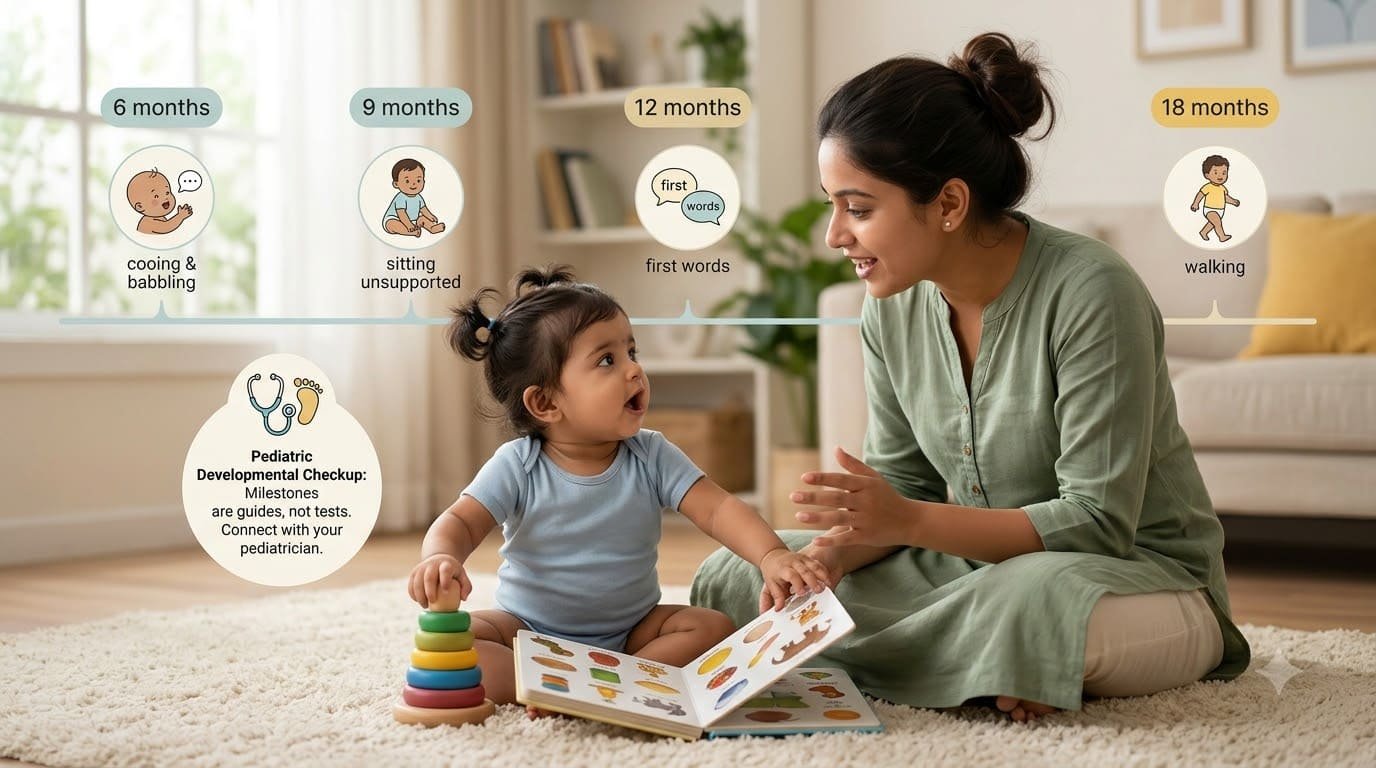
Medical Disclaimer: This article is for informational purposes only. All babies develop at their own pace. These signs are indicators of healthy development — not a test your baby must pass.
Signs of intelligent baby India is one of the most searched parenting questions — and one of the most misunderstood. My mother called my daughter a genius at four months old because she tracked a moving toy with her eyes for thirty seconds.
My mother-in-law countered that she was probably normal, because her son — my husband — had also tracked toys early and look how that had turned out (this was said with great affection and mild disparagement simultaneously, which is a skill that only Indian mothers-in-law have fully mastered).
The paediatrician, when I mentioned all of this, said something I’ve thought about many times since: “Every parent thinks their baby is showing signs of exceptional intelligence. Mostly they’re just showing signs of healthy development. Which is exactly what you want.”
She was right. The “signs of intelligence” that people get excited about are, for the most part, signs of normal, healthy brain development. A baby who makes eye contact, tracks objects, responds to voices, shows curiosity, and reaches milestones within normal ranges is a baby whose brain is developing well. That is the goal. That is intelligence, for this age, in the most meaningful sense.
This guide covers what actually indicates healthy cognitive development in babies, what the science says about early intelligence, why the Indian context adds specific pressure to this question, and what genuinely supports your baby’s brain development.
Signs of Intelligent Baby India — Why This Topic Is Complicated
In many Indian families, a child’s intelligence is not a private matter. It’s discussed at family gatherings, compared across cousins, referenced in conversations with neighbours, and held up as a reflection of parenting quality.
The pressure this creates on parents — particularly new parents — to see and claim signs of exceptional intelligence in their babies is real. And it sometimes leads to a distorted reading of normal development as exceptional, or — more damagingly — to anxiety when a baby doesn’t display the “signs” that a relative’s baby supposedly displayed.
According to the Indian Academy of Pediatrics, developmental assessment in the first year should focus on whether a baby is progressing through expected milestones within normal ranges — not on identifying exceptionality. The World Health Organization’s child development framework similarly emphasises that healthy, on-track development is the goal — not early achievement of milestones.
What follows are genuine early indicators of healthy cognitive development. Some babies display more of these more prominently. Many display them quietly, in ways that are easy to miss. All of them are normal. None of them, absent other context, indicate genius. All of them indicate a brain that is developing well.
What Intelligence Actually Means in the First Year
Intelligence in adults is complex, multidimensional, and not fully reducible to any single measure. In infants and toddlers, what researchers look for are indicators of healthy cognitive function — the processes that underlie all later learning and thinking.
These include: attention and focus (can the baby sustain interest in something), memory (does the baby remember things), language acquisition (how quickly and richly language develops), problem-solving (does the baby figure things out), social understanding (does the baby read other people’s cues and intentions), and curiosity (does the baby actively seek new information and experiences).
IQ tests are not reliable predictors before age four. What we can observe before then are developmental markers — signs that these underlying processes are functioning well.
12 Signs of Intelligent Baby India — What Science Actually Shows
1. Strong Eye Contact From Early On
In the first weeks of life, newborns focus best at approximately 20–30 centimetres — the distance from your face to theirs during feeding. A baby who makes sustained, intentional eye contact with caregivers from the early weeks is showing that the social brain — the systems involved in reading and responding to other people — is active and developing.
By two months, a baby who holds your gaze and responds to your facial expressions with their own — smiling when you smile, stilling when you look serious — is demonstrating early social intelligence that underlies all later learning.
What this looks like: Baby quiets and focuses when you make eye contact. Smiles in response to your smile. Turns toward your face when you speak.
What it means: The social brain’s foundational systems are active. This is one of the strongest early predictors of later language and cognitive development.
2. Early and Rich Vocalisation
Babies who babble early, babble often, and babble with variety — changing sounds, changing rhythms, responding to your vocalisation with their own — are showing signs of strong early language processing.
Language development is one of the most robust indicators of cognitive development researchers have. The quantity and quality of vocalisation in the first year consistently predicts later language ability, which in turn predicts academic and cognitive outcomes.
What this looks like: Varied babbling from around 4 months. Responding to your speech with sounds of their own. Imitating your sounds and rhythms. Using different sounds in different situations.
What it means: The language-processing systems are active and developing. The child is practising the phonological building blocks of language.
Indian context: In multilingual homes, babies exposed to multiple languages may take slightly longer to produce their first clear word in any one language — but their total vocalisation is rich and their overall language development is equal to or ahead of monolingual peers. Don’t mistake multilingual development for slow development.
3. Sustained Attention — The Ability to Focus
Most young babies have short attention spans. A baby who can focus on a single object, person, or activity for longer than expected for their age is showing strong executive function — the brain’s ability to direct and sustain attention.
Research published in child development journals consistently shows that sustained attention in infancy is one of the stronger predictors of later cognitive performance. A baby who can look at a mobile intently for several minutes rather than glancing and looking away is showing this capacity.
What this looks like: Watching a moving object carefully. Examining a new toy from different angles before mouthing it. Staying focused on a face-to-face interaction without becoming distracted.
What it means: Executive function systems are developing well. Sustained attention is the basis of all later learning.
4. Strong Object Permanence — Earlier Than Expected
Object permanence — understanding that things continue to exist even when they can’t be seen — typically develops around 6–8 months. A baby who shows signs of this earlier, or who shows particularly sophisticated versions of it, is demonstrating strong representational thinking.
Signs include: looking for a dropped object rather than losing interest, showing distress when a favourite person leaves (which requires knowing they still exist), looking in the place where an object was hidden even after seeing it moved.
What this looks like: Searching for a toy that has been covered. Looking toward where you went after you left the room. Anticipating your return.
What it means: Representational thinking — the ability to hold a mental image of something not currently present — is developing. This is a foundational cognitive capacity.
5. Early Imitation
Babies who imitate facial expressions, sounds, and actions earlier and more accurately than typical are showing strong social cognition and learning capacity. Imitation is how most early learning happens — it requires attention, memory, and motor coordination working together.
A four-month-old who sticks out their tongue when you stick out yours. A seven-month-old who claps when you clap. A ten-month-old who picks up a phone and holds it to their ear. All of these are imitation — and all indicate that the brain is actively watching, processing, and replicating.
What this looks like: Mirroring your expressions from early months. Copying actions you demonstrate. Repeating sounds you make.
What it means: Social learning — the mechanism through which humans acquire most of their knowledge and skills — is active and functioning well.
6. Curiosity and Exploration
A baby who reaches for new objects, examines things from multiple angles, shows interest in new people and environments, and generally seems driven to understand the world around them is showing one of the most consistent predictors of cognitive development.
Curiosity is not just a personality trait. It reflects the brain’s reward system responding to novelty with engagement rather than withdrawal. Babies with strong curiosity learn faster because they’re perpetually seeking new information.
What this looks like: Reaching for new objects rather than avoiding them. Turning toward new sounds. Showing interest in unfamiliar faces. Examining objects carefully before mouthing them.
What it means: The brain’s learning drive is active. This is one of the most consistent early predictors of later intellectual engagement.
7. Preference for Novelty
Closely related to curiosity: babies who quickly habituate to familiar stimuli (stop looking at something they’ve seen before) and show renewed interest in new stimuli are demonstrating efficient information processing.
Researchers use a measure called “habituation” — showing a baby the same image repeatedly and measuring how quickly their interest declines, then showing a new image and measuring how quickly interest is renewed. Faster habituation and stronger renewed interest both indicate efficient cognitive processing.
What this looks like: Baby looks at a new toy intently, then loses interest once it’s familiar. Immediately shows renewed interest when something new is introduced. Prefers new books to familiar ones (even though familiar books feel more comfortable to parents).
What it means: The brain is processing new information efficiently and moving on to seek more — a hallmark of strong learning systems.
8. Early Problem-Solving
A baby who figures out how to get what they want — reaching around an obstacle, dropping objects to see what happens, using one object to get another — is demonstrating early problem-solving capacity.
This doesn’t have to be dramatic. A seven-month-old who moves a pillow aside to get a toy that rolled behind it has just solved a spatial problem. A nine-month-old who uses a stick to reach an object that’s too far away has made a genuine cognitive leap.
What this looks like: Using one toy to reach another. Moving obstacles to get to something. Trying different approaches when the first doesn’t work.
What it means: Causal reasoning and means-end thinking are developing. These are the foundations of all later problem-solving.
9. Rich Emotional Range and Empathy
Babies who show a wide range of emotions — not just happiness and distress, but curiosity, frustration, excitement, comfort-seeking — and who respond to other people’s emotional states are showing strong social-emotional intelligence.
A ten-month-old who notices when you’re sad and moves toward you, or who shows concern when another baby cries, is demonstrating early empathy. This is a genuine cognitive achievement — it requires reading another person’s emotional state and connecting it to an appropriate response.
What this looks like: Showing distress when another child cries. Moving toward a sad caregiver. Responding differently to happy versus serious facial expressions.
What it means: Social cognition — the understanding of other minds — is active and developing. Emotional intelligence is deeply interconnected with cognitive intelligence throughout life.
10. Early Intentional Communication
Pointing, waving, showing objects to others, using specific sounds consistently for specific meanings — all of these are signs of intentional communication, which requires understanding that another person has a mind that can receive your communication.
This is a significant cognitive and social milestone. A baby who points at a bird and looks at you to share the experience understands that you have a perspective that can be directed — that you can see what they see if they direct your attention.
What this looks like: Pointing to share experiences (not just to get things). Waving bye-bye with understanding of its social meaning. Using consistent sounds for specific people or things.
What it means: Joint attention and intentional communication are established. These are among the strongest predictors of later language and cognitive development.
11. Early and Diverse Language Comprehension
Understanding language before being able to produce it is universal — receptive language always develops ahead of expressive language. But babies who understand a wide range of words and simple instructions early are showing strong language-processing capacity.
A nine-month-old who consistently turns when their name is called, understands “no,” recognises several object names, and follows simple instructions (“wave bye-bye”) has strong receptive language for their age.
What this looks like: Responding consistently to their name. Understanding common words before saying them. Following simple instructions with good comprehension.
What it means: Language processing systems are developing ahead of or alongside expressive language. Strong receptive language consistently predicts strong expressive language and later reading ability.
12. Reaching Developmental Milestones Within or Ahead of Normal Range
Consistently reaching motor, language, social, and cognitive milestones at or before the typical age — not in isolation but across multiple domains — is a positive indicator of overall healthy development.
Isolated early achievement of one milestone (like walking at 10 months) says little about overall cognitive development. Consistent, across-the-board development across all domains is more meaningful.
What this looks like: Rolling, sitting, standing, walking — all within or ahead of typical ranges. Language developing consistently. Social milestones — smiling, pointing, waving — appearing on or ahead of schedule.
What it means: Overall brain development is progressing well across all domains.
What Signs of Intelligent Baby India Don’t Actually Mean
They don’t mean your baby is a genius. They mean your baby is developing well — which is exactly what you want.
They don’t mean a baby who doesn’t display them prominently is less intelligent. Many babies show these signs quietly, in ways that are easy to miss unless you’re watching closely.
They don’t predict adult intelligence with any reliability. The human brain is extraordinarily plastic and continues developing throughout childhood and adolescence. Early signs are not destiny.
They definitely don’t mean you should be anxious if your baby is developing normally but doesn’t seem to be showing “extra” signs. Normal is good. Normal is the goal.
What Actually Supports Your Baby’s Cognitive Development
Since the question behind “is my baby intelligent” is often really “am I doing everything right for my baby’s development” — here is what the research actually shows supports cognitive development:
Responsive interaction. The single most consistently supported driver of cognitive development is a caregiver who responds to the baby’s communication, follows their attention, and engages in genuine back-and-forth interaction. No app, toy, or programme substitutes for this.
Talking. The quantity and quality of words a child hears in the first three years is one of the strongest predictors of later language and cognitive ability. Talk while you do everything. Narrate. Describe. Ask questions. Tell stories.
Reading together. Not performing the book, but interacting around it — pointing, commenting, following the baby’s attention. From any age.
Allowing exploration. Babies who are allowed to explore their environment — to reach, grab, mouth, move — learn faster than babies whose exploration is restricted. Safe exploration is how the brain learns.
Limiting screens. Passive screen time replaces the responsive human interaction that drives development. It does not substitute for it. For more on this, our screen-free childhood challenge guide covers the evidence in detail.
Adequate nutrition. The brain needs specific nutrients to develop — iron, DHA, choline, zinc, iodine, B12. Our superfoods for toddler brain development guide covers exactly which Indian foods provide these.
Sleep. The developing brain consolidates learning during sleep. A baby who sleeps adequately learns and remembers better than one who doesn’t. Our newborn sleep tips guide and 4 month sleep regression guide cover the first year of sleep in detail.
FAQ — Signs of Intelligent Baby India
Q: My baby doesn’t make much eye contact. Should I be worried?
Limited eye contact in the first weeks is normal — newborn vision is limited and eye contact develops over the first months. By three months, most babies make sustained, responsive eye contact. If your baby is not making eye contact by three to four months, or consistently avoids eye contact when approached — mention this to your paediatrician. Consistent eye contact avoidance can be an early indicator that warrants assessment.
Q: My baby started talking very early. Does this mean they are gifted?
Early language development is one of the stronger predictors of later cognitive ability — but early talking alone does not confirm giftedness or guarantee exceptional outcomes. Many early talkers develop within normal adult ranges. Many late talkers catch up completely. Healthy language development — not early talking specifically — is what matters.
Q: My neighbour’s baby is doing everything earlier than mine. Is my baby less intelligent?
Almost certainly not. Development has wide normal ranges and the variation between individual babies within normal development is enormous. A baby who walks at nine months and one who walks at fifteen months are both developing normally. Comparing your baby to any individual baby is not informative — the normal range is the relevant context, not your neighbour’s specific baby.
Q: How can I tell if my baby is gifted?
Reliable assessment of giftedness is not possible before age four, and most paediatric guidelines don’t recommend formal testing before school age. Before then, healthy, on-track development across all domains is the meaningful measure. If you have genuine concerns about your child’s development — in either direction — speak to your paediatrician.
Q: My baby seems very advanced but my family keeps saying “all babies are like this.” Who is right?
Both, in a way. Most of what looks like exceptional intelligence in babies is healthy development — which all babies show in different ways and at different rates. Some babies do show early indicators that later correspond to high cognitive ability. But the overlap between “healthy development” and “signs of giftedness” is very large at this age — the two are not easily distinguishable in infancy.
Q: Does watching educational videos help my baby’s intelligence?
The research here is clear and consistent: educational videos for babies under 18 months have not been shown to accelerate development and may delay language development when they replace interaction time. Your face, your voice, and your responsive engagement teach your baby far more than any screen. After 18 months, co-watched, age-appropriate content with a parent who interacts around it is significantly less concerning than solo passive viewing.
More from MumPappaHub — Read These Next:
- Baby Development Month by Month
- Child Development Milestones
- Toddler Language Development
- Sensory Play for Toddlers India
- Superfoods for Toddler Brain Development
- Screen-Free Childhood Challenge
- Newborn Sleep Tips
- 4 Month Sleep Regression
- Indian Baby Weight Chart 0-12 Months
- Baby Vaccination Schedule India 2026
- Baby First Year Milestones
- Baby Blues vs Postpartum Depression
About This Article
Written by the MumPappaHub editorial team — including a mother whose daughter was called a genius at four months for tracking a toy with her eyes, and whose mother-in-law questioned this with mild disparagement. The paediatrician settled it. She was showing signs of healthy development. Which was exactly right.
Reviewed for accuracy against WHO child development guidelines and Indian Academy of Pediatrics developmental assessment guidance. This content is for general informational purposes and does not constitute medical advice. Always consult your paediatrician with concerns about your baby’s development.
MumPappaHub — Real talk for real parents. mumpappahub.com

1 Comment