
Medical Disclaimer: This article is for informational purposes only. Only a qualified developmental paediatrician, child psychiatrist, or psychologist can diagnose autism spectrum disorder. If you have concerns about your child’s development, consult your paediatrician — do not self-diagnose based on any checklist.
Autism early signs toddler India is a topic that more Indian parents are searching — and rightly so. Early identification of autism spectrum disorder (ASD) is one of the most important things a parent can do, because the earlier intervention begins, the better the outcomes.
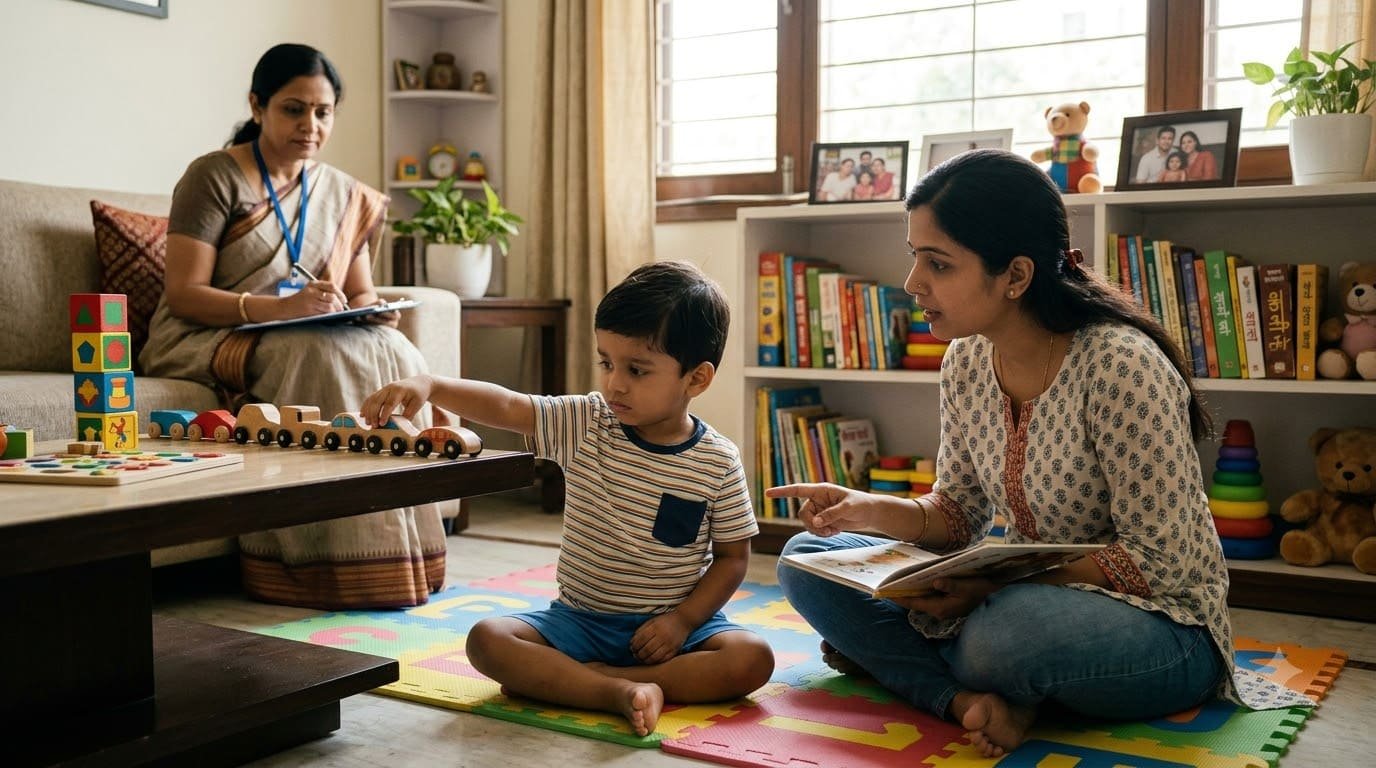
My friend’s son was 18 months when she first mentioned something to his paediatrician. He wasn’t pointing. He had six words at 12 months and now seemed to have fewer. He lined up his toy cars with intense focus but didn’t respond when she called his name from across the room. The paediatrician referred him immediately for developmental assessment.
He was diagnosed with autism at 22 months. Early intervention began at 24 months. He is now six years old, attending a mainstream school with support, communicating clearly, and thriving.
The paediatrician told my friend: “The fact that you noticed and brought him at 18 months is the most important thing you did.”
This guide covers the early signs of autism in Indian toddlers — what to watch for, why early identification matters, and what to do if you have concerns.
Why Early Identification Matters
Autism early signs toddler India is important because the brain is most plastic — most responsive to learning and intervention — in the first three years of life.
According to the World Health Organization’s guidelines on autism spectrum disorders, ASD affects approximately 1 in 100 children globally. Early behavioural intervention — speech therapy, occupational therapy, applied behaviour analysis — started before age 3 produces significantly better outcomes than intervention started later. The Indian Academy of Pediatrics has issued specific guidelines on early ASD screening in India, recognising that Indian children with autism are often identified late due to limited awareness, cultural factors, and limited access to developmental specialists.
Why Indian children are often identified late:
“He’ll talk when he’s ready”: The most common delay in seeking assessment. In Indian families, late talking is often attributed to personality, gender (“boys talk late”), or family traits. While late talking has many causes — most of which are not autism — it always warrants assessment.
“He’s just shy”: Social withdrawal and difficulty with eye contact are frequently attributed to temperament in Indian children rather than triggering developmental assessment.
Joint family masking: In joint family households, a child who doesn’t respond to one caregiver may still receive attention from others — masking the lack of response to name and social communication difficulties.
Limited awareness: Many Indian parents — and some general physicians — are not familiar with the early signs of autism, leading to missed or delayed identification.
What Is Autism Spectrum Disorder?
Autism spectrum disorder is a neurodevelopmental condition characterised by:
- Differences in social communication and interaction — difficulties with social reciprocity, nonverbal communication, and developing and maintaining relationships.
- Restricted, repetitive patterns of behaviour and interests — repetitive movements or speech, insistence on sameness, highly focused interests, unusual responses to sensory input.
“Spectrum” means there is enormous variation — autism looks very different in different children. Some autistic children have no speech; others are highly verbal. Some have intellectual disability; others have average or above-average intelligence. The common thread is the pattern of social communication differences and restricted/repetitive behaviours.
Autism is not caused by vaccines, bad parenting, trauma, or diet. It is a neurodevelopmental condition with complex genetic factors.
10 Best Warning Signs — Autism Early Signs Toddler India
Warning Sign 1 — No Response to Name by 12 Months
A baby typically begins responding to their name — turning toward the sound, making eye contact, showing recognition — by 9-12 months. A child who consistently does not turn when their name is called by 12 months warrants assessment.
Important distinction: The child may hear well (passing hearing test) but not orient to their name socially. This is different from a hearing problem — it is a social communication difference.
Indian family context: In loud joint family households, a child may be dismissed as “not paying attention.” Test specifically: in a quiet room, stand behind the child and call their name. If the child does not turn after 2-3 calls, this is worth noting.
Warning Sign 2 — No Pointing by 12-14 Months
Pointing is one of the most important early social communication milestones — and one of the most reliable early indicators of autism risk when absent.
There are two types of pointing: Imperative pointing: Pointing to request something — “I want that.” Declarative pointing: Pointing to share interest — “Look at that!” — with accompanying eye contact to check if you’re looking too.
Declarative pointing — the “look at this!” pointing — is the more significant milestone. A child who points to request things but never points to share interest or show you something is showing a pattern worth discussing with a paediatrician.
Normal by: 12-14 months. Absence by 14 months warrants assessment.
Warning Sign 3 — No Babbling or Words by Expected Ages
Red flags for speech and language:
- No babbling by 12 months
- No single words by 16 months
- No two-word phrases by 24 months
- Any loss of language or social skills at any age — this is the most urgent sign
The last point is critical: a child who had words and lost them, or who was socially responsive and became less so, requires immediate assessment regardless of age. This regression is a significant red flag.
Indian context: “Boys talk late” is often used to normalise late speech in Indian families. While boys do typically develop language slightly later than girls, any child — male or female — who is not meeting these milestones warrants a paediatrician consultation, not reassurance.
Warning Sign 4 — Limited or No Eye Contact
Eye contact is one of the foundations of social communication. From birth, typically developing babies are drawn to human faces and make eye contact readily.
A toddler with autism may make inconsistent, fleeting, or minimal eye contact — particularly during social interaction. They may look at objects rather than people, or at the edge of faces rather than the eyes.
Important nuance: Some autistic children make reasonable eye contact in some situations. Eye contact that is inconsistent, initiated on the child’s terms but not in response to others’ bids for attention, or absent during communication is more significant than complete absence of eye contact.
Indian cultural context: Indian children may be taught not to make prolonged eye contact with elders as a sign of respect. A child who makes eye contact with familiar peers and parents but not in general is different from a child who makes minimal eye contact across all settings.
Warning Sign 5 — Limited Social Smile and Social Engagement
By 6 weeks, typically developing babies smile responsively — a smile that is social, in response to a face or voice. By 3-4 months, there is clear delight in social interaction.
A toddler with autism may:
- Not smile responsively or in response to social interaction
- Not initiate social interaction — preferring to be alone with objects
- Not show interest in other children’s play
- Not look to parents for reference when encountering something new or uncertain (social referencing)
The joint family test: In an Indian joint family with many people, does the child greet returning family members? Show things to grandparents? Look to parents when uncertain? A child who is consistently uninterested in these social exchanges warrants observation.
Warning Sign 6 — Repetitive Movements or Play
Repetitive behaviours — called “stimming” — include:
- Hand flapping
- Rocking back and forth
- Spinning in circles
- Toe walking (walking on tiptoes)
- Repeated lining up of objects
- Spinning wheels or other objects repeatedly rather than playing with them functionally
Important: All toddlers do some of these things some of the time. It is the frequency, intensity, and whether the behaviour is flexible (can be interrupted without significant distress) that matters. A child who hand flaps briefly when excited is different from a child who flaps for extended periods and is extremely distressed when interrupted.
Object play: A toddler who plays with toys by lining them up, sorting them, or spinning them — rather than using them functionally (cars for driving, cups for pretend tea) — or who is intensely focused on parts of objects rather than the whole (the wheel of a car rather than the car itself) shows a pattern worth noting.
Warning Sign 7 — Lack of Pretend Play
Pretend play — using a banana as a phone, pretending to make tea, feeding a toy bear — typically begins around 12-18 months and develops substantially through the toddler years.
Autistic children often have limited or absent pretend play. They may play with toys in repetitive, inflexible ways rather than imaginatively.
When to note: A two-year-old who has no pretend play — no feeding dolls, no driving toy cars with accompanying sounds, no “cooking” in a play kitchen — warrants developmental assessment.
Warning Sign 8 — Unusual Sensory Responses
Autistic children often have atypical responses to sensory input — either hypersensitive (over-reactive) or hyposensitive (under-reactive), or both in different sensory domains.
Hypersensitivity examples:
- Extreme distress at everyday sounds (mixer, pressure cooker, traffic)
- Strong aversion to certain textures — refusing to walk on grass, extreme difficulty with certain food textures
- Distress at being touched or hugged
- Intense reaction to certain smells
Hyposensitivity examples:
- Seeming not to notice pain — not crying when hurt
- Seeking intense sensory input — crashing into things, spinning excessively
- Mouthing objects well beyond the typical age
Indian context: Sensory sensitivity is often attributed to “being fussy” in Indian children. A child who is consistently and significantly distressed by sensory input that others find neutral warrants assessment.
Warning Sign 9 — Insistence on Sameness and Extreme Distress at Change
Many autistic children have a strong need for routine and sameness — and experience significant distress when routines are disrupted.
Examples:
- Extreme distress at minor changes in routine — a different route home, food presented differently
- Insistence on eating specific foods only
- Distress at sitting in a different chair, using a different cup, or any alteration to an established routine
Important distinction: All toddlers have some preference for routine and resistance to change — this is developmentally normal. The autism-associated pattern is the intensity and inflexibility of the distress, and the extent to which it affects daily functioning.
Warning Sign 10 — Not Sharing Interests or Achievements
By 9-12 months, typically developing babies begin to share their experiences — showing objects to caregivers, looking to check the caregiver’s reaction when something interesting happens. This joint attention — sharing experience — is a fundamental building block of social communication.
Autism-associated pattern: A child who explores and discovers but doesn’t bring things to show parents. A child who achieves something but doesn’t look to the parent for shared pleasure. A child who is interested in things but doesn’t try to get the parent to look at the same thing.
This absence of sharing — “look what I found!” — is one of the most consistent early signs of autism and one of the most important to know about.
The M-CHAT-R — A Screening Tool for Indian Parents
The Modified Checklist for Autism in Toddlers — Revised (M-CHAT-R) is a validated, free screening questionnaire for autism in toddlers aged 16-30 months. It is used by paediatricians worldwide and is available in Hindi and other Indian languages.
The M-CHAT-R is a screening tool — not a diagnostic tool. A positive screen means assessment is recommended, not that the child has autism. A negative screen does not rule out autism.
Ask your paediatrician to administer the M-CHAT-R at the 18-month and 24-month developmental checks. In India, this screening is not yet universally administered — you may need to specifically request it.
What to Do if You Have Concerns
Step 1 — See Your Paediatrician
Bring your specific concerns, with examples: “She doesn’t respond to her name. She had 10 words at 12 months and now seems to have fewer. She doesn’t point.”
Specific, concrete observations are more useful than “I’m worried about her development.”
Step 2 — Request a Developmental Assessment
If your paediatrician shares your concern, ask for a referral to a developmental paediatrician, child psychiatrist, or psychologist — whichever is available in your area.
In India:
- Government teaching hospitals (AIIMS, PGI, major medical colleges) have developmental paediatrics departments with shorter or subsidised waiting times
- Child Development Centres (CDC) — attached to many medical colleges
- NIMHANS (Bangalore), NIMHAMS — specialist centres
- Private developmental paediatricians — available in most major Indian cities
Step 3 — Begin Speech Therapy While Waiting for Assessment
If there is a speech delay alongside any social communication concerns — do not wait for the autism assessment before beginning speech therapy. Speech therapy benefits children with autism and children with other causes of speech delay. Waiting for a diagnosis before beginning therapy delays intervention unnecessarily.
Step 4 — Trust Your Instinct
Parents notice things about their children that others miss. If your instinct says something is different — pursue assessment even if you are told “he’ll catch up” or “don’t worry.” Early identification is the most important thing you can do.
FAQ — Autism Early Signs Toddler India
Q: My son is 18 months and not talking. Does he have autism?
Speech delay has many causes — most of which are not autism. Hearing loss, language exposure (including multilingual environments), and speech and language disorders can all cause late talking without autism. However, any child not talking at 18 months warrants a paediatrician assessment — both for hearing evaluation and developmental assessment. Look at the full picture: Is there eye contact? Does he point? Does he respond to his name? Does he show things to you? The social communication patterns matter as much as the words.
Q: My daughter makes eye contact and is very social, but she flaps her hands a lot. Should I be worried?
Hand flapping alone — in an otherwise socially engaged, communicative toddler — is unlikely to indicate autism. It is common in typically developing toddlers when excited. If the flapping is very frequent, sustained, and accompanied by any of the other signs in this guide — it is worth mentioning to your paediatrician. If your daughter is socially engaged, responding to her name, pointing, making eye contact, and developing language — the occasional hand flap is not a red flag on its own.
Q: The doctor says my son will “catch up.” But something feels different. What do I do?
Trust your instinct and seek a second opinion or a developmental specialist directly. General paediatricians vary in their familiarity with early autism signs — a developmental paediatrician has specific training that makes early identification more reliable. “He’ll catch up” is sometimes true. It is also sometimes the wrong reassurance. If you have specific concerns about social communication — not just late talking — pursue a developmental assessment.
Q: My child was meeting milestones and then seemed to go backward. Should I be worried?
Yes — any regression in language or social skills warrants immediate assessment. Loss of language, loss of eye contact, withdrawal from social interaction that the child previously engaged in — these are significant signs that require same-week paediatrician assessment, not a “wait and see” approach.
Q: Is autism more common in India?
The prevalence of autism in India is estimated at approximately 1 in 100 children — similar to global estimates. India’s population size means a very large number of children with autism are present, but many are undiagnosed or diagnosed late. Awareness is increasing and more services are becoming available, but early identification remains a challenge in many parts of the country.
More from MumPappaHub — Read These Next:
- Speech Delay in Toddlers India
- Toddler Language Development
- Child Development Milestones
- Baby Development Month by Month
- Cognitive Development Activities India
- When Do Babies Start Talking India
- Baby First Year Milestones
- Screen Time Guidelines Children India
- Signs of Intelligent Baby India
- Positive Parenting Tips India
- Indian Baby Weight Chart
- Baby Fever Guide India
About This Article
Written by the MumPappaHub Research Team — including a researcher whose friend first mentioned something to her son’s paediatrician at 18 months. He wasn’t pointing. He had had words and seemed to have fewer. He was diagnosed at 22 months, began intervention at 24 months, and is now six years old in a mainstream school. The paediatrician said: “The fact that you noticed and came at 18 months is the most important thing you did.”
Reviewed for accuracy against WHO guidelines on autism spectrum disorders and Indian Academy of Pediatrics screening guidelines for ASD in Indian children. This content is for general informational purposes only and does not constitute medical or diagnostic advice. Only a qualified specialist can diagnose autism spectrum disorder.
MumPappaHub — Real talk for real Indian parents. mumpappahub.com
