
Medical Disclaimer: This article is for informational purposes only. For specific behavioural or developmental concerns about your child, consult a paediatrician or child psychologist.
Positive parenting tips India is a topic I approached with scepticism the first time I read about it.
The phrase sounded Western — something designed for parents who had time to sit cross-legged on the floor and process emotions while their toddler had a meltdown in a supermarket. Not for a household where the nani is visiting, the pressure cooker is going, two cousins are playing loudly in the next room, and my son has just thrown his dal on the floor for the third time that evening.
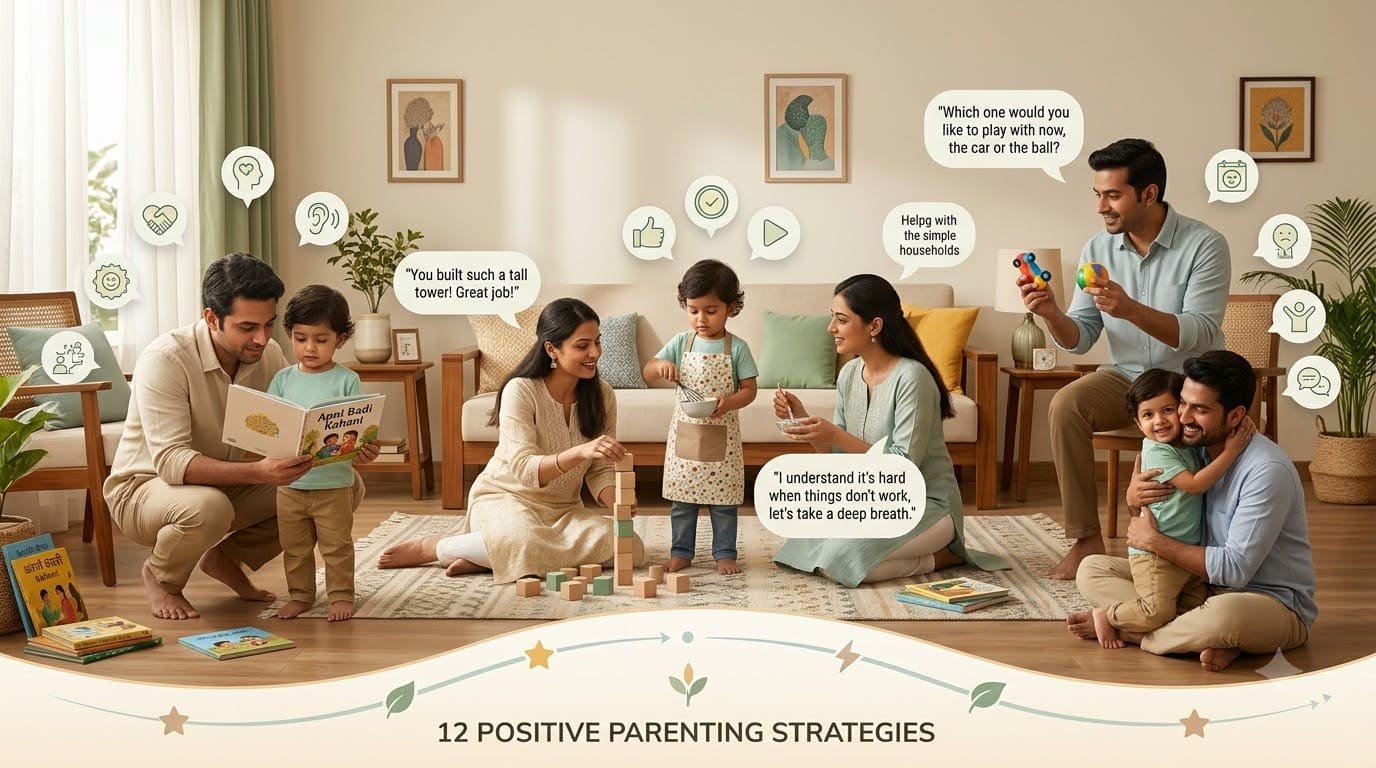
What changed my mind was understanding what positive parenting actually is — and isn’t. It is not permissive parenting. It is not never saying no. It is not pretending that everything is fine when it isn’t. It is a set of specific, evidence-backed strategies for guiding children’s behaviour in ways that build the relationship between parent and child rather than eroding it. Strategies that work in Indian households, with Indian family dynamics, and with the very specific pressures that Indian parents navigate.
This guide covers 12 positive parenting tips India — with the science behind each one, honest notes about how they work in Indian contexts, and what to do when they don’t work immediately (which they won’t, always, because children are not predictable).
What Positive Parenting Tips India Actually Means — And What It Doesn’t
Positive parenting tips India begins with a clarification: positive parenting is not the same as soft parenting or permissive parenting.
Permissive parenting = no boundaries, no expectations, child decides everything.
Positive parenting = clear boundaries, consistent expectations, enforced respectfully and with warmth.
The distinction matters because the most common criticism of positive parenting in Indian families is that “all this positivity produces spoiled children.” This is a critique of permissive parenting, not positive parenting. The research consistently shows the opposite of what the critics fear — children raised with positive parenting strategies have better self-regulation, better social skills, better academic outcomes, and stronger emotional resilience than children raised with either permissive or harsh parenting.
According to the World Health Organization’s guidelines on parenting for lifelong health, positive parenting programmes demonstrate consistent evidence of improving child behaviour, reducing harsh punishment, and strengthening parent-child relationships across diverse cultural contexts. The Indian Academy of Pediatrics recognises that authoritative parenting — warm but firm, responsive but boundaried — produces the best developmental outcomes for Indian children.
12 Positive Parenting Tips India — Strategies That Work
1. Connect Before You Correct — The Most Important Rule
Positive parenting tips India starts here — before any correction, any instruction, any attempt to change behaviour, make a genuine connection with the child.
A child who feels connected to you is significantly more likely to cooperate with you. A child who feels disconnected — rushed, ignored, criticised — will resist.
Connection before correction looks like: getting down to the child’s eye level before speaking. Making brief eye contact and using their name. A brief moment of physical contact — a hand on the shoulder. Then the instruction or correction.
This takes ten seconds. The difference in the child’s response is often significant.
In the Indian context: This may feel unnatural at first in households where parents and authority figures traditionally speak down to children rather than at their level. It does not undermine authority — it makes the authority more effective.
2. Describe Behaviour, Not Character
The language used when correcting a child’s behaviour matters — not as an abstract ideal, but in measurable ways.
What not to say: “You’re so naughty.” “You’re being stupid.” “You’re a bad boy/girl.”
What to say instead: “Throwing food is not okay. Food stays in the bowl.”
The first type of statement attacks the child’s identity — they begin to believe “I am naughty” or “I am bad” and behave accordingly. The second type describes the specific behaviour and states the expectation — leaving the child’s identity intact and giving them a clear path to different behaviour.
Research on this is consistent: character-based criticism (“you’re bad”) predicts worse behaviour over time. Behaviour-based correction (“that behaviour is not okay”) predicts better outcomes.
The Indian grandmother test: This is sometimes the hardest positive parenting shift to make in Indian households where “naughty” and “stubborn” and “mischievous” are used affectionately. Awareness is the first step — begin to notice the labels being applied.
3. Offer Choices Within Boundaries
Toddlers and young children need some sense of control. When every aspect of their day is decided for them, the only place they can exercise control is in refusing to cooperate. Offering choices within boundaries gives them legitimate autonomy — reducing the battles.
How it works: The boundary is set by the parent. The choice is between two options that are both acceptable.
“Do you want to eat your dal before the rice or the rice before the dal?” “Do you want to wear the blue kurta or the yellow one?” “Do you want your bath now or in five minutes?”
The child gets to choose. The parent gets the outcome they need. The battle doesn’t happen.
Limit choices to two. More than two options overwhelms a young child and defeats the purpose.
4. Name the Emotion, Shrink the Behaviour
When a child is in emotional distress — crying, angry, refusing to cooperate — the most effective first response is to name what they’re feeling before attempting to address the behaviour.
“You’re really angry that your cousin took your toy.” “You’re sad that we have to leave the park.” “You’re frustrated because the puzzle isn’t working.”
This works because children who feel understood calm down faster than children who feel managed or corrected. The emotional brain (the amygdala) cannot cooperate with the rational brain when it’s flooded with emotion. Naming the emotion signals that the parent understands — which partially calms the emotional flooding — and then rational communication becomes possible.
The Indian context: Many Indian parents were raised in households where children were expected to control their emotions rather than have them named and validated. “Don’t cry” and “stop being silly” are deeply embedded responses. Changing this pattern requires conscious effort — but the payoff in reduced tantrums and better emotional regulation in the child is well documented.
For detailed guidance on managing the most intense toddler emotional episodes, our toddler tantrums tips guide covers specific strategies for the worst moments.
5. Use Natural and Logical Consequences
Consequences for behaviour work best when they are naturally connected to the behaviour — not arbitrary punishment.
Natural consequence: “You didn’t wear your sweater, now you’re cold.” The child experiences the natural result of their choice.
Logical consequence: “You threw food on the floor, so we clear your plate and mealtime is over.” The consequence is directly connected to the action.
Arbitrary punishment: “You threw food, so no screen time tomorrow.” The connection between food throwing and losing screen time the next day is not immediately clear to a young child, making the consequence less effective as a teaching tool.
Logical consequences teach children to connect their actions with outcomes — which is the basis of self-regulation and responsible behaviour. They work best from about age three, when children can begin to understand the reasoning.
6. Praise Effort, Not Just Results
“You worked so hard on that puzzle.” “I saw you trying again and again — that’s wonderful.”
versus
“You’re so smart.” “You’re so talented.”
Research from Stanford psychologist Carol Dweck — and dozens of subsequent studies — shows that praising effort rather than innate ability builds a growth mindset: the belief that abilities can be developed through work. Children praised for effort try harder challenges, persist longer when things are difficult, and show better academic outcomes over time.
Children praised primarily for being “smart” or “talented” avoid challenges (to avoid looking “not smart”), give up more quickly when things are hard, and are more sensitive to failure.
The Indian parent pressure: In many Indian families, “he’s very intelligent” and “she’s so bright” are the primary compliments directed at children. This is well-intentioned. Supplementing with specific, effort-focused praise significantly improves outcomes.
7. Get Down to Their Level — Literally
Physical positioning during communication with young children matters. When an adult stands over a child and speaks down, the child experiences the interaction as threatening or intimidating — even when the content is benign.
Getting down to the child’s level — crouching, sitting, kneeling — changes the dynamic. The child is more likely to make eye contact, more likely to listen, and more likely to respond cooperatively.
This is particularly effective during instruction and correction. It’s also particularly effective when a child is distressed — getting physically low creates a sense of safety.
8. Consistent Routines — The Invisible Positive Parenting Tool
Children who have consistent, predictable routines have significantly fewer behaviour problems than children whose days are unpredictable.
This is not about rigid schedules — it is about reliable sequences. Meals happen at roughly the same time. The bedtime sequence follows the same pattern. The morning routine has a consistent flow. These predictable sequences reduce anxiety in children because they know what’s coming.
Many behaviour problems in young children are actually anxiety responses to unpredictability. A child who doesn’t know when dinner is coming, when bedtime is, or whether today is the day they go to nani’s house, is a child who is constantly on edge. Consistent routines reduce this anxiety — and with it, the associated behaviour problems.
The Indian context: Joint family households, extended family visits, festivals, travel — Indian family life is less predictable than the nuclear family structure that most parenting research assumes. The goal isn’t rigidity — it’s reliable sequences within whatever the day looks like. Even in a festival-disrupted household, a consistent bedtime routine provides an anchor.
For guidance on sleep routines specifically, our baby sleep schedule guide and newborn sleep tips cover the routine-building process at each age.
9. Catch Them Being Good — Deliberately
The human attention system responds to problems. Parents naturally notice and respond to misbehaviour — which, inadvertently, means that misbehaviour gets attention and good behaviour is ignored.
Deliberately noticing and commenting on good behaviour shifts this dynamic.
“I noticed you waited your turn with your cousin just now. That was kind.” “You packed your bag without being asked. That was really responsible.” “You used your words to say you were angry instead of hitting. I’m proud of you.”
The more specifically good behaviour is noticed, the more it is repeated. This is not manipulation — it is how attention and reinforcement work in the human brain.
Target: Aim to notice and comment on at least three good behaviours for every one correction. This ratio — not perfection, just the ratio — is associated with significantly better outcomes.
10. Repair After Conflict — Model What You Want to See
Every parent loses their patience. Every parent says something harsher than intended. Every parent has moments they would take back.
What separates effective parenting from ineffective parenting is not the absence of these moments — it is what happens after them.
Repairing after a conflict — acknowledging what happened, apologising specifically, re-establishing connection — models exactly the behaviour parents want children to develop. It also repairs the relationship rather than leaving a residue of rupture.
“Earlier when I was really frustrated and I shouted — I shouldn’t have done that. I’m sorry. I love you.”
This is hard. It is also one of the most powerful things a parent can do — both for the relationship and for teaching the child how to repair their own relationships.
The Indian context: Apologising to children is not part of many Indian parenting traditions — it can feel like it undermines authority. The evidence suggests the opposite: parents who repair relationships maintain more authority and influence over their children than those who don’t.
11. Manage Your Own State First
A regulated parent can regulate a child. A dysregulated parent cannot.
When a parent is angry, anxious, overwhelmed, or exhausted, the capacity to respond thoughtfully to a child’s behaviour is significantly reduced. The responses that emerge in these states are the ones most likely to be regretted.
Managing the parent’s own emotional state is not self-indulgence — it is a prerequisite for effective parenting. This means: rest when possible. Ask for help when depleted. Step away from a situation that is escalating if it is safe to do so. Return when regulated.
The phrase that helps: “Put on your own oxygen mask first.” Not because the child matters less — because an oxygen-deprived parent cannot effectively help anyone.
For support with the emotional dimensions of the early parenting period, our baby blues vs postpartum depression guide covers the mental health aspects of this season.
12. Family Meetings — For Older Toddlers and Children
From about age three onwards, brief, regular family meetings — even five minutes — create space for children to contribute to family decisions, raise concerns, and feel genuinely included.
This does not mean children set the rules. It means children have a voice in some decisions that affect them — which increases their investment in following through on those decisions.
“We’re planning next Sunday. Would you like to go to the park or to nana’s house?” “We need to make a rule about screen time. What do you think is fair?”
Children who are heard cooperate better than children who are dictated to. Family meetings also model the skills of discussion, compromise, and democratic decision-making — skills that serve children for life.
Why Traditional Indian Parenting Works Well — And Where Positive Parenting Adds Value
Indian parenting traditions have genuine strengths: the emphasis on family connection, respect for elders, the concept of duty and responsibility, the collective rather than purely individual orientation. These are real assets that positive parenting does not seek to replace.
Where positive parenting adds specific value:
Reducing harsh physical punishment. Research is clear that physical punishment — however culturally normalised — increases aggression, reduces self-regulation, and damages the parent-child relationship without producing the compliance it aims for. India’s Protection of Children from Sexual Offences Act and evolving child protection frameworks both move in the direction of reducing corporal punishment.
Building emotional literacy. Traditional Indian households often prioritise duty and behaviour over emotional expression. Building children’s capacity to name, understand, and regulate their emotions produces better long-term outcomes — academically, socially, and in mental health.
Preserving the relationship through the difficult years. The parent-child relationship is the single most important predictor of how much influence parents retain over their children during adolescence. Positive parenting — through consistent warmth alongside firm expectations — preserves this relationship.
FAQ — Positive Parenting Tips India
Q: Isn’t positive parenting just letting children do whatever they want?
No — this is the most common misconception. Positive parenting is authoritative parenting: warm and responsive, but with clear expectations and consistent follow-through. It is the opposite of permissive parenting. The word “positive” refers to the approach — not to saying yes to everything.
Q: My mother-in-law thinks I’m being too soft. How do I handle this?
The most effective response is observable results over time — a child who is well-regulated, cooperative, and warm is the best argument for the approach. In the short term: “We’re trying a new approach based on what our paediatrician suggested” is often the most practical framing in Indian families where medical authority carries weight.
Q: My three-year-old completely ignores consequences. Nothing works. What do I do?
Three-year-olds have limited impulse control — this is neurological, not defiant. Consequences need to be immediate (within seconds, not minutes), brief, and consistent. If something isn’t working after two to three weeks of genuine consistency — see your paediatrician. Some behaviour challenges in this age group have underlying causes that warrant assessment.
Q: How do I use positive parenting in a joint family where different family members have different approaches?
This is one of the most common challenges for Indian parents. What works: agree with your partner on the approach and present a consistent front. Have the grandparent conversation privately and with respect — “we’ve been learning about this approach and we’d love your support.” Focus on the areas where you have the most influence — particularly bedtime and direct one-on-one interactions.
Q: At what age can I start using positive parenting strategies?
From birth. The foundations — responsive interaction, naming emotions, consistent routines — are appropriate from the newborn period. More sophisticated strategies like logical consequences and family meetings become relevant from age two to three. There is no age at which positive parenting strategies stop being appropriate.
More from MumPappaHub — Read These Next:
- Toddler Tantrums Tips: What Actually Works
- Baby Sleep Schedule Month by Month India
- Screen-Free Childhood Challenge
- Baby First Year Milestones
- 4 Month Sleep Regression
- Newborn Sleep Tips
- Baby Blues vs Postpartum Depression
- Child Development Milestones
- Toddler Language Development
- Sensory Play for Toddlers India
- Newborn Care Tips
- Baby Fever Guide
About This Article
Written by the MumPappaHub editorial team — including a parent who initially read “positive parenting” and thought it sounded like it was designed for someone with more patience and a quieter household. The dal got thrown on the floor regardless. The strategies here helped anyway.
Reviewed against WHO guidelines on parenting for lifelong health and Indian Academy of Pediatrics guidance on child behaviour and development. This content is for general informational purposes only and does not constitute medical or psychological advice. For specific concerns about your child’s behaviour or development, consult your paediatrician.
MumPappaHub — Real talk for real parents. mumpappahub.com

12 Comments