
Medical Disclaimer: This article is for informational purposes only. Every child develops at their own pace. Consult your paediatrician if your child shows no interest in potty training by age 3.5 or has persistent accidents after age 4.
Potty training guide India is something I needed urgently at 2 years and 3 months — when my son showed absolutely zero interest in the potty and I was listening to a chorus of advice from everyone around me.
My mother-in-law said he was ready at 18 months and I had waited too long. My neighbour’s daughter had trained in three days at 22 months using a sticker chart. The WhatsApp group was split between the “child-led approach” camp and the “firm boundaries” camp. My mother suggested we just take his nappy off and let him figure it out himself — which is, it turns out, actually a component of a real training method.
My paediatrician said: “He’ll train when he’s ready. Your job is to make ready easier.”
That sentence reframed everything. This guide is built on that principle — understanding the signs of readiness, the techniques that genuinely work in Indian households, and the patience that the entire process requires.
Potty Training Guide India — When Is the Right Time?
Potty training guide India must start with readiness — because starting before a child is developmentally ready produces months of frustration, accidents, and power struggles. Starting when the child is genuinely ready can happen in days to weeks.
According to the World Health Organization’s guidelines on child development, bladder and bowel control is a developmental milestone that emerges as the relevant neurological pathways mature — typically between 18 months and 3 years, with the average around 27 months. The Indian Academy of Pediatrics recommends beginning potty training when the child shows readiness signs, not at a specific age.
The IAP and WHO both agree: There is no single correct age. Pressuring a child before developmental readiness is less effective and more stressful than waiting for the right window.
Signs Your Child Is Ready:
Physical readiness:
✅ Stays dry for 2+ hours at a time
✅ Has regular, predictable bowel movements
✅ Can pull pants up and down independently
✅ Shows awareness of wet/dirty nappy
Cognitive readiness:
✅ Understands simple instructions
✅ Can say or signal "pee" or "poo"
✅ Shows interest in bathroom activities
✅ Can follow 2-step instructions
Emotional readiness:
✅ Wants to be independent
✅ Interested in "big kid" underwear
✅ Not in a major transition (new sibling,
   new house, new school)
Most Indian children are ready between 22 and 30 months. Boys often train slightly later than girls on average.
The Indian Context — What Makes Potty Training Different Here
Several factors make potty training in Indian households specifically different from Western approaches:
Joint family dynamics: Multiple adults with different approaches — nani using one method, mummy using another — create confusion for the toddler. Consistency across all caregivers is the single most important factor in successful training.
Summer heat: Indian summers make the “nappy-free time” approach particularly accessible — warm weather means the child can be without a nappy comfortably, making accidents easier to manage and giving the child better body awareness.
The Indian toilet: Traditional Indian-style toilets (squat toilets) actually have an ergonomic advantage for toddlers — the squatting position is natural and effective. If your home has a Western-style toilet, a footstool under the child’s feet helps them achieve a similar position.
Domestic helpers and grandparents: In many Indian households, domestic helpers or grandparents manage parts of the day. They need to follow the same approach for training to succeed.
10 Best Potty Training Tips India
1. Choose Your Method — And Be Consistent
There are several effective potty training approaches. The most important thing is to choose one and apply it consistently.
Method 1 — Child-Led Approach (Recommended for most Indian families): Introduce the potty when the child shows interest. Let them sit on it without pressure. Follow their cues. This approach takes longer but is lower-stress and produces less resistance.
Method 2 — Intensive 3-Day Training: Remove nappies entirely over a long weekend. Stay home. Watch the child closely and rush to the potty at the first sign they need to go. Celebrate successes. Respond calmly to accidents. This works well for children who are clearly ready but haven’t made the transition.
Method 3 — Scheduled Sitting: Take the child to the potty at regular intervals — after waking, after meals, before bath, before bed — regardless of whether they ask. Over time, the regular routine builds the habit.
Most Indian families find a combination approach works best — scheduled sitting with child-led elements and celebration of successes.
2. Get the Right Equipment
A child-sized potty: A standalone potty that the child can access independently is more effective than a toilet insert for young toddlers. The child’s feet are flat on the floor, they feel secure, and they can get on and off themselves.
A toilet insert with footstool: For older toddlers (2.5+) who are ready for the adult toilet with support. The footstool is essential — dangling feet create insecurity and make the squatting position impossible.
Cloth training pants: Thicker than regular underwear but not as absorbent as a nappy. The child feels wet when they have an accident — which helps them learn — but the mess is contained. Available in India at most baby shops.
India-specific option: Many Indian families use open-crotch pants (langot-style) during training in warm weather — practical and traditional.
3. Introduce the Potty Before Training Begins
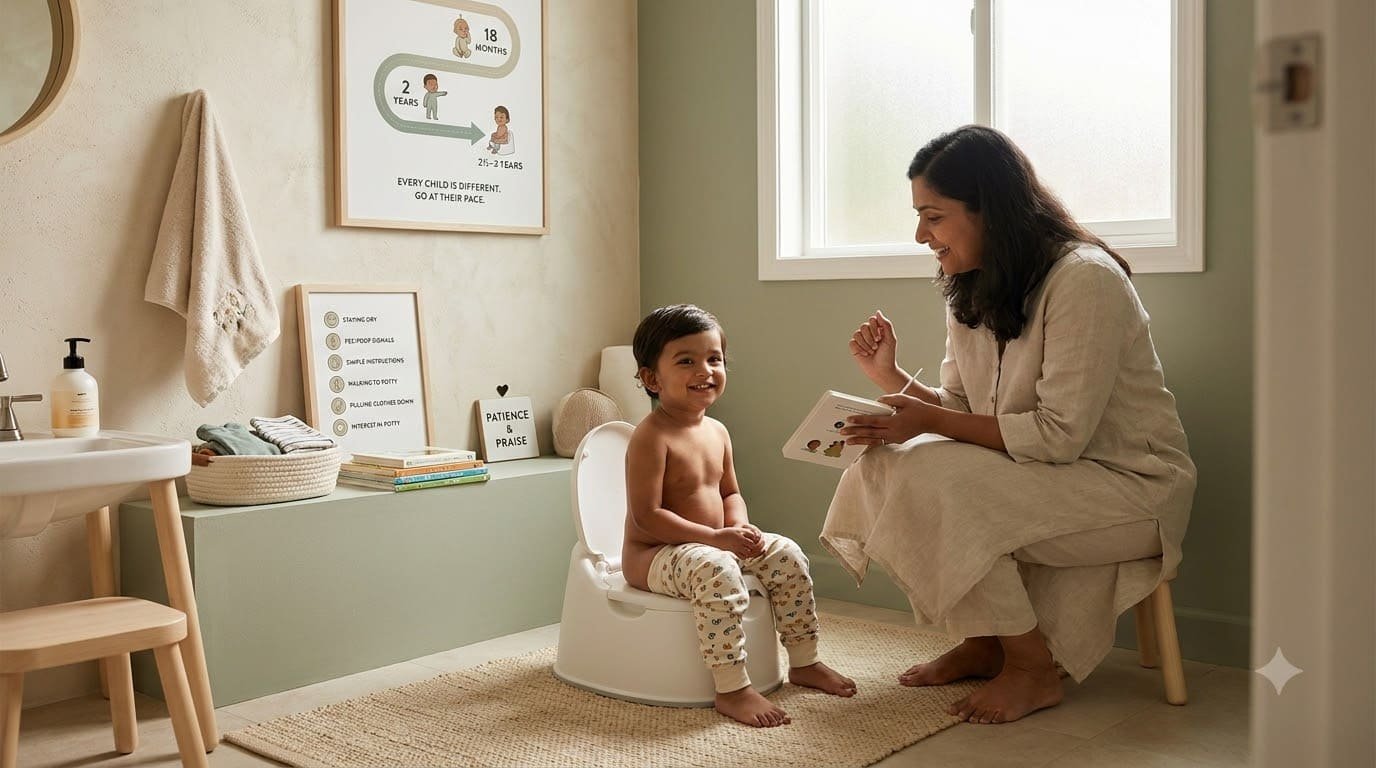
Before you start training, introduce the potty as a familiar, non-threatening object. Let it sit in the bathroom or wherever the child will use it. Explain what it’s for. Let the child sit on it with clothes on. Read books about potty training.
This familiarisation phase — 1-2 weeks — means the potty is not new and scary on Day 1 of training. The child has already explored it and knows what it is.
4. Language and Words — India Specific
Agree on clear, consistent words for what you’re doing. Use the same words every time, across all caregivers.
Common Indian English terms used:
- “Susu” / “pee-pee” / “wee”
- “Potty” / “latrine” / “number two”
Choose your family’s words and use them consistently. When the child starts using the word themselves — this is often a sign they’re making the cognitive connection.
In Hindi: “Susu karna hai?” / “Potty karna hai?” — simple, clear, and the same every time.
5. Nappy-Free Time — Build Body Awareness
One of the most effective training techniques — particularly in India’s warm climate — is extended nappy-free time. When a child is not wearing a nappy, they experience the immediate physical sensation of needing to go, rather than the nappy automatically absorbing it.
How to do it: Let the child play nappy-free at home for increasing periods of time. Have the potty accessible. Watch for signs — squatting, grabbing the genital area, going quiet, a particular expression. When you see these signs: “Do you need to susu? Let’s go to the potty!”
Manage accidents calmly: Clean up without strong emotion. “You had an accident. Next time we’ll try to get to the potty.” Calm, matter-of-fact.
6. Celebrate Successes — The Right Way
Celebration matters — but the approach matters more than the celebration itself.
What works: Genuine, warm praise immediately after success. “You did it! You used the potty! I’m so proud of you!” Specific praise is more effective than generic.
Sticker charts work well for children aged 2.5+. A sticker for every potty success, building toward a small reward, provides visible progress the child can track.
What doesn’t work: Excessive reward — large gifts or treats for every success sets an expectation that can’t be sustained. Praise and a sticker is usually sufficient.
Forced celebration — if the child seems indifferent, that’s fine. The praise doesn’t need to be theatrical.
7. Handle Accidents Without Reaction
Accidents will happen throughout training — they are not failures. How the adult responds to accidents significantly affects the child’s attitude toward the process.
The right response: Calm, matter-of-fact. “Oops, you had an accident. Let’s change your clothes and try to use the potty next time.”
What not to do: Express disappointment, frustration, or shame. Never punish accidents. Shame around bodily functions creates problems that persist well beyond potty training.
The Indian family challenge: In joint families, multiple adults may react differently to accidents. Nani may sigh. Dada may express concern. The child receives inconsistent messages. Brief the whole household before training begins: accidents are expected and are responded to calmly.
8. Manage the Night — Separately
Daytime dryness and night-time dryness are separate developmental achievements controlled by different neurological systems. Most children achieve daytime dryness months before night-time dryness.
The approach: Train for daytime first. Don’t try to manage nights simultaneously — it’s too much at once and night-time training cannot be accelerated by the same techniques (the child needs to develop the ability to rouse when they need to go).
When to tackle nights: Once daytime is consistently reliable and the child is waking with a dry nappy most mornings — then begin reducing night nappies.
Most children achieve reliable night-time dryness between 3 and 5 years. Occasional night accidents (enuresis) up to age 7 is within normal range.
9. Potty Training Regression — What to Do
Regression — a child who was trained returning to accidents — is extremely common and has specific triggers: a new sibling, starting school, a family move, illness, or any significant stress.
What to do: Go back to basics temporarily — scheduled sitting, reminders, training pants if needed. Don’t express frustration. Address the underlying cause if possible — the new sibling, the school anxiety, whatever is driving the regression.
Most regressions resolve within 2-4 weeks once the stressor eases.
Not regression: Occasional accidents in a trained child — these are normal and expected for months after initial training. A child who is trained will still have occasional accidents, particularly when absorbed in play, when ill, or when the toilet isn’t immediately accessible.
10. When to Step Back
If training is producing significant distress — the child is crying, refusing, having complete meltdowns around the potty — stop. Take a break of 4-6 weeks. Return to training after a reset.
Forced training against significant resistance takes longer and produces more stress than pausing and restarting when the child is more ready. This is not failure — it is reading your child accurately.
Common Potty Training Questions — India Specific
Q: My mother-in-law says I should have started at 18 months. Am I too late at 2.5?
No. Research consistently shows that starting too early — before developmental readiness — extends the training process rather than shortening it. Children who begin training after 27 months typically train faster than children who begin earlier. 2.5 is not late — it is actually optimal for many children.
Q: My son is 3 and still not trained. Should I be worried?
By age 3, most children are ready for training even if they resist. Consult your paediatrician if there has been no progress at all by 3.5 — there may be developmental factors worth assessing. Otherwise, stay consistent, reduce pressure, and give it time.
Q: My daughter trained quickly but my son is struggling. Why?
On average, girls train 2-3 months earlier than boys. This is a real and documented difference — partly biological, partly related to the slightly earlier verbal development in girls which helps with communication about needs. This doesn’t mean boys can’t train early or that something is wrong — just that the comparison isn’t fair.
Q: Should I use pull-ups or cloth training pants?
Pull-ups feel like nappies and many children treat them as such — they don’t feel the discomfort of an accident. Cloth training pants — thicker underwear that contains the mess but allows the child to feel wet — work better for building awareness. Use pull-ups for naps and nights; cloth pants during training hours.
Q: My toddler is refusing to poop on the potty but will pee fine. What do I do?
Poop training often lags behind pee training and is one of the most common potty training challenges. Many children feel insecure releasing their bowels in a new position or place. Don’t force. Watch for signs they need to poop and offer the potty calmly. Some children take weeks longer for poop than pee — this is entirely normal.
Q: The domestic helper/ayah uses a different approach. How do I manage this?
Have a specific, brief conversation with the ayah or domestic helper about the approach you’re using. Write down the key points: the words you use, how to respond to accidents, how to celebrate successes. Consistency from all caregivers is the single most important factor in training speed.
More from MumPappaHub — Read These Next:
- Positive Parenting Tips India
- Toddler Tantrums Tips India
- Toddler Language Development
- Child Development Milestones
- Bedtime Routine for Baby India
- Screen Time Guidelines Children India
- Child Safety Proofing Guide
- Baby First Year Milestones
- Baby Development Month by Month
- Indian Baby Weight Chart
- Baby Fever Guide
- Newborn Care Tips
About This Article
Written by the MumPappaHub editorial team — including a mother whose son showed zero potty training interest at 2 years 3 months while the WhatsApp group debated methods and her mother-in-law suggested she had waited too long. Her paediatrician said: “He’ll train when he’s ready. Your job is to make ready easier.” He trained in three weeks at 28 months.
Reviewed for accuracy against WHO child development guidelines and Indian Academy of Pediatrics recommendations on toilet training. This content is for general informational purposes only and does not constitute medical advice.
MumPappaHub — Real talk for real parents. mumpappahub.com

1 Comment