
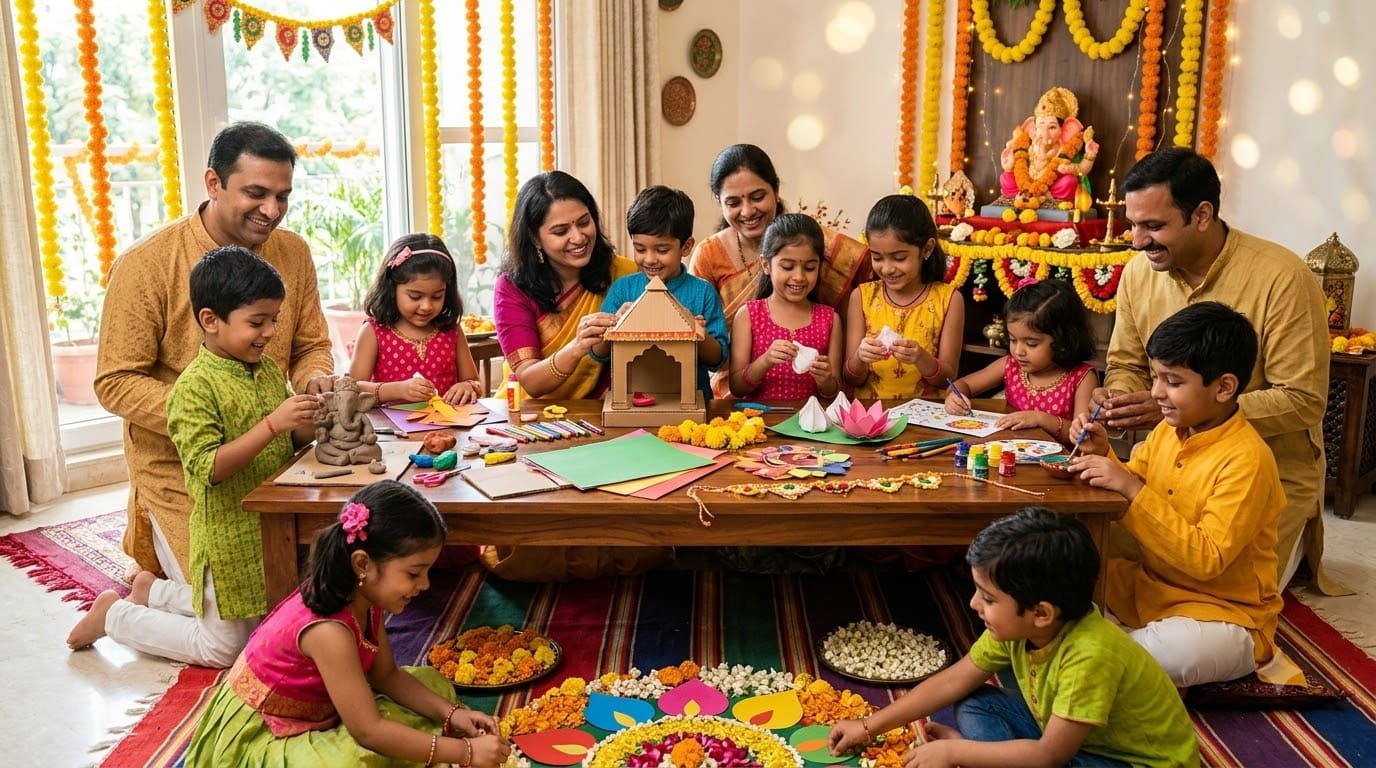
Last year, my daughter insisted on making her own Ganpati instead of just watching me set up the pooja corner. What started as “let her play with clay for ten minutes so I can cook” turned into an entire afternoon, flour on the kitchen floor, glitter in places glitter should never be, and a slightly lopsided clay Ganesha that she was prouder of than anything I’ve ever bought from a shop.
That lopsided little idol sat on our shelf for months. Guests would ask about it, and she’d launch into this whole story about how she made his ears “extra big because Ganpati likes to listen to everyone.”
If you’re searching for genuine ganesh chaturthi craft ideas for kids this year, not just something to keep them dressed up and photographed for five minutes, here are the activities that actually worked in our house, plus a few I wish someone had told me about earlier.
Why Ganesh Chaturthi Craft Ideas for Kids Actually Matter
Festivals tend to happen around young children more than with them. The pooja, the modaks, the visarjan — kids often watch from the side while adults manage the actual traditions.
Getting them hands-on with age-appropriate crafts does two things. It gives them a genuine sense of ownership over the festival, rather than it just being something that happens to the house once a year. And it’s a natural, low-pressure way to talk about the stories and meaning behind Ganesh Chaturthi — why Ganpati is welcomed into homes, what the modak represents, why the immersion happens — in a way that sticks far better than a lecture would.
1. Eco-Friendly Clay Ganpati Making
This was the activity that started it all in our house, and it remains the one my daughter talks about most.
Use natural clay (shadu mati) rather than Plaster of Paris — beyond being significantly better for the environment during visarjan, it’s also softer and easier for small hands to shape. Give your child a rough starting shape — a cone for the body, a ball for the head — and let them build from there rather than trying to guide every detail. The “wrong” proportions are usually the best part.
Younger toddlers can simply press their handprint into a flat piece of clay to create a keepsake, while older kids can attempt a full small idol with adult help on the finer details.
2. Paper Plate Ganesha Masks
A genuinely easy one for a rainy afternoon, and it works well for a range of ages.
Cut a paper plate into the basic shape of Ganesha’s face and ears, let your child paint it however they like — realistic colours are optional, and glittery purple Ganpati faces are apparently very much in fashion in our house — then attach a popsicle stick or elastic band so it can be worn or held up like a mask.
3. Modak-Shaped Playdough Activity
Real modak-making is a kitchen activity best left mostly to adults, but a playdough version lets kids mimic the shape and process without the heat or mess of actual cooking.
Roll small balls of playdough, flatten them into a disc, and show your child how to pinch and pleat the edges up into the classic modak shape before sealing the top. It’s genuinely good fine-motor practice, and most kids find the pleating oddly satisfying once they get the hang of it.
4. Ganesha Rangoli with Kid-Safe Materials
Traditional rangoli powder can be genuinely messy and, for younger kids, ends up more on clothes than the floor. A kid-friendly version using coloured rice, lentils, or flower petals arranged into a simple Ganesha outline or lotus pattern gives a similar visual effect with far less cleanup.
Draw a simple outline with chalk first, and let your child fill it in with whatever coloured materials you’ve got on hand. It doesn’t need to be symmetrical to look genuinely festive.
5. Decorated Diya Painting
Plain terracotta diyas, a few pots of acrylic paint, and total creative freedom. This one works well for almost any age — toddlers can dab colour on with their fingers, while older kids can attempt actual patterns.
Let them dry fully before use, and keep a few aside undecorated in case anyone wants a do-over halfway through — this happened more than once in our house.
6. Ganpati Bappa Handprint Art
A simple, sweet one for younger toddlers who aren’t quite ready for detailed craft work. Paint their palm and fingers, press it onto paper, and once dry, help them turn the shape into a simple Ganesha outline — the palm becomes the head, the fingers can be shaped into ears with a bit of extra drawing.
This one makes a genuinely lovely keepsake, especially if you do it every year and watch the handprint grow.
7. Paper Craft Modak Garland
For slightly older kids, cutting out modak shapes from coloured paper and stringing them into a garland is a nice way to decorate the house with something they made themselves, rather than store-bought bunting.
Draw a simple modak template, let your child trace and cut a batch of them (with supervision for the cutting), and thread them onto string or ribbon to hang near the pooja area or across a doorway.
8. Ganesha Colouring and Storytelling Session
Sometimes the simplest activity works best, especially on a day when everyone’s a bit tired. A set of Ganesha-themed colouring sheets, paired with telling (or reading) the story of why Ganesha has an elephant head, turns colouring time into a natural way to introduce the mythology behind the festival.
9. Recycled Material Ganpati Decoration
Cardboard, old bangles, bottle caps, and fabric scraps can all become part of a “recycled Ganpati” craft — building a flat Ganesha shape from cardboard and decorating it entirely with things you’d otherwise throw away.
This one doubles as a gentle, age-appropriate introduction to the idea of eco-friendly celebrations, which connects nicely to the broader push toward sustainable Ganesh Chaturthi celebrations happening across Indian cities.
10. Mini Visarjan Ritual for Kids
If your family does a symbolic visarjan at home in a tub or bucket before the larger community immersion, involving your child in this small ritual — even just letting them pour the water or say a simple goodbye to the clay idol they made — helps them understand the full arc of the festival, not just the fun setup part.
This was genuinely the moment that helped my daughter understand what visarjan actually meant, more than any explanation I gave beforehand.
Keeping the Eco-Friendly Angle in Mind
One thing I didn’t fully appreciate until we started making our own idols is how much of a difference the material choice makes. Plaster of Paris idols don’t dissolve properly in water and contribute meaningfully to water pollution during the immersion season, while natural clay idols dissolve safely and return to the earth as intended.
If your child’s craft idol is going to be immersed rather than kept as a keepsake, sticking to natural, biodegradable materials throughout — clay, natural colours, no plastic decorations — matters more than it might seem for a small home craft project.
For more activity ideas that work well across the year, not just for festivals, our sensory play for toddlers and screen-free play ideas guides have plenty of similar hands-on inspiration.
Age-Appropriate Guide: What Works for Which Age
| Age Group | Best Activities |
|---|---|
| Under 2 years | Handprint art, finger-painted diyas |
| 2-4 years | Playdough modaks, paper plate masks, simple rangoli |
| 4-6 years | Clay Ganpati with help, paper garlands, recycled decorations |
| 6+ years | Independent clay idol making, detailed colouring and storytelling, mini visarjan participation |
FAQ — Ganesh Chaturthi Craft Ideas for Kids
What age can kids start making their own Ganpati idol?
Even toddlers as young as two can participate in a simplified way, like pressing clay into a rough shape or doing a handprint version. More detailed idol-making, with actual shaping of features, tends to work better from around age four or five with adult guidance.
Is clay Ganpati making safe for young children?
Natural clay (shadu mati) is generally safe and non-toxic, making it a good choice for kids’ craft projects. Always supervise younger children to make sure they aren’t putting clay in their mouths, and wash hands thoroughly afterward.
What’s the best eco-friendly alternative to Plaster of Paris idols for a kids’ craft project?
Natural clay, known as shadu mati, is the most widely recommended alternative. It shapes similarly to Plaster of Paris but dissolves safely in water without the environmental harm, making it ideal for both craft projects and eventual immersion.
How do I explain the meaning of Ganesh Chaturthi to a young child?
Simple storytelling works best — focusing on Ganesha as a remover of obstacles and a bringer of good fortune, welcomed into the home like a special guest. Pairing the story with a hands-on activity, like colouring or craft-making, tends to help it stick far better than explanation alone.
Can these craft activities be done with a large group, like a school class?
Most of these, particularly the paper plate masks, diya painting, and colouring sessions, adapt well to group settings with minimal individual supervision needed. Clay idol making works best in smaller groups or at home, since it needs more one-on-one guidance.
What should I do with the craft idol after the festival?
If it’s made from natural clay, a small symbolic home immersion in a bucket or tub is a lovely way to complete the tradition. If it’s a keepsake craft, like a handprint or paper decoration, many families simply keep it as a memory of that year’s celebration.
More from MumPappaHub — Read These Next:
- Sensory Play for Toddlers
- Screen-Free Play Ideas
- Independence Day Craft Ideas for Kids
- Raksha Bandhan Activities for Kids
- Patriotic Baby Names for August
- Toddler Language Development
- Positive Parenting Tips India
- Screen Time Guidelines for Children in India
About the Author
This article was written by the MumPappaHub editorial team, drawing on personal parenting experience with festival crafts and activities. This content is for general informational purposes only.
MumPappaHub — Real talk for real parents. mumpappahub.com

2 Comments