
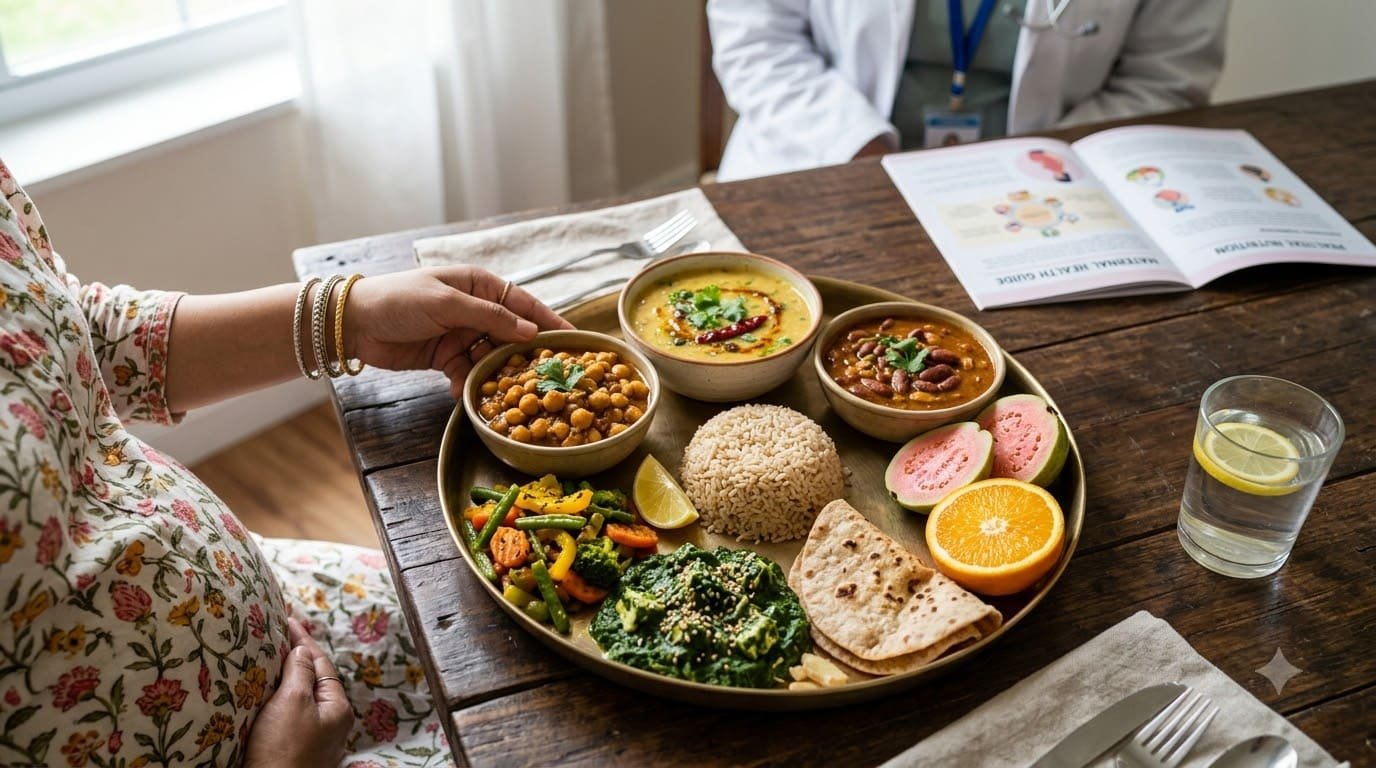
Medical Disclaimer: This article is for informational purposes only and reviewed against WHO, FOGSI, and IAP guidelines. Anaemia in pregnancy requires medical diagnosis and treatment. Never self-prescribe iron supplements. Always follow your gynaecologist’s specific guidance.
Anemia in pregnancy India is not a rare complication. It is the most common nutritional deficiency among Indian pregnant women — affecting approximately 50% of pregnant women across India, according to national health surveys.
My friend Priya found out she was anaemic at her 20-week antenatal check. Her haemoglobin was 9.2 g/dL — below the 11 g/dL threshold for anaemia in pregnancy. She had felt tired, but she had attributed it to pregnancy. She was breathless on climbing one flight of stairs, but she thought that was normal. Her paediatrician later told her that many Indian women live with significant anaemia for months without recognising it as a medical condition.
Her gynaecologist prescribed iron and folic acid supplements and a specific dietary plan. By Week 32, her haemoglobin was 11.4 g/dL. Normal delivery at 38 weeks.
This guide covers everything Indian pregnant women need to know about anaemia in pregnancy — why it is so common in India, what symptoms to recognise, which foods genuinely help, and how it is treated.
What Is Anaemia in Pregnancy India?
Anaemia in pregnancy India — a haemoglobin level below 11 g/dL in the first and third trimester, or below 10.5 g/dL in the second trimester — is classified by severity:
| Severity | Haemoglobin Level |
|---|---|
| Mild | 10-10.9 g/dL |
| Moderate | 7-9.9 g/dL |
| Severe | Below 7 g/dL |
According to the World Health Organization’s guidelines on anaemia in pregnancy, iron deficiency is the most common cause of anaemia globally and in India. The Federation of Obstetric and Gynaecological Societies of India (FOGSI) and the Indian Academy of Pediatrics both identify anaemia as one of the most significant and most preventable causes of maternal and neonatal complications in India.
Why anaemia in pregnancy is particularly common in India:
- Many Indian women enter pregnancy already iron-deficient — from years of inadequate dietary iron and recurrent menstrual blood loss
- The Indian diet is predominantly plant-based, and plant iron (non-haem iron) is less bioavailable than animal iron (haem iron)
- Multiple pregnancies close together deplete iron stores
- Vegetarian and vegan diets have lower dietary iron bioavailability
- Cultural food practices may limit iron-rich foods during pregnancy
Complications of untreated anaemia in pregnancy:
- Preterm birth
- Low birth weight baby
- Postpartum haemorrhage (excessive bleeding after delivery)
- Maternal mortality risk
- Impaired brain development in the baby
- Low iron stores in the newborn — affecting the baby’s development in the first months of life
Symptoms — Recognising Anaemia in Pregnancy
Many Indian women with moderate anaemia have adapted to the symptoms and do not recognise them as abnormal. Key symptoms:
🔴 Persistent fatigue — beyond normal pregnancy tiredness 🔴 Breathlessness — on mild exertion (climbing one flight of stairs) 🔴 Palpitations — feeling the heart beating fast 🔴 Pale inner eyelids, pale tongue, pale nail beds 🔴 Dizziness or lightheadedness — particularly on standing 🔴 Headache — persistent, not relieved by rest 🔴 Reduced concentration and brain fog 🔴 Cold hands and feet
The adaptation problem: Many Indian women have been mildly or moderately anaemic for years before pregnancy. Their bodies have adapted to lower haemoglobin levels, and they may not experience obvious symptoms even with haemoglobin as low as 8-9 g/dL. This is why blood tests at antenatal visits are essential — you cannot rely on symptoms alone to diagnose or exclude anaemia.
10 Best Iron-Rich Foods and Treatments for Anaemia in Pregnancy India
1. The Antenatal Blood Test — Non-Negotiable
The single most important action for anaemia in pregnancy is getting the blood test done.
FOGSI recommends haemoglobin testing:
- At the first antenatal visit (as early as possible)
- At 28 weeks
- At 36 weeks
- Any time symptoms suggest anaemia
The test: A simple blood test measuring haemoglobin (Hb) and ideally serum ferritin (iron stores). Available at all government health centres and laboratories.
Under PMSMA: Free antenatal blood tests — including haemoglobin — are available on the 9th of every month at government health facilities under the Pradhan Mantri Surakshit Matritva Abhiyan.
Do not skip your antenatal blood tests. Anaemia detected early is managed effectively. Anaemia detected late or not at all becomes a delivery complication.
2. Iron and Folic Acid Supplementation — Follow Your Doctor
The primary treatment for iron deficiency anaemia in pregnancy is oral iron supplementation — prescribed by your gynaecologist based on your haemoglobin level.
Under the National Health Mission: Free Iron and Folic Acid (IFA) tablets are provided to all pregnant women registered at government health facilities — one tablet daily from the first trimester.
The prescription: For women without anaemia: preventive dose — one IFA tablet daily For mild-moderate anaemia: therapeutic dose — two IFA tablets daily (or as prescribed) For severe anaemia: parenteral (injection) iron or blood transfusion may be needed
Taking iron tablets correctly:
- Take on an empty stomach for best absorption — or with orange juice (vitamin C improves iron absorption)
- Do not take with tea, coffee, or milk — these reduce iron absorption significantly
- Take at a consistent time daily
- Continue for at least 3 months after haemoglobin normalises — to rebuild iron stores
Side effects: Nausea, constipation, dark stools — these are common and not dangerous. If nausea is severe, take the tablet after a light meal. Increase fibre and water intake for constipation.
3. Palak (Spinach) — The Iron-Rich Green
Palak is India’s most available iron-rich leafy green — and one of the most important dietary additions for anaemic pregnant women.
Iron content: 100g fresh palak provides approximately 2.7mg of iron.
The absorption challenge: Plant iron (non-haem iron) from palak is absorbed at only 2-20% efficiency — much lower than animal iron. Consuming vitamin C alongside palak significantly increases absorption.
How to maximise palak iron:
- Palak sabzi with a squeeze of lemon juice
- Palak dal — combining palak iron with dal iron
- Palak paratha with amla chutney (amla is extremely high in vitamin C)
- Palak rice with nimbu squeezed at serving
Daily target: At least one serving of palak or another iron-rich green (methi, sarson, bathua) daily.
4. Jaggery (Gur) — Traditional Iron Source
Jaggery contains iron — approximately 11mg per 100g — significantly more than refined sugar. Traditional Indian belief in jaggery as a blood-building food has genuine nutritional basis.
How to use in pregnancy:
- Replace refined sugar with jaggery in tea, porridge, and sweets
- Jaggery with ghee and roti — a traditional pre-meal combination
- Til-gur laddoo — sesame seeds with jaggery (both iron-rich)
- Chikki (peanut brittle with jaggery)
Note: Jaggery is still sugar — use in moderation, particularly if gestational diabetes is a concern. The iron content per small serving is modest — jaggery supports rather than replaces dietary iron from vegetables and dal.
5. Ragi (Finger Millet) — The Most Iron-Rich Grain
Ragi is extraordinary among Indian grains — 100g of ragi provides 3.9mg of iron, more than three times the iron in wheat (1.2mg) and significantly more than rice (0.6mg).
For vegetarian Indian pregnant women with anaemia, replacing wheat or rice with ragi at one or two meals daily makes a meaningful difference to dietary iron intake.
Ragi preparations for pregnancy:
- Ragi porridge (ragi kanji) for breakfast
- Ragi roti instead of wheat roti
- Ragi dosa
- Ragi laddoo with jaggery and dry fruits
- Ragi idli
6. Dal and Legumes — Daily Iron Foundation
Dal at every meal is the most practical and sustainable dietary intervention for anaemia in pregnancy. All varieties of dal provide meaningful iron:
| Dal | Iron per 100g cooked |
|---|---|
| Rajma | 2.9mg |
| Kala chana | 3.3mg |
| Moong dal | 1.8mg |
| Masoor dal | 2.4mg |
| Toor dal | 1.6mg |
| Chana dal | 2.5mg |
The vitamin C pairing: Eat dal with a source of vitamin C at the same meal — a small glass of nimbu paani, amla chutney, raw tomato, or a piece of guava. This improves non-haem iron absorption by 2-3 times.
The tea/coffee blocker: Avoid tea or coffee within one hour before or after eating iron-rich foods or taking iron tablets. The tannins in tea are among the most powerful inhibitors of iron absorption.
7. Dates (Khajoor) — Sweet Iron Source
Dried dates provide approximately 0.9mg of iron per 100g and also contain vitamin C, potassium, and magnesium. They are a traditional Indian pregnancy food with genuine nutritional value.
The late pregnancy benefit: The late pregnancy benefit of dates extends beyond iron — research shows that eating 6 dates daily from Week 36 is associated with better cervical ripening and higher rates of spontaneous labour onset. For anaemic pregnant women, dates provide a pleasant iron-containing food that also supports delivery preparation.
How to use: 4-6 dates daily as a snack from Week 20 onward (discuss with gynaecologist if gestational diabetes is present) Date and dry fruit laddoo — a traditional pregnancy energy food
8. Amla (Indian Gooseberry) — Vitamin C for Iron Absorption
Amla is one of the richest natural sources of vitamin C — one small amla provides more vitamin C than an orange. As vitamin C dramatically improves iron absorption, making amla a daily part of the diet is one of the most effective dietary strategies for anaemia in pregnancy.
How to use:
- Fresh amla in salad or chutney
- Amla juice diluted (sour, so dilute with water)
- Amla pickle (small amount with meals)
- Amla murabba (preserves in sugar — in moderation)
- Amla powder (churna) in water
The timing: Eat amla or another vitamin C food at the same meal as your iron-rich foods — the enhancement of absorption is immediate and significant
9. Beetroot — Traditional Blood-Builder
Beetroot is a traditional Indian pregnancy food for anaemia — and while its iron content is modest (0.8mg per 100g), it contains folate, potassium, and nitrates that support blood vessel health and circulation.
The traditional belief that beetroot “makes the blood” may overstate its iron contribution, but beetroot as part of a varied, iron-rich diet has genuine benefits.
How to use:
- Beetroot raita
- Beetroot sabzi (cooked)
- Beetroot and carrot salad with lemon
- Beetroot paratha
- Beetroot juice mixed with amla juice
10. Lotus Seeds (Makhana) — Iron-Rich Pregnancy Snack
Makhana (fox nuts/lotus seeds) provides approximately 1.4mg of iron per 100g and is one of the most commonly recommended Indian pregnancy snacks. They are easily digestible, widely available, and traditionally associated with pregnancy nutrition.
How to use:
- Roasted makhana with ghee — the most common form
- Makhana kheer — a traditional pregnancy dessert
- Makhana combined with dry fruits as a snack
Foods and Drinks That Block Iron Absorption — Avoid With Iron-Rich Foods
❌ Tea (chai) — avoid within 1 hour of iron-rich foods
❌ Coffee — same as tea
❌ Milk — calcium blocks iron absorption
❌ Antacids — reduce iron absorption
❌ Excess bran/phytates — reduce iron availability
The chai culture challenge: Indian chai culture means many women drink multiple cups of tea daily, often with and after meals. This is one of the most significant contributors to poor iron absorption in Indian women. Shifting tea to between meals — not with meals — makes a meaningful difference.
When to Seek Urgent Medical Attention
🚨 Haemoglobin below 7 g/dL — severe anaemia requiring medical intervention 🚨 Severe breathlessness at rest 🚨 Chest pain or palpitations at rest 🚨 Fainting 🚨 No improvement in haemoglobin after 4 weeks of treatment
FAQ — Anemia in Pregnancy India
Q: My doctor has prescribed iron tablets but they make me very nauseous. What can I do?
Take the tablet with a small amount of food rather than completely empty stomach — this reduces nausea, though slightly reduces absorption. Take it at night before bed when nausea is less bothersome. Ask your gynaecologist about a different iron preparation — some forms (ferrous bisglycinate) cause less nausea than others (ferrous sulphate). Do not stop the tablets without discussing with your doctor.
Q: Can I get enough iron from diet alone without supplements?
For women who are already anaemic when identified in pregnancy — dietary changes alone are insufficient to correct anaemia within the timeframe of pregnancy. Supplementation is necessary. Dietary changes support supplementation and help rebuild stores after delivery, but cannot replace supplements when haemoglobin is already low.
Q: My haemoglobin is 10.2 g/dL. Is this dangerous?
10.2 g/dL is mild anaemia. With appropriate treatment — iron supplementation and dietary improvement — this is fully manageable and excellent outcomes are expected. Follow your gynaecologist’s prescribed treatment plan and attend all scheduled haemoglobin recheck appointments.
Q: I am vegetarian. Can I get enough iron?
Vegetarian Indian diets can provide adequate iron — but it requires deliberate planning. Dal at every meal, ragi instead of wheat sometimes, palak and other iron-rich greens daily, vitamin C with every iron-rich meal, and avoiding tea with meals — plus prescribed supplementation if anaemic. Vegetarian women need to be particularly attentive to iron intake throughout pregnancy.
Q: Is it safe to take iron supplements throughout pregnancy?
Yes — the WHO recommends iron and folic acid supplementation for all pregnant women throughout pregnancy as a preventive measure, regardless of haemoglobin level. This is one of the most well-established and safe pregnancy supplements. Follow your gynaecologist’s prescribed dose.
More from MumPappaHub — Read These Next:
- Pregnancy Diet Chart India
- Foods to Avoid During Pregnancy India
- Gestational Diabetes India
- Normal Delivery Tips India
- C-Section Recovery India
- Pregnancy Week by Week Second Trimester
- Pregnancy Week by Week Third Trimester
- Hospital Bag Checklist India
- Iron Rich Foods Babies Toddlers India
- Breastfeeding Problems India
- Newborn Care Tips
- Pregnancy Calendar Week by Week
About This Article
Written by the MumPappaHub Research Team — including a researcher whose friend Priya was diagnosed with anaemia at 20 weeks. Haemoglobin 9.2 g/dL. She had felt tired but thought it was pregnancy. Breathless on one flight of stairs but thought it was normal. By Week 32, with treatment and diet changes, her haemoglobin was 11.4 g/dL. Normal delivery at 38 weeks.
Reviewed for accuracy against WHO guidelines on anaemia in pregnancy, FOGSI clinical recommendations on iron deficiency anaemia management in Indian pregnant women, and Indian Academy of Pediatrics guidance. This content is for general informational purposes only. Always follow your gynaecologist’s specific treatment guidance.
MumPappaHub — Real talk for real Indian parents. mumpappahub.com
