
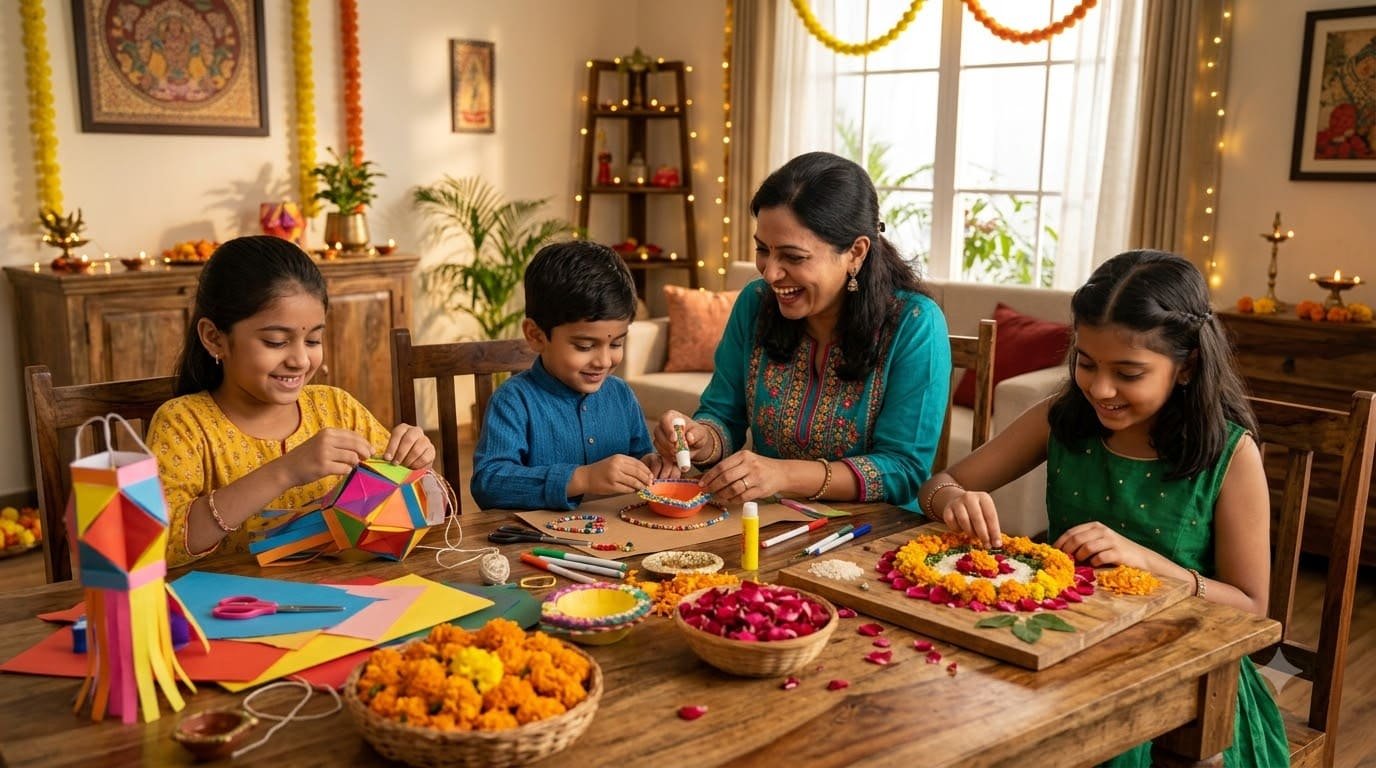
Diwali craft ideas for kids India is what every Indian parent starts searching in the week before the festival — looking for activities that are genuinely doable with small children, that don’t require craft supplies only available online with 10-day delivery, and that actually connect children to the meaning of the festival rather than just keeping them busy.
My mother had a simple rule for Diwali: every child in the house made at least one thing that went into the Diwali celebration. It didn’t matter how small or imperfect. The youngest cousin’s lopsided paper diya sat next to the professional brass ones on the windowsill every year. He is now 24 and he still talks about it.
That is the spirit behind this guide — Diwali craft ideas for kids that make them participants in the festival, not spectators.
Why Diwali Crafts Matter for Children
Diwali — the festival of lights — is one of India’s most visually and sensory rich festivals. For children, it offers:
Creative participation: Making something with their hands for a festival they love is deeply meaningful — more than watching adults make things.
Cultural connection: When children make a rangoli or paint a diya, they are doing what Indian children have done for generations. This is cultural transmission through doing.
Sensory learning: Colours, textures, shapes, light — Diwali crafts engage multiple senses simultaneously, supporting cognitive and motor development.
Pride and ownership: “I made that” — when the diya they painted is part of the Diwali display, children experience genuine pride and belonging.
12 Best Diwali Craft Ideas for Kids India
Craft 1 — Painted Clay Diyas
The most classic and most beloved Diwali craft for children. Clay diyas (mitti ke diye) are available at markets across India from Rs 2 each from October onward.
Materials:
- Plain clay diyas
- Poster paint or acrylic paint
- Paintbrushes (various sizes)
- Glitter glue (optional)
- Sequins or small mirrors (optional)
Age-appropriate approach:
Toddlers (2-3 years): Finger painting the diya in broad strokes. The result will be abstract and beautiful. Let them choose the colours.
Preschoolers (3-5 years): Brushes with bold patterns — dots, stripes, geometric shapes. Glitter glue dots added after the paint dries.
Older children (5+): Detailed designs — flowers, geometric patterns, traditional motifs. Sequins pressed into the wet paint.
The lighting: Light the diya together that evening. “You painted this diya. Now we’re going to light it.” This connection — making and then using — is the heart of the craft.
Safety: Adult manages the lighting of diyas. Keep lit diyas away from children’s reach.
Craft 2 — Paper Lanterns (Kandil)
Paper lanterns hung at windows and doorways are a traditional Diwali decoration — and making them is one of the easiest, most satisfying crafts for children of all ages.
Simple version for young children:
Take a rectangular piece of coloured paper (A4 size works). Fold in half lengthwise. Cut slits from the folded edge toward the open edge — leaving about 2cm uncut at the open edge. Unfold. Roll into a cylinder and tape the ends together. Attach a paper or ribbon handle at the top.
Decorated version: Before folding — decorate the paper with Diwali patterns using crayons, markers, or poster paint. Let dry. Then fold and cut. The pattern shows through the slits when hung near a light.
Tissue paper version: Cut tissue paper into squares. Crumple loosely. Fill a paper bag or lantern shape with the crumpled tissue. Add a tea light inside (adults only manage the tea light).
Age: 4+ for simple lantern, 2+ with parent help
Craft 3 — Rice and Flower Rangoli
Traditional rangoli requires fine motor precision that young children don’t yet have — but these adaptations are fully accessible and genuinely beautiful.
Rice rangoli: Draw a simple rangoli outline in chalk on the floor. Colour rice at home by placing in a zip-lock bag with a few drops of food colouring and shaking. Make several colours. Fill the chalk outline sections with different coloured rice.
Flower petal rangoli: Collect marigold petals (the traditional Diwali flower). Arrange them in concentric circles on the floor. No fine motor skill needed — just placing petals.
Stamp rangoli: Cut a potato in half. Carve a simple shape — circle, leaf, star. Dip in rangoli colour powder mixed with a little water. Stamp a repeating pattern.
Age: 2+ (with help), 4+ (more independently)
Materials readily available: Rangoli colour powder is available at most Indian markets for Rs 10-20 per packet before Diwali. Marigold flowers are widely available.
Craft 4 — Lakshmi and Ganesha Footprint Art
This is one of the most meaningful Diwali crafts — because it connects the child physically to the festival’s symbolism. In the Diwali tradition, Lakshmi’s footprints are drawn or printed leading into the home to invite the goddess of wealth and prosperity.
How to do it: Paint the child’s foot (sole) with red or yellow poster paint. Press firmly onto paper or card. Lift carefully. Add toe prints separately if needed. Let dry. Draw lotus flower or decorative elements around the footprints with a fine marker.
The story: “Diwali is when Goddess Lakshmi visits homes that are clean and bright. We make her footprints to welcome her. These are your footprints — you’re welcoming Lakshmi!”
Age: Any age (toddlers need full adult help, older children can do with guidance)
Note: Poster paint washes off easily. Do this before the bath.
Craft 5 — Diwali Greeting Cards
Making Diwali cards for family members — grandparents, cousins, neighbours — is a craft activity that is also a lesson in relationship and generosity.
Simple card techniques:
Stamp card: Use potato stamps, bottle cap stamps, or bubble wrap stamped with paint to create patterns.
Collage card: Cut and paste coloured paper shapes — diyas, fireworks, stars, lamps.
Handprint card: Child’s handprint as the base of a diya flame or firework.
Watercolour wash: Wash the card background with diluted watercolour paints. Let dry. Draw diya or festival design with black marker on top.
Inside message: Even young children can dictate a Diwali message that the parent writes, and then “sign” with their name or mark.
The distribution: Taking the card to give to the recipient — grandparents, the neighbour — is as important as making it.
Age: 2+ (stamping and handprints), 4+ (more complex designs)
Craft 6 — Decorated Diwali Thali
Making a decorated puja thali — the plate used for the Diwali puja — gives children an active role in the family’s religious practice.
Materials:
- Plain steel or brass plate (use one that is not the “good” one)
- Acrylic paint suitable for metal
- Foam stickers in Diwali shapes (available at stationery shops)
- Rhinestones or sequins
- Glitter glue
How to do it: Paint the rim of the thali in the child’s chosen colour. Allow to dry. Add foam stickers, rhinestones, glitter glue decorations. Allow to dry completely.
The use: This thali, made by the child, is used for the Diwali puja. “You made this. Tonight we use it for puja.”
Age: 4+ (with parental guidance on paint and metal)
Craft 7 — Paper Diya Mobile
A hanging mobile of paper diyas — suspended from a stick or dowel — makes a beautiful window decoration and is entirely manageable for children aged 4+.
Materials:
- Coloured paper or card (orange, yellow, red)
- Thread or wool
- A thin stick or wooden dowel
- Scissors and glue
How to make: Draw diya shapes on coloured paper — or use a diya template. Cut out. Decorate with markers or glitter. Punch a hole at the top of each diya. Thread through wool or string. Attach strings of different lengths to the dowel. Hang in a window.
Age: 4+ (cutting with child-safe scissors), 6+ (more independent)
Craft 8 — Salt Dough Lakshmi Footprints
Salt dough is a simple, made-at-home craft material that creates keepsakes lasting years.
Salt dough recipe: 1 cup plain flour + 1/2 cup salt + 1/2 cup water. Knead until smooth.
How to use: Roll out to 1cm thickness. Press the child’s foot into the dough to make an impression. Cut a neat shape around the footprint with a knife. Use a straw to make a hole at the top (for hanging). Bake at 180°C for 2-3 hours until completely hard. When cool — paint and decorate.
The keepsake: A salt dough Lakshmi footprint from Diwali 2026 — with the child’s age and date written on the back — is a family keepsake that lasts indefinitely.
Age: Any age (toddlers need full help), 5+ (more involvement in decorating)
Craft 9 — Diwali Story Booklet
For children who love stories — making a small Diwali story booklet combines literacy, art, and cultural learning.
How to make: Fold several sheets of A4 paper in half to make a small booklet. Staple at the fold.
The content: The child (with parent help as needed) illustrates and writes (or dictates) the Diwali story — Ram and Sita returning from Lanka, the people lighting diyas to welcome them, the meaning of light over darkness.
Page 1: Ram and Sita in the forest Page 2: The battle with Ravana Page 3: Returning home Page 4: People lighting diyas Page 5: Our family celebrating Diwali
Age: 5+ (writing), 3+ (drawing with narration)
Craft 10 — Decorating with Marigolds
Marigolds — the quintessential Diwali flower — are available abundantly and inexpensively across India before the festival. Using marigolds in simple decorations is an age-appropriate activity for even very young children.
Marigold string: Thread marigold flowers onto thick wool or string using a blunt needle. A child-sized garland to hang at the door.
Marigold vase: Fill a simple clay pot or glass with water. Arrange marigold stems. Place at the entrance.
Floating flowers: A shallow bowl of water with floating marigold heads — with a small diya floating among them. Visually beautiful and very easy.
Age: 3+ (stringing with adult help), 5+ (more independently)
Craft 11 — Diyas from Air-Dry Clay
For a more durable diya than the bought mitti versions, children can make their own diyas from air-dry clay (available at art supply stores) or homemade salt dough.
How to shape: Roll a ball of clay. Press a thumb into the centre to make the bowl. Pinch one side up to make the spout. Shape a small base. Leave to air-dry (2-3 days) or bake (salt dough).
Decorate: Once dry — paint, glitter, sequins.
The satisfaction: A diya that the child shaped with their own hands and decorated, that holds an actual flame on Diwali night, is a profound experience of craft becoming real.
Age: 4+ (with parental guidance on shaping)
Craft 12 — Diwali Memory Box
A keepsake craft for the whole festival week — decorate a small box to hold Diwali memories.
Materials:
- A small cardboard box (a shoebox, or a small gift box)
- Wrapping paper or newspaper (for covering)
- Paints, markers, stickers
- “Diwali 2026” written or printed on the lid
During the festival week: The child places small Diwali memories in the box — a dried marigold petal, a piece of sparkler stick (cold), the wrapper from mithai, a small photograph, a piece of rangoli colour.
After Diwali: The box is closed and stored. A memory box that accumulates Diwali mementos across years becomes a family treasure.
Age: 4+ (decorating the box), any age (contributing memories)
Diwali Craft Safety for Young Children
Diyas and flames: Never leave lit diyas near children unsupervised. Keep lit diyas on stable surfaces. Ensure loose clothing is tied back near open flames.
Paints and glues: Use non-toxic, washable poster paints for young children. Acrylic paints are for older children and adults. Child-safe PVA glue for all ages.
Scissors: Child-safe, rounded-tip scissors for children under 6. Adult supervision for any cutting activity.
Fireworks: Small children and fireworks are genuinely dangerous. The safest Diwali for young children involves sparklers (held by adults, kept at arm’s length), not crackers. Many Indian families are now celebrating cracker-free Diwali — a responsible choice that is also safer for children’s lungs and hearing.
FAQ — Diwali Craft Ideas for Kids India
Q: My 18-month-old is too young for most crafts. What can she do?
Finger painting a diya (with close supervision and non-toxic paint). Pressing flower petals onto a rangoli outline. Placing marigold heads in a bowl of water. Wearing her Diwali outfit and being part of the lighting ceremony. Presence and inclusion are the craft at this age — not the output.
Q: I have no craft supplies at home. What can I do with just household materials?
Paper lanterns (just paper, scissors, and tape). Rangoli with rangoli powder from the market (Rs 10-20). Flower petal rangoli from marigolds. Painted diyas from the market (bought plain, painted with food colouring if no paint available). Diwali greeting cards with crayons.
Q: My son has no interest in crafts. How do I engage him?
Start with what he already loves. If he loves cars — make a “road” rangoli. If he loves drawing — make Diwali story booklets. If he loves cooking — make mithai with you as the Diwali activity. The craft is a vehicle for participation, not the goal itself.
Q: How do I explain Diwali to a 3-year-old while crafting?
Keep it simple and sensory. “Diwali is the festival of lights. We light diyas because light is stronger than darkness — just like good is stronger than bad. We light this diya together — look how the darkness goes away when the flame comes on.” The concept through the experience, not through explanation.
More from MumPappaHub — Read These Next:
- Navratri Activities for Kids India
- Ganesh Chaturthi Craft Ideas for Kids
- Independence Day Craft Ideas for Kids
- Sensory Play for Toddlers India
- Cognitive Development Activities India
- Screen Time Guidelines Children India
- Positive Parenting Tips India
- Sibling Rivalry Tips India
- Toddler Language Development
- Baby Development Month by Month
- Discipline Toddler India
- Baby Fever Guide India
About This Article
Written by the MumPappaHub Research Team — including a researcher whose mother had a simple rule: every child in the house made at least one thing for Diwali. The youngest cousin’s lopsided paper diya sat next to the brass ones on the windowsill every year. He is 24 now and still talks about it.
This content is for general informational and cultural purposes. All craft activities should be done with appropriate adult supervision. Diya and flame safety guidelines apply.
MumPappaHub — Real talk for real Indian parents. mumpappahub.com
