
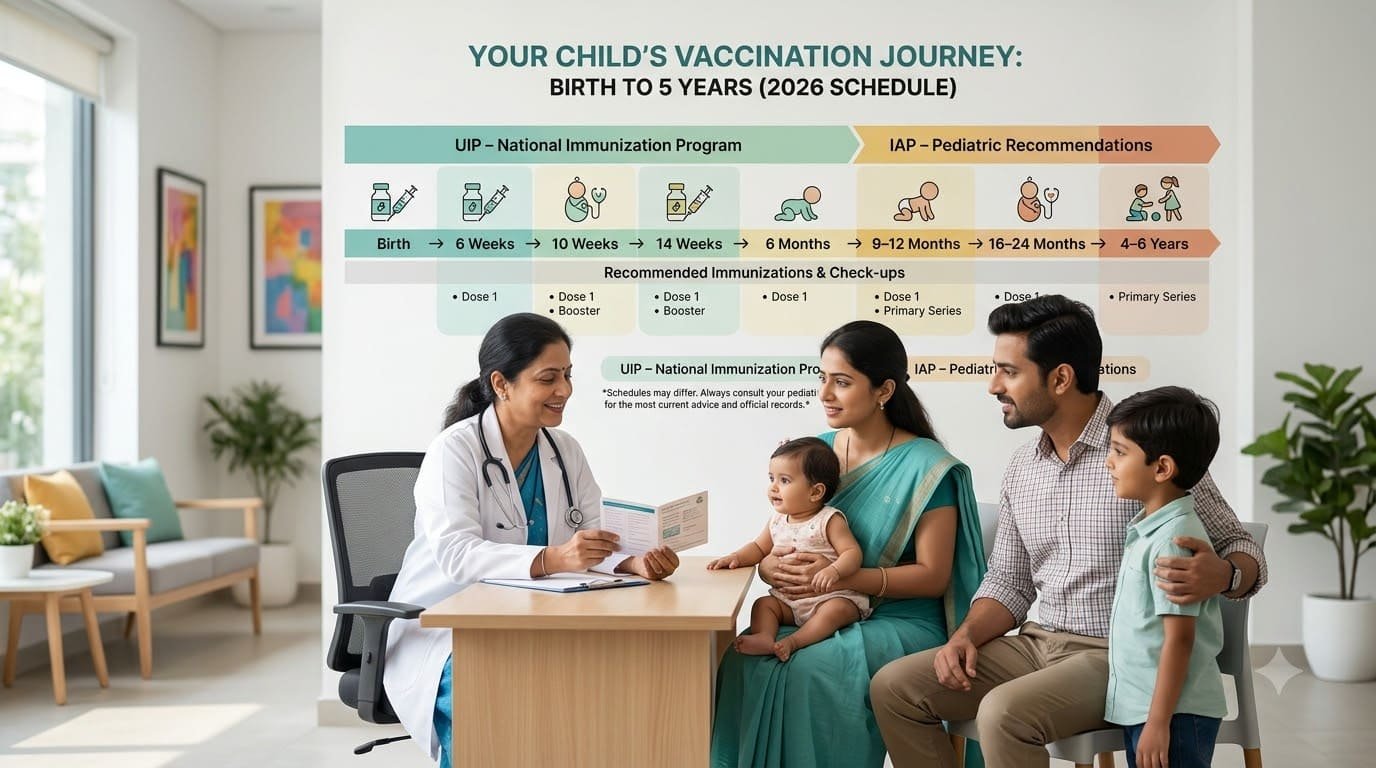
Baby vaccination schedule India 2026 can feel like reading a different language the first time a nurse hands it to you — dates, abbreviations, and no context for any of it.
Medical Disclaimer: This article is for informational purposes only. Always consult your paediatrician for the vaccination schedule specific to your baby. This guide is based on IAP 2026 and Government of India UIP guidelines.
My daughter’s vaccination booklet looked like a government document the first time I opened it.
Rows of dates. Abbreviations I didn’t recognise. BCG, OPV, DTwP, Hib, PCV, IPV — all in a table that assumed I knew what each of these stood for and why they mattered. The clinic gave it to me at discharge with a brief explanation I couldn’t absorb because I had been awake for twenty-six hours and had just had a baby.
By the six-week visit, I had written all the abbreviations on a piece of paper and googled each one separately. I wished someone had just explained it clearly the first time.
This is that explanation. The baby vaccination schedule India 2026 follows two main frameworks — the Government’s free UIP programme and the IAP’s comprehensive recommended schedule. This complete guide covers what each vaccine is, what it protects against, when it’s given, what’s free and what’s paid, and what to do if you miss a dose. No abbreviations without explanation. No assumptions that you already know this.
Baby Vaccination Schedule India 2026 — Two Types
India has two vaccination schedules that run simultaneously, and understanding the difference saves a lot of confusion at the clinic.
UIP — Universal Immunisation Programme Run by the Government of India under the Ministry of Health and Family Welfare. These vaccines are free of cost at all government health centres and primary health centres. This is the mandatory schedule that every Indian baby should receive.
IAP — Indian Academy of Pediatrics Schedule Recommended by the Indian Academy of Pediatrics — the professional body of paediatricians in India. The IAP schedule includes all UIP vaccines plus additional recommended vaccines that offer broader protection. Most private paediatricians follow the IAP schedule. These additional vaccines are paid for privately.
According to the Indian Academy of Pediatrics, the IAP immunisation schedule is updated regularly based on the latest evidence and disease burden data in India. The World Health Organization’s vaccine recommendations form the international framework that both UIP and IAP build upon for the Indian context.
Which one to follow? If you have access to a private paediatrician, follow the IAP schedule — it provides more comprehensive protection. If you rely on government health centres, the UIP schedule is free and covers the most critical vaccines. Many families combine both.
Why Baby Vaccination Schedule India 2026 Matters
At Birth (Within 24 Hours)
| Vaccine | Full Name | Protects Against | Free (UIP) |
|---|---|---|---|
| BCG | Bacillus Calmette-Guérin | Tuberculosis (TB) | Free |
| OPV-0 | Oral Polio Vaccine — Birth Dose | Polio | Free |
| Hepatitis B-1 | Hep B Birth Dose | Hepatitis B liver disease | Free |
Why these three at birth? BCG is given immediately because TB is still endemic in India and newborns are most vulnerable. The birth dose of Hepatitis B is critical — it must be given within 24 hours of birth to prevent mother-to-baby transmission. OPV at birth provides early intestinal immunity against polio.
6 Weeks (42 Days)
| Vaccine | Full Name | Protects Against | Free (UIP) |
|---|---|---|---|
| DTwP-1 | Diphtheria, Tetanus, Pertussis | Diphtheria, Tetanus, Whooping cough | Free |
| IPV-1 | Injectable Polio Vaccine | Polio | Free |
| Hib-1 | Haemophilus influenzae type b | Meningitis, pneumonia, epiglottitis | Free |
| Hepatitis B-2 | Second dose | Hepatitis B | Free |
| PCV-1 | Pneumococcal Conjugate Vaccine | Pneumonia, meningitis | Free |
| Rotavirus-1 | RV1 | Severe diarrhoea from rotavirus | Free |
Note on DTwP vs DTaP: Government centres give DTwP (whole cell pertussis). Private clinics often offer DTaP (acellular pertussis) which causes fewer side effects — mild fever and soreness — but costs more. Both protect equally well. Ask your paediatrician which is available.
What to expect after 6-week vaccines: Mild fever (38–38.5°C), fussiness, and soreness at the injection site are normal and expected. Give paracetamol at the correct dose for your baby’s weight. For guidance on managing post-vaccination fever, our baby fever guide covers what’s normal and when to call the doctor.
10 Weeks
| Vaccine | Full Name | Free (UIP) |
|---|---|---|
| DTwP-2 | Second dose | Free |
| IPV-2 | Second dose | Free |
| Hib-2 | Second dose | Free |
| Hepatitis B-3 | Third dose | Free |
| PCV-2 | Second dose | Free |
| Rotavirus-2 | Second dose | Free |
14 Weeks
| Vaccine | Full Name | Free (UIP) |
|---|---|---|
| DTwP-3 | Third dose | Free |
| IPV-3 | Third dose | Free |
| Hib-3 | Third dose | Free |
| PCV-3 | Third dose | Free |
| Rotavirus-3 | Third dose (if 3-dose vaccine used) | Free |
By fourteen weeks, your baby will have received the primary series of the most critical vaccines. This is a significant milestone in the immunisation schedule.
6 Months
| Vaccine | Free (UIP) | Notes |
|---|---|---|
| Influenza-1 | Paid | First of two doses, one month apart |
| OPV-1 | Free | Additional oral polio dose |
About the flu vaccine: The influenza vaccine is an annual vaccine — the flu virus mutates every year, which is why it’s given fresh each year. The IAP recommends it from 6 months onwards. The first year, two doses are given one month apart. From the second year, one dose annually.
9 Months
| Vaccine | Full Name | Free (UIP) |
|---|---|---|
| MMR-1 | Measles, Mumps, Rubella | Free |
| OPV-2 | Oral Polio Vaccine | Free |
| Typhoid Conjugate (TCV) | Typhoid Conjugate Vaccine | Paid (IAP) |
| Vitamin A-1 | Vitamin A supplementation | Free |
About MMR: The MMR vaccine protects against three diseases simultaneously — measles (which is still a significant cause of childhood illness in India), mumps, and rubella. Two doses are needed for full protection.
About Typhoid Conjugate Vaccine: The newer TCV has replaced the older typhoid vaccine in the IAP schedule. It works from 6 months of age — unlike the older vaccine which was only effective from age 2 — and provides longer-lasting protection. Given typhoid’s prevalence in India, this is a strongly recommended vaccine even though it’s not on the free UIP schedule.
12 Months (First Birthday Area)
| Vaccine | Full Name | Free (UIP) |
|---|---|---|
| Hepatitis A-1 | First dose | Paid (IAP) |
| PCV Booster | Pneumococcal booster | Free |
| Influenza (annual) | Annual flu shot | Paid |
| Varicella-1 | Chickenpox vaccine | Paid (IAP) |
About Hepatitis A: Two doses are given at least 6 months apart starting at 12 months. Hepatitis A spreads through contaminated food and water — a significant concern in India. Strongly recommended.
About Varicella (Chickenpox): Many parents wonder why chickenpox needs a vaccine since “everyone got it.” Chickenpox can cause serious bacterial infections, pneumonia, and hospitalisation in young children. Two doses are recommended.
15 Months
| Vaccine | Full Name | Free (UIP) |
|---|---|---|
| MMR-2 | Second MMR dose | Free |
| Varicella-2 | Second chickenpox dose | Paid |
16–18 Months (Booster Phase)
| Vaccine | Full Name | Free (UIP) |
|---|---|---|
| DTwP Booster | DTP booster | Free |
| IPV Booster | Polio booster | Free |
| Hib Booster | Hib booster | Free |
| Hepatitis A-2 | Second Hepatitis A dose | Paid |
| Typhoid Booster | TCV booster (every 3 years) | Paid |
Why boosters matter: Immunity from the primary vaccine series wanes over time. Boosters are not optional extras — they’re an essential part of complete immunisation. Skipping boosters is one of the most common mistakes parents make.
2 Years
| Vaccine | Notes |
|---|---|
| Typhoid Booster | If TCV given at 9 months, booster now |
| Annual Influenza | Every year from 6 months |
4–6 Years (Pre-School Boosters)
| Vaccine | Full Name | Free (UIP) |
|---|---|---|
| DTP Booster-2 | Second DTP booster | Free |
| OPV Booster | Polio booster | Free |
| MMR-3 | Third MMR dose (IAP) | Paid |
| Varicella Booster | Second chickenpox dose if not given earlier | Paid |
Free vs Paid — Quick Reference
Completely Free at Government Centres (UIP):
BCG, OPV (all doses), Hepatitis B (all doses), DTwP (all doses + booster), IPV (all doses), Hib (all doses), PCV (all doses), Rotavirus, MMR (1st and 2nd dose), Vitamin A.
Paid at Private Clinics (IAP Additional):
DTaP (alternative to DTwP — smoother side effects), Typhoid Conjugate Vaccine (TCV), Hepatitis A (2 doses), Varicella (chickenpox, 2 doses), Annual Influenza, Meningococcal vaccine (optional).
The Vaccination Booklet — Keep It Safe
Every baby in India receives a vaccination booklet — sometimes called the MCP (Mother and Child Protection) card — at birth or at the first clinic visit. This booklet:
Records every vaccine given, with date and dose. Is required for school admission in many states. Is needed if you travel internationally with your child. Provides a catch-up plan reference if doses are missed.
Keep it in a waterproof cover. Take it to every paediatrician visit. Don’t lose it — getting a duplicate is possible but cumbersome.
What to Do Before and After Vaccination
Before the visit:
Feed your baby normally — a hungry baby is an unhappy baby at the clinic. Dress your baby in easy-access clothing — a vest under a zippered outfit makes it easier. Bring the vaccination booklet. Note any illness in the days before — tell your paediatrician if your baby has had a fever in the past two days, as some vaccines are delayed during acute illness.
After vaccination:
Mild fever is normal and expected. Give paracetamol at the correct weight-based dose — ask your paediatrician beforehand so you’re prepared. Soreness and redness at the injection site are normal. A warm compress helps. Fussiness and crying for a few hours post-vaccination is normal. BCG site develops a small lump, then a blister, then a scar over 6–8 weeks — this is normal and not a reaction.
When to call the doctor after vaccination:
Fever above 39°C that doesn’t come down with paracetamol. Crying that is continuous for more than 3 hours. Seizure. Unusual limpness or unresponsiveness. Severe redness or swelling at the injection site spreading significantly beyond it.
Missing a Dose — What Actually Happens
One of the most common sources of anxiety: what if we miss a scheduled vaccine?
The reassuring answer: you do not start the schedule over. Missing a dose means you resume from where you left off. The previous doses are not wasted.
What to do: bring the vaccination booklet to the paediatrician and explain which dose was missed. They will calculate the catch-up schedule. Most doses can be given slightly later than scheduled without significantly compromising protection.
What’s not okay: leaving doses permanently missed. Immunity without the complete primary series or boosters is genuinely incomplete for several key vaccines.
Common Questions Indian Parents Ask About Vaccination
Q: My baby had a cold on vaccination day. Should I postpone?
A: A mild cold without fever is generally not a reason to postpone. A fever above 38°C, a more significant illness, or if your baby seems genuinely unwell — tell your paediatrician and they’ll advise. Most mild upper respiratory symptoms don’t require postponement.
Q: Can I give all the vaccines on one day?
A: In the early schedule, multiple vaccines are given at the same visit — this is intentional and safe. The immune system can handle multiple vaccines simultaneously without being overwhelmed. Splitting them across multiple visits actually means more injections and more distress overall.
Q: My baby cried a lot after the 6-week vaccines. Will it be the same every time?
A: The 6-week vaccines often produce the most reaction because it’s the largest number of new vaccines given at once to a very young baby. Subsequent visits often go more smoothly as the baby is older and some of the vaccines are boosters rather than first exposures.
Q: The government centre says the PCV and rotavirus vaccines are not available today. What do I do?
A: Vaccine supply at government centres can be inconsistent. If a vaccine is unavailable at the scheduled time, note it in the booklet and get it as soon as it becomes available — ideally within a few weeks. Don’t let a supply issue mean the vaccine is permanently missed. Private clinics always have stock.
Q: Is the paid DTaP really better than the free DTwP?
A: Both protect equally well against diphtheria, tetanus, and pertussis. The difference is in side effects — DTwP (whole cell) causes more fever and local reactions; DTaP (acellular) causes fewer. If your budget allows, DTaP is more comfortable for the baby. If not, DTwP provides the same protection.
Q: We missed the 9-month TCV. Can we still give it later?
A: Yes — speak to your paediatrician. The TCV can be given at any point after 6 months. Catching up later is better than not giving it at all, particularly given typhoid’s prevalence in India.
Q: My neighbour says too many vaccines weaken the immune system. Is this true?
A: No — this is a common misconception. The immune system is capable of responding to thousands of antigens simultaneously. The vaccines in the schedule represent a tiny fraction of what the immune system encounters daily. Vaccines train the immune system; they don’t burden it.
Q: What is the new HPV vaccine campaign in 2026?
A: In February 2026, the Government of India launched a nationwide free HPV vaccination campaign for 14-year-old girls under the UIP — a significant addition targeting cervical cancer prevention. This is separate from the infant and toddler schedule.
More from MumPappaHub — Read These Next:
- Baby Development Month by Month
- Indian Baby Weight Chart 0-12 Months
- Baby Teething: Age, Signs & Home Remedies
- Baby Fever Guide: When to Worry
- Newborn Sleep Tips
- Baby First Year Milestones
- Starting Baby on Solid Foods
- Superfoods for Toddler Brain Development
- 4 Month Sleep Regression
- Newborn Care Tips
- Baby Blues vs Postpartum Depression
- Toddler Fever Guide
About This Article
Written by the MumPappaHub editorial team — including a mother who received her daughter’s vaccination booklet at hospital discharge after twenty-six hours without sleep and spent the next week googling every abbreviation in it separately. She wishes someone had just explained it clearly the first time.
Reviewed for accuracy against IAP 2026 immunisation schedule recommendations, Government of India UIP guidelines, and WHO vaccine policy tables. This content is for general informational purposes only and does not constitute medical advice. Always follow your paediatrician’s specific guidance for your baby’s vaccination schedule.
MumPappaHub — Real talk for real parents. mumpappahub.com

12 Comments