
Medical Disclaimer: This article is for informational purposes only. If your baby has significant difficulty with motor milestones for their age, consult your paediatrician or a paediatric physiotherapist.
Gross motor skills baby India is something Indian parents increasingly search — often after a paediatrician mentions that tummy time is important, or when a baby seems slower to sit or crawl than a neighbour’s child, or when a grandparent’s worry about a baby’s movement patterns prompts a closer look.
My nephew was placed directly in a bouncer seat from Week 1. He was comfortable, he was safe, and the family could see him easily. He spent most of his awake hours in the bouncer for the first four months — resting, watching, occasionally smiling.
At his four-month check his paediatrician asked about tummy time. His mother said he didn’t like it. The paediatrician checked his neck muscles. They were weaker than she expected. She said: “The bouncer is fine for short periods. But babies need floor time — on their tummies, on their backs, rolling, reaching. That’s how the muscles develop.”
They started floor time that week. By six months he had caught up completely. But those first four months — the bouncer months — had slowed what should have been happening naturally.
This guide covers gross motor development for Indian babies and the activities that support it.
What Are Gross Motor Skills?
Gross motor skills baby India refers to the large muscle movements of the body — head control, rolling, sitting, crawling, standing, and walking — that develop in a predictable sequence through the first two years of life.
Gross motor skills require:
- Muscle strength — particularly core strength (trunk and abdomen)
- Balance and coordination — the brain-body connection
- Proprioception — awareness of the body’s position in space
- Opportunity — physical experience that allows muscles to develop
According to the World Health Organization’s motor development milestones, gross motor development follows a consistent sequence across all cultures, though the exact timing varies within a normal range. The Indian Academy of Pediatrics includes gross motor assessment at every well-baby check from 6 weeks onward.
Why gross motor development matters: Strong gross motor foundations support fine motor development (the hands work better when the trunk is stable), postural health, physical confidence, and eventually academic learning (sitting upright for prolonged periods in school requires core strength).
Gross Motor Milestones — Birth to 2 Years
| Age | Gross Motor Milestone |
|---|---|
| 1 month | Turns head side to side on stomach |
| 2 months | Holds head at 45° on stomach |
| 3 months | Holds head at 90°, props on forearms |
| 4 months | Pushes up on extended arms, rolls front to back |
| 6 months | Sits with support, rolls both directions |
| 7-8 months | Sits without support, begins crawling |
| 9-10 months | Pulls to stand, cruises along furniture |
| 12 months | Stands alone, may take first steps |
| 15 months | Walks independently |
| 18 months | Runs (stiffly), climbs stairs with support |
| 24 months | Kicks a ball, jumps, climbs |
Why Indian Babies Sometimes Have Motor Delays
Several India-specific factors can slow gross motor development:
Limited floor time: Traditional Indian practices of keeping babies in cradles, jhoolas, bouncers, or being held continuously reduce the floor time that builds motor strength.
Over-swaddling: Tight swaddling that restricts limb movement, particularly in the first months, limits the spontaneous kicking and arm waving that builds muscle strength.
Bouncer/rocker overuse: Baby bouncers and rockers are convenient but passive — babies in bouncer seats are not using their muscles to support themselves.
Oil massage on slippery floors: The Indian practice of baby oil massage followed by a bath is beneficial — but placing an oiled baby on a slippery floor surface without supervision removes the safe motor practice opportunity.
Skipping crawling: Some Indian families encourage early walking by holding the baby upright, which can actually delay walking by skipping the crawling phase that builds shoulder girdle strength.
10 Best Gross Motor Activities for Babies India
1. Tummy Time — The Foundation of Everything
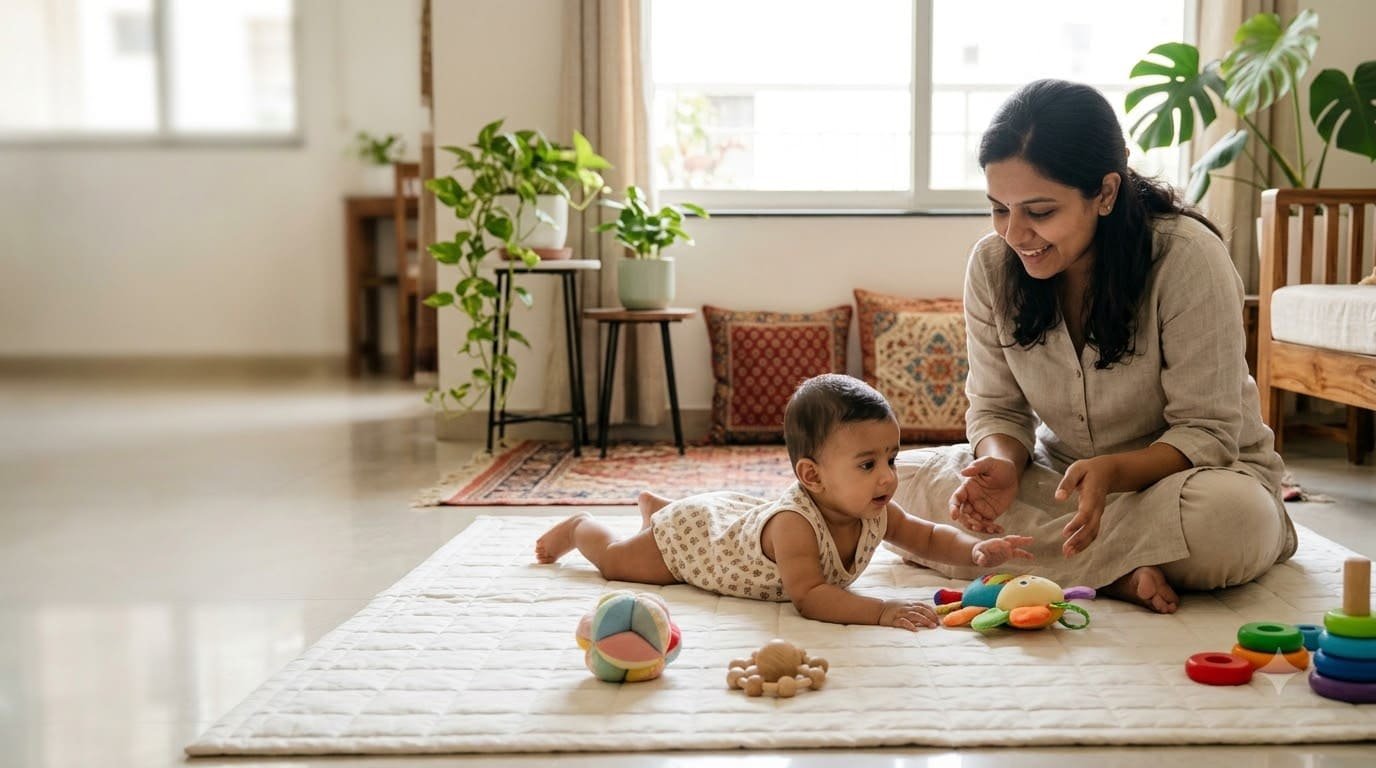
Tummy time — placing the baby awake and supervised on their stomach — is the single most important gross motor activity for babies in the first six months.
Why it matters: Back sleeping (the correct sleep position for SIDS prevention) means babies spend their sleep time on their backs. Tummy time provides the front-lying position that strengthens the neck, shoulder, arm, and core muscles needed for rolling, sitting, crawling, and eventually walking.
When to start: From Day 1. Even newborns can have brief tummy time — start with 2-3 minutes, 2-3 times daily, increasing gradually.
How to make it work: Place baby on a firm, flat surface (not the bed — too soft). Get down to the baby’s level — make eye contact, talk, show toys. For young babies who dislike tummy time — place on your chest (you reclined, baby on your front) or across your lap.
Daily target: 0-3 months: Work up to 30 minutes cumulative daily 3-6 months: 1 hour daily cumulative 6 months+: As much as baby tolerates — they will be pushing up, rolling, and eventually crawling
The India context: Many Indian babies have limited tummy time because families worry they’ll be uncomfortable. Brief discomfort during tummy time is normal — the baby is using new muscles. Stop if the baby is genuinely distressed, but gentle fussing is okay.
2. Floor Time — Unrestricted Movement
Beyond tummy time, unrestricted floor time — on a clean mat or bedsheet — allows babies to kick, reach, roll, and explore movement freely.
Setup in Indian homes: A cotton durrie or folded bedsheet on the floor provides a safe, slightly textured surface. Indian cotton mattresses (gadda) or a firm yoga mat also work. Not a foam mat that is too soft — babies need a firm surface to push against.
What happens during floor time: Young babies kick, wave arms, look around — all building muscle strength. From 3-4 months: reaching for toys placed just out of reach. From 4-5 months: rolling attempts begin. From 6-7 months: pivoting, beginning to push up.
How long: As much awake time as possible on the floor rather than in bouncers, rockers, or being held.
3. Supported Sitting — Building Core Strength
Sitting upright requires significant core strength — the abdominal and back muscles that support the trunk. Building this strength starts long before independent sitting.
Supported sitting activities: Lap sitting — baby seated on your lap, facing out. Support as needed but gradually reduce support over weeks. Cushion support — place a firm cushion or folded blanket behind and to the sides when the baby begins sitting, providing a safe fall zone. High chair sitting — from around 5-6 months, sitting in a high chair during family meals provides core exercise in context.
The Indian gaddi: Some Indian families use a gaddi (cushioned support ring) to seat babies upright before they can sit independently. A well-designed gaddi that supports without completely constraining is fine — but floor time without gaddi support is still needed for core development.
4. Reaching for Toys — Building Arm and Core Strength
Reaching for objects — especially objects placed just slightly out of reach — is one of the most effective gross motor activities because it requires the baby to shift weight, recruit core muscles, and extend the arms.
Age-appropriate reaching activities: 2-3 months: Hanging toys above (baby gym/play gym) that the baby swipes at 3-4 months: Toys placed at the side during tummy time, encouraging weight shifting 4-6 months: Toys placed just ahead during tummy time, encouraging inching forward 6+ months: Objects placed to the side or slightly behind, encouraging pivoting
Indian household toys that work: Stainless steel katoris (visually interesting, safe) Bright fabric pieces or scarves Textured objects — dry dal in a small sealed bag The family phone or keys (under supervision — familiar objects are highly motivating)
5. Baby Massage — Traditional and Evidence-Based
Indian baby massage — the traditional maalish — has documented gross motor benefits. Massage improves muscle tone, joint flexibility, and body awareness (proprioception), all of which support motor development.
For gross motor development: Leg massage — long strokes from thigh to ankle, then ankle to thigh. Gentle ankle rotations. Arm massage — long strokes from shoulder to wrist. Gentle wrist rotations. Bicycle legs — as part of massage routine, gentle leg cycling.
Timing: After massage, place the baby on the floor for tummy time while the skin is warm and the muscles are relaxed — this is an ideal combined routine.
For complete massage guidance including Indian-specific techniques, our baby massage maalish India guide covers safe techniques and traditional Indian practices.
6. Supported Standing — Weight-Bearing Practice
Weight-bearing through the legs is essential preparation for standing and walking. Supported standing — holding the baby upright with feet flat on a firm surface — provides leg strengthening from around 4-5 months.
How to do it safely: Hold the baby under the arms, feet flat on your thighs or on a firm surface. Allow the baby to bear weight through the legs for brief periods. The baby will bounce — bouncing is leg muscle exercise.
Important: Do not force a baby to stand before they show the muscle strength and control to bear weight. Support should come from you — not from positioning devices that keep babies upright before they have the strength.
From 9-10 months: Cruising — walking along furniture — is the natural progression from supported standing. Ensure low, stable furniture for the baby to hold.
7. Ball Play — Rolling, Kicking, Chasing
A simple ball — any size appropriate for the baby’s age — provides endless gross motor activity.
For young babies (3-6 months): Roll a large, bright ball slowly in front of the baby during tummy time. The visual tracking and reaching toward the ball builds neck and arm strength.
For older babies (6-10 months): Place a ball just ahead during crawling practice — the ball rolling away motivates the baby to crawl after it.
For cruising and walking babies (10-18 months): Push a large ball toward the baby for them to kick. Chase the ball together. This is highly motivating movement practice.
Indian household: Any round object works — a large lemon, a small coconut, a fabric ball made from old cloth.
8. Obstacle Experiences — Crawling Over and Under
Once crawling begins, obstacle experiences provide rich gross motor challenge — crawling over cushions, under tables, through tunnels.
Simple Indian household obstacles: A rolled blanket to crawl over (works from around 7-8 months) A low coffee table to crawl under Cushions arranged to crawl between A tunnel made from an open-ended cardboard box
Why obstacles matter: Crawling over uneven surfaces requires the baby to constantly adjust balance and muscle recruitment — far more development than crawling on a flat floor.
The stairs: Many Indian homes have stairs or step-ups between rooms. Under close supervision, crawling up and down stairs is one of the best gross motor challenges available. Never leave a crawling baby near stairs unsupervised.
9. Outdoor Play — Natural Surfaces and Challenges
Indian outdoor environments — courtyards, parks, gardens — provide gross motor opportunities that indoor environments cannot replicate.
Natural surface benefits: Grass requires more muscular effort to walk on than a smooth floor. Sand (beach visits, sandpits) provides challenging resistance. Uneven surfaces require constant balance adjustment. Inclines (slopes in parks) provide uphill/downhill challenge.
What outdoor play provides that indoor play doesn’t: Varied sensory input — different textures underfoot. Wider space for walking, running, and exploring. Social motor learning — watching and imitating other children.
Indian outdoor opportunities: Society or park visits — even 30-45 minutes of outdoor floor/grass time daily. Morning walks in a pram or carrier — the movement itself is vestibular stimulation. Water play outdoors in summer — the resistance of water provides natural motor challenge.
10. Dancing and Movement Songs
Nursery rhymes and songs with accompanying movements provide vestibular stimulation and body awareness that support gross motor development.
Vestibular stimulation: Swinging the baby gently, bouncing on the knee, rocking — all provide vestibular input that supports balance development.
Indian movement songs: “Machli Jal Ki Rani Hai” — with swimming arm movements “Chanda Mama” — with rocking “Aeroplane” — holding the baby outstretched like an aeroplane (vestibular input, core activation)
Baby carriers: Wearing the baby in a carrier while the caregiver moves — walks, housework, dancing — provides constant vestibular stimulation and trunk activation against the caregiver’s body movements.
Red Flags — When to See the Paediatrician
🚨 No head control by 4 months 🚨 Not rolling either direction by 6 months 🚨 Not sitting with support by 6 months 🚨 Not sitting without support by 9 months 🚨 Not pulling to stand by 12 months 🚨 Not walking independently by 18 months 🚨 Loss of previously acquired motor milestones 🚨 Significant asymmetry — consistently preferring one side for movement (may indicate weakness on the other side) 🚨 Floppy muscle tone or unusually stiff muscle tone
Paediatric physiotherapy is the specialist assessment and treatment for gross motor delays — available at most government medical colleges and private rehabilitation centres in Indian cities.
FAQ — Gross Motor Skills Baby India
Q: My 5-month-old hates tummy time and cries immediately. What should I do?
Start with very brief tummy time — 30 seconds — and build gradually. Get down to the baby’s level and make it engaging. Try tummy time on your chest rather than the floor. After an oil massage when muscles are relaxed is a good time. The key is frequency over duration — 10 brief tummy times daily is better than one long one. Most babies improve their tolerance within 2-3 weeks of consistent, gentle practice.
Q: My baby skipped crawling and went straight to walking. Is this a problem?
Some babies do walk without crawling — and most develop normally. However, crawling provides important shoulder girdle strengthening and bilateral coordination that skipping it can occasionally leave gaps in. If your baby skipped crawling but is walking well and meeting all other developmental milestones, mention it to your paediatrician at the next check but don’t panic.
Q: My mother-in-law keeps the baby in the jhoola all day. Is this affecting development?
Continuous time in a jhoola (swing/cradle) reduces the floor time that builds motor strength. Brief jhoola time is fine and culturally valued — but babies also need significant time on the floor, particularly on their tummies. A gentle conversation — “the paediatrician has said floor time is important for his muscles” — is the most effective framing.
Q: My baby is 10 months and not crawling. Should I be worried?
Not all babies crawl — some bottom-shuffle or go directly to pulling to stand. What matters at 10 months is: can the baby move across the floor independently (any method), bear weight on the legs when supported, and show strong, coordinated trunk strength? If the baby is not moving independently at all at 10 months, discuss with your paediatrician.
Q: Is it harmful to use a baby walker?
Yes — baby walkers are not recommended by the IAP or WHO. They delay walking rather than accelerating it (babies in walkers spend less time on the floor where gross motor development actually happens), and they are a significant safety hazard (falls down stairs). Many countries have banned them. Avoid baby walkers entirely.
More from MumPappaHub — Read These Next:
- Fine Motor Skills Toddler India
- Cognitive Development Activities India
- Baby Development Month by Month
- Child Development Milestones
- 2 Year Old Milestones India
- Sensory Play for Toddlers India
- Baby Massage Maalish India
- Newborn Care Tips
- Newborn Sleep Tips
- Indian Baby Weight Chart
- Screen Time Guidelines Children India
- Baby Vaccination Schedule India 2026
About This Article
Written by the MumPappaHub Research Team — including a researcher whose nephew spent his first four months primarily in a bouncer seat. At his four-month check the paediatrician found his neck muscles weaker than expected and asked about tummy time. They started floor time that week. By six months he had caught up completely. This guide is what that family needed from Week 1.
Reviewed for accuracy against WHO motor development milestone guidelines and Indian Academy of Pediatrics developmental assessment guidance for Indian infants. This content is for general informational purposes only. Consult your paediatrician for specific motor concerns.
MumPappaHub — Real talk for real Indian parents. mumpappahub.com
