
Medical Disclaimer: This article is for informational purposes only and reviewed against WHO Integrated Management of Childhood Illness (IMCI) guidelines and Indian Academy of Pediatrics (IAP) fever management recommendations. Always consult your paediatrician for guidance specific to your child.
Toddler fever guide India is what every parent desperately needs at 2 AM — when your toddler’s forehead is burning, your mother-in-law is insisting on three blankets, the WhatsApp group has seven conflicting opinions, and you can’t remember whether 38.5°C means call the doctor or give Calpol and wait.
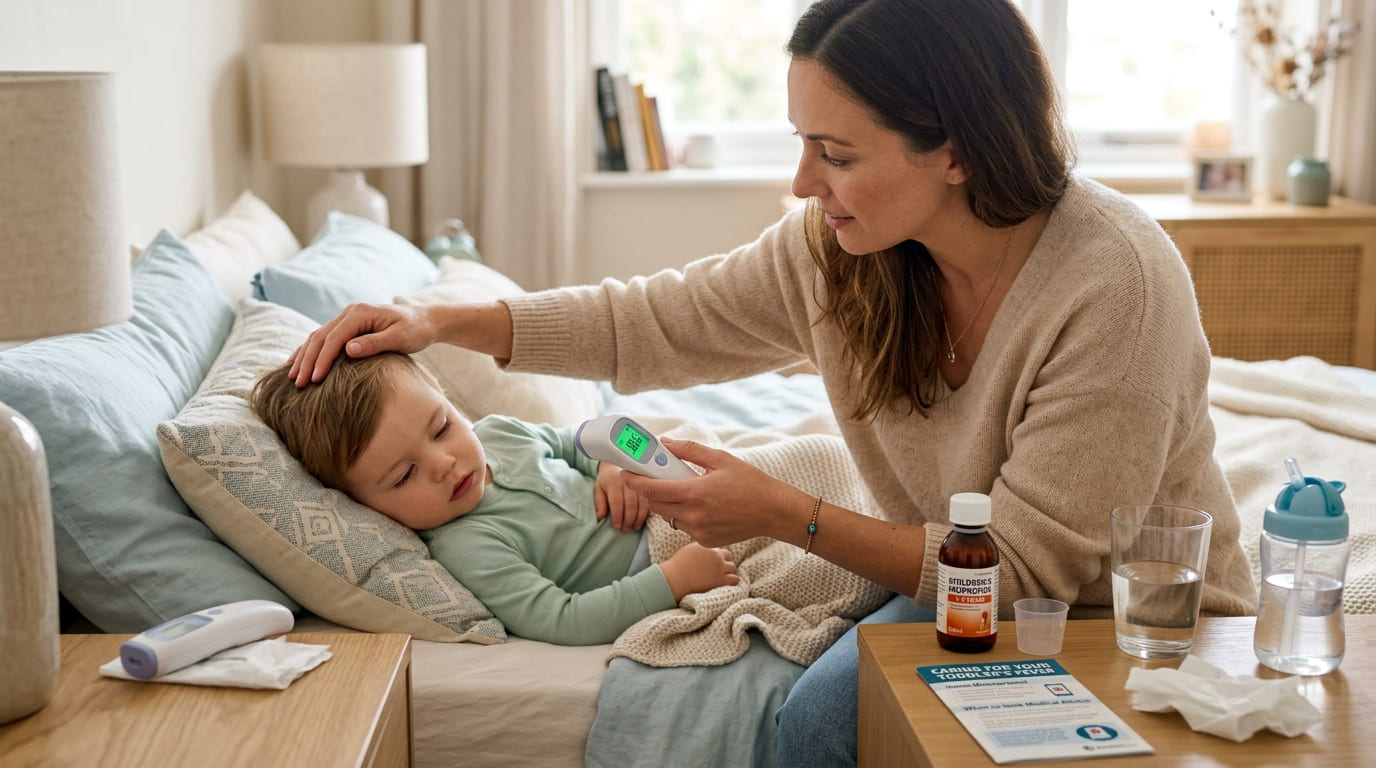
My son spiked 39.8°C on a Saturday night. Clinic closed. Hospital was forty minutes away. I stood in our bedroom holding the thermometer, completely unsure whether I was about to make a terrible mistake by staying home or an unnecessary panic trip to the hospital.
This guide is what I needed that night. The actual temperatures in Celsius. The Indian medicines by name. The IAP guidelines. What actually warrants a hospital visit versus what you can manage at home. No Fahrenheit, no Tylenol, no American guidelines — this is for Indian parents, with Indian medicines, in Indian conditions.
What Toddler Fever Guide India Must Cover First — What Is a Fever?
Toddler fever guide India starts with this: fever is not an illness. It is your toddler’s immune system doing exactly what it’s supposed to do.
When a virus or bacteria enters the body, the immune system releases compounds called pyrogens. These signal the hypothalamus — the brain’s internal thermostat — to raise the body’s temperature. The elevated temperature makes the body hostile to many pathogens, speeds up white blood cell production, and accelerates the immune response.
According to the World Health Organization’s Integrated Management of Childhood Illness guidelines, fever in children is one of the most common presentations in clinical care — and in the vast majority of cases, it resolves safely with appropriate home management and monitoring.
The Indian Academy of Pediatrics is clear: how your toddler is behaving matters significantly more than the number on the thermometer. A toddler with 39°C who is alert, drinking fluids, and responding to you is less concerning than a toddler with 38.2°C who is unusually limp and unresponsive.
Temperature number + behaviour together = the complete picture.
What Temperature Is a Fever in Toddlers? — In Celsius
Indian parents use Celsius. This guide uses Celsius.
| Method | Fever Threshold | Notes |
|---|---|---|
| Rectal | 38°C or above | Most accurate — gold standard |
| Axillary (armpit) | 37.5°C or above | Reads 0.5°C lower than actual |
| Ear (tympanic) | 38°C or above | Reliable from 6 months |
| Forehead (temporal) | 38°C or above | Good for screening only |
Normal body temperature range for toddlers: 36.5°C to 37.5°C
Your hand on the forehead tells you something is happening. It does not tell you how serious it is. Always confirm with a thermometer.
Age-Specific Fever Action Guide — India
| Age | Temperature | Action |
|---|---|---|
| Under 3 months | 38°C+ (any fever) | 🚨 Go to doctor/hospital NOW |
| 3–6 months | 38°C+ | Call paediatrician same day |
| 6 months–2 years | 38–39°C | Monitor at home with care |
| 6 months–2 years | 39°C+ | Paracetamol + monitor closely |
| 6 months–2 years | 40°C+ | Same day medical assessment |
| 2–5 years | Under 39°C + well | Home management appropriate |
| 2–5 years | 40°C+ | Medical assessment needed |
| Any age | 40.5°C+ | Go to hospital immediately |
The most important rule: Under 3 months = any fever = go to the doctor. Do not manage at home. Do not give medicine and wait. Go.
12 Best Toddler Fever Tips India — Home Management
1. Hydration First — Most Important
Fever causes fluid loss through sweating and faster breathing. Dehydration worsens fever and makes everything harder.
For toddlers:
- Water, diluted coconut water, ORS solution
- Small amounts frequently — not large amounts at once
- Nimbu pani (light, not too sweet)
- Ice pops made from diluted juice for reluctant drinkers
- Continue breastfeeding if still nursing — breast milk is hydration and immunity together
Signs of adequate hydration: Wet nappies or urination every 4–6 hours, tears when crying, moist mouth.
Signs of dehydration — call the doctor:
- No urination for 6+ hours
- No tears when crying
- Sunken eyes
- Dry cracked lips
- Unusual lethargy
2. Dress Lightly — Never Bundle Up
The instinct to wrap a feverish toddler in blankets is very common in Indian households — and counterproductive. The body is trying to lose heat. Bundling prevents this.
One layer of thin cotton clothing. Cotton sheet only if needed at night. Keep the room comfortably cool — fan on low is fine.
If the toddler is shivering: Shivering is the body raising its temperature — it can happen even during fever. It does not mean they are cold. A very light cotton layer is appropriate but do not add heavy blankets.
3. Lukewarm Sponge Bath — When Appropriate
A lukewarm sponge bath can help bring temperature down temporarily and provide comfort. It is not essential but is not harmful when done correctly.
Correct method: Water should be comfortably warm — not cold, not cool. Approximately body temperature or slightly below. Sponge the forehead, neck, armpits, and groin. Keep the room warm enough that the child does not shiver.
Never use: Cold water, ice water, alcohol rub. Cold causes shivering which raises temperature further. Alcohol is absorbed through a child’s skin and is dangerous — this traditional remedy is genuinely harmful.
4. Paracetamol — The Right Way
Paracetamol (Calpol, Crocin, Febrex, Metacin) is safe and effective for fever management in toddlers from 3 months. Always dose by weight — not by age.
Standard IAP dosing: 10–15 mg/kg per dose, every 4–6 hours, maximum 4–6 doses in 24 hours.
| Toddler Weight | Dose (at 120mg/5ml — Calpol standard) |
|---|---|
| 5–6 kg | 3–3.5 ml |
| 6–8 kg | 3.5–5 ml |
| 8–10 kg | 5–6 ml |
| 10–12 kg | 6–7.5 ml |
| 12–15 kg | 7.5–9 ml |
| 15–18 kg | 9–11 ml |
Critical points about paracetamol dosing:
Check the concentration on your bottle. Calpol comes in 120mg/5ml (infant) and 250mg/5ml (junior). The ml dose is very different. Do not use the same ml dose if you switch between them.
Use the measuring syringe that comes with the medicine. Kitchen spoons are not accurate enough.
Write down the time of each dose. At 2 AM you will not reliably remember.
Paracetamol takes 30–60 minutes to work. It brings temperature down by approximately 1–1.5°C. A toddler with 39.5°C who comes to 38°C after an hour has responded well.
5. Ibuprofen — When to Use It
Ibuprofen (Brufen, Ibugesic) can be used from 6 months. It has the additional benefit of reducing inflammation alongside fever.
Dosing: 5–10 mg/kg per dose, every 6–8 hours.
When to prefer ibuprofen over paracetamol:
- High fever (above 39.5°C) that is causing significant discomfort
- Fever alongside pain — ear pain, throat pain, body aches
- When paracetamol alone has not provided adequate comfort
Never give ibuprofen to:
- Babies under 6 months
- Dehydrated children
- Children with kidney problems
- On an empty stomach — give after food or milk
Alternating paracetamol and ibuprofen: Some paediatricians recommend this for high stubborn fevers. Only do this if your paediatrician has given you a specific written plan with exact timings. Confusion between the two medicines is a real risk.
6. Never Give Aspirin to Children
Aspirin is associated with Reye’s syndrome in children — a rare but serious condition affecting the liver and brain. Never give aspirin to any child under 18 years for fever or pain unless specifically prescribed by a doctor for a specific condition.
7. Monitor Behaviour — More Than Temperature
Check your toddler’s behaviour regularly during fever:
Reassuring signs: Alert when awake. Making eye contact. Crying normally (not unusually weak or high-pitched). Drinking fluids. Playing a little when temperature comes down with medicine.
Concerning signs: Unusually lethargic or difficult to rouse. Not responding to you normally. Crying weakly or inconsolably. Refusing all fluids. Seems worse rather than better.
A toddler who looks well despite a high temperature is less concerning than one who looks unwell with a moderate temperature.
8. Febrile Seizures — What to Do
A febrile seizure — convulsion triggered by a rapid temperature rise — affects approximately 2–5% of children between 6 months and 5 years. They are frightening. They are almost always harmless.
During a febrile seizure:
- Stay calm — this matters for what comes next
- Place the child on their side on a flat surface
- Do not put anything in their mouth — not a spoon, not a finger, nothing
- Time the seizure
- Do not try to restrain movements
- Remove objects nearby that could cause injury
Most febrile seizures last under 5 minutes and stop on their own.
After a febrile seizure: Call your paediatrician or go to the hospital — even if the child seems fine. A first febrile seizure always needs medical evaluation to confirm the diagnosis and rule out other causes.
Call an ambulance immediately if: The seizure lasts more than 5 minutes. The child does not recover to their normal self within 30 minutes. The seizure repeats within the same illness.
9. Traditional Remedies — What’s Safe and What’s Not
Safe — these cause no harm:
- Tulsi kadha (holy basil warm water) — provides hydration and mild comfort
- Warm ajwain water — carminative, not harmful
- Ginger tea for toddlers over 12 months — mild anti-inflammatory
- Extra breastfeeding
Avoid completely:
- Alcohol rub (spirit/surgical spirit on skin) — absorbed through skin, causes hypoglycaemia and toxicity. Genuinely dangerous.
- Bundling in heavy blankets — raises temperature further
- Cold water bath — causes shivering, raises temperature
- Forehead onion slices — no evidence, not harmful but not useful
- Giving adult paracetamol in smaller doses — adult tablets are a completely different dose form. Never.
10. Vaccination Fever — What’s Normal
Most vaccinations produce mild fever within 24 hours. This is a normal immune response, not a sign that something went wrong.
Normal post-vaccination fever: 38–38.5°C, begins within 24 hours, resolves within 48 hours.
What to give: Paracetamol at the correct weight-based dose. Ask your paediatrician at the vaccination visit what dose to give and when to start.
When to call about vaccination fever: Fever above 39°C after vaccination. Fever persisting beyond 48 hours. Any unusual swelling at the injection site beyond normal redness.
For the complete vaccination schedule, our baby vaccination schedule India 2026 guide covers every vaccine from birth to 5 years.
11. Keep a Fever Log
Simple but valuable. Write down:
- Time of each temperature reading
- Temperature recorded
- Medicine given, dose, time
- How the child is behaving
This log is extremely useful when you speak to your paediatrician — they can assess the pattern, not just the current temperature.
12. Monsoon Season — Extra Vigilance
During monsoon season in India, fever that does not respond normally to paracetamol — or fever that improves and then returns after a fever-free day — should prompt investigation for dengue or malaria.
Dengue warning signs alongside fever: severe headache, pain behind the eyes, joint and muscle pain, rash appearing around day 3–5, bleeding gums or nose.
Our dengue and malaria in children guide covers what to watch for during monsoon season specifically.
When to Go to the Doctor — Clear List
Go Immediately — Do Not Wait:
Any baby under 3 months with any fever (38°C or above)
Fever above 40°C in any toddler regardless of behaviour
Febrile seizure — go after it stops, call ambulance if it doesn’t stop within 5 minutes
Stiff neck — cannot move head normally, cannot touch chin to chest
Purple or red spots on skin that do not fade when you press a glass against them — possible meningococcal rash
Difficulty breathing — breathing fast, nostrils flaring, skin pulling in between ribs, bluish lips
Severe dehydration — no urination for 6+ hours, no tears, sunken eyes
Unusual limpness — cannot be roused, not responding normally
Call Your Paediatrician Same Day:
Fever lasting more than 48 hours in a toddler under 2 years.
Fever lasting more than 72 hours in a toddler over 2 years.
Fever that returned after being gone for more than 24 hours.
Fever with no obvious cause — no cough, no cold, no obvious illness.
Your instinct that something is wrong — always a valid reason to call.
5 Common Fever Myths in India — Debunked
Myth 1: High fever means serious illness
Fact: A mild viral cold can cause 40°C. A bacterial meningitis can start at 38.5°C. The number alone tells you little. Behaviour is the more important indicator.
Myth 2: Bundling up helps “sweat out” the fever
Fact: Bundling prevents the body from losing heat and raises the temperature further. It can increase seizure risk. One light cotton layer only.
Myth 3: Teething causes high fever
Fact: Teething may cause a slight temperature rise — but not above 38°C. If a teething toddler has a high fever, look for another cause.
Myth 4: You must wake them up for medicine
Fact: Sleep is more important than medication. If the child is sleeping and not in obvious distress, let them sleep. Give medicine when they naturally wake.
Myth 5: Fever will damage the brain
Fact: Fever caused by infection does not damage the brain. The hypothalamus prevents the body from raising temperature high enough to cause brain damage through infection. Brain damage from heat only occurs in extreme external heat situations (like a child left in a car). Infection fever is different.
FAQ — Toddler Fever Guide India
Q: My toddler has 38.5°C but is playing normally. Do I need to give medicine?
Medicine is for comfort, not for hitting a target number. If the toddler is alert, playing, drinking, and not in obvious distress at 38.5°C — you can monitor without medicine. Give medicine when they seem uncomfortable, not purely based on the number.
Q: The fever came down with Calpol but came back 5 hours later. Is this serious?
No — this is completely normal. Paracetamol’s effect is temporary (4–6 hours). The fever returning when the medicine wears off means the underlying illness is still active. This is expected. What’s more concerning is fever that returns after being genuinely absent for 24+ hours — that pattern warrants a call to your paediatrician.
Q: My toddler won’t take the medicine — keeps spitting it out. What do I do?
Mix the dose into a small amount (5ml) of juice or milk. Use the syringe and aim for the inside of the cheek rather than the back of the throat. Give it slowly. Some children accept medicine better when they’re upright. If they vomit within 5 minutes, you can repeat the dose. After 15–20 minutes, wait for the next scheduled dose.
Q: Is it okay to give both Calpol and Brufen together?
Not at the same time — they should be alternated with time between them. Only alternate if your paediatrician has given you a specific plan. The risk is confusion about what was given and when, leading to accidental double dosing of one medicine.
Q: My son has had fever for 3 days. He seems okay but the fever keeps coming back. What should I do?
Three days of fever in a toddler warrants a paediatrician visit regardless of how he seems. Three days is the outer limit of watching and waiting. The paediatrician will assess for ear infection, throat infection, urinary tract infection, or other causes that need specific treatment.
Q: Is it normal for fever to be higher in the evenings?
Yes — completely normal. The body’s temperature naturally cycles over the day, typically lowest in the morning and highest in the evening. A fever that seems manageable at 10 AM and worse at 7 PM is following this natural pattern, not necessarily worsening.
More from MumPappaHub — Read These Next:
- Baby Fever Guide: When to Worry
- Baby Vaccination Schedule India 2026
- Dengue & Malaria in Children: Monsoon Guide
- Waterborne Diseases Children Monsoon
- Diaper Rash Treatment India
- Baby Teething Signs & Remedies India
- Baby Development Month by Month
- Newborn Sleep Tips
- Newborn Care Tips
- Baby Blues vs Postpartum Depression
- Indian Baby Weight Chart 0-12 Months
- Superfoods for Toddler Brain Development
About This Article
Written by the MumPappaHub editorial team — including a parent who stood in their bedroom at 2 AM holding a thermometer showing 39.8°C on a Saturday night with the clinic closed, completely unsure whether to drive to the hospital or give Calpol and watch. They gave the Calpol, watched carefully, checked every hour, and the fever broke by morning. The guide they needed that night is this one.
Reviewed for accuracy against WHO Integrated Management of Childhood Illness (IMCI) guidelines and Indian Academy of Pediatrics fever management recommendations. Paracetamol dosing based on IAP standard 10–15mg/kg/dose guidelines. This content is for general informational purposes only and does not constitute medical advice. Always consult your paediatrician for guidance specific to your child.
MumPappaHub — Real talk for real parents. mumpappahub.com

12 Comments