
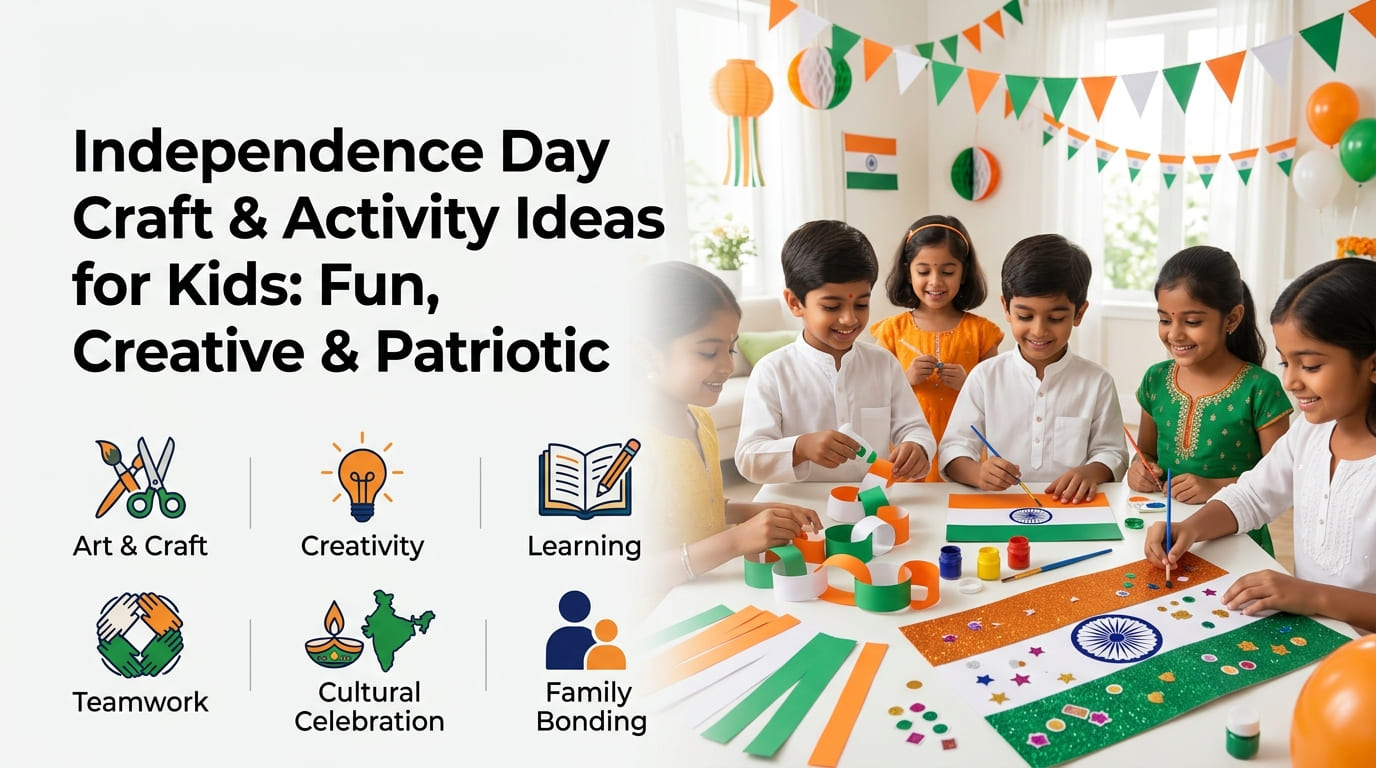
August 15th in our house starts the same way every year.
My daughter wakes up, runs to the window, and announces — “Mamma, it’s Independence Day!” Like she discovered it herself. Like nobody else in the country knows.
That’s when I go digging through my folder of Independence Day craft ideas for kids — the ones I’ve collected and tested over the years, the ones that actually hold a seven-year-old’s attention longer than five minutes.
And honestly? That enthusiasm is the whole point. Before flags and speeches and the national anthem on television — there is a seven-year-old in her pyjamas, genuinely excited about being Indian.
The question is always what to do with that excitement. School gives them the history, while television gives them the spectacle. However, at home — in the hours before and after the official celebrations — there’s a window to do something hands-on, creative, and genuinely memorable.
Why Independence Day Activities Matter for Children
Beyond the textbook
According to UNESCO’s guidelines on cultural education, children develop a deeper understanding of national identity and civic values through experiential, hands-on activities rather than passive learning. Making something with their hands — a tricolour craft, a paper flag, a DIY diorama — creates a memory and an emotional connection that a classroom lesson alone cannot.
Independence Day is also one of the best opportunities to have honest, age-appropriate conversations about freedom, sacrifice, and what it means to be part of something larger than yourself. Indeed, these conversations land very differently when the child is elbow-deep in orange, white, and green paint.
The Indian Academy of Pediatrics notes that creative play in children supports cognitive development, emotional regulation, and social skills — making craft activities not just fun but genuinely developmental.
Age-Wise Activity Guide
For babies and toddlers (0–2 years)
Toddlers can’t cut or glue — but they can touch, explore, and make a beautiful mess. At this age, furthermore, the activity is really for you as much as for them — creating their first Independence Day memory, even if they won’t remember it consciously.
Handprint tricolour flag: Paint three horizontal stripes — saffron, white, green — on a sheet of white paper using finger paints. Press baby’s hand or foot into the centre of the white stripe for the “Ashoka Chakra.” Frame it. They’ll love seeing it when they’re older.
Sensory bin with tricolour: Fill a tray with orange marigold petals, white rice, and green moong dal. Let them explore the textures and colours. Simple, safe, and genuinely engaging for under-twos.
🛒 Products needed:
- Non-toxic finger paints — 🛒 Check Latest Price on Amazon →
- Sensory tray — 🛒 Check Latest Price on Amazon →
For preschoolers (3–5 years)
This age group is perfect for guided crafts — they can follow simple instructions, use child-safe scissors with help, and their enthusiasm for making things is at its absolute peak. Moreover, they love the sense of accomplishment that comes with a finished project.
Paper plate flag: Paint a paper plate in three stripes — saffron on top, white in the middle, green at the bottom. Draw a simple Ashoka Chakra in the white section with a blue marker. Add a stick handle. Done — and they’ll wave it all day.
Tricolour rangoli: Use coloured rice (dyed with food colouring) to create a simple rangoli pattern in three colours. Children this age love the pouring and arranging. Set up the outline for them and let them fill it in.
Pinwheel flag: Cut a square of paper diagonally from each corner toward the centre, fold every other point to the middle, and push a pin through a bead into a pencil eraser. The result is a spinning, tricolour pinwheel that takes about ten minutes and causes enormous delight — both during and after making it.
🛒 Products needed:
- Child-safe scissors — 🛒 Check Latest Price on Amazon →
- Coloured rice craft kit — 🛒 Check Latest Price on Amazon →
- Paper plates bulk pack — 🛒 Check Latest Price on Amazon →
For school-age children (6–10 years)
This is the sweet spot for Independence Day crafts — children old enough to work more independently, with fine motor skills developed enough for more detailed projects, and curious enough to want to understand the history behind what they’re making. As a result, this age group gets the most out of research-based activities.
DIY kite: Kite-flying on Independence Day is a beloved Indian tradition. Making a kite from scratch — bamboo sticks, tissue paper, string — is a full afternoon project that connects directly to the day’s cultural significance. Templates and tutorials are widely available online, and moreover, the flying is the reward at the end.
Freedom fighter portrait: Choose one freedom fighter together — not always Gandhi, not always Bhagat Singh, but someone your child hasn’t encountered before. Research together, then draw or paint a portrait and write three things they learned underneath. Finally, frame it for their room.
Tricolour lantern: Cut a rectangle of card, fold and cut horizontal slits across the middle section (like a paper lantern), then roll and tape into a cylinder. Next, paint or colour in orange, white, and green, and add a handle. The result is beautiful for an evening display.
Independence Day journal: Give your child a blank notebook and spend the morning filling it — drawings of freedom fighters they admire, things they’re grateful India has, things they wish were different, what freedom means to them personally. A journal they’ll return to every year.
🛒 Products needed:
- Kite making kit — 🛒 Check Latest Price on Amazon →
- Acrylic paint set kids — 🛒 Check Latest Price on Amazon →
- Blank journal notebook kids — 🛒 Check Latest Price on Amazon →
- Craft card stock paper — 🛒 Check Latest Price on Amazon →
For older children and tweens (11–14 years)
Older children need activities that engage their developing critical thinking and give them genuine agency — not just colouring by numbers. Therefore, the best activities for this age group involve research, creation, and real decision-making.
Create a documentary: Give them your phone and challenge them to create a five-minute documentary about Independence Day — what it means to people in your family, your neighbourhood, your city. For instance, they could interview grandparents, ask the autorickshaw driver, and then edit it all together.
Freedom fighter research project: Pick a relatively unknown freedom fighter — Matangini Hazra, Usha Mehta, Tiruppur Kumaran — and create a detailed poster, presentation, or illustrated biography. The less famous ones often have the most extraordinary stories.
Design a postage stamp: First, research what Indian postage stamps have looked like through history. Then design an original stamp commemorating a person, event, or value that your child thinks deserves recognition. Finally, frame the finished version.
Letter to the future: Write a letter to be opened on Independence Day 2047 — the centenary of independence. What do you hope India will look like by then? What do you want the next generation to know about this moment? Seal it, date it, and store it somewhere safe — perhaps with a note explaining where to find it.
🛒 Products needed:
- Poster making supplies —🛒 Check Latest Price on Amazon →
- Sketch pens set premium — 🛒 Check Latest Price on Amazon →
Independence Day Craft Ideas — Quick Reference
10-minute crafts (when you’re short on time)
Tricolour bookmark: Cut a strip of card, colour in three stripes, then draw a small Ashoka Chakra in the centre. Practical, patriotic, and done in minutes.
Paper flag garland: Cut rectangles of orange, white, and green paper, fold each over a string, and tape in place. Hang across a window or doorway for ten minutes of effort and maximum festive impact.
Ashoka Chakra paper plate: Paint a paper plate blue, then use a protractor or trace a circular object to draw the wheel. Divide it into 24 sections and let the child colour each spoke while you talk about what the 24 spokes represent.
Handprint flag canvas: Stripe a small canvas in saffron, white, and green, then press the child’s handprint into the centre. A piece of art made at a specific age, on a specific Independence Day — genuinely irreplaceable in five years.
Craft supplies worth having before August 15th
🛒 Independence Day Craft Kit — Build Your Own:
- Tricolour craft paper pack — 🛒 Check Latest Price on Amazon →
- Non-toxic washable paint set — 🛒 Check Latest Price on Amazon →
- Glitter glue set —🛒 Check Latest Price on Amazon →
- Foam sheets assorted — 🛒 Check Latest Price on Amazon →
- Craft glue sticks — 🛒 Check Latest Price on Amazon →
- Washi tape tricolour — 🛒 Check Latest Price on Amazon →
Independence Day Activities Beyond Crafts
History comes alive — activities that teach
Freedom fighter card game: Write names of freedom fighters on one set of cards and their contributions on another, then match them up — race to complete the set. Essentially, it’s learning disguised as a game.
Map activity: Print or draw a blank map of undivided India from 1947, then mark significant locations — Amritsar, Jallianwala Bagh, Dandi, Sabarmati Ashram, Cellular Jail. Talk about each location while marking it, since the geography makes the history feel real.
Then and now photo comparison: Find photographs of Indian cities or landmarks from 1947 alongside current photographs, then compare them. Notice what has changed, what has stayed exactly the same, and what surprises them most. Often, the answers surprise even the parents.
Independence Day quiz: Create age-appropriate questions — easy for younger children, progressively harder for older ones. Offer small prizes for correct answers — as a result, a family quiz at dinner brings everyone enthusiastically to the table.
Creative expression activities
Write a national anthem verse: Ask your child what verse they would add to the national anthem if they could — specifically, what would they want to say about India that isn’t already in it? This seemingly simple question opens extraordinary conversations about values, identity, and belonging.
Draw India’s future: Give every child a large piece of paper and ask them to draw India in 2047 — the centenary year. No rules, no prompting — simply see what they imagine. Often, the results are extraordinary.
Independence Day pledge: Write a personal pledge — three things they commit to doing in the coming year as a citizen. Keep them small and realistic, then put it somewhere they’ll actually see it throughout the year.
Independence Day Food Ideas — Tricolour Everything
Food is one of the easiest ways to bring the day’s colours into the home without extra crafting. In fact, tricolour food takes less preparation than most crafts and often becomes the most-remembered part of the celebration.
Tricolour sandwiches: Start with a saffron layer of carrot and cream cheese or orange jam, followed by a white layer of plain cream cheese or white butter, and finally a green layer of coriander chutney or avocado spread. Cut into triangles and arrange as a flag.
Tricolour fruit skewers: Simply thread orange segments or mango pieces, banana slices, and green grapes or kiwi onto skewers. The result is a snack that looks festive and takes only three minutes.
Tricolour rice: Cook plain rice and divide into three portions — colour one with turmeric for saffron, leave one plain for white, and mix the third with spinach puree for green. Layer in a bowl or plate for a simple, striking, and delicious result.
Tricolour popsicles: Layer mango pulp on the bottom, coconut milk or vanilla yoghurt in the middle, and kiwi or pista kulfi at the top, then freeze in moulds. Consequently, you get an Independence Day treat that children will talk about.
Tricolour lassi: Pour three colours into a tall glass — mango lassi, plain lassi, and kiwi or mint lassi — by layering carefully over the back of a spoon. The result is both beautiful and delicious.
Books Worth Reading on Independence Day
Reading together on Independence Day — a story about a freedom fighter, a picture book about what India means, a chapter from a historical account — creates a ritual that children carry into adulthood. Indeed, what they read on this day often shapes how they think about citizenship for years.
Recommended by age group:
Young children will enjoy Kiranmala and the Kingdom Beyond — an adventure set in Indian mythology — alongside The Wheels of the Bus in India which celebrates everyday Indian life. Picture books about Gandhi, Nehru, and lesser-known freedom fighters are also widely available in Indian bookshops.
School-age readers will connect with Freedom by Linda Hess for age-appropriate history, The Blue Umbrella by Ruskin Bond for values and village life, and illustrated biographies of freedom fighters like Bhagat Singh, Rani Laxmibai, and Subhas Chandra Bose.
Older children and tweens can explore The Discovery of India through excerpts adapted for young readers, while more mature readers may try Midnight’s Children. Additionally, India After Gandhi by Ramachandra Guha is accessible for serious young readers.
🛒 Books on Amazon:
- Children’s books about Indian freedom fighters — 🛒 Check Latest Price on Amazon →
- Independence Day India picture books — 🛒 Check Latest Price on Amazon →
Making It a Family Tradition
The most powerful Independence Day activities are the ones that become annual rituals — the thing your child expects every August 15th, the thing they’ll do with their own children one day.
Some families watch the flag hoisting at the Red Fort together every year. Others make the same craft annually and compare how it changes as the child grows. Still others have the same breakfast, read the same poem, or visit the same memorial.
The specific activity matters less than the consistency. A handprint flag made at age three, age five, age eight, and age twelve — the same activity, the same day, different hands, different awareness — is therefore one of the most beautiful things a family can make together.
For more on building meaningful family traditions and creative play, our sensory play for toddlers guide and screen-free play ideas have year-round activities that support creativity and development. And for the screen-free challenge that many families take on around Independence Day, our screen-free childhood challenge guide is worth reading.
FAQ — Independence Day Craft & Activity Ideas for Kids
About Crafts and Supplies
Q: What are the easiest Independence Day crafts for toddlers? A: Handprint crafts are the easiest and most memorable — paint three stripes on paper, press baby’s hand in the centre for the Ashoka Chakra. Sensory bins with tricolour materials (orange marigolds, white rice, green dal) are another excellent option for very young children. Both require minimal supplies and create lasting memories.
Q: Where can I buy Independence Day craft supplies in India? A: Most stationery shops, craft stores, and online retailers stock tricolour craft supplies in July and August. Amazon India has a wide range — coloured paper, paints, foam sheets, glitter glue — available with quick delivery. Links to specific products are included throughout this article for convenience.
Q: How do I make a kite with my child for Independence Day? A: You need two thin bamboo sticks (one slightly longer), strong thread, tissue paper or thin plastic sheet, and string for flying. Tie the sticks in a cross shape, stretch thread around the frame to create the kite outline, cover with tissue paper cut to shape and glued down, attach a long tail of ribbons for balance, and tie flying string to the centre cross. Plenty of video tutorials are available for specific shapes.
About Activities and Learning
Q: How do I explain Independence Day to a toddler? A: Keep it simple and concrete. “India has a birthday today — we’re celebrating because we became free a long time ago. Free means we get to make our own rules.” Toddlers don’t need the full historical context — they need something they can feel, which is why crafts and celebrations matter more than explanations at this age.
Q: Which freedom fighters should I introduce to my primary school child? A: Beyond Gandhi and Nehru — who children encounter everywhere — consider introducing Bhagat Singh (courage and conviction), Rani Laxmibai (bravery and leadership), Sarojini Naidu (poetry and politics), Annie Besant (a foreigner who chose India), and Tiruppur Kumaran (who died rather than lower the flag). Diverse stories create a richer understanding.
Q: How can I make Independence Day meaningful for a teenager who isn’t interested? A: Don’t force the crafts. Instead — watch a documentary together, read an excerpt from history, have an honest conversation about what they think India does well and what needs to change. Teenagers respond to being taken seriously. A conversation about citizenship, rights, and responsibilities lands better than a paper flag at this age.
About Traditions and Celebrations
Q: What is a good Independence Day family tradition to start? A: The handprint flag is the most popular long-term tradition — the same craft, different size hands, every year. Another excellent one is the “letter to the future” — sealed on Independence Day and opened the following year, tracking how thinking and priorities change. Or a family quiz at dinner, with slightly harder questions every year.
Q: Are there Independence Day events for children in Indian cities? A: Yes — most cities have flag hoisting ceremonies at parks, schools, and cultural centres that are open to the public. Many museums have special programming in the week around August 15th. Check local listings for your city in the first two weeks of August.
More from MumPappaHub — Read These Next:
- Screen-Free Play Ideas for Kids
- Sensory Play for Toddlers
- Screen-Free Childhood Challenge
- Toddler Language Development
- Child Development Milestones
- Potty Training Guide
- Toddler Tantrums Tips
- Baby First Year Milestones
- Newborn Care Tips
- Superfoods for Toddler Brain Development
- Picky Eater Strategies
- Baby Sleep Training Guide
About This Article: Written by the MumPappaHub editorial team. This content is for general informational and creative inspiration purposes. Affiliate links are included — MumPappaHub earns a small commission on qualifying purchases at no extra cost to you.
MumPappaHub — Real talk for real parents. mumpappahub.com

3 Comments