
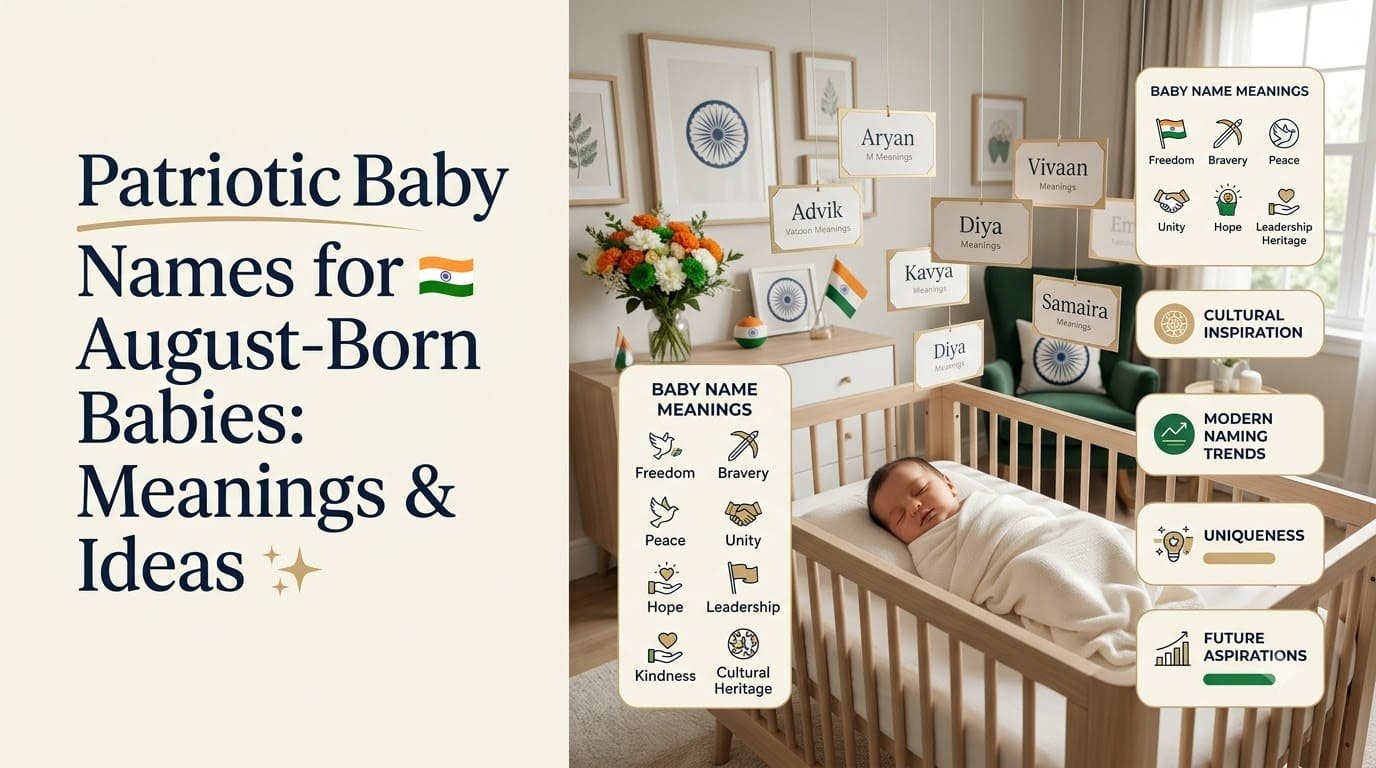
Patriotic baby names for August babies carry more history than most seasonal lists suggest.
A friend of mine had her son on August 14th last year — one day before Independence Day. The nurses in the ward were joking that he’d arrived just in time to watch the flag-hoisting from the nursery window.
She ended up naming him Veer. Not because it was trending anywhere. She just liked what it meant, and the timing felt right.
That’s really what this list is about. Not a random collection of “patriotic” names pulled off the internet, but names that carry real history — names that Indian parents have actually chosen, generation after generation, because they mean something.
If your baby arrived in August, or you’re expecting around Independence Day, here’s a proper look at names worth considering, along with the stories behind them.
Why This Month Changes How Parents Think About Names
There’s something about August in India. Flags on balconies. Old black-and-white footage playing on TV. Grandparents telling stories about 1947 that somehow sound different every time you hear them.
For parents having a baby during this month, some of that spirit naturally seeps into the naming process. Not everyone goes looking for a patriotic name on purpose. Sometimes it just happens — you’re scrolling through options, and a name like Swaraj or Azad catches your eye differently than it would in, say, March.
Whatever brings you to this list, these are names with weight. They’ve been carried by real people. They mean something beyond just sounding nice.
Boy Names With Real History Behind Them
Veer — Simply means “brave.” Short, strong, easy to say. One of the most commonly chosen names in this category, and for good reason.
Azad — Means “free.” This one carries actual historical weight — Chandrashekhar Azad took this as part of his name during the freedom movement, and it’s stuck around ever since as a name parents choose deliberately.
Bhagat — Straight from Bhagat Singh. The name itself just means “devotee,” but say it out loud and most Indians immediately think of one person.
Arjun — Older than the freedom movement by centuries, from the Mahabharata. Means “bright” or “shining.” Not overtly patriotic, but a name of quiet strength that pairs well with the mood of the month.
Chandra — Means “moon.” Also tied to Chandrashekhar Azad’s name, and used widely on its own too.
Ranvijay — “Victorious in battle.” A heavier, more traditional name — works well if you want something with real presence.
Tejas — Means “brilliance” or “radiance.” Modern, common, doesn’t feel like it’s trying too hard to be meaningful — it just is.
Ashoka — After the emperor who went from conqueror to peace advocate. Means “without sorrow.” A name with an actual arc to its story, which some parents find appealing.
Samar — Means “battle,” though in practice it’s used more to suggest resilience than actual conflict.
Netaji-inspired names — Some families lean toward names connected to Subhas Chandra Bose, whose title meant “respected leader.” Not a first name itself, but the association carries weight for families who admire him specifically.
Girl Names That Carry the Same Weight
Swaraj — Means “self-rule.” This is the word of India’s independence movement, the one Gandhi built an entire philosophy around. Not common, which makes it stand out.
Sarojini — After Sarojini Naidu, poet and freedom fighter, known as the Nightingale of India. The name itself means “lotus.”
Kranti — Means “revolution.” Bold, a little unexpected, memorable.
Bharati — Comes from “Bharat,” India’s own name for itself. About as directly connected to the country as a name can get.
Aparajita — Means “undefeated.” Strong without being harsh-sounding — it flows nicely too.
Shakti — Means “power,” tied to divine feminine energy in Indian tradition. One of the more universally recognised names on this list.
Vijaya — “Victory.” Simple, classic, fits a child born in a month of celebration.
Deepa — Means “light” or “lamp.” Evokes diyas, the imagery of light breaking through darkness — which is really what independence stories are about.
Rani — Inspired by Rani Lakshmibai, one of India’s most fiercely remembered historical figures. Means “queen” on its own too.
Priyamvada — Means “one who speaks sweetly.” More classical and literary, less overtly patriotic, but it fits the same era of Indian naming tradition.
If You Want a Name Tied to a Specific Freedom Fighter
Some parents don’t just want a meaning — they want a direct connection to someone specific. Bhagat, Chandrashekhar, Sarojini, and Rani all work this way. According to the National Portal of India, the freedom movement was shaped by hundreds of individuals whose stories are still taught in schools today, which means there’s no shortage of names to draw from if this is the route you want to take.
There’s something nice about a name like this. Your child will eventually ask what it means, or who it’s after, and you’ll have an actual story to tell them — not just a definition from a baby names website.
A Few Practical Things to Think About
Say it with your surname, out loud, more than once. Some of these names are longer or have a specific rhythm to them. What sounds good on paper doesn’t always sound good in a sentence.
Think about the nickname it’ll naturally shrink into. Tejas becomes “Tej.” Aparajita might become “Apu.” Decide if you’re okay with that version too, because that’s often what actually gets used day to day.
Don’t force the “patriotic” angle if it doesn’t genuinely resonate with you. A name should feel right first. The history is a bonus, not the whole reason.
If your family likes to be involved in naming, a name with real historical roots often makes for a nicer conversation with grandparents than a purely modern, trend-based one.
For a broader look at the naming process itself, our complete guide to choosing a baby name and our ultimate guide to the perfect baby name for 2026 go into more detail on sound, meaning, and family tradition.
FAQ — Patriotic Baby Names
Q: Do these names only make sense for babies born in August?
Not really. The timing feels fitting, but plenty of parents choose these names year-round simply because they like what they mean.
Q: Is Swaraj actually used as a name today?
It is, though it’s not common. That’s part of the appeal for parents who choose it — it stands out, and it’s instantly recognisable to anyone who knows Indian history.
Q: Can I use one of these as a middle name instead?
Yes, and a lot of parents do exactly that. Something like Bhagat or Sarojini works well tucked in as a middle name, so it’s there without being the name your child uses every day.
Q: Are any of these names unisex?
Kranti and Chandra are both used across genders in different parts of India, though it varies by region and community. Worth checking local convention if that matters to you.
Q: How do I know if a name will still feel right when my child is older?
Try saying it as if you’re introducing a teenager, then again as if introducing an adult at work. Names with real, solid meanings — like most of the ones here — tend to hold up better over time than names chosen purely for how they sound right now.
More from MumPappaHub — Read These Next:
- Unique Baby Names 2026
- How to Choose a Baby Name
- Ultimate Guide to the Perfect Baby Name 2026
- Independence Day Craft Activity Ideas for Kids
- Baby First Year Milestones
About This Article: Written by the MumPappaHub editorial team. Name meanings and historical references are compiled from commonly cited sources on Indian naming traditions and independence history. This content is for general informational purposes only.
MumPappaHub — Real talk for real parents. mumpappahub.com

2 Comments