
Medical Disclaimer: This article is for informational purposes only and reviewed against WHO antenatal care guidelines. Always follow your gynaecologist’s specific advice for your pregnancy.
Pregnancy week by week second trimester is the phase most Indian mothers describe as “when pregnancy finally started feeling real.”
My sister called me from her anomaly scan at week 20, completely overwhelmed, speaking so fast I could barely understand her. The baby had waved. Not reflexively — deliberately, she was convinced — right at the moment the sonographer moved the probe. She had a video. She watched it seventeen times that evening.
The second trimester is often this — the phase where pregnancy transforms from something you know intellectually into something you feel completely. The nausea lifts. Energy returns. The bump appears. And somewhere around week 18 to 20, something extraordinary happens: you feel your baby move for the first time.
This guide covers every week of the second trimester — what is happening with your baby, what is changing in your body, what tests are due, and the specific Indian context that most pregnancy guides miss entirely.
Pregnancy Week by Week Second Trimester — What This Phase Is
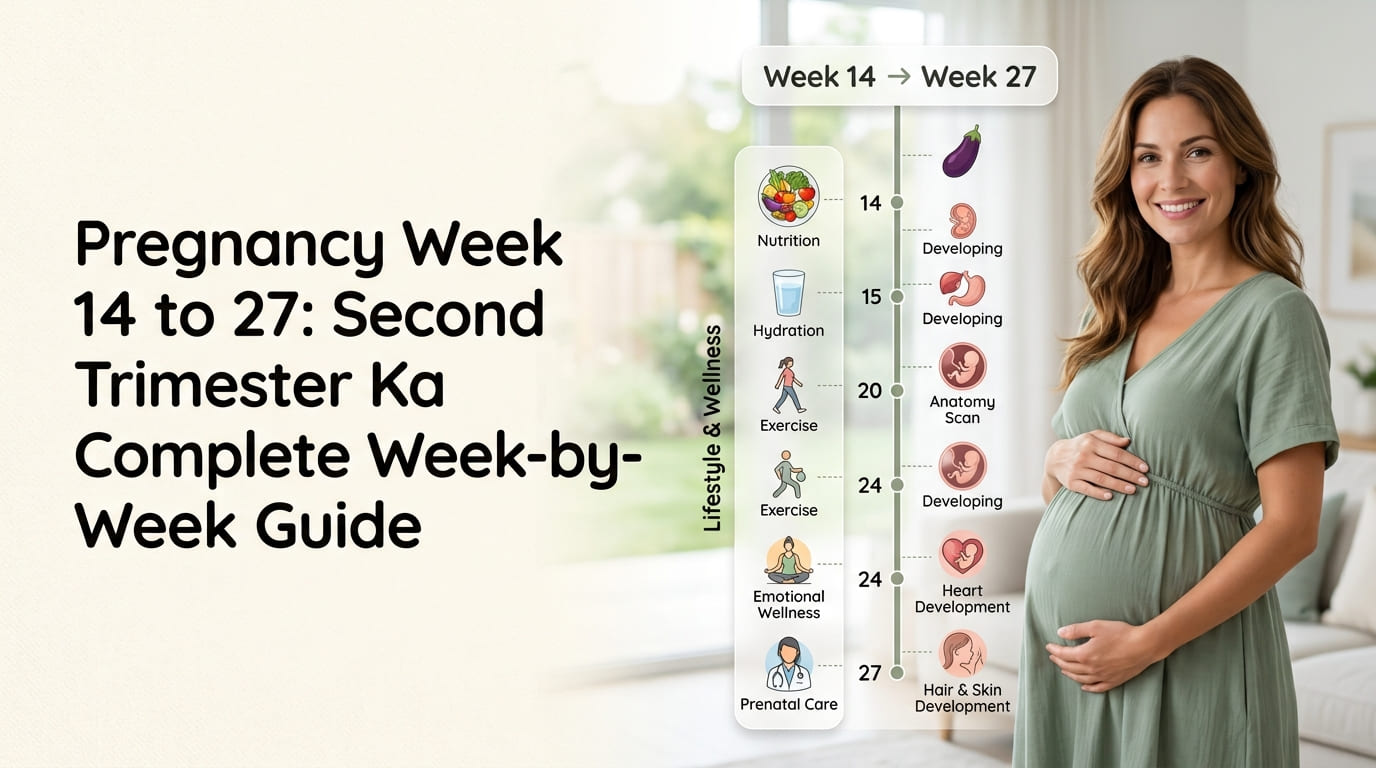
The pregnancy week by week second trimester runs from Week 14 to Week 27 — fourteen weeks that most women experience as the most comfortable phase of their entire pregnancy.
According to the World Health Organization’s antenatal care guidelines and FOGSI (Federation of Obstetric & Gynaecological Societies of India) guidelines, the second trimester is a critical period for fetal development — organ systems established in the first trimester now grow and mature rapidly. It is also when two of the most important screening tests of pregnancy take place: the anomaly scan (typically Week 18–20) and the gestational diabetes screening (typically Week 24–28). The Indian Academy of Pediatrics recommends that Indian pregnant women ensure these tests are completed within the recommended windows.
Why the second trimester feels different:
The intense nausea and exhaustion of the first trimester resolve for most women by Week 13–14. The dramatic physical changes and discomfort of the third trimester haven’t yet arrived. The second trimester occupies a window where most women feel well enough to enjoy being pregnant — and it’s worth savouring.
What’s Happening in Your Baby — Week by Week
Week 14 — The Second Trimester Begins
Baby size: Lemon (approximately 8.7 cm, 43 grams)
Your baby’s face is becoming distinctly human. Facial muscles are developing — the baby can squint, frown, and make grimacing expressions. The neck is more defined, allowing the head to move more freely. The limbs are lengthening and proportions are becoming more recognisable.
For you this week: The nausea that may have dominated your first trimester typically begins to resolve around this time. Energy starts returning — many women describe Week 14 as the first week they felt like themselves again.
India tip: If your first trimester involved significant nausea and reduced eating — as it does for many Indian women — your appetite returning this week is a good opportunity to focus on the nutrient-dense Indian foods your baby needs: dal at every meal, curd daily, ragi porridge, and green leafy vegetables. Our pregnancy diet chart India guide covers exactly what to eat this trimester.
Week 15 — The Baby Can Hear You
Baby size: Apple (approximately 10 cm, 70 grams)
Your baby’s ears are now positioned correctly on the sides of the head and hearing is developing. Research shows babies begin responding to sound from around this week — they can hear your voice, your heartbeat, and muffled sounds from outside.
For you this week: Some women notice their skin changing — the “pregnancy glow” some experience is real and results from increased blood circulation and oil production. Others experience the opposite: dry patches, pigmentation, or acne. Both are normal hormonal responses.
Nosebleeds become more common in the second trimester due to increased blood volume and the expansion of blood vessels in the nasal passages. They are uncomfortable but not dangerous unless very heavy or persistent.
India tip: Begin talking to your baby this week. It sounds self-conscious at first — narrating what you’re cooking, singing a bhajan or lullaby, telling the baby about your day. But your voice is one of the first things your baby learns to recognise. By birth, they will know it.
Week 16 — The Bump Is Visible
Baby size: Avocado (approximately 11.6 cm, 100 grams)
The baby’s eyes are closed but can make side-to-side movements. The skeletal system continues to harden from cartilage to bone. For some pregnancies — depending on position — the sex of the baby may be visible on an ultrasound this week.
For you this week: The bump is now clearly visible to others, not just you. Maternity clothes become genuinely necessary rather than just comfortable. Round ligament pain — a sharp or aching sensation on the sides of the lower abdomen — may begin as the uterus grows and the supporting ligaments stretch.
India tip: Round ligament pain is frequently misidentified as something more serious by first-time mothers. It typically occurs with sudden movement — standing up quickly, sneezing, turning over in bed. Moving more slowly prevents most episodes. If pain is severe, persistent, or accompanied by other symptoms — call your doctor.
Week 17 — Fat Begins Forming
Baby size: Pear (approximately 13 cm, 140 grams)
Your baby is now developing fat deposits — the brown fat that will help regulate body temperature after birth. The baby’s sweat glands are developing. Fingerprints are forming — the unique pattern that will identify this person for their entire life.
For you this week: Increased blood volume — which peaks at around 50% above normal during pregnancy — may cause heart palpitations, dizziness when standing, and increased sweating. These are normal physiological changes.
Constipation is very common in the second trimester due to the hormone progesterone slowing the digestive system and the growing uterus pressing on the intestines. Adequate water intake and fibre-rich foods — dal, fruits, green vegetables — are the most effective management.
Week 18 — First Movements (Quickening)
Baby size: Bell pepper (approximately 14.2 cm, 190 grams)
This is one of the most anticipated moments of pregnancy: the first felt movement. Called quickening, the sensation is often described as a light flutter — like bubbles, like gas, like someone gently pressing from the inside. It’s easy to miss or mistake for something else at first. Within days or weeks, it becomes unmistakable.
First-time mothers: May feel movement anywhere from Week 16 to Week 22. Earlier in subsequent pregnancies because you know what to look for.
For you this week: Your anomaly scan — the detailed mid-pregnancy ultrasound — is typically scheduled around Week 18–20. This is one of the most comprehensive scans of pregnancy, checking the baby’s brain, heart, spine, kidneys, limbs, and overall development. It is not a “gender scan” — though the sex may be visible if you wish to know. It is a detailed assessment of your baby’s anatomy.
India tip: Book your anomaly scan now if you haven’t already. Government facilities offer this scan free under PMSMA. Private hospital waiting times can be significant — don’t leave booking too late.
Week 19 — Vernix and Lanugo
Baby size: Mango (approximately 15.3 cm, 240 grams)
Two things are happening on your baby’s skin this week:
Vernix caseosa — a thick, waxy white coating is forming on the baby’s skin. It protects the skin from the amniotic fluid that surrounds it. Some of it remains on the baby at birth and is best left to absorb naturally rather than washed off immediately.
Lanugo — fine downy hair covers the baby’s body, helping the vernix adhere. It is shed before birth in most babies — though some premature babies are born with significant lanugo.
For you this week: Stretch marks may begin appearing — on the abdomen, breasts, and thighs. They are caused by the skin stretching faster than its collagen can adapt. Genetics is the primary determinant of whether you develop stretch marks — not creams or oils, though moisturising does support skin elasticity and comfort.
Back pain — which affects the majority of pregnant women — typically intensifies this week as the growing uterus shifts the centre of gravity. A firm pillow between the knees when sleeping on your side helps significantly.
Week 20 — Halfway!
Baby size: Banana (approximately 16.4 cm, 300 grams)
You are exactly halfway through your pregnancy. The anomaly scan — if not already done — happens this week. Your baby’s movements are becoming more frequent and stronger. Many partners feel movement from the outside for the first time around now.
For you this week: The anatomy scan at Week 20 is the most comprehensive ultrasound of pregnancy. The sonographer will examine:
- Brain and neural tube
- Heart — four chambers, major vessels
- Spine — for neural tube defects
- Abdominal wall — for gastroschisis or omphalocele
- Kidneys and bladder
- Limbs — counting fingers and toes
- Placenta position
- Amniotic fluid levels
- Cervical length
India tip: Bring a support person to the anomaly scan — a partner, your mother, or a close friend. The scan is long (30–45 minutes), sometimes emotionally intense, and having someone with you matters.
Week 21 — The Digestive System Practises
Baby size: Carrot (approximately 26.7 cm crown-to-heel, 360 grams)
Your baby begins swallowing amniotic fluid this week — a significant milestone because it exercises the digestive system and provides practice for the sucking and swallowing coordination needed for feeding after birth. The swallowed fluid is processed by the kidneys and excreted as urine — which then becomes part of the amniotic fluid in a continuous cycle.
For you this week: Appetite often increases significantly around Week 21. The second trimester requires approximately 300 extra calories daily — not “eating for two” but meaningfully more than usual. Focus on nutrient density: protein at every meal, iron-rich dal, calcium from curd and paneer, and DHA from walnuts or fish.
Week 22 — Face Is Fully Formed
Baby size: Papaya (approximately 27.8 cm, 430 grams)
Your baby’s face is now completely formed — eyebrows, eyelashes, and lips are distinct. The baby’s eyes are developed but the irises still lack pigmentation — the final eye colour will become clear after birth. Taste buds are functioning — the baby can taste the amniotic fluid, which is flavoured by what you eat.
For you this week: Linea nigra — the dark vertical line running from the navel to the pubic bone — appears in many women around this time. It is caused by hormonal changes affecting skin pigmentation and fades after delivery.
Braxton Hicks contractions — painless tightening of the uterus — may begin this week. They are practice contractions, preparing the uterus for labour. They are irregular, do not increase in frequency or intensity, and go away with movement or hydration.
Week 23 — The Baby Responds to Sound
Baby size: Grapefruit (approximately 28.9 cm, 501 grams)
Your baby’s hearing is now acute enough to respond to specific sounds — a door slamming nearby may produce a visible startle on ultrasound. The baby recognises your voice specifically and responds differently to it than to other voices.
For you this week: Swelling (oedema) of the hands and feet is common from the second trimester onward. Mild swelling at the end of the day is normal — the result of increased fluid retention and the pressure of the growing uterus on blood return from the legs. Sudden, severe swelling — particularly in the face and hands — combined with headache warrants immediate medical attention as it can indicate pre-eclampsia.
Week 24 — Viability Milestone
Baby size: Corn cob (approximately 30 cm, 600 grams)
Week 24 is a significant medical milestone: the threshold of viability. A baby born at 24 weeks has approximately a 50% chance of survival with intensive neonatal care. This does not mean premature birth is the plan — it means that if birth happens at this stage, medical intervention is possible and increasingly effective.
The gestational diabetes screening: Between Week 24 and Week 28, every pregnant woman should be screened for gestational diabetes. The standard test involves drinking a glucose solution and testing blood sugar response. Gestational diabetes — elevated blood sugar during pregnancy — affects approximately 15–20% of Indian pregnant women (one of the highest rates globally, due to South Asian genetic predisposition).
If gestational diabetes is diagnosed: it is manageable with diet, exercise, and sometimes medication. Unmanaged gestational diabetes increases risks for both mother and baby. Detection allows management.
India tip: Don’t skip the glucose screening. Many Indian women avoid it because they feel fine and don’t believe they have diabetes. You cannot feel gestational diabetes — screening is the only way to know.
Week 25 — The Baby Grips
Baby size: Cauliflower (approximately 34.6 cm, 660 grams)
Your baby’s grip reflex is now strong — if something touches the palm, the fingers close around it. This is the same reflex that makes newborns grip your finger with surprising strength in the first minutes after birth.
For you this week: Sleep becomes increasingly difficult as the bump grows. The most recommended sleeping position in the third trimester — and increasingly from the second trimester — is on your left side. This position optimises blood flow to the placenta by avoiding compression of the vena cava (the large vein returning blood from the lower body to the heart).
A pregnancy pillow — placed between the knees and supporting the bump — significantly improves sleep comfort.
Week 26 — Eyes Open
Baby size: Lettuce head (approximately 35.6 cm, 760 grams)
Your baby’s eyes open for the first time this week. They can perceive light through the uterine wall — a bright light shone on the abdomen will cause the baby to turn away. The retinas are developing and the optic nerves are maturing.
For you this week: Rib pain and shortness of breath may begin as the uterus expands upward. The diaphragm is being pushed up, reducing lung capacity. This is normal but can be uncomfortable — sitting up straight, avoiding large meals that expand the stomach, and sleeping propped up on pillows can help.
Haemorrhoids — swollen veins in the rectal area — are extremely common in the second and third trimesters. Increased blood volume, constipation, and pressure from the uterus all contribute. High fibre diet, adequate hydration, and avoiding prolonged sitting or standing help prevent and manage them.
Week 27 — Second Trimester Complete
Baby size: Broccoli (approximately 36.6 cm, 875 grams)
Your baby’s brain is developing rapidly — brain wave activity is detectable, and sleep and wake cycles are established. Many women notice regular periods of activity followed by quiet — these are the baby’s sleep cycles. The baby may hiccup, which you feel as regular, rhythmic movements distinct from kicks.
For you this week: You are at the threshold of the third trimester — the final stretch. Your uterus now extends well above the navel. Total weight gain at this point typically ranges from 7–10 kg, depending on pre-pregnancy weight.
The third trimester brings its own physical demands — and its own set of preparations. For everything that happens from Week 28 onward, our third trimester pregnancy guide covers the complete final phase.
Essential Tests in the Second Trimester
Anomaly Scan (Week 18–20) — The Most Important Scan of Pregnancy
What it checks: Complete fetal anatomy — brain, heart, spine, kidneys, limbs, face, abdominal wall.
What it can detect: Neural tube defects, heart abnormalities, kidney problems, cleft lip and palate, limb abnormalities.
Where to get it: Government hospitals under PMSMA — free. Private hospitals — cost varies.
Do not miss this scan.
Gestational Diabetes Screening (Week 24–28)
The oral glucose challenge test or glucose tolerance test — depending on your doctor’s protocol.
High risk for Indian women: South Asian genetic heritage increases gestational diabetes risk significantly. Do not skip this test regardless of whether you feel fine.
Anatomy Scan Follow-Up (if recommended)
If the anomaly scan shows anything requiring further assessment, your doctor will schedule a follow-up. Do not delay follow-up scans if recommended.
Nutrition in the Second Trimester — Indian Foods That Matter
The second trimester’s nutritional priorities:
Iron: Your blood volume increases 50% during pregnancy. Iron demand is enormous. Dal at every meal, ragi twice a week, palak dal with lemon, sesame seeds, jaggery instead of sugar. Iron supplement as prescribed — take with nimbu paani or amla for maximum absorption.
Calcium: Your baby’s bones are forming rapidly. Curd daily, paneer several times a week, full-fat milk, ragi. If dairy is limited — sesame seeds are one of the richest calcium sources available in Indian food.
Protein: For fetal growth. Dal, paneer, curd, eggs (2 daily is excellent), chicken or fish if non-vegetarian, rajma, chole.
DHA: For fetal brain development — peaks in the third trimester but begins now. Walnuts daily, flaxseeds ground into roti atta, fish for non-vegetarians. Discuss DHA supplementation with your doctor.
Common Second Trimester Discomforts — What Actually Helps
| Discomfort | What Helps | What Doesn’t |
|---|---|---|
| Round ligament pain | Move slowly, support bump | Pain medicine (unnecessary) |
| Back pain | Left-side sleep, pillow between knees | Lying flat |
| Constipation | Water, dal, fruits, walking | Laxatives without doctor advice |
| Swelling (mild) | Elevation, water, left-side rest | Salt restriction (don’t self-prescribe) |
| Braxton Hicks | Hydration, rest, position change | Panic — these are normal |
| Heartburn | Small meals, sitting upright | Eating immediately before lying down |
Warning Signs — Call Your Doctor Immediately
Severe abdominal pain or cramping
Vaginal bleeding — any amount
Sudden severe swelling of face, hands, or feet
Severe headache with visual changes (signs of pre-eclampsia)
Fever above 38°C
Reduced or absent fetal movement after Week 24 — if you notice significantly reduced movement, contact your doctor same day
Signs of urinary tract infection — burning, frequency, pain — UTIs are common in pregnancy and can trigger premature labour if untreated
FAQ — Pregnancy Week by Week Second Trimester
Q: When will I feel the baby move for the first time?
Most first-time mothers feel movement between Week 18 and Week 22. In subsequent pregnancies, movement is often noticed earlier — from Week 16 — because you recognise what to look for. The sensation is initially subtle — many women describe it as bubbles, fluttering, or gentle pressure. Within days to weeks it becomes unmistakable kicking and rolling.
Q: I haven’t felt the baby move at Week 20. Should I worry?
Not necessarily — if your anomaly scan showed a healthy, active baby. The placenta’s position significantly affects when you feel movement: an anterior placenta (attached to the front wall of the uterus) acts as a cushion that muffles movement, meaning many women with anterior placentas feel movement later — sometimes not until Week 22–24. Ask your sonographer at your anomaly scan about your placenta position.
Q: What foods are particularly important in the second trimester?
Iron-rich foods are the priority — Indian women have very high rates of iron deficiency anaemia during pregnancy. Dal at every meal with lemon juice or amla to improve absorption, ragi, palak, jaggery, and sesame seeds. Protein from dal, paneer, curd, and eggs. Calcium from curd, paneer, and ragi. The combination of these Indian kitchen staples covers most of the second trimester’s specific nutritional needs.
Q: Is it safe to travel during the second trimester?
The second trimester — particularly Weeks 14 to 28 — is generally considered the safest time to travel during pregnancy. Morning sickness has resolved, the pregnancy is stable, and the bump is not yet large enough to make movement very difficult. Air travel is generally safe. Long car journeys should include regular stops to move around and reduce blood clot risk. Discuss travel plans with your gynaecologist.
Q: My anomaly scan showed a “soft marker” — what does this mean?
Soft markers are ultrasound findings that are slightly more common in certain chromosomal conditions but are also present in healthy pregnancies. They are not diagnoses — they are findings that may prompt further discussion or additional testing. If your anomaly scan mentions a soft marker, discuss specifically with your gynaecologist what it means in your case and whether any follow-up is recommended. Don’t rely on internet research for this particular conversation.
Q: When should I start preparing for labour and birth?
The second trimester is the ideal time to begin childbirth education — antenatal classes, reading about labour and delivery, discussing birth preferences with your gynaecologist, and deciding where you will deliver. Our hospital bag checklist India guide covers what to prepare — starting to gather items from Week 28 onwards means you’re not rushing in the third trimester.
More from MumPappaHub — Read These Next:
- First Trimester Survival Guide (Week 1–13)
- Third Trimester Guide (Week 28–40)
- Pregnancy Diet Chart India
- Foods to Avoid During Pregnancy India
- Pregnancy Insomnia: What Helps
- Pregnancy Yoga for Normal Delivery
- Hospital Bag Checklist India
- Early Signs of Labour
- Baby Blues vs Postpartum Depression
- How to Increase Breast Milk Supply
- Newborn Care Tips
- Iron Rich Foods Babies Toddlers India
About This Article
Written by the MumPappaHub editorial team — including an aunt whose sister called from her Week 20 anomaly scan convinced the baby had deliberately waved. She had a video. She watched it seventeen times that evening. The second trimester does that to you.
Reviewed for accuracy against WHO antenatal care guidelines and Indian Academy of Pediatrics recommendations for pregnancy care. This content is for general informational purposes only and does not constitute medical advice. Always follow your gynaecologist’s specific guidance for your pregnancy.
MumPappaHub — Real talk for real parents. mumpappahub.com

5 Comments