
Medical Disclaimer: This article is for informational purposes only and reviewed against WHO antenatal care guidelines. Always follow your gynaecologist’s specific advice for your pregnancy.
Pregnancy week by week first trimester is something most women research in private, often at odd hours, often before they’ve told anyone.
I found out I was pregnant on a Thursday evening. By Friday morning I had read approximately forty-seven articles. I knew the size of the embryo at six weeks (a lentil), the exact hormones causing my nausea (hCG, progesterone), and the precise week at which the baby’s heart would begin beating (Week 6). I knew more about the first trimester than I had known about anything in recent memory.
What I didn’t know — and what the articles didn’t tell me — was what any of it would actually feel like. The exhaustion that made getting off the sofa feel like an achievement. The nausea that arrived not just in the morning but at 3 PM, at 7 PM, at 2 AM. The anxiety that lives alongside early pregnancy — the constant quiet awareness of how fragile everything is.
This guide covers the pregnancy week by week first trimester properly — what is happening developmentally, what you will feel, the India-specific context that most guides miss, and the essential tests that must be done in these thirteen weeks.
Pregnancy Week by Week First Trimester — The Foundation
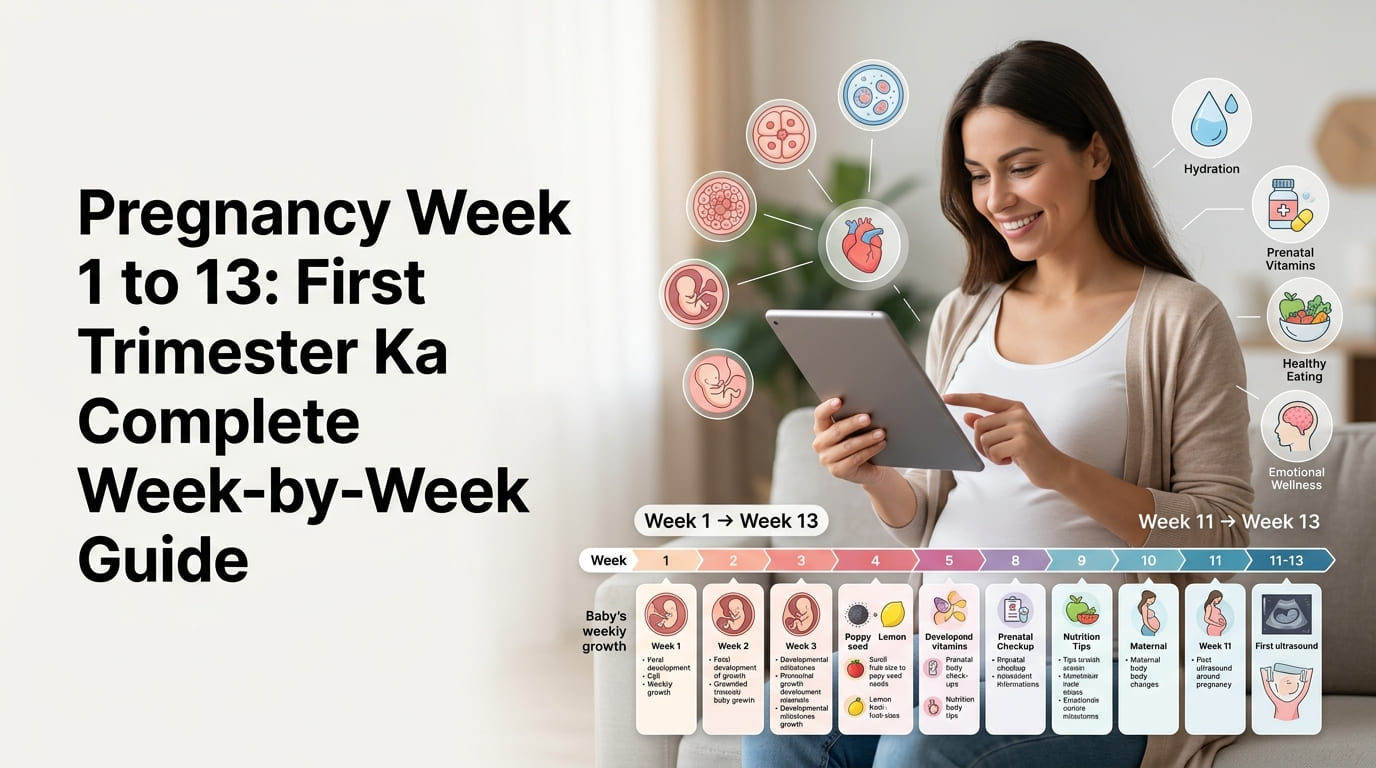
The pregnancy week by week first trimester — Weeks 1 through 13 — is the most critical developmental period of your baby’s entire life.
According to the World Health Organization’s antenatal care guidelines and FOGSI (Federation of Obstetric & Gynaecological Societies of India) recommendations, the first trimester is when every organ system of the human body is established. The brain, heart, spine, lungs, kidneys, liver — all of these are formed, in their most basic versions, within the first twelve weeks. What happens in these weeks sets the foundation for the rest of development.
The Indian Academy of Pediatrics recommends that Indian pregnant women register for antenatal care as early as possible in the first trimester — ideally before Week 10 — to ensure that essential first-trimester screenings are not missed.
One important note on counting: Pregnancy weeks are counted from the first day of your last menstrual period (LMP) — not from conception. This means Weeks 1 and 2 occur before you are technically pregnant. Conception typically happens around Week 2-3. Your positive pregnancy test usually arrives around Week 4.
Week by Week — First Trimester Complete Guide
Weeks 1 and 2 — Before Pregnancy Begins
What’s happening: Technically, pregnancy is calculated from the first day of your last period — so Weeks 1 and 2 are actually the weeks before conception. Your body is preparing for ovulation. An egg is maturing in one of your ovaries.
Conception: Ovulation typically occurs around Day 14 of a 28-day cycle (the end of Week 2). Fertilisation — when a sperm successfully meets the egg — occurs within 24 hours of ovulation.
For you: No pregnancy symptoms because you are not yet pregnant. If you are trying to conceive, this is when folic acid supplementation is most important — neural tube defects occur in the first weeks after conception, often before you know you’re pregnant.
India tip: Start folic acid (400–600 mcg daily) as soon as you begin trying to conceive — not after a positive test. This is one of the most important things you can do for your baby’s neurological development and it requires no prescription.
Week 3 — Fertilisation
Baby size: Microscopic — a single cell dividing
A single sperm has fertilised your egg. The resulting single cell — called a zygote — begins dividing immediately: one cell becomes two, two become four, four become eight. This tiny ball of cells travels from the fallopian tube toward the uterus, continuing to divide as it travels.
For you: No symptoms yet. You may not know you are pregnant. Some women experience very mild implantation cramping — a slight sensation as the fertilised egg begins its journey. Most notice nothing at all.
Week 4 — Implantation and the Positive Test
Baby size: Poppy seed (approximately 0.1 mm)
The ball of cells — now called a blastocyst — reaches the uterus and burrows into the uterine lining. This is implantation. As it implants, the cells begin producing the hormone hCG (human chorionic gonadotropin) — the hormone that makes a home pregnancy test positive.
For you: Your period is due this week — and won’t arrive. A home pregnancy test taken on the day of your missed period will typically be positive. Some tests are sensitive enough to detect hCG a few days before the missed period.
Implantation bleeding: Some women notice very light spotting around the time of implantation — often mistaken for a light period. It is lighter in colour than a period, lasts only 1-2 days, and is not accompanied by significant cramping.
India tip: A positive home pregnancy test is the beginning. Book your first antenatal appointment immediately — government hospitals offer free first antenatal care, blood tests, and initial screening. Private hospitals: book within the week.
Week 5 — Hormones Take Over
Baby size: Sesame seed (approximately 1.5 mm)
The embryo is developing three distinct cell layers — the ectoderm (which will become skin and nervous system), the mesoderm (muscles, bones, circulatory system), and the endoderm (digestive system, lungs, liver). The neural tube — which will become the brain and spinal cord — begins forming.
For you: Week 5 is when many women first notice pregnancy symptoms:
Fatigue: Profound, unexpected exhaustion. The body is doing extraordinary metabolic work — the placenta is forming, hormone levels are surging. The tiredness of early pregnancy is unlike normal tiredness and does not respond to the usual solutions.
Nausea: The infamous “morning sickness” — which occurs at any hour of the day or night. Caused primarily by rising hCG levels and heightened sensitivity to smells. Peaks around Week 8-10.
Breast tenderness: Often the first noticeable symptom — breasts feel full, heavy, and sensitive to touch.
Frequent urination: The kidneys increase their filtering rate in pregnancy, and the growing uterus puts pressure on the bladder.
Week 6 — The Heartbeat
Baby size: Lentil (approximately 4 mm)
This week contains one of the most significant moments of early pregnancy: the development of the baby’s heart. The primitive heart tube begins beating around Week 6 — a flickering on an early ultrasound that is one of the most moving things most parents ever see.
The baby’s face is beginning to form — the earliest structures that will become the eyes, nose, and mouth are appearing. Arm and leg buds are visible as tiny bumps.
For you: Nausea may intensify this week. Many women find that staying ahead of hunger — small, frequent snacks rather than waiting for hunger — significantly reduces nausea severity. Ginger in any form is genuinely helpful: adrak chai, fresh ginger in warm water, ginger biscuits. Strong smells are often the most potent nausea trigger — your kitchen may need some management.
India tip: The early ultrasound at 6-8 weeks (transvaginal ultrasound) confirms the pregnancy is in the uterus (not ectopic), detects a heartbeat, and estimates gestational age. If you haven’t had this scan, ask your gynaecologist about scheduling it.
Week 7 — Brain Development Accelerates
Baby size: Blueberry (approximately 8 mm)
The baby’s brain is developing at a remarkable rate — producing approximately 100 new brain cells per minute at this stage. The face continues forming: eye patches are visible, the inner ear is developing, and the tip of the nose can be seen. Arm and leg buds are lengthening.
For you: Frequent urination intensifies as the uterus grows and the kidneys increase filtration. Some women experience hypersalivation — an unusual increase in saliva production, particularly uncomfortable for those already dealing with nausea.
Constipation: The hormone progesterone relaxes smooth muscle throughout the body — including the digestive tract. This slows digestion and causes constipation in many pregnant women from the first trimester. Adequate water and fibre (fruits, dal, green vegetables) are the most effective management.
Week 8 — Everything Is Developing Simultaneously
Baby size: Raspberry (approximately 14 mm)
This is one of the most developmentally busy weeks of pregnancy. Fingers and toes are forming. The baby’s eyes have a lens and cornea. The internal organs — kidneys, intestines, lungs, liver — are all developing rapidly.
The baby makes spontaneous movements at Week 8 — these are random, driven by developing neural connections, and you cannot yet feel them (the uterus is still very small).
For you: Nausea often peaks around Week 8-10. This is usually the hardest week of the first trimester for women experiencing significant morning sickness. Vitamin B6 supplementation (under your doctor’s guidance) has evidence for reducing nausea severity. In severe cases — hyperemesis gravidarum, where vomiting prevents adequate nutrition — medical treatment is necessary.
The smell sensitivity: Many Indian women find the smell of cooking spices — particularly tempering in hot oil — intensely nauseating during this period. This is a recognised and very common trigger. Asking family members to cook while you’re out of the kitchen, or cooking outside or with excellent ventilation, helps significantly.
Week 9 — The Embryo Becomes a Fetus
Baby size: Cherry (approximately 22 mm)
At Week 9, your baby transitions from embryo to fetus — a technical distinction marking the transition from the period of initial organ formation to the period of growth and refinement.
All major organ systems have formed. The baby’s tail (yes — a small tail-like structure) disappears this week. The genitals are developing but sex cannot yet be determined on ultrasound. Teeth buds are forming below the gums.
For you: The uterus is now approximately the size of a grapefruit — not visible externally yet, but you may feel bloating and a subtle tightening in the lower abdomen. Mood variability — unexpected crying, anxiety, irritability — is extremely common and is the result of the most dramatic hormonal changes occurring in your body in real time.
Week 10 — Fingers and Toes Are Distinct
Baby size: Strawberry (approximately 3.1 cm)
The baby’s fingers and toes are now clearly separate. The face is looking increasingly human. The baby is moving constantly — wriggling, kicking, turning — though you won’t feel these movements for several more weeks.
For you: The first trimester screening window opens around now:
NT Scan (Nuchal Translucency Scan): A specialised ultrasound measuring the fluid at the back of the baby’s neck — used to assess risk for chromosomal conditions including Down’s syndrome. Best performed between Weeks 11 and 13.
First trimester blood tests: Combined with the NT scan — measuring specific hormones in your blood alongside the ultrasound measurement to give a risk assessment.
India tip: The NT scan is available at most private hospitals and many government hospitals. It must be done within the Week 11-13 window — do not delay booking if you want this screening.
Week 11 — The Baby Is Moving Constantly
Baby size: Fig (approximately 4.1 cm)
The baby’s diaphragm is developing — the muscle that makes breathing possible. The baby is practising breathing movements by inhaling and exhaling amniotic fluid. Hiccups may begin — you won’t feel them yet, but they’re visible on ultrasound.
For you: Some women notice a slight reduction in nausea this week. Energy may begin returning. The dark line running from the navel to pubic bone — linea nigra — may become visible on darker skin tones.
First trimester screening: The NT scan is ideally done this week or next. If you have had genetic testing recommended — Non-Invasive Prenatal Testing (NIPT) — this can be done from Week 10 onward. Discuss with your gynaecologist which screening is appropriate for you based on your age and risk factors.
Week 12 — The Risk Changes
Baby size: Lime (approximately 5.4 cm)
The baby’s reflexes are developing rapidly — fingers will curl if the palm is touched, toes will curl, eyes squeeze shut. The risk of miscarriage drops significantly after Week 12 as the most critical developmental period completes.
The placenta is now fully functioning — taking over from the corpus luteum the hormonal production that has been sustaining the pregnancy.
For you: Many women experience a meaningful improvement in nausea this week as hCG levels plateau and begin to drop slightly. Energy returns. The emotional weight of the first trimester — the anxiety, the secrecy, the exhaustion — often lifts.
This is typically when couples choose to share the news more widely. The reduced miscarriage risk after Week 12 is the medical reason most people wait until this point.
India tip: First trimester bleeding is a significant concern for many Indian women — both because miscarriage is genuinely more common in the first trimester and because any bleeding is frightening. If you experience bleeding at any point in pregnancy, contact your gynaecologist. Do not wait and see. Most first trimester bleeding does not indicate miscarriage — but it needs assessment.
Week 13 — First Trimester Complete
Baby size: Peach (approximately 7.4 cm)
Your baby’s fingerprints are forming — the unique pattern that will identify this person forever. The baby’s vocal cords are developing. The head and body are becoming more proportionate — the head is no longer the majority of the baby’s total size.
For you: Welcome to the second trimester. Energy returns, nausea resolves for most women, and the pregnancy that has been your complete internal preoccupation for thirteen weeks begins to become visible to the world.
The second trimester brings its own changes, tests, and milestones — for everything from Week 14 onward, our pregnancy week by week second trimester guide covers the next phase completely.
Essential First Trimester Tests — India Guide
First Antenatal Visit (As Early as Possible)
What happens: Weight, blood pressure, urine test. Blood tests for haemoglobin, blood group, Rh factor, HIV, syphilis, hepatitis B. Discussion of your medical history, family history, and current medications.
Where: Government hospitals — free. Private hospitals — varies. Anganwadi centres for community support.
Early Ultrasound (Week 6-8)
Confirms pregnancy is in the uterus (not ectopic). Detects heartbeat. Estimates gestational age and calculates due date.
NT Scan and First Trimester Screening (Week 11-13)
Measures nuchal translucency (fluid at back of neck). Combined with blood tests for Down’s syndrome risk assessment. Must be done before Week 14 — the window closes.
NIPT (Non-Invasive Prenatal Testing) — Optional
Blood test from Week 10 onward. Highly accurate screening for chromosomal conditions. Not universally available — discuss with your gynaecologist.
First Trimester Nutrition — Indian Foods That Matter
Folic acid: Supplement (400-600 mcg) daily throughout the first trimester and ideally from before conception. Also from food: palak, methi, moong dal, amla, beetroot, eggs.
Iron: Iron deficiency affects most Indian pregnant women — start building stores now. Dal at every meal with lemon juice. Ragi. Jaggery instead of sugar. Iron supplement as prescribed.
Protein: For the embryo’s rapid cell division. Dal, paneer, curd, eggs, dahi.
Ginger: For nausea. Adrak chai, fresh ginger in warm water, ginger in cooking. Evidence-based and safe in the amounts used in cooking and chai.
What to avoid: Raw papaya, unpasteurised dairy, undercooked eggs or meat, excess caffeine (limit to 1-2 cups chai daily), alcohol (zero safe amount in pregnancy).
For a complete trimester-wise Indian pregnancy diet guide, our pregnancy diet chart India guide covers exactly what to eat at each stage.
Managing First Trimester Nausea — What Actually Works
| Strategy | How | Evidence |
|---|---|---|
| Small frequent meals | Every 2-3 hours, never empty stomach | Strong |
| Ginger | Adrak chai, ginger biscuits, fresh ginger water | Good |
| Cold food | Less aromatic than hot food — easier to tolerate | Practical |
| Vitamin B6 | 10-25 mg, 3x daily (doctor advice) | Moderate |
| Avoiding triggers | Identify your specific smell/food triggers | Essential |
| Rest | Fatigue worsens nausea significantly | Strong |
| Nimbu paani | Sipped slowly — citrus can reduce nausea | Practical |
When to call your doctor: If you cannot keep any food or fluids down for 24 hours. If you are losing weight. If you are becoming dehydrated — dark urine, dizziness. These indicate hyperemesis gravidarum which needs medical management.
Warning Signs — Call Your Doctor
Heavy vaginal bleeding (light spotting — call; heavy bleeding — go to hospital)
Severe abdominal pain or cramping
Fever above 38°C
Severe vomiting — unable to keep anything down for 24 hours
Burning or pain on urination — UTIs are common in pregnancy and can cause complications
Shoulder pain alongside abdominal pain (possible ectopic pregnancy sign)
Any symptom that worries you — always appropriate to call
FAQ — Pregnancy Week by Week First Trimester
Q: I had a positive test but don’t feel pregnant. Is something wrong?
Not necessarily — symptoms vary enormously between women and between pregnancies. Some women have significant nausea from Week 5; others have minimal symptoms throughout. The absence of symptoms is not an indicator of pregnancy health. What matters is what your blood tests and early ultrasound show — not how you feel.
Q: My nausea is so bad I can barely eat. Is my baby getting enough nutrition?
In the first trimester, your baby’s nutritional needs are very small — they are microscopic for much of this period. Your pre-pregnancy nutritional stores cover most of what they need. Focus on staying hydrated and eating whatever you can tolerate — even if that’s only plain rice, toast, and nimbu paani for weeks. The baby will be fine. Discuss with your gynaecologist if you are truly unable to eat anything.
Q: When should I tell my employer I’m pregnant?
In India, the Maternity Benefit Act (2017) requires notification to the employer when claiming maternity leave — typically around Week 32-34. Earlier disclosure is a personal choice. Many women tell their employers when they need accommodations (nausea, fatigue, frequent doctor visits) in the first trimester, but there is no legal requirement to do so early.
Q: Is it safe to travel in the first trimester?
Generally yes, with some caveats. The first trimester is actually considered relatively safe for travel — there is no evidence that travel itself increases miscarriage risk. However, nausea and fatigue may make travel very uncomfortable. Air travel: generally safe. Road travel: ensure regular stops. Avoid areas with Zika or malaria risk without discussing with your doctor.
Q: I’ve had a previous miscarriage. How do I manage the anxiety this pregnancy?
Anxiety following pregnancy loss is completely normal and very common. It does not damage the pregnancy. Discuss your history with your gynaecologist — more frequent early monitoring (additional scans, more regular check-ins) is often offered to women with previous losses and is reasonable to request. Connecting with others who have experienced pregnancy loss and subsequent pregnancy can also help significantly.
Q: What exercises are safe in the first trimester?
Most regular exercise that you were doing before pregnancy can continue in the first trimester with modifications. Walking and yoga are excellent. High-impact activities and contact sports should be discussed with your gynaecologist. Listen to your body — fatigue and nausea may naturally limit what you can do. For pregnancy-safe yoga, our pregnancy yoga for normal delivery guide covers safe poses at each trimester.
More from MumPappaHub — Read These Next:
- Second Trimester Guide (Week 14–27)
- Third Trimester Guide (Week 28–40)
- Pregnancy Diet Chart India — Trimester by Trimester
- Foods to Avoid During Pregnancy India
- Manage Morning Sickness Naturally
- Pregnancy Insomnia: What Helps
- Pregnancy Yoga for Normal Delivery
- Hospital Bag Checklist India
- Early Signs of Labour
- Baby Blues vs Postpartum Depression
- How to Increase Breast Milk Supply
- Newborn Care Tips
About This Article
Written by the MumPappaHub editorial team — including a mother who found out she was pregnant on a Thursday evening and by Friday morning had read forty-seven articles about the first trimester. She knew the size of a six-week embryo. She knew nothing about what it would actually feel like. This is that guide.
Reviewed for accuracy against WHO antenatal care guidelines and Indian Academy of Pediatrics recommendations for first trimester care. This content is for general informational purposes only and does not constitute medical advice. Always follow your gynaecologist’s specific guidance for your pregnancy.
MumPappaHub — Real talk for real parents. mumpappahub.com

4 Comments