
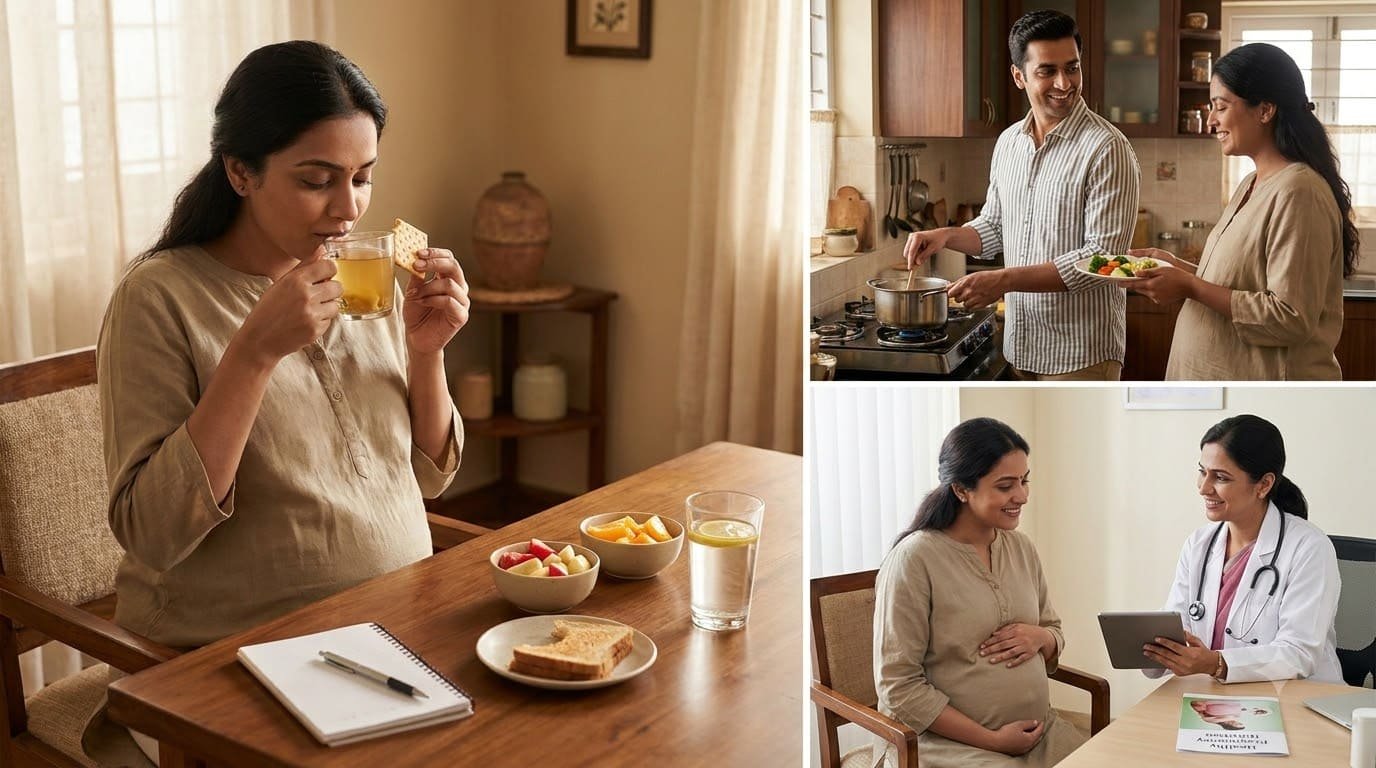
Medical Disclaimer: This article is for informational purposes only and reviewed against WHO, FOGSI, and IAP guidelines. If you cannot keep any fluids down for 24 hours, or are losing weight, contact your gynaecologist immediately — this may be hyperemesis gravidarum requiring medical treatment.
Morning sickness remedies India is what every newly pregnant Indian woman searches at some point — usually between 5 AM and 7 AM, when the name “morning” sickness seems particularly cruel given that it has also arrived at 2 PM, 6 PM, and 11 PM.
My first trimester was dominated by nausea from Week 5 to Week 13. Not constant vomiting — I was one of the women who feels perpetually on the edge of nausea without always tipping over. The smell of dal tadka, which I had previously loved, made me leave the kitchen. The smell of my husband’s aftershave made me leave the room. The smell of a neighbour’s cooking, floating through the window at 7 AM, made me intensely grateful for our bathroom.
What helped was a combination of things — some traditional Indian remedies that my mother and grandmother swore by, some dietary adjustments that took weeks to figure out, and one or two things I found in research that I wouldn’t have tried otherwise. This guide is that combination — tested, India-specific, and honest about what works and what doesn’t.
Morning Sickness Remedies India — Understanding What’s Happening
Morning sickness remedies India work best when you understand the mechanism — because nausea in pregnancy is not random. It is caused by specific, identifiable triggers that can be managed.
The primary cause of morning sickness is the rapid rise in human chorionic gonadotropin (hCG) — the hormone produced by the developing placenta. hCG levels double every 48-72 hours in early pregnancy and peak around Week 8-10. This is precisely when nausea is typically worst.
According to the World Health Organization’s guidelines on nutrition in pregnancy, nausea and vomiting affect 70-80% of pregnant women globally and are associated with a normally progressing pregnancy — counter-intuitively, nausea is often a reassuring sign that the pregnancy hormones are doing what they should. The Federation of Obstetric and Gynaecological Societies of India (FOGSI) and Indian Academy of Pediatrics both recognise that most pregnancy nausea can be effectively managed with dietary and lifestyle adjustments before medication is needed.
Why “morning” sickness is a misnomer: The name persists because nausea is often worst in the morning — blood sugar drops overnight during fasting, and low blood sugar is one of the most reliable nausea triggers. But nausea can occur at any hour, and many women find it worst in the evenings.
What makes it worse in Indian households: The strong aromatics of Indian cooking — mustard seeds tempering in hot oil, the smell of garam masala, the intensity of freshly ground masalas — are among the most potent smell-triggered nausea stimuli. This is not a judgement of Indian food — it is a physiological reality that needs specific management.
12 Best Morning Sickness Remedies India
1. Ginger — The Most Evidence-Based Remedy
Ginger (adrak) is the single most researched natural remedy for pregnancy nausea, with multiple clinical trials showing it reduces nausea severity and vomiting frequency. It contains gingerols and shogaols — compounds that work on serotonin receptors in the gut to reduce the nausea signal.
How to use ginger:
Adrak chai (ginger tea): Fresh ginger grated into hot water, steeped for 5 minutes, strained. Add a little honey if needed (only after 12 months in babies, but fine for pregnant women). Sip slowly.
Fresh ginger water: A small piece of fresh ginger steeped in warm water — milder than tea but still effective.
Ginger biscuits/cookies: Easy to keep by the bedside for the first morning moments. Many Indian bakeries make simple ginger biscuits.
Ginger candy (saunth): Dried ginger candy — available at most Indian grocery stores — for moments when making tea isn’t possible.
Important: Avoid ginger in large medicinal amounts (over 1g daily as supplements) without discussing with your gynaecologist. The amounts used in cooking and chai are safe.
2. Nimbu Paani — Vitamin C and Citrus Rescue
The smell and taste of lemon is one of the most reliable quick nausea reducers — and the mechanism is real, not placebo. Citrus smell stimulates the limbic system in ways that can briefly override the nausea signal.
How to use:
- Fresh nimbu paani — lemon squeezed into cold water, sipped slowly
- A cut lemon held near the nose during nausea episodes (the smell alone helps many women)
- Nimbu pickle — the sharp sourness can cut through nausea for some women
- Frozen nimbu paani ice cubes — sucked slowly when nausea is severe and sipping is difficult
The electrolyte bonus: If vomiting is occurring, nimbu paani with a pinch of salt and sugar provides electrolytes that help maintain hydration — functioning as a simple homemade ORS for mild cases.
3. The Most Important Rule — Never Empty Stomach
The single most effective nausea management strategy is preventing the blood sugar drop that intensifies nausea. An empty stomach is a guaranteed nausea trigger in the first trimester.
The practice: Eat small amounts every 2-3 hours — not three large meals. The stomach should never be completely empty.
Before getting out of bed: Keep crackers, plain biscuits, or dry toast on the bedside table. Eat 2-3 biscuits before sitting up. Wait 10-15 minutes. Then get up slowly. This 10-minute window, where blood sugar rises slightly before movement, is one of the most effective morning nausea management strategies.
Indian options for the bedside:
- Plain Marie biscuits or cream crackers
- Mathri (plain, unsalted)
- Plain roasted makhana
- Rice cakes
4. Cold Foods Over Hot — The Smell Reduction Strategy
Hot food releases significantly more aroma than cold food. In a first trimester where smell sensitivity is dramatically heightened, this difference is meaningful.
What to do:
- Eat food at room temperature rather than hot
- Cold curd, cold fruits, cold nimbu paani
- Let food cool completely before eating
- Refrigerate leftovers and eat them cold rather than reheating
India-specific challenge: Indian food is typically eaten hot. The solution is to cook the night before and eat at room temperature the next day — or to cook outside the home temporarily. Many first trimester women in India find that someone else doing the cooking, or eating at room temperature, resolves a significant portion of meal-triggered nausea.
5. Saunf (Fennel Seeds) — The Traditional Indian Digestive
Saunf has been used as a digestive and carminative in Indian households for centuries — and there is pharmacological basis for its effectiveness. Fennel contains anethole — a compound with antispasmodic properties that reduces gut cramping and the associated nausea.
How to use:
- Plain saunf chewed slowly after meals
- Saunf soaked in water overnight, strained — drink the water
- Saunf tea — boil saunf in water, strain, sip warm
- Saunf and mishri (rock sugar) combination — the classic post-meal digestive
Availability: Every Indian kitchen has saunf. This is perhaps the most accessible Indian morning sickness remedy.
6. Ajwain (Carom Seeds) — Carminative and Digestive
Ajwain contains thymol — a compound with documented antispasmodic, carminative, and anti-nausea properties. It has been used in Indian traditional medicine for digestive complaints for centuries.
How to use:
- Ajwain water: boil 1 teaspoon of ajwain in 2 cups of water, strain, sip warm throughout the day
- Plain ajwain chewed with a pinch of black salt
- Ajwain in light food — added to roti or plain khichdi
Particularly useful for: Nausea that is accompanied by bloating and gas — which is common in the first trimester as the digestive system slows.
7. Jeera (Cumin) Water — Digestion Support
Cumin has mild anti-nausea and digestive properties and is used across India as a first-line digestive remedy.
How to make jeera water: Dry roast 1 teaspoon of jeera in a pan until aromatic. Add to 2 cups of water. Simmer for 5 minutes. Strain and cool. Sip throughout the day.
Cold jeera water — made the previous evening and refrigerated — can be sipped first thing in the morning before eating.
8. Amla (Indian Gooseberry) — Vitamin C and Anti-Nausea
Amla contains extraordinarily high levels of vitamin C — research suggests vitamin C may have a modest anti-nausea effect in pregnancy, and anecdotally many Indian pregnant women find amla helpful.
How to use:
- Fresh amla — a small piece chewed slowly
- Amla murabba — the sweet preserved version, easier to eat when nausea is high
- Amla juice diluted in water
- Amla candy
Bonus: The iron absorption benefit of amla’s vitamin C is particularly valuable in pregnancy. Eating amla alongside iron-rich foods is one of the most practical nutrition habits for Indian pregnant women.
9. Vitamin B6 — Evidence-Based Supplement
Vitamin B6 (pyridoxine) has solid clinical evidence for reducing pregnancy nausea. Multiple studies show that 10-25 mg of vitamin B6 three times daily significantly reduces nausea severity.
In India: Vitamin B6 is available as a supplement and is also present in many prenatal vitamins. Before taking additional B6, check whether your prenatal supplement already contains it.
Discuss with your gynaecologist before adding B6 supplements — the appropriate dose depends on what’s already in your prenatal vitamin and your specific symptoms.
Food sources of B6 (helpful as dietary support):
- Banana — one of the best food sources and a practical first-trimester food
- Chickpeas (chana)
- Potato
- Dal
10. Acupressure — The P6 Point
The Neiguan (P6) acupressure point — located on the inner wrist, approximately three finger-widths below the wrist crease, between the two central tendons — has been studied in multiple trials for pregnancy nausea. The evidence is mixed but several well-designed trials show a meaningful benefit.
How to use: Apply firm pressure with the thumb to the P6 point on each wrist for 2-3 minutes, alternating wrists, whenever nausea is significant.
Sea-band wristbands — available online in India — use a small button to apply constant pressure to this point. Many pregnant women find wearing them throughout the first trimester provides background nausea reduction.
No side effects. No cost beyond the wristbands if you choose to use them. Worth trying.
11. Managing the Indian Kitchen Challenge
This section is specific to Indian households and addresses the most common practical challenge: how to manage when the smell of cooking is unavoidable.
Practical strategies:
Cook outside if possible: An outdoor chulha or balcony cooking in early trimester is a genuine option some families arrange.
Ventilate aggressively: Exhaust fan, windows open, the kitchen door closed — reduce indoor accumulation of cooking smells.
Cook at off-hours: Prepare food at times when nausea is lower (for many women, this is late morning or early afternoon), refrigerate, and eat cold or at room temperature.
Ask for help: Family members cooking while the pregnant woman is in another room is not a luxury — it is a practical accommodation that significantly reduces smell-triggered nausea.
Temporary smell strategies: A piece of fresh lemon held near the nose while cooking or passing through the kitchen. A light cotton mask. Briefly leaving the room during tempering.
Bland cooking temporarily: Reducing the intensity of spicing — particularly the tadka — in the first trimester is a practical adjustment. Mild dal, plain khichdi, simple curd rice. Not forever. Just through the worst weeks.
12. Hydration — Even When Drinking Feels Impossible
Dehydration worsens nausea — creating a cycle where nausea reduces fluid intake, which worsens nausea, which further reduces fluid intake.
When drinking feels impossible:
- Small sips rather than large amounts — a few sips every 15 minutes
- Cold fluids rather than warm (for many women)
- Ice chips or ice made from nimbu paani — sucked slowly
- Coconut water — natural electrolytes, often well-tolerated when plain water isn’t
- Oral rehydration solution (ORS) — if vomiting is occurring
What to avoid: Large amounts at once. Carbonated drinks (temporarily helpful for some, worse for others). Very sweet drinks — they can trigger nausea in themselves.
When Nausea Becomes Hyperemesis Gravidarum
Hyperemesis gravidarum (HG) is severe, uncontrolled nausea and vomiting in pregnancy that goes beyond normal morning sickness. It affects approximately 1-3% of pregnancies and requires medical treatment.
Signs that this is beyond morning sickness:
- Cannot keep any food or fluids down for 24 hours
- Vomiting more than 3-4 times daily consistently
- Losing weight (more than 5% of pre-pregnancy body weight)
- Signs of dehydration — dark urine, dizziness, rapid heartbeat
- Unable to perform daily activities
What to do: Contact your gynaecologist the same day. HG is treated with intravenous fluids, anti-nausea medications, and sometimes hospitalisation. It is not managed with home remedies. It is not a sign of weakness or failure. It is a medical condition.
The distinction matters because many women with HG delay seeking help — either because they feel they should be managing it, or because they’re told it’s “just morning sickness.” It is not.
When Does Morning Sickness End?
For most women: by Week 13-14. The drop in hCG after it peaks at Week 10 typically brings a gradual improvement in nausea. Many women describe a specific day — sometimes a specific hour — when they realised the nausea had lifted.
For some women: it persists into the second trimester, occasionally throughout pregnancy. This is more common and more manageable when appropriately treated — if nausea is persisting beyond Week 16, discuss it specifically with your gynaecologist rather than waiting it out.
For our complete second trimester guide — what happens after the first trimester ends — the nausea lifting is one of the most anticipated milestones of Week 13-14.
FAQ — Morning Sickness Remedies India
Q: Is morning sickness a sign of a healthy pregnancy?
Counterintuitively, yes — in most cases. Nausea in early pregnancy is associated with elevated hCG, which reflects a normally progressing pregnancy. Studies have found that women who experience nausea in the first trimester have slightly lower miscarriage rates than those who don’t. This doesn’t mean the absence of nausea indicates a problem — symptoms vary enormously — but if you have nausea, it is generally reassuring rather than concerning.
Q: Can I take anti-nausea medication in pregnancy?
Yes — but only under a doctor’s prescription. Several anti-nausea medications are considered safe in pregnancy in India, including doxylamine (often combined with B6), ondansetron (for more severe nausea), and promethazine. Never take anti-nausea medication without discussing it specifically with your gynaecologist — not all anti-nausea medicines are safe in pregnancy.
Q: My mother-in-law says I should eat despite the nausea. Is she right?
Partially. The important thing is to keep something in the stomach — but forcing large meals when nausea is severe can make things significantly worse. Small amounts every 2-3 hours is more effective than three large meals. The goal is to never be completely empty, not to eat normally sized meals.
Q: Is ginger tea safe throughout the first trimester?
Ginger in the amounts used in cooking and chai — fresh ginger steeped in water — is considered safe in the first trimester. The concern about ginger is at higher medicinal doses (standardised ginger supplements at doses above 1g daily). Fresh ginger in cooking and tea, at normal culinary amounts, is safe and evidence-supported.
Q: The smell of cooking makes me immediately nauseous. What do I do?
This is one of the most common and most disruptive first trimester experiences in Indian households. Practical strategies: someone else cooks while you’re in another room, you eat food at room temperature rather than hot (dramatically less aromatic), you keep a cut lemon nearby during cooking exposure, you reduce spicing intensity temporarily. This is a legitimate pregnancy accommodation — not a preference or weakness.
Q: My morning sickness started at Week 5 but I’m now at Week 15 and it hasn’t stopped. Is this normal?
Nausea persisting past Week 14-15 is less common but not rare — approximately 10% of pregnant women continue to experience nausea into the second trimester. If it’s significantly affecting your quality of life or nutrition, discuss it specifically with your gynaecologist rather than waiting. Medical management is available and effective
More from MumPappaHub — Read These Next:
- Pregnancy Week by Week First Trimester
- Pregnancy Week by Week Second Trimester
- Pregnancy Diet Chart India
- Foods to Avoid During Pregnancy India
- Pregnancy Insomnia: What Helps
- Pregnancy Yoga for Normal Delivery
- Hospital Bag Checklist India
- Early Signs of Labour
- Baby Blues vs Postpartum Depression
- Iron Rich Foods Babies Toddlers India
- Newborn Care Tips
- How to Increase Breast Milk Supply
About This Article
Written by the MumPappaHub editorial team — including a mother whose first trimester was defined by the smell of dal tadka becoming an enemy. She ate food at room temperature for six weeks. She survived. The tadka eventually became beloved again by Week 14.
Reviewed for accuracy against WHO guidelines on nutrition in pregnancy, FOGSI clinical recommendations for nausea management in pregnancy, and Indian Academy of Pediatrics guidance. This content is for general informational purposes only and does not constitute medical advice. If nausea is severe, persistent, or preventing adequate nutrition — consult your gynaecologist.
MumPappaHub — Real talk for real parents. mumpappahub.com
