
Medical Disclaimer: This article is for informational purposes only and reflects general guidance and personal experience. Always visit facilities in person and consult your paediatrician regarding your child’s specific needs before making a decision.
I toured seven daycares before I picked one, and I still remember standing outside the fourth one, in the car, crying a little, because I genuinely didn’t know how to tell a good one from a place that just had nicer paint on the walls.
Every brochure said the same things. “Nurturing environment.” “Individual attention.” “Holistic development.” After the third identical pamphlet, none of those words meant anything to me anymore. What actually helped, eventually, was figuring out how to choose the right daycare for your toddler based on specific, checkable things — not marketing language, not the fanciest playground, but the details that actually predict whether your child will be safe, happy, and genuinely cared for during the hours you’re not there.
This is the guide I put together after that exhausting search, built from what I actually learned walking into real classrooms, asking real questions, and occasionally getting answers that made me quietly walk right back out.
Start With What Actually Matters: Safety and Staff Ratios
Before curriculum, before the beautiful sensory corner, before any of it — this is where I’d tell any parent to start.
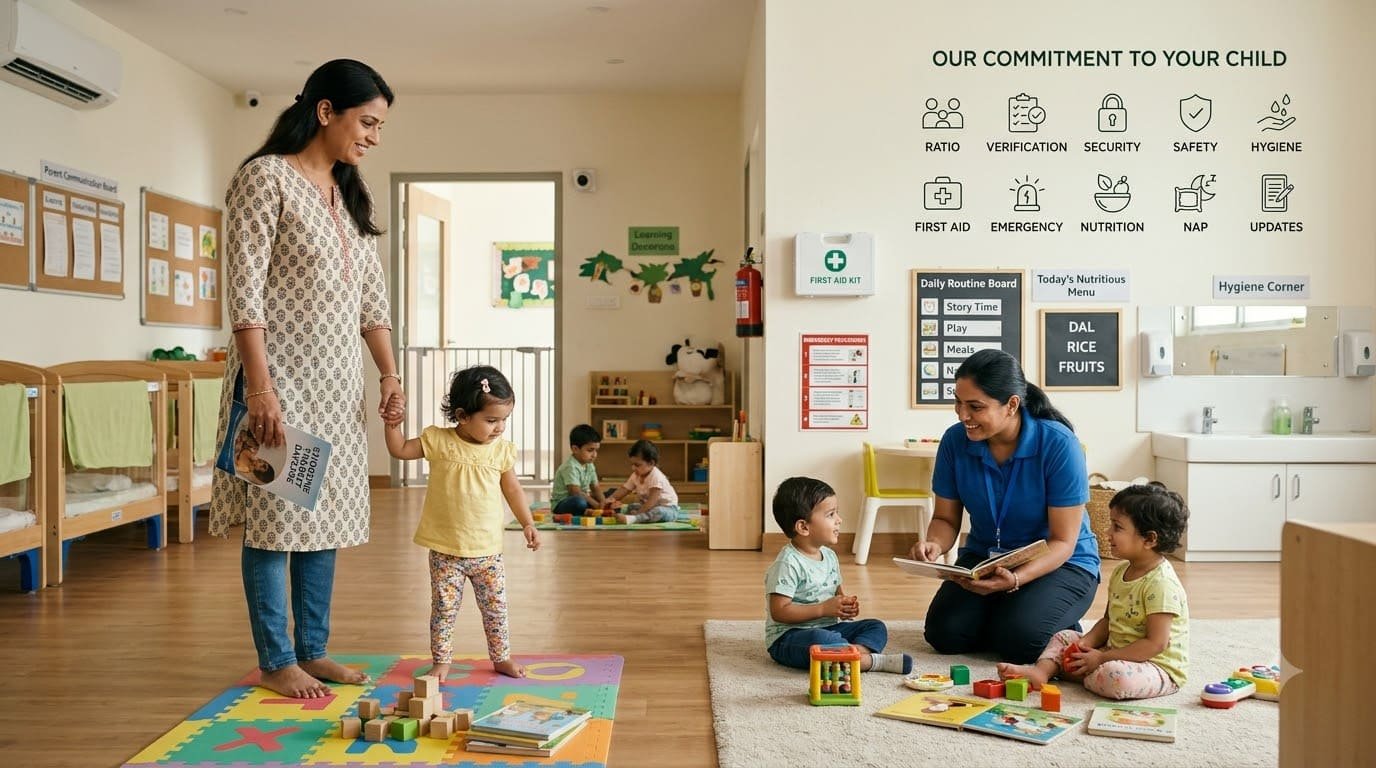
Staff-to-child ratio is the single most important number in this entire decision. For toddlers between one and two years, a ratio of roughly one adult to every four to six children is considered reasonable in most quality facilities. Anything significantly higher than that means less actual attention for your child, no matter how nice the classroom looks.
Ask directly about staff turnover. A daycare with the same core teachers for two or three years is a very different environment from one where staff changes every few months. High turnover, however it’s explained, is worth taking seriously as a red flag.
Check background verification for all staff, not just teachers — this includes support staff, drivers, and anyone with access to children. A facility that’s vague or defensive about this question is not one I’d trust. The Ministry of Women and Child Development has outlined creche and daycare quality standards under the National Creche Scheme, which is a useful benchmark to ask about even for private facilities that fall outside the scheme itself.
Look at the physical safety basics with your own eyes. Covered electrical points, cushioned corners on furniture, safe staircase gates, clean drinking water, and a properly equipped first-aid kit that isn’t locked away somewhere inaccessible.
Ask what happens in a medical emergency. A good daycare has a clear, specific answer — which hospital they use, how quickly parents are contacted, whether a staff member is trained in basic first aid or CPR. A vague answer here told me more than any brochure could.
Visit in Person, and Visit Unannounced If You Can
Scheduled tours show you the best version of a place. Everyone’s on their best behaviour, the toys are freshly arranged, and the teacher you meet is often the most experienced one on staff.
If the daycare allows it, a second, unannounced visit — even just dropping by during a normal day — tells you far more. Are the children actually engaged, or largely left in front of a screen? Do staff seem genuinely warm with the kids, or just going through motions? Is the noise level what you’d expect from happy, active toddlers, or does something feel off?
I did this with my top two choices, and honestly, it’s what made the final decision for me. One place looked identical to the other on paper. In person, during an unscheduled fifteen minutes, the difference was obvious.
Understanding Curriculum Without Getting Lost in Buzzwords
Every daycare in India seems to use the words “Montessori-inspired,” “holistic,” and “play-based” somewhere in their materials, often without much behind them. Here’s what actually helped me evaluate this properly.
Ask to see an actual daily schedule, not a vague description. A real schedule shows structured play, free play, outdoor time, rest, and meals in specific blocks — this tells you far more than any philosophy statement.
Ask how screen time is handled. The American Academy of Pediatrics recommends minimal to no screen time for children under two, and limited, high-quality content for slightly older toddlers. A daycare that uses screens as a regular pacifier during the day, rather than an occasional, brief, supervised activity, is worth reconsidering.
Ask about outdoor time specifically. Many urban daycares in India have limited outdoor space, but a good one still prioritises some outdoor or gross-motor activity daily, weather permitting.
Observe how transitions are handled — moving from playtime to snack time to nap time. Chaotic, rushed transitions with a lot of shouting are a different environment from calm, predictable ones, even if the actual activities look similar on a schedule.
Questions I Wish I’d Asked Earlier
What’s the actual daily routine, hour by hour? Not the marketing version — the real one, including nap timing, meal timing, and how flexible it is if your child’s routine differs slightly.
How do you handle a toddler who’s having a difficult day — a meltdown, refusing to nap, not wanting to eat? The answer here reveals a lot about the underlying approach to discipline and comfort.
What’s your policy on sick children, both in terms of when a child needs to stay home and how illness is communicated to other parents? This matters enormously once your child is in a group setting for the first time.
How is food handled — is it provided, or do parents pack it, and if provided, who prepares it and where? Given how often allergies and dietary preferences come up, a clear, specific answer matters here.
How and when will I be updated during the day? Some daycares send photos or brief updates through an app; others tell you almost nothing until pickup. Know which one you’re choosing, and whether it matters to you.
What’s the actual policy on discipline? Vague answers like “we use positive reinforcement” are fine as a starting point, but ask for a specific example of how a toddler biting or hitting another child is handled in practice.
For more on navigating toddler behaviour generally, our guides on toddler tantrums tips and 8 proven tips to handle toddler tantrums cover strategies that are worth comparing against what a daycare tells you during your visit.
Red Flags I Learned to Watch For
A facility that discourages or seems uncomfortable with unannounced visits. Reluctance to share references from current parents. Vague or evasive answers about staff qualifications or background checks. Visible overcrowding, or a ratio that doesn’t match what was promised. Children who seem notably subdued, overly quiet, or disengaged during a visit. A strong, unpleasant smell, or visible cleanliness issues in bathrooms and kitchen areas. High staff turnover that isn’t explained satisfactorily.
None of these alone is necessarily disqualifying, but more than one together is a genuine reason to keep looking.
Making the Transition Easier Once You’ve Chosen
Choosing the daycare is really only the first half of this process. The transition itself — for both you and your toddler — is its own challenge.
A gradual settling-in period, where you stay with your child for shortening amounts of time over the first few days, tends to work far better than a sudden full-day drop-off on day one. Most good daycares in India will actually suggest this themselves, and I’d be a little cautious of one that doesn’t offer any settling-in process at all.
Separation anxiety in the first couple of weeks is extremely common and usually eases with consistency, even when the first few drop-offs feel genuinely awful. Our guide on child development milestones covers what’s developmentally typical at different toddler ages, which can help set realistic expectations for how your child might handle this transition.
For the practical side of preparing your toddler’s daily bag and routine once daycare starts, our monsoon school bag tips guide has genuinely useful packing habits that apply well beyond just the monsoon season.
What I’d Tell a Friend Starting This Search Today
Don’t decide from a website or a brochure alone. Visit in person, more than once if you can. Trust specific, checkable answers over vague, reassuring language. And don’t feel obligated to explain a “no” if a place doesn’t feel right — you don’t owe any daycare a reason, even if everything on paper looked fine.
I picked the fifth place I visited, not the one with the fanciest playground, not the cheapest, and not the one closest to home. I picked it because when I walked in unannounced, a teacher was sitting on the floor, at eye level, patiently helping a toddler who was mid-meltdown, without rushing or raising her voice. That’s the thing no brochure can tell you, and it ended up being exactly the environment my son needed.
FAQ — Choosing the Right Daycare for Your Toddler
At what age can I start sending my toddler to daycare in India?
Most daycares accept children from around six months to one year, though many parents wait until closer to eighteen months to two years. The right age depends on your specific circumstances, including work requirements and your child’s temperament, and there’s no single universally correct answer.
How do I know if the staff-to-child ratio is actually being followed, not just promised?
An unannounced visit during a regular day is the most reliable way to check this. Count the number of adults actually present with a group of children, rather than relying on the number quoted during a scheduled tour.
Is a more expensive daycare automatically a better one?
Not necessarily. Price often reflects location, facilities, and branding more than actual caregiving quality. Some of the most attentive, well-run daycares are not the most expensive ones in a given area, which is exactly why in-person evaluation matters more than price alone.
How long does it typically take for a toddler to adjust to daycare?
Most toddlers take anywhere from a few days to a few weeks to settle in comfortably, with some difficulty at drop-off being extremely common during this period. Consistency in routine and a gradual settling-in process generally shorten this adjustment period.
What should I do if my toddler cries every single day at drop-off, even after a few weeks?
Some ongoing separation anxiety is normal, but persistent daily distress well beyond the typical adjustment period is worth discussing directly with the daycare staff, and possibly with your paediatrician, to rule out other underlying concerns.
Should I choose a daycare close to home or close to my workplace?
This depends heavily on your daily routine and who handles pickup and drop-off. A location close to your commute route, rather than strictly closest to home or work, is often the most practical choice for busy working parents.
How many daycares should I visit before deciding?
There’s no fixed number, but visiting at least three to five gives you enough comparison to recognise genuine differences in quality, rather than judging any single facility in isolation. I visited seven, though most parents find three to five sufficient.
More from MumPappaHub — Read These Next:
- Toddler Tantrums Tips
- 8 Proven Tips to Handle Toddler Tantrums
- Child Development Milestones
- Positive Parenting Tips India
- Screen Time Guidelines for Children in India
- Monsoon School Bag Tips
- Baby’s First Year Milestones
- Toddler Language Development
About the Author
This article was written by the MumPappaHub editorial team, drawing on personal experience navigating the daycare selection process in India. This content is for general informational purposes only and does not constitute professional childcare or medical advice.
MumPappaHub — Real talk for real parents. mumpappahub.com
