
Medical Disclaimer: This article is for informational purposes only. Ear infections in babies require paediatrician assessment. Never put any drops in your baby’s ear without a doctor’s prescription. Delay in treatment can lead to complications.
Baby ear infection India is something most Indian parents encounter in the first two years of their child’s life — often without realising what it is, because babies cannot tell you their ear hurts.
My nephew had his first ear infection at nine months. He had a cold for five days that seemed to be improving — the runny nose was reducing, the mild fever had gone. Then on Day 6, he became intensely irritable, refused to eat, and kept pulling at his right ear. He also started waking multiple times at night when he had previously been sleeping reasonably well.
His mother thought it was teething. It wasn’t. The paediatrician found a middle ear infection — acute otitis media — in the right ear. Five days of antibiotics, and he was back to normal.
The pulling-at-the-ear was the clue she almost missed. This guide is everything Indian parents need to know about recognising, managing, and preventing ear infections in babies and toddlers.
What Is a Baby Ear Infection?
Baby ear infection India — medically called otitis media — is inflammation of the middle ear, almost always following a viral respiratory infection (cold). When a baby has a cold, the Eustachian tube — the tube that connects the middle ear to the back of the throat — can become swollen and blocked. Fluid accumulates in the middle ear and becomes infected by bacteria.
According to the World Health Organization’s guidelines on ear diseases in children, acute otitis media is one of the most common childhood infections globally and a leading reason for antibiotic prescriptions in children under 5. The Indian Academy of Pediatrics identifies ear infections as particularly common in Indian children due to the high prevalence of respiratory infections, exposure to indoor smoke in some households, and the high rate of upper respiratory tract infections in the first two years of life.
Why babies are more prone than adults:
The Eustachian tube in babies is shorter, more horizontal, and more floppy than in adults — making it easier for bacteria from the throat to travel to the middle ear and for fluid to accumulate. This anatomical difference explains why ear infections are so much more common in young children and reduce significantly as children grow older.
10 Best Signs of Baby Ear Infection India
Sign 1 — Pulling or Tugging at the Ear
The most recognisable sign — though not always present and sometimes absent even with significant ear infection.
A baby who repeatedly pulls, tugs, or slaps at one or both ears — particularly when combined with other signs — is showing a classic ear infection signal. The pulling is the baby’s attempt to relieve the pressure or pain they feel in the ear.
Important nuance: Babies also pull at ears when teething, when they are tired or overstimulated, or simply when they have discovered their ears. Ear-pulling alone, without other signs, is not necessarily an ear infection. Ear-pulling alongside fever, crying, and feeding refusal — this combination warrants assessment.
Sign 2 — Fever
A fever appearing or returning after a cold has been improving is one of the most reliable signals that a secondary infection — often an ear infection — has developed.
The typical pattern: the cold improves over 3-5 days, fever resolves, the parent thinks the illness is over — then on Day 5-7, fever returns. This secondary fever, after apparent improvement, should prompt a paediatrician check for ear infection.
Sign 3 — Intense Irritability — Worse Than Usual
A baby with an ear infection is typically more irritable than usual — not just mildly fussy but genuinely distressed, crying for extended periods, difficult to console.
Ear infection pain is caused by pressure in the middle ear — which is worse when the baby lies down (fluid pressure changes with position) and when sucking (the swallowing motion changes ear pressure). This explains why babies with ear infections often cry more when lying flat and refuse to feed.
Sign 4 — Feeding Refusal
A breastfed or bottle-fed baby who suddenly refuses to feed — or feeds very briefly and then pulls away crying — may have an ear infection.
The mechanism: swallowing during feeding changes pressure in the Eustachian tube and middle ear, which causes pain when there is active infection. The baby feeds, feels pain, and stops.
This is a significant sign in young babies where the pulling-at-ear sign may not yet be present.
Sign 5 — New Night Waking or Worse Sleep
A baby who has been sleeping reasonably well and suddenly begins waking multiple times at night — particularly if this follows a cold — may have an ear infection.
Lying down increases the pressure sensation in an infected middle ear. Sleep, which involves periods of lying flat, becomes uncomfortable. The baby wakes more frequently than usual.
Sign 6 — Discharge from the Ear
If fluid or pus is visible draining from the ear — the eardrum has perforated (developed a small hole). This sounds alarming but is actually a sign of pressure release — the pain often reduces after perforation as the pressure is relieved.
What to do: See the paediatrician the same day. Do not insert anything into the ear. Do not put any drops in the ear. The perforation typically heals on its own once the infection is treated.
Sign 7 — Balance Problems
The inner ear is involved in balance. A baby with a significant middle ear infection may seem unsteady — stumbling more than usual if they are walking, or seeming less stable.
This sign is more relevant in toddlers who are already walking than in young babies.
Sign 8 — Not Responding to Sounds Normally
Fluid in the middle ear reduces hearing — temporarily. A baby who seems to not hear normally, who is not responding to their name or to sounds at the usual distance, may have fluid-related hearing reduction from an ear infection.
Important: This is temporary while the infection is active. It does not indicate permanent hearing loss.
Sign 9 — Symptoms Following a Cold
The timing is one of the most reliable indicators. Ear infections in babies almost always follow a viral upper respiratory infection — a cold. A baby who is 3-7 days into a cold and develops new or worsening symptoms is in the highest-risk window for ear infection development.
This pattern — cold followed by new fever, new irritability, feeding refusal — should prompt a paediatrician visit.
Sign 10 — Crying When Lying Flat or During Feeding
The positional and feeding-related pain described above is specific enough to be a reliable sign. A baby who is relatively calm when upright and in distress when horizontal, or who cries specifically during feeds, warrants ear assessment.
When to See the Paediatrician
See Same Day:
🚨 Baby under 6 months with any ear infection symptoms 🚨 Fever above 38.5°C 🚨 Visible discharge from the ear 🚨 Severe pain — baby cannot be consoled 🚨 Any signs of balance problems
See Within 24 Hours:
- Baby 6-24 months with ear infection symptoms
- Fever 38-38.5°C with ear-related symptoms
- Significant feeding refusal
Monitor at Home (Older Children):
- Children over 2 years with mild symptoms and no fever
- Mild ear discomfort without other signs
- Always see within 48-72 hours if not improving
Treatment — What the Paediatrician Will Do
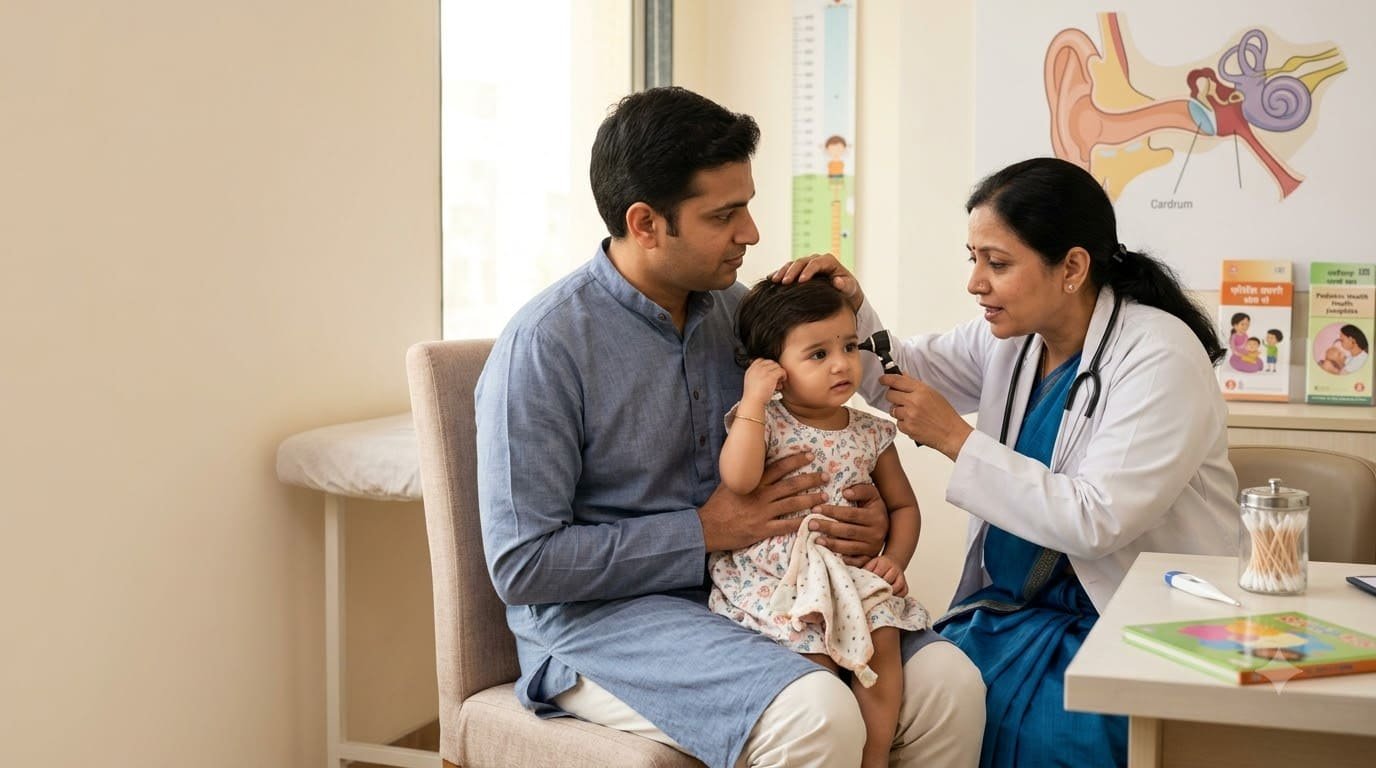
Examination: The paediatrician will use an otoscope to look at the eardrum. A red, bulging, or perforated eardrum confirms the diagnosis.
Antibiotics: Whether to prescribe antibiotics depends on the child’s age and severity:
- Under 6 months: Antibiotics are almost always prescribed
- 6-24 months: Usually antibiotics
- Over 2 years with mild symptoms: Sometimes watchful waiting for 48-72 hours is appropriate
Amoxicillin is the first-line antibiotic for ear infections in Indian children — prescribed by weight and given for 5-10 days depending on age and severity.
Complete the course: Even if the baby seems better in 2-3 days, complete the full antibiotic course. Stopping early leaves bacteria that can cause recurrence.
Safe Home Care During Ear Infection Treatment
Pain Relief:
Paracetamol (Calpol) or ibuprofen (for babies over 6 months) — given at the correct dose for the baby’s weight — provides genuine pain relief. Give before sleep to improve night comfort.
Positioning:
Keep the baby more upright when possible — sitting supported rather than lying flat. For sleeping, slightly elevating the head of the mattress (not a pillow — a folded towel under the mattress) reduces overnight pressure discomfort.
Warm Compress:
A warm (not hot) cloth held gently against the affected ear can provide comfort relief. Ensure it is comfortably warm on your own skin before applying near the baby’s ear.
Continue Feeding:
Despite the discomfort of feeding, adequate nutrition and hydration support recovery. For breastfed babies — try different feeding positions that are more comfortable. Upright positioning during feeding can reduce the pressure change that causes pain.
What NOT to Do:
❌ Do not put any oil, drops, or liquid in the ear without a doctor’s prescription ❌ Do not insert cotton buds or any object into the ear canal ❌ Do not give adult ear drops ❌ Do not stop antibiotics early when the baby seems better
Preventing Ear Infections — India-Specific Tips
Breastfeeding: Exclusive breastfeeding for 6 months significantly reduces ear infection risk. Breast milk contains antibodies that reduce respiratory infection frequency — the precursor to ear infections. If bottle feeding, always hold the bottle — never prop it — and feed in a semi-upright position.
Vaccination:
- Pneumococcal vaccine (PCV): Significantly reduces ear infections caused by Streptococcus pneumoniae, one of the most common ear infection bacteria. Part of India’s Universal Immunisation Programme.
- Influenza vaccine: Annual flu vaccine reduces the respiratory infections that precede ear infections.
- Hib vaccine: Protects against Haemophilus influenzae, another common ear infection cause.
Avoid passive smoke exposure: Children exposed to cigarette smoke — including in households where someone smokes — have significantly higher rates of ear infections. Smoking anywhere in the home is relevant.
Reduce daycare exposure in infancy: Daycare/crèche attendance before 12 months is associated with higher ear infection rates due to increased respiratory virus exposure. Where possible, delaying crèche attendance reduces risk — this is not always practical but is worth knowing.
Treat colds promptly: While colds cannot be prevented, saline nasal drops and maintaining nasal hygiene during a cold reduce the nasal congestion that blocks the Eustachian tube and predisposes to ear infection.
Recurrent Ear Infections — When to Seek Specialist Assessment
Some children have recurrent ear infections — three or more in six months, or four or more in a year. These children warrant referral to an ENT (ear, nose, and throat) specialist for assessment.
Options the ENT may discuss: Grommets (tympanostomy tubes): Small tubes inserted into the eardrum under brief general anaesthesia that allow fluid to drain and reduce infection recurrence. Very commonly done in children with recurrent ear infections — highly effective.
Adenoidectomy: Removal of the adenoids (tissue at the back of the nasal passage), which when enlarged, block the Eustachian tube opening and contribute to recurrent ear infections.
Hearing assessment: A child with recurrent ear infections or persistent fluid in the ear (glue ear) warrants a formal hearing test — particularly before school age, when hearing is critical for language development.
FAQ — Baby Ear Infection India
Q: My 9-month-old is pulling his ear but has no fever. Should I be worried?
Ear pulling without fever and without other signs is often not an ear infection — babies pull at ears when teething, tired, or simply exploring. Watch for 24 hours. If he develops fever, becomes significantly more irritable, refuses feeds, or seems in distress — see the paediatrician. If he has just had a cold — the risk of ear infection is higher and earlier assessment is appropriate.
Q: The paediatrician said to wait 48 hours before starting antibiotics. Is this safe?
For children over 2 years with mild symptoms and no fever, a 48-72 hour watchful waiting period is evidence-based — many mild ear infections resolve without antibiotics. However, if symptoms worsen, fever develops, or the child is in significant distress during the waiting period — return to the paediatrician for antibiotic prescription. Always follow your paediatrician’s specific guidance.
Q: My baby has had four ear infections this year. What should I do?
Request a referral to an ENT specialist. Four infections in a year meets the threshold for specialist assessment and discussion of grommet insertion, which is highly effective for recurrent ear infections. Also ensure all vaccinations are up to date — particularly PCV and Hib.
Q: Can I put garlic oil in my baby’s ear? My mother-in-law recommends it.
No. Do not put any oil, liquid, or drops in your baby’s ear without a doctor’s prescription. If the eardrum has perforated — which can occur without obvious external signs — putting liquid in the ear can cause further damage. Garlic oil in an intact ear with an infection also does not treat the middle ear infection (it can’t reach the middle ear through an intact drum). Warm compress on the outside of the ear is safe and helpful.
Q: Will my baby’s hearing be permanently affected?
Temporary hearing reduction during and shortly after an ear infection is normal — the fluid in the middle ear reduces sound conduction. Once the infection resolves and the fluid drains, hearing returns to normal in most cases. Children with recurrent ear infections or persistent fluid (glue ear) should have formal hearing assessment — persistent fluid over months can affect language development if hearing is significantly reduced.
More from MumPappaHub — Read These Next:
- Baby Fever Guide India
- Baby Cold Season Change India
- Baby Cold and Cough Home Remedies
- Baby Vaccination Schedule India 2026
- Baby Eye Care India
- Newborn Care Tips
- Baby Development Month by Month
- Indian Baby Weight Chart
- Baby Teething Signs India
- Baby Gas Colic Relief India
- Newborn Sleep Tips
- How to Increase Breast Milk Supply
About This Article
Written by the MumPappaHub Research Team — including a researcher whose nephew pulled at his ear on Day 6 of a cold while his mother thought it was teething. It wasn’t. The paediatrician found acute otitis media. Five days of antibiotics. Back to normal. The pulling-at-the-ear was the clue she almost missed.
Reviewed for accuracy against WHO guidelines on ear diseases in children and Indian Academy of Pediatrics recommendations on otitis media management in Indian children. This content is for general informational purposes only. Always consult your paediatrician for diagnosis and treatment.
MumPappaHub — Real talk for real Indian parents. mumpappahub.com
