
Medical Disclaimer: This article is for informational purposes only. If your child has a speech delay or language difficulty, consult your paediatrician or a speech-language pathologist before making significant changes to your language strategy at home.
Raising bilingual child India is not a parenting choice — it is a parenting reality. India has 22 officially recognised languages and hundreds of regional languages and dialects. The average urban Indian child grows up hearing at least two languages at home, a third at school, and possibly more with grandparents and extended family. Bilingualism in India is not special — it is the norm.
And yet Indian parents worry about it constantly.
My brother and his wife come from different states — he speaks Punjabi, she speaks Kannada, and their shared language with each other is Hindi. At home, the child hears all three. At his playschool, English is the medium. His paediatrician, when they expressed worry about his mixed-language speech at age two, laughed gently. “He is not confused,” she said. “He is learning. Give him six months.”
At two and a half he was speaking in sentences that mixed Punjabi, Hindi, and English fluidly. By three he had separated them — speaking Hindi with his parents, Punjabi with his dada-dadi, English at school. His paediatrician called it “code-switching.” His grandmothers called it “akalmand bachcha.”
Both were right.
The Science of Raising Bilingual Child India
Raising bilingual child India should begin with what the research actually shows — because Indian parents are often given contradictory advice that is not grounded in evidence.
According to the World Health Organization’s guidelines on child development, language development follows a predictable sequence regardless of how many languages a child is exposed to. The Indian Academy of Pediatrics recognises that the multilingual environment typical of Indian families is developmentally appropriate and that bilingual children meet language milestones within the same range as monolingual children.
What research shows about bilingual children:
✅ Bilingual children do not have language delays — they meet milestones at the same ages as monolingual children when all languages are counted together.
✅ Mixed-language speech (code-switching) is normal — not confusion. Code-switching is a sophisticated linguistic behaviour that demonstrates language competence, not deficiency.
✅ Earlier is better for language acquisition — the first three years are a critical window for language learning. Children exposed to multiple languages early develop native-level proficiency in each.
✅ Bilingualism has cognitive benefits — improved executive function, better attention control, enhanced problem-solving, and potentially delayed onset of dementia in old age.
✅ Total vocabulary across languages matters — a bilingual child with 150 words in Hindi and 150 words in English has equivalent language development to a monolingual child with 300 words in one language.
Common Indian Myths About Bilingual Children — Debunked
Myth 1: Speaking multiple languages confuses the child. Reality: Children have an extraordinary capacity to distinguish between languages from birth. What looks like confusion — mixing words from two languages — is normal code-switching, a competence, not a problem.
Myth 2: The child should master one language before learning another. Reality: Simultaneous bilingualism — learning two languages from birth — produces native-level proficiency in both. Sequential bilingualism — adding a second language after the first is established — also works but produces a different language profile. Neither is superior.
Myth 3: Bilingual children are slower to talk. Reality: Bilingual children begin talking at the same age as monolingual children. They may have a smaller vocabulary in each individual language early on — but their total vocabulary across all languages is equivalent. This is normal and temporary.
Myth 4: English-only is best for the child’s future. Reality: Strong mother tongue foundation supports second language acquisition. Children who have a solid grounding in their home language learn English more effectively, not less. Abandoning the home language in favour of English-only parenting is not supported by research and deprives the child of cultural identity and connection to family.
Myth 5: Children should not mix languages. Reality: Code-switching — switching between languages mid-sentence — is a normal, sophisticated bilingual behaviour. It is not laziness or confusion. It is how fluent bilinguals naturally communicate, and it is cognitively demanding.
10 Best Proven Tips for Raising a Bilingual Child in India
1. One Parent One Language (OPOL) — The Gold Standard Strategy
The most well-researched strategy for raising a bilingual child is OPOL — One Parent One Language. Each parent consistently speaks their own language to the child.
How it works: If one parent’s first language is Tamil and the other’s is Hindi — the Tamil-speaking parent always speaks Tamil with the child, and the Hindi-speaking parent always speaks Hindi. The parents speak to each other in their shared language (often Hindi or English).
Why it works: The child hears each language from a consistent source, in consistent contexts. This helps the brain separate and organise the languages clearly.
Indian practical example: My brother speaks Punjabi to his son. His wife speaks Kannada. They speak Hindi to each other and their son hears Hindi as the family common language. At school — English. The child is building four language systems simultaneously, which is entirely within the normal range for Indian children.
Important: Consistency matters more than perfection. Missing the OPOL approach occasionally does not damage language development.
2. Minority Language at Home — Protect the Less Common Language
In India, English and Hindi often dominate — the school language, the media language, the language of opportunity. Home languages — regional mother tongues — can get squeezed out.
Why it matters: The language the child hears least is the language most at risk of not being fully acquired. If the child hears Marathi only from the grandparents during occasional visits, Marathi will not develop robustly.
The home language protection strategy: Make the minority language — the regional mother tongue or lesser-used home language — the dominant language at home. The school and the outside world will provide the majority language (Hindi/English) with or without your effort.
Practical approach: “At home we speak [mother tongue]. At school they speak English. You will learn both. At home we practise our language.”
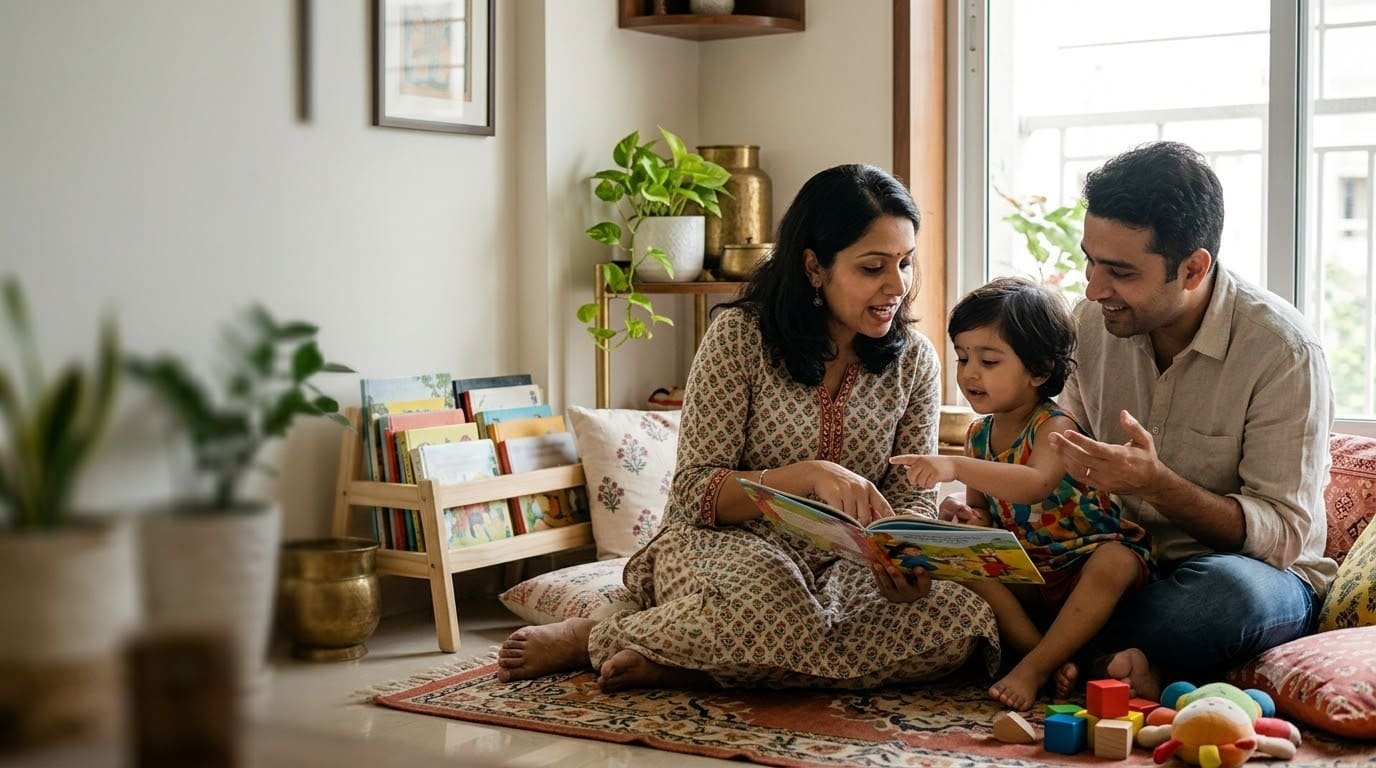
3. Read in All Languages — Books Are the Foundation
Reading aloud to children in all their languages is one of the most powerful language development interventions available — providing rich vocabulary, sentence structure, and narrative exposure in each language.
Indian language books available: Hindi: Vast children’s literature available — Pratham Books, Tulika Books, and others publish high-quality Hindi children’s books. Tamil, Telugu, Kannada, Malayalam, Bengali, Marathi: All have children’s literature — Tulika Books in particular publishes in multiple Indian languages. English: Widely available.
For toddlers: Board books in the home language alongside English board books. For preschoolers: Picture books, simple stories. For school-age: Chapter books in both languages.
The library habit: Many Indian city libraries have multi-language children’s sections. Building a home library in multiple languages signals to the child that all their languages have value and status.
4. Connect Language to Identity and Culture — Not Just Communication
The most successful multilingual children are those who value all their languages — who understand that each language is a window into a world, a family, and a culture.
Why this matters: Children who see their home language as “backward” or “only for old people” will resist using it. Children who see it as a source of pride and connection will maintain it.
How to build language pride: Connect the language to beloved people — “This is Nani’s language. When you speak Telugu, she lights up.” Connect it to culture — festivals, food, music, stories are all in the language. Avoid denigrating the home language — “Don’t speak that at home, only English” teaches the child that the home language has lower status. Celebrate when the child switches appropriately — “You spoke Kannada to Ajji — she was so happy!”
5. Language-Rich Environments — Television, Music, Stories
Children acquire language through exposure — the more varied and rich the exposure, the stronger the acquisition.
Media in all languages: Allow age-appropriate television and YouTube in the home language — not just English. Many Indian children watch only English content, which accelerates English at the expense of the home language.
Music: Indian classical, folk, and film music in the home language — children absorb language through songs with extraordinary efficiency.
Audiobooks and podcasts: Indian language storytelling for children is increasingly available on platforms like Kuku FM, Storytel, and YouTube.
Real conversations: No media replaces the language richness of real conversation between people. The more the parent talks to the child in the home language — narrating daily activities, asking questions, telling stories — the richer the language acquisition.
6. Grandparents — The Minority Language Champions
In the Indian joint or extended family structure, grandparents are frequently the primary speakers of the home language — particularly when parents have moved to a city and adopted Hindi/English as the daily working language.
Grandparents as language teachers: Position grandparents explicitly as the language teachers for the home language. “Dadi is the Rajasthani teacher in this family. When you go to Dadi, speak Rajasthani.”
Regular and extended contact with grandparents — visits, video calls daily — provides the home language exposure that parents in an urban Hindi/English environment may not be providing.
The emotional connection: Children learn language most efficiently from people they love and want to connect with. The motivation to speak Nani’s language comes from the relationship — which is why grandparent relationships are such powerful language acquisition engines.
7. Language Play — Make It Fun
Young children learn language through play. Making language learning playful — games, songs, stories, pretend play — produces better acquisition than formal instruction.
Language play ideas for Indian families:
- Antakshari in the home language — teaches vocabulary, pronunciation, and cultural repertoire simultaneously
- Naming games — “Say it in Hindi, now say it in English, now say it in Tamil”
- Storytelling together — “You tell one part in Hindi, I tell one part in Kannada”
- Cooking together while naming ingredients in the home language
- Hindi/Tamil/Kannada nursery rhymes and folk songs
Avoid: Making language learning feel like a test or a chore. The child who is drilled and corrected constantly around language will develop language anxiety rather than language fluency.
8. Manage the School-Home Language Gap
Indian children often come home speaking in the school language — English or Hindi — even when the home language is different. This is normal and does not mean the home language is lost. But it requires active management.
The post-school language switch: Have a deliberate transition — “At home we speak [home language]. You can switch now.”
For young children, maintain the home language consistently even when they reply in English. The child hears the home language from you — even if they respond in English, they are absorbing the home language from your input.
The homework question: Some parents do homework with the child in English only — the school language. This is appropriate for English-medium content. But conversations about life, feelings, stories, and daily activities can remain in the home language.
9. Code-Switching — Understand and Embrace It
Code-switching — moving between languages within a conversation or even within a sentence — is one of the most distinctively Indian linguistic behaviours.
“Aaj school mein mera friend ne mujhe invite kiya party ke liye — so I said yes!”
This is not language confusion. This is sophisticated bilingual competence — the speaker has two or more fully functional language systems and switches between them fluidly based on context, topic, and interlocutor.
What to do: Do not correct code-switching as a mistake. The child who code-switches is demonstrating linguistic sophistication, not deficiency.
When code-switching is a concern: If the child cannot separate the languages when required — cannot speak Hindi-only with a Hindi-only speaker or English-only in an English-only context — this may indicate that one language is not fully developed. Discuss with your paediatrician or a speech-language pathologist.
10. Know the Real Red Flags — When to Seek Assessment
Bilingualism does not cause language delays. But language delays can occur in bilingual children — and need to be assessed and addressed.
Not a red flag (normal bilingual development): Mixed-language speech (code-switching) — normal Slightly smaller vocabulary in each individual language — normal Preferring one language over another in some contexts — normal Responding in a different language than spoken to — normal
Real red flags — see your paediatrician: 🚨 No words in ANY language by 12-13 months 🚨 No two-word combinations in any language by 24 months 🚨 Total vocabulary across all languages significantly below milestone range 🚨 Loss of previously acquired language in any language 🚨 Significant difficulty being understood by familiar adults in any language at 36 months
The IAP guidance: When assessing language milestones in bilingual Indian children — total vocabulary across all languages, not vocabulary in any single language, is the relevant measure.
The Indian English Pressure — A Special Note
Indian families increasingly face pressure to make English the only home language — driven by the belief that English-medium education produces better outcomes. This approach has a significant cost.
What research shows: Children who receive strong mother tongue instruction in early childhood acquire English more effectively in the long run than those who switch to English-only instruction before the home language is established.
A child who speaks Tamil fluently at home and switches to English at school develops superior bilingual competence compared to a child who speaks “broken Tamil” at home and broken English at school.
The strongest English speakers in India are typically those who had a strong foundation in their home language first.
FAQ — Raising Bilingual Child India
Q: My 2-year-old mixes Tamil and English constantly. Should I correct this?
No — this is normal code-switching and demonstrates that both languages are active in the child’s mind. Continue speaking each language consistently to the child. By 3-4 years, most bilingual children begin to separate languages appropriately by context. Correction and pressure can create language anxiety without improving separation.
Q: My in-laws say we should only speak Hindi at home so the child is not confused. Should we?
No — research does not support this advice. Speak your home languages at home. The child is not confused. They are learning multiple systems simultaneously — which is what the Indian multilingual environment naturally supports. Hindi will be reinforced powerfully by school, media, and the wider community.
Q: My son speaks Hindi fluently but his English is delayed compared to classmates. Is this a problem?
Not necessarily — children from Hindi-dominant homes often have stronger Hindi than English in early years, with English catching up rapidly once school exposure intensifies. If his English is progressing (even if slower than classmates) and his Hindi is strong, this is typical bilingual development. If English is not progressing at all by 5-6 years despite school exposure, discuss with the school and your paediatrician.
Q: We are from different states with different languages. Which language should we use at home?
Both — and possibly Hindi or English as the family bridge language. The OPOL approach (each parent speaks their own language) works well for intercultural Indian families. Children in these families typically become the most confidently multilingual — they have genuine motivation to communicate with both parents and both extended families.
Q: My daughter understands Kannada but refuses to speak it — only speaks Hindi. What do I do?
This is a common pattern — passive bilingualism, where the child understands a language but speaks another. Passive knowledge is a foundation — she has the Kannada in there. Increase the positive motivation to speak it — speak to her in Kannada consistently, connect it to people she loves (grandparents), and make conversations in Kannada rewarding. Do not force or correct. Kannada production will increase as the motivation increases.
More from MumPappaHub — Read These Next:
- Toddler Language Development
- Speech Delay in Toddlers India
- When Do Babies Start Talking India
- Cognitive Development Activities India
- 3 Year Old Milestones India
- 2 Year Old Milestones India
- Autism Early Signs Toddler India
- Sensory Play for Toddlers India
- Positive Parenting Tips India
- Screen Time Guidelines Children India
- Joint Family Parenting India
- Baby Development Month by Month
About This Article
Written by the MumPappaHub Research Team — including a researcher whose brother and sister-in-law come from Punjab and Karnataka. Their son hears Punjabi, Kannada, Hindi and English at home. At two, he mixed them all. At two and a half, sentences in all four. At three, he had separated them — speaking each language with its people. His paediatrician called it code-switching. His grandmothers called it akalmand bachcha. Both were right.
Reviewed for accuracy against WHO child development guidelines and Indian Academy of Pediatrics language milestone guidance for bilingual and multilingual Indian children. This content is for general informational purposes only. For speech delay concerns in bilingual children, consult your paediatrician or a speech-language pathologist.
MumPappaHub — Real talk for real Indian parents. mumpappahub.com
