
Medical Disclaimer: This article is for informational purposes only. Developmental milestones are ranges, not fixed deadlines. If you have specific concerns about your child’s development, consult your paediatrician.
2 year old milestones India is something Indian parents search with a particular mix of curiosity and anxiety — because the second birthday brings with it a flood of comparisons, from relatives, from WhatsApp groups, from other parents at the park, all of them offering opinions about whether your child is doing what they should be doing.
My neighbour’s daughter turned two last month. At the birthday party, five different relatives offered assessments of her development within the first hour. One thought her speech was excellent. Another thought she should be talking more. Her grandmother was concerned she wasn’t yet using a spoon properly. Her uncle wanted to know if she could count.
Her mother — a calm, sensible woman — smiled through all of it and later told me: “I stopped worrying about what she should be doing when I started watching what she actually is doing. She’s curious, she’s happy, she’s learning every single day. That’s what matters.”
She was right. This guide covers the genuine 2-year-old developmental milestones for Indian children — what to watch for, what varies, what actually matters, and when to seek professional assessment.
2 Year Old Milestones India — How to Use This Guide
2 year old milestones India should be understood as ranges, not precise deadlines. Child development is not a race — children reach milestones at different ages within a normal range, and reaching a milestone slightly later than a peer does not indicate a problem.
According to the World Health Organization’s guidelines on child development, developmental milestones represent the median age at which most children acquire a skill — which means half of children acquire it earlier and half acquire it later. The Indian Academy of Pediatrics provides milestone guidance specifically calibrated for Indian children, accounting for the linguistic diversity, joint family environment, and cultural practices that influence development in India.
What milestones tell us: They indicate whether a child is developing within the expected range. They help identify children who may benefit from early assessment and support.
What milestones don’t tell us: They don’t predict a child’s intelligence, personality, or future success. A child who walks at 9 months is not more capable than a child who walks at 14 months. A child who speaks in full sentences at 20 months is not more intelligent than a child who reaches the same milestone at 24 months.
10 Best Development Signs — 2 Year Old Milestones India
Milestone 1 — Language: 50+ Words and Beginning Two-Word Phrases
By age 2, most children have a vocabulary of at least 50 words and are beginning to combine two words into simple phrases.
What this looks like: “Mummy aao” (Mummy come) “Aur doodh” (More milk) “Baba gaya” (Papa gone) “Nahi khaana” (Don’t want food)
The Indian multilingual context: Indian children raised in multilingual households — exposed to Hindi, a regional language, and possibly English — may have a smaller vocabulary in each individual language but a larger combined vocabulary across languages. This is normal and reflects linguistic processing capacity, not delay.
Concerned if: The child has fewer than 50 words total across all languages at 24 months, or is not combining any two words. Any loss of words previously acquired warrants immediate paediatrician referral.
Milestone 2 — Following Two-Step Instructions
A 2-year-old should be able to follow simple two-step instructions — two related actions in sequence.
Examples: “Jao aur apna joota lao” (Go and get your shoe) “Thali uthao aur kitchen mein rakh do” (Pick up the plate and put it in the kitchen) “Haath dho aur aao” (Wash your hands and come)
What this demonstrates: Working memory, attention, and the ability to process and execute sequential instructions — all important foundations for later learning.
Indian household context: Two-step instructions are naturally woven into Indian household life — “jao aur dadi ko bulao,” “apna dabba rakh aur haath dho.” These everyday interactions are genuine developmental practice.
Milestone 3 — Pointing to Body Parts When Named
By 2 years, a child should be able to point to multiple body parts when named — nose, eyes, ears, mouth, hands, feet, stomach, and others.
How to check: “Naak kahan hai?” (Where is the nose?) The child should point correctly.
Why it matters: Body part identification demonstrates vocabulary, following instructions, and the ability to connect language with physical reality.
Expanding vocabulary: Indian families naturally teach body parts in local language — “naak,” “aankh,” “kaan,” “muh” — which is entirely appropriate and equally valid. Bilingual body part knowledge (in both Hindi/regional language and English) is a bonus, not a requirement.
Milestone 4 — Pretend Play
By 2 years, most children are engaging in simple pretend play — using objects symbolically, acting out familiar scenarios.
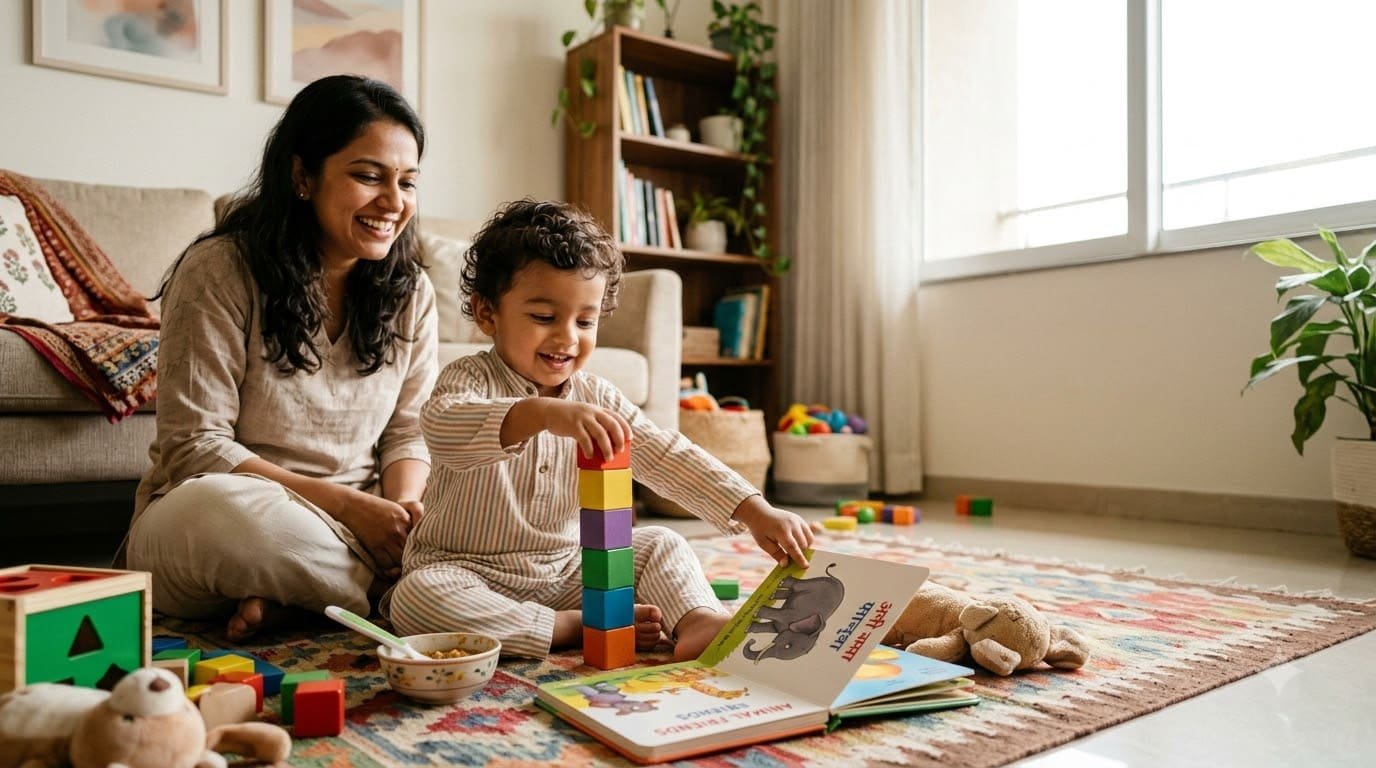
What this looks like: Feeding a doll or stuffed animal Pretending to cook on a toy stove or with kitchen utensils “Driving” a toy car with accompanying sounds Pretending to talk on a phone Pretending to sleep
Why it matters: Pretend play is one of the most cognitively demanding activities a toddler engages in. It requires symbolic thinking — the ability to let one thing represent another — which is a foundational cognitive skill.
Indian household advantage: Children who watch and participate in Indian household activities — cooking, puja, family routines — have rich material for pretend play. A child playing “making chai” or “doing aarti” is showing exactly the pretend play development that matters.
Milestone 5 — Running and Basic Physical Skills
By 2 years, most children are running — though still somewhat unsteadily. They are also:
- Kicking a ball
- Climbing furniture with increasing confidence
- Walking up and down stairs with support
- Beginning to jump (both feet leaving the ground)
The Indian context: Children in Indian households often have access to varied physical environments — courtyards, varying floor surfaces, different levels — that provide natural gross motor challenges. Children who spend time on the floor, on grass, climbing and exploring, develop motor skills through this natural engagement.
Concerned if: The child is not walking steadily, is not attempting to run, has very limited mobility, or falls very frequently compared to peers.
Milestone 6 — Using a Spoon (With Mess)
By 2 years, most children are attempting to use a spoon to self-feed — with significant mess. This is appropriate and expected. The mess is part of the learning.
What this looks like: The child picks up the spoon, scoops food (mostly successfully), brings it to the mouth (mostly successfully), eats (with food on face, hands, table, and floor). This is not a sign of a problem — it is exactly what a 2-year-old feeding themselves looks like.
The Indian household context: Many Indian children eat with their hands — which is culturally appropriate and also develops fine motor skills. Whether a child uses a spoon or hands, the milestone is self-feeding with increasing independence. A child who feeds themselves with hands is meeting the self-feeding milestone.
Grandmother’s concern at the birthday party: Entirely normal 2-year-old feeding behaviour. It takes another 1-2 years for truly neat spoon use to develop.
Milestone 7 — Increasing Independence and “No” Phase
The 2-year-old’s emerging independence — the insistence on doing things themselves, the frequent “nahi” and resistance to direction — is not misbehaviour. It is a developmental milestone.
What this looks like: Wanting to dress themselves (even if they can’t yet) Insisting on doing tasks independently Saying “main karunga/karungi” (I’ll do it) Strong preferences about food, clothing, routine Significant emotional reactions when thwarted
Why it matters: The emerging autonomy of a 2-year-old is the foundation of healthy self-concept and independent functioning. A child who never asserts independence at this age is showing the absence of a milestone, not better behaviour.
For Indian parents in joint families: This phase is particularly challenging when multiple adults have expectations about a child’s compliance. The 2-year-old asserting “nahi” to a grandparent is not disrespectful — they are developmentally on track. Managing this with warmth and firm limits rather than suppressing it completely produces better outcomes.
Milestone 8 — Social Interest in Other Children
By 2 years, most children show interest in other children — watching them, approaching them, beginning to play near them (parallel play) and occasionally with them (associative play).
What this looks like: Watching other children with interest Playing alongside another child with similar toys (parallel play) Brief interactions — offering a toy, taking a toy Beginning to imitate other children’s play
What is NOT expected at 2: Cooperative, sharing, collaborative play — this develops more between ages 3-4. A 2-year-old who grabs toys from other children is not antisocial — they are developmentally age-appropriate.
Indian family context: Children in joint families with cousins, siblings, or regular family gatherings have natural opportunities for this social development. These experiences are genuinely valuable.
Milestone 9 — Recognising Familiar People and Objects in Pictures
By 2 years, most children can identify familiar people and objects in photographs — pointing to parents, grandparents, pets, and common objects when named.
What this looks like: “Dadi kahan hain?” (Where is grandmother?) — child points to grandmother’s photo Identifying common objects (apple, ball, dog) in picture books Recognising their own photo
Why it matters: This demonstrates visual recognition, vocabulary, and the understanding that pictures represent real things — a symbolic understanding that supports later reading readiness.
Indian household opportunity: Photo albums, WhatsApp photos shown on a phone, pictures on walls — all of these are natural opportunities for this kind of recognition practice in Indian households.
Milestone 10 — Beginning to Sort by Colour and Shape
By 2 years, many children are beginning to match and sort objects by basic attributes — putting all the red blocks together, matching circles to circles.
What this looks like: Simple shape sorters Matching socks by colour Sorting dal by type (with help) Beginning to name colours (may be inconsistent)
Note: Consistent, accurate colour naming typically develops between 2.5-3.5 years. A 2-year-old who calls everything “laal” (red) or gets colours mixed up is developmentally normal. The ability to sort and match — even without naming — is the milestone at this age.
Red Flags — When to See the Paediatrician
These patterns at 24 months warrant assessment:
Language:
- Fewer than 50 words total
- No two-word combinations
- Any loss of words previously used
- Not pointing to communicate
Social communication:
- Not making eye contact
- Not responding to name consistently
- No interest in other children
- No pretend play
Motor:
- Not walking steadily
- Not beginning to run
- Significant regression in previously acquired motor skills
General:
- Loss of any skill previously mastered
- Significant regression after a period of normal development
- Your instinct that something is not right
The paediatrician is the right first point of contact — they will conduct a developmental assessment and refer for specialist assessment if needed.
The Indian Comparison Trap — A Note for Parents
Indian parenting culture is highly comparison-oriented — between siblings, cousins, neighbours’ children, children of colleagues. This comparison is rarely useful and frequently anxiety-producing.
The honest truth: Development varies within a normal range. A child who speaks 80 words at 24 months and a child who speaks 50 words at 24 months are both within the normal range. Comparing them as if one is “better” is not accurate or useful.
What actually matters: Is the child’s development progressing — more words than last month, more skills than last quarter? Is the child curious, engaged, and learning? Is the trajectory positive?
The birthday party relatives: Comparing one child’s development to another child at a birthday party, based on a 20-minute observation, tells you almost nothing about either child’s development. The paediatrician who has followed the child across multiple visits has the relevant information.
FAQ — 2 Year Old Milestones India
Q: My son is 24 months and not yet combining two words. Should I be worried?
Two-word combinations by 24 months is an IAP milestone that warrants assessment if absent. This doesn’t mean something is definitely wrong — it means a paediatrician should evaluate. Bring specific observations: how many words does he have? Does he point to communicate? Does he respond to his name? Make eye contact? The complete picture matters more than any single milestone.
Q: My daughter knows words in both Hindi and English but not many in either language. Is this normal?
Yes — this is typical of multilingual children. The relevant measure is total vocabulary across all languages, not vocabulary in any single language. If her total combined vocabulary across Hindi, English, and any other language she’s exposed to is 50+ words at 24 months, she is on track. If you’re unsure, your paediatrician can assess.
Q: My 2-year-old still throws tantrums constantly. Is this normal?
Yes — 2 years is the peak age for tantrums. The emotional regulation system that controls impulsive emotional responses is not yet developed. Tantrums are expected and normal. They typically peak around 2-2.5 years and reduce gradually through age 3-4. Our toddler tantrums tips India guide covers what actually works.
Q: My toddler still puts everything in her mouth. Is this a problem at 2?
Mouthing behaviour typically peaks around 6-12 months and gradually reduces. Most children have stopped mouthing non-food objects by 18-24 months. If mouthing is still very frequent at 24 months — particularly mouthing unusual objects or materials — mention it to your paediatrician as it can sometimes indicate sensory seeking behaviour worth assessing.
Q: My son can count to 10 but can’t have a conversation. Is this normal?
Rote counting — reciting numbers in sequence — is a memory skill that many children acquire early, sometimes before their general language development catches up. It is not a sign of advanced development; it is a separate skill. Conversational language — understanding, responding, initiating — is the more significant developmental measure at this age.
More from MumPappaHub — Read These Next:
- Baby Development Month by Month
- Child Development Milestones
- Toddler Language Development
- Speech Delay in Toddlers India
- Autism Early Signs Toddler India
- Cognitive Development Activities India
- Toddler Tantrums Tips India
- Toddler Behavior Problems India
- Discipline Toddler India
- Screen Time Guidelines Children India
- Indian Baby Weight Chart
- Baby Fever Guide India
About This Article
Written by the MumPappaHub Research Team — including a researcher whose neighbour’s daughter turned two and received five developmental assessments from relatives within the first hour of her birthday party. Her mother said: “I stopped worrying about what she should be doing when I started watching what she actually is doing.” She was right.
Reviewed for accuracy against WHO child development guidelines and Indian Academy of Pediatrics developmental milestone guidance for Indian children. This content is for general informational purposes only. Consult your paediatrician for specific developmental concerns.
MumPappaHub — Real talk for real Indian parents. mumpappahub.com
