
Medical Disclaimer: This article is for informational purposes only. If your toddler’s sleep problems are accompanied by snoring, breathing pauses, or other health concerns, consult your paediatrician.
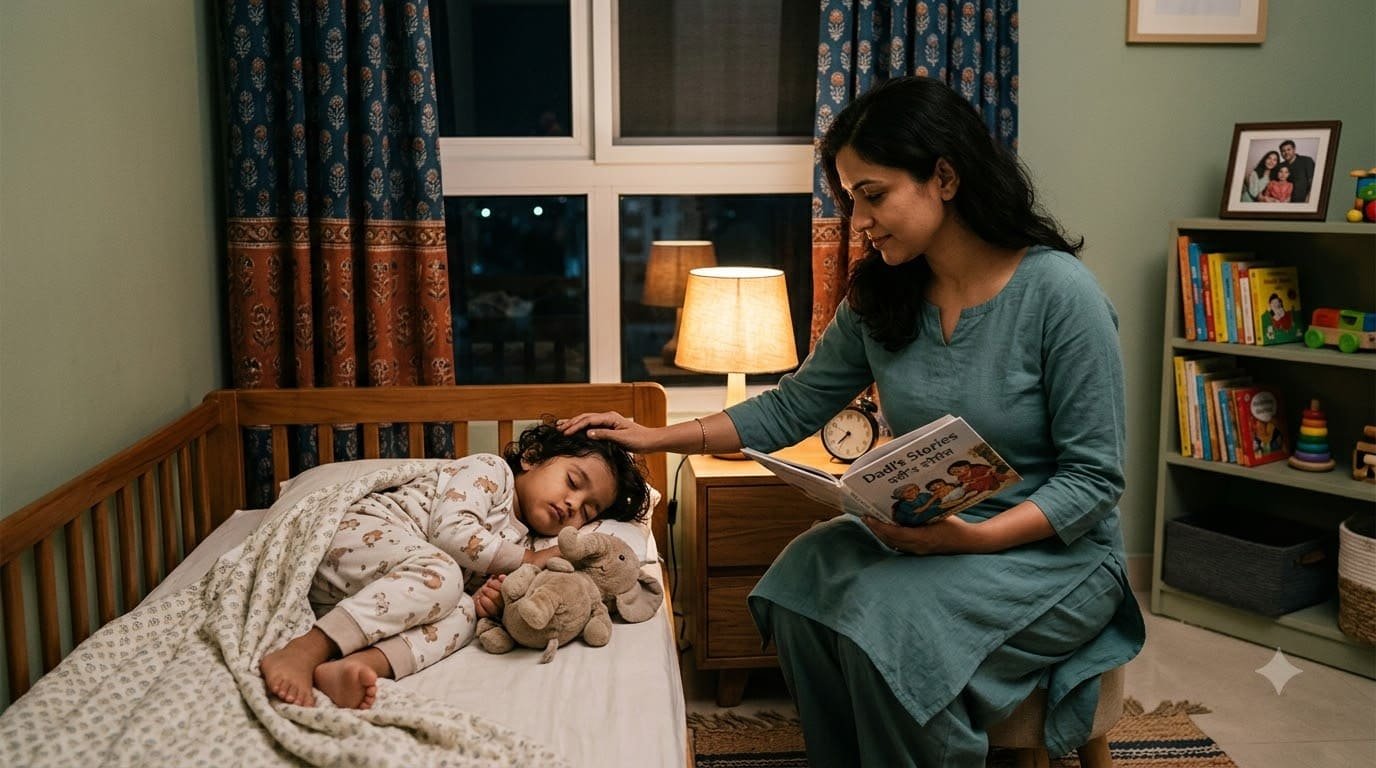
Toddler sleep problems India is what every parent of a one, two, or three-year-old searches at some point — usually at 2 AM, on their phone, while a toddler who was supposed to be asleep is very much not asleep and is requesting, with considerable urgency, that someone lie down with them immediately.
My son was two years and four months when he began waking at 2 AM every single night. Not crying — just awake, sitting up, expecting company. He had slept reasonably well before this. Nothing had changed. There was no new sibling, no house move, no illness. He simply decided, one Tuesday, that 2 AM was an appropriate time to begin his day.
This lasted six weeks. Six weeks of 2 AM wake-ups, of lying next to him until he settled, of going back to my own bed at 3:30 AM and lying awake until 5 AM wondering whether this was permanent.
It was not permanent. But navigating it required understanding what was actually happening — developmentally, neurologically, and in the specific context of Indian households where “let him cry” is rarely a realistic option when grandparents are sleeping in the next room.
Toddler Sleep Problems India — Why Toddlers Wake at Night
Toddler sleep problems India begins with understanding that toddler night waking is almost always normal — not a sign of a problem, not a sign of bad parenting, and not something that requires a dramatic solution.
According to the World Health Organization’s guidelines on child development and sleep, toddler sleep is fundamentally different from adult sleep. Toddlers cycle between light and deep sleep more frequently than adults, and each time they enter a light sleep phase — which happens multiple times per night — they are more likely to fully wake. The Indian Academy of Pediatrics recognises that toddler night waking has specific Indian household dimensions — joint family sleeping arrangements, feeding practices, and developmental factors — that require India-specific guidance.
Most common causes of toddler night waking:
Sleep associations: The most common cause. If a toddler learns to fall asleep with a parent present, feeding, or rocking — they need the same condition when they wake briefly between sleep cycles. No parent = can’t resettle = full wake-up.
Developmental leaps: Language acquisition, learning to walk, toilet training — all of these create neurological activity that disrupts sleep. Parents often notice sleep regression during or just after developmental milestones.
Separation anxiety: Peaks between 18-24 months. Toddlers become more aware of separation and wake seeking reassurance that the parent is near.
Teething: The one-year and two-year molars are the most disruptive teething events. Molar pain is genuinely uncomfortable and frequently surfaces at night.
Over-tiredness: Counter-intuitively, an over-tired toddler wakes more at night. Too late a bedtime or inadequate daytime napping leads to worse night sleep.
Temperature: In Indian summers, a hot room directly disrupts sleep quality. In the monsoon-to-winter transition, inadequate warmth becomes an issue.
Illness: Even a mild cold or blocked nose significantly disrupts sleep.
The Indian Context — What Makes Toddler Sleep Different Here
Several factors make toddler sleep problems in Indian households specifically different from the Western context:
Joint family sleeping: Many Indian toddlers co-sleep — either in the parents’ bed or in the same room as grandparents. “Sleep training” methods that involve leaving the child to cry are often not practical when multiple adults share sleeping spaces and are disturbed by the crying.
Feeding to sleep: In many Indian households, toddlers are still being breastfed or given a bottle to sleep well into the second year. This creates a strong sleep association that requires gradual, gentle unwinding.
Grandparent dynamics: A toddler who wakes at night and finds a grandparent willing to immediately pick them up, rock them, or bring them into bed — learns quickly that night waking is rewarded with comfort and company. This is not wrong — it is responsive caregiving — but it does establish a pattern.
Monsoon and season changes: Season transitions in India — particularly monsoon to winter — bring temperature changes that affect sleep significantly. A toddler who slept well in September humidity may wake frequently in October as temperatures drop and they feel cold.
10 Best Proven Solutions for Toddler Sleep Problems India
1. Consistent Bedtime Routine — The Foundation of Everything
A consistent, calming bedtime routine is the single most evidence-based intervention for toddler sleep. It signals to the toddler’s brain — through sensory cues — that sleep is coming, triggering melatonin release and physiological preparation for sleep.
What works: A sequence of 3-4 activities that happen in the same order every night. Bath → warm milk (in a cup, not bottle) → story → lights out is a classic and effective sequence. The routine should take 20-30 minutes and end with the child in their sleep space.
Indian household adaptation: The routine should happen at the same time every night — including during joint family gatherings. A toddler whose bedtime routine is consistently disrupted by family events will have consistently disrupted sleep. It is appropriate to excuse the toddler from late evening family gatherings for their sleep routine.
The timing: Most toddlers need a bedtime between 7 and 8:30 PM. Later than 8:30 PM typically leads to overtiredness — and overtired toddlers sleep worse, not better.
For more on building an effective bedtime routine, our bedtime routine for baby India guide covers the full approach.
2. Address Sleep Associations — Gently
If your toddler can only fall asleep with a specific condition — your presence, a feed, rocking — and wakes during the night requiring the same condition to resettle, this is a sleep association.
The principle: A toddler who falls asleep independently at bedtime is more likely to resettle independently during night wakings. The goal is to gradually shift from needing the association to not needing it.
Gentle approach for Indian households:
Gradual withdrawal: Rather than leaving the room entirely (which leads to crying), move progressively further away over several nights. Present at the bedside → sitting in a chair → sitting at the door → outside the door.
Fading: If the toddler feeds to sleep, gradually reduce the amount of feeding before sleep over 1-2 weeks until the feeding no longer triggers sleep.
Chair method: Sit quietly beside the toddler as they fall asleep. Each night, move the chair slightly further away. No talking, no rocking — just quiet presence that gradually reduces.
These methods take 1-3 weeks. They require consistency across all caregivers — including grandparents. A grandparent who rocks the toddler to sleep on the nights when parents are away undoes progress.
3. Nap Management — Get This Right First
The most common cause of difficult night sleep in toddlers that parents don’t consider is incorrect nap timing or duration.
The key rules:
Toddlers aged 12-18 months typically need one nap of 1-2 hours. Toddlers aged 18 months-3 years typically need one nap of 1-1.5 hours. The nap should end by 3 PM — a nap ending at 4 PM or later will push back night sleep readiness significantly. A toddler who naps too late will not be tired enough for an appropriate bedtime. A toddler who skips the nap entirely becomes overtired by evening — and overtired toddlers wake more at night.
The overtired paradox: Indian grandparents often keep toddlers awake during the day believing they will sleep better at night. The opposite is true — a well-napped toddler sleeps better at night than an overtired one.
4. The Sleep Environment — Temperature and Darkness
The sleep environment directly affects sleep quality in toddlers.
Temperature: The ideal sleeping temperature is 20-22°C. In India:
- Summer and monsoon: fan on, light cotton clothing, minimum blanket
- Winter (especially North India): appropriate warmth — but not so warm that the toddler sweats
- Season transitions: check whether the toddler is waking because of temperature discomfort
Darkness: Melatonin — the sleep hormone — is suppressed by light. A dark room significantly improves toddler sleep onset and quality. Blackout curtains or heavy curtains help, particularly in summer when sunrise is early.
Noise: A consistent low-level sound — fan, white noise — is more conducive to sleep than silence that is interrupted by sudden sounds. In joint family homes where household noise continues into the evening, a fan provides consistent background sound that masks sudden noise triggers.
5. Handling Night Wakings — The Right Response
How you respond to night wakings determines whether they reduce or persist.
The principle: Respond calmly and briefly, with minimum stimulation, and help the toddler resettle in their sleep space.
What to do: Go to the toddler calmly. Brief reassurance — “I’m here, time to sleep” — in a quiet, boring voice. Minimal light. Help them lie down. Leave as soon as they are calm, even if not yet fully asleep.
What not to do: Bringing the toddler to the parents’ bed (if the goal is independent sleep — this creates a habit). Turning on lights. Engaging in conversation or play. Responding with anxiety or frustration, which escalates the toddler’s arousal.
The joint family complication: If multiple adults respond to a night waking differently — one responds briefly, another brings the child into their bed — the child receives inconsistent signals. A brief family conversation about the agreed response is more effective than any individual technique.
6. Managing Separation Anxiety at Night
Separation anxiety peaks at 18-24 months and is one of the most common causes of night waking in this age group. The toddler wakes, realises they are alone, and becomes distressed.
What helps:
Transitional object: A soft toy or small blanket that the toddler associates with comfort and security. The same object should be present at bedtime and available during the night.
Predictable check-ins: For a toddler distressed by separation, brief, predictable check-ins — “I’ll come back to check on you in five minutes” — with the parent actually returning — builds trust that being alone is temporary.
Daytime attachment: Counter-intuitively, responsive daytime caregiving — picking up when distressed, lots of physical closeness during the day — reduces night separation anxiety, not increases it. A securely attached toddler is less anxious at night than an insecurely attached one.
7. Teething Night Waking — Management
Molar teething — the one-year and two-year molars — causes genuine discomfort that surfaces particularly at night when there are no daytime distractions.
Recognising teething waking: The toddler is distressed rather than awake and interactive. Drooling is increased. The toddler may gnaw on fingers. Waking coincides with a visible molar eruption.
Management: A child-appropriate pain reliever (Calpol/paracetamol syrup) given before bedtime during active molar pain significantly improves sleep. Always use the correct dose for your child’s weight — your paediatrician will advise.
Cold teething rings offered before sleep provide comfort. Gentle gum massage.
Teething waking resolves when the tooth emerges — it is time-limited, not permanent.
8. Screen Time Before Bed — Remove This Trigger
Blue light from screens suppresses melatonin and delays sleep onset. A toddler who watches a tablet or phone in the hour before bed will take significantly longer to fall asleep.
Remove all screens at least one hour before the bedtime routine begins. This is one of the most straightforward and most frequently overlooked interventions for toddler sleep problems.
The Indian joint family challenge: If older children in the household are watching television in shared spaces, a toddler who is present will be exposed to screen light. A separate, darker space for the toddler’s pre-bedtime routine solves this.
Our screen time guidelines children India guide covers the complete IAP recommendations.
9. Consistent Approach Across All Caregivers
This is the most important structural requirement for any toddler sleep improvement — and the most commonly violated one in Indian joint families.
A toddler is extraordinarily good at identifying which adult will give them what they want at 2 AM. If Nani will bring them into her bed while Mummy insists they sleep in their own space — the toddler will call for Nani.
The conversation: Brief, private, respectful. “We’re trying to help [name] learn to sleep through the night. The approach we’re using is [X]. Can you follow the same approach when you respond to him at night? It will only work if everyone does the same thing.” Most grandparents, when the request is framed as asking for their help rather than criticising their instincts, are willing to cooperate.
10. When to Simply Wait — Developmental Phases Pass
Some toddler sleep disruptions are developmental phases that pass on their own regardless of what the parent does.
The 18-month sleep regression. The two-year developmental leap. The transition from two naps to one. The period when a new motor skill — walking, running, climbing — is being consolidated neurologically and disrupts sleep.
These phases typically last 2-6 weeks. Maintaining the bedtime routine, responding calmly at night, and waiting is sometimes the most effective approach.
Knowing that a disruption is likely temporary — and that it will pass — is itself useful. It reduces parental anxiety, which reduces the intensity of the response to night wakings, which sometimes reduces the wakings themselves.
When to See the Paediatrician
Most toddler night waking is behavioural and developmental — normal and manageable. See your paediatrician if:
Your toddler snores loudly or appears to stop breathing during sleep — this may indicate obstructive sleep apnea
Night waking is accompanied by significant distress, screaming that the child cannot be roused from (night terrors), or sleepwalking
Sleep problems are significantly affecting the toddler’s daytime mood, behaviour, or development
You have tried consistent approaches for 4-6 weeks without any improvement
Your instinct tells you something is wrong beyond normal sleep disruption
FAQ — Toddler Sleep Problems India
Q: My 2-year-old has never slept through the night. Is this normal?
Frequent night waking in a two-year-old is common, though not universal. If the child is healthy, developing normally, and the night waking is manageable — this is within the range of normal. If night waking is affecting the child’s or family’s functioning significantly, a consistent sleep approach is worth implementing. Most two-year-olds who wake frequently have a sleep association — they need a specific condition to fall asleep that they can’t recreate when they wake between sleep cycles.
Q: My toddler only sleeps if I lie next to him. How do I change this?
Gradually and consistently. The chair method — sitting quietly beside the toddler, moving progressively further over 1-2 weeks — is the most practical approach for Indian households where crying is not an option. It requires patience and consistency. The most important thing is that all caregivers use the same approach — a grandparent who lies down with the toddler on alternate nights prevents any progress.
Q: My toddler was sleeping well and then suddenly started waking. Why?
Sleep regressions following developmental leaps are extremely common. Walking, talking, toilet training — all of these involve neurological changes that temporarily disrupt sleep. Illness, teething, and life changes (new sibling, travel, new school) also trigger sleep disruption in previously good sleepers. In most cases, maintaining the bedtime routine and responding calmly allows the regression to resolve within 2-6 weeks.
Q: Is co-sleeping causing my toddler’s sleep problems?
Co-sleeping itself does not cause sleep problems — many toddlers who co-sleep sleep well. What causes night waking is a sleep association — if the toddler can only settle with a parent physically present and touching them, they will wake fully each time they move into light sleep and find the parent not immediately there. If co-sleeping is working for your family, it is not something that needs to change. If you want to transition to independent sleep, the gradual approaches described in this guide work for toddlers who have been co-sleeping.
Q: My mother-in-law says I should just let him cry. My husband says the same. Should I?
The “cry it out” or extinction method is effective for some families and some children. It is also genuinely difficult — emotionally for parents and distressing for the toddler in the short term. It is not appropriate in joint family households where other family members are disturbed. Modified approaches — gradual withdrawal, the chair method, fading — achieve similar outcomes with less distress. There is no single correct approach. The right approach is one that is consistent, appropriate for your household, and that your family can maintain.
More from MumPappaHub — Read These Next:
- Bedtime Routine for Baby India
- Baby Sleep Schedule Month by Month India
- 4 Month Sleep Regression
- Newborn Sleep Tips
- Screen Time Guidelines Children India
- Toddler Tantrums Tips India
- Toddler Behavior Problems India
- Positive Parenting Tips India
- Sibling Rivalry Tips India
- Toddler Language Development
- Baby Development Month by Month
- Baby Fever Guide
About This Article
Written by the MumPappaHub Research Team — including a researcher whose son decided at two years and four months that 2 AM was an excellent time to wake up. For six weeks. With no apparent reason. It was not permanent. But navigating it without letting him cry in a house where grandparents slept next door required understanding what was actually happening — which is what this guide is.
Reviewed for accuracy against WHO child development and sleep guidelines and Indian Academy of Pediatrics recommendations on toddler sleep. This content is for general informational purposes only and does not constitute medical advice.
MumPappaHub — Real talk for real Indian parents. mumpappahub.com
