
Medical Disclaimer: This article is for informational purposes only. If sibling rivalry is severely affecting your child’s emotional wellbeing or behaviour, consult a paediatrician or child psychologist.
Sibling rivalry tips India is what my sister-in-law searched desperately the week her second child came home from the hospital.
Her firstborn — a confident, cheerful three-year-old girl who had been the undisputed centre of the universe for thirty-six months — took one look at the new baby, turned to her mother, and said with great composure: “Take it back.”
Over the next four weeks, this child — who had never once hit anyone — began hitting. She began waking at night. She began refusing food she had previously eaten without complaint. She began following her mother from room to room with a degree of intensity that suggested she expected the baby to disappear the moment she looked away.
Her paediatrician, when consulted, was entirely unsurprised. “This is exactly what we expect,” she said. “She’s not becoming difficult. She’s communicating the most difficult thing that has ever happened to her in the only language she has available.”
That reframe — sibling jealousy and rivalry as communication, not misbehaviour — is the foundation of every effective strategy in this guide.
Sibling Rivalry Tips India — Understanding What’s Actually Happening
Sibling rivalry tips India must begin with the brain science, because understanding what is happening neurologically changes everything about how parents respond.
A toddler or young child who gets a new sibling has not been prepared — by evolution, by neurology, or by developmental stage — for the experience of suddenly sharing their parents. The attachment system in a young child’s brain is wired for exclusive or primary access to caregivers. The arrival of a sibling who now occupies significant parental time and attention is, from the child’s neurological perspective, a genuine threat to their primary attachment relationship.
According to the World Health Organization’s guidelines on child development and family wellbeing, sibling conflict is a normal and expected part of development in families with multiple children. The Indian Academy of Pediatrics recognises that sibling rivalry in Indian households has specific cultural dimensions — including the joint family context, comparison culture, and the particular pressures of the Indian educational environment — that require India-specific guidance.
Sibling rivalry is not a sign of bad parenting. It is not a sign that your children don’t love each other. It is a developmental stage that, managed well, teaches children some of the most important skills they will ever learn: conflict resolution, empathy, fairness, and how to maintain relationships through difficulty.
The India-Specific Context — What Makes Sibling Rivalry Different Here
Several factors make sibling rivalry in Indian families different from the Western experience that most parenting resources describe:
The joint family comparison culture: In many Indian extended families, children are compared — openly and frequently — across cousins, siblings, and neighbours’ children. “Your cousin got 90 marks, why did you get only 75?” “Your sister eats everything — why are you so fussy?” These comparisons, even when well-intentioned, intensify sibling rivalry by framing siblings as competitors rather than teammates.
Grandparent favouritism: In joint family households, grandparents often have visible preferences — the eldest grandchild, the only grandson, the child who resembles a favourite relative. Children notice this with extraordinary precision. Perceived grandparent favouritism is one of the most common sources of sibling resentment in Indian families.
Gender dynamics: In many Indian households, different rules and expectations apply to sons and daughters — different curfews, different freedoms, different domestic responsibilities. Children who experience these as inequities between themselves and a sibling develop resentment that presents as rivalry.
Academic pressure: As children enter school, academic comparison between siblings — marks, rankings, teachers’ assessments — becomes a significant source of rivalry in Indian families. The elder child who was average in school watching a younger sibling excel academically is a specific and common Indian sibling rivalry pattern.
New baby arrival in joint families: When a new baby arrives in a joint family home, the older child doesn’t just have to share parents — they have to share grandparents, aunts, uncles, and the entire household’s attention simultaneously. The magnitude of the perceived displacement is larger than in nuclear family settings.
12 Best Sibling Rivalry Tips India
1. Prepare the Older Child Before the New Baby Arrives
The most effective intervention happens before the sibling arrives, not after.
What works: Include the older child in preparations — buying baby items, setting up the room, choosing a gift the older child will give the baby.
Use books and age-appropriate stories about becoming an older sibling. The older sibling role — protector, teacher, big brother/sister — gives the child a positive identity that includes the new baby rather than being threatened by them.
Be honest about what will change and what won’t. “The baby will need a lot of feeding and sleeping help at first. But our special time — your bath, your bedtime story — that stays.”
What not to do: Promise things you can’t deliver (“Nothing will change!”) or minimise the child’s concerns (“Don’t be silly, you’ll love the baby!”).
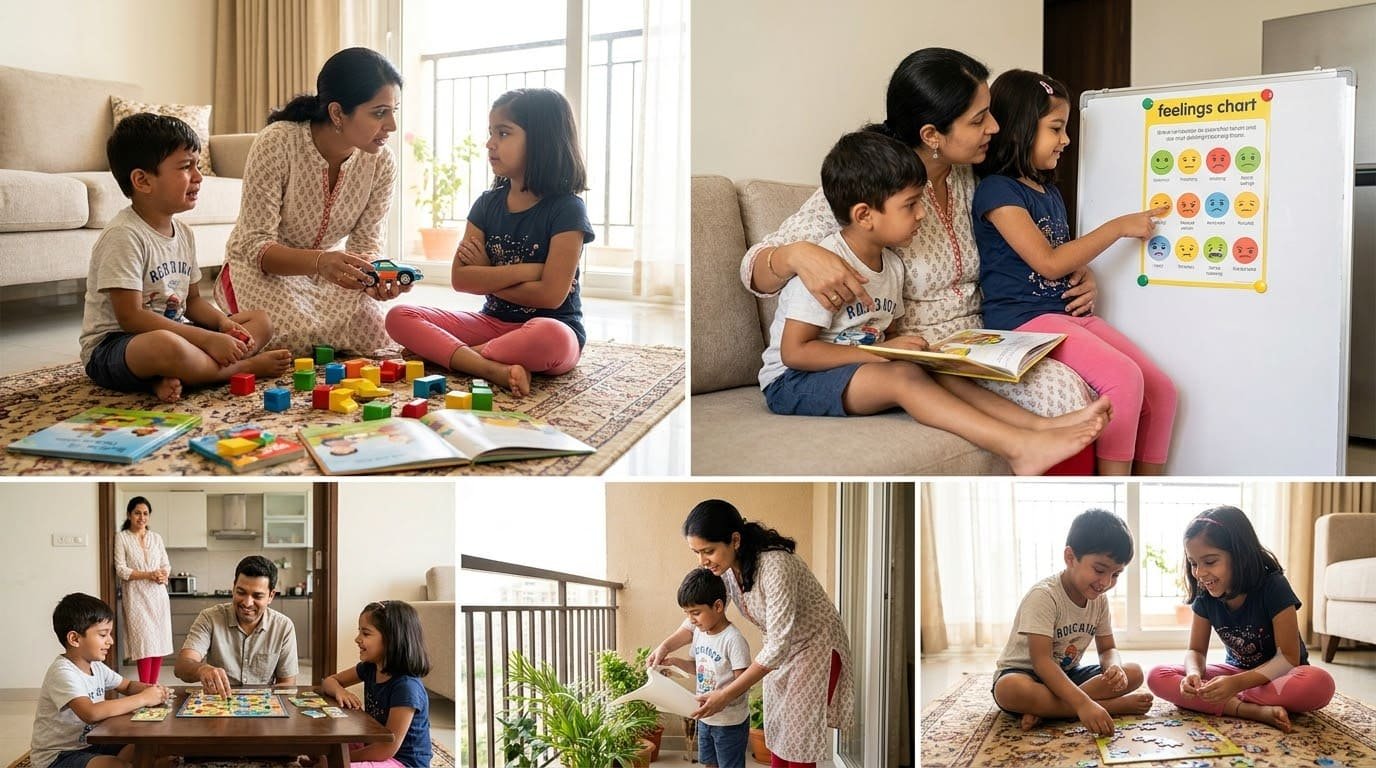
2. Name the Emotion — Don’t Dismiss the Jealousy
When the older child expresses jealousy — through words, behaviour, or regression — the most effective first response is to name it without dismissing it.
What not to say: “You should love your baby sister.” “Don’t be jealous.” “Big boys/girls don’t act like this.” “The baby needs me more right now.”
What to say: “You’re feeling left out right now. That makes sense.” “It’s hard when I’m busy with the baby and you want my attention. I understand.” “You love me and you want more of my time. I love you too.”
The emotion named and acknowledged reduces in intensity. The emotion dismissed or contradicted intensifies — and expresses itself through behaviour.
3. Protect One-on-One Time — Non-Negotiable
The most powerful antidote to sibling jealousy is predictable, protected one-on-one time with each parent.
This does not need to be long. Twenty minutes of completely undivided attention — phone away, other sibling not present — once a day is more powerful than hours of proximity where the parent is distracted.
Make it predictable: “Every evening after bath, that’s our special time — just you and me.” Predictability allows the child to trust that the time is coming, rather than competing constantly for it.
In joint families: Each parent — and ideally each grandparent — having specific regular one-on-one time with each child reduces the feeling that attention must be competed for.
4. Never Compare — The Single Most Important Rule
In Indian families, comparison is often expressed as motivation. It is not. It is fuel for rivalry.
Never say: “Your brother doesn’t behave like this.” “Your sister got better marks — why can’t you?” “Why can’t you be more like her?” “When your brother was your age, he was already doing this.”
Say instead: “I believe you can do this.” “Let’s think about what would help you.” “I’m proud of how you’re working on this.”
Each child should be assessed against their own trajectory — their own previous performance, their own improvement — not against their sibling. This is the rule most Indian parents agree with in principle and find most difficult in practice.
5. Don’t Always Take Sides — Teach Problem-Solving Instead
When siblings fight, the instinct is to identify who was wrong and correct it. This produces resentment — the “wronged” child feels validated, the “corrected” child feels unfairly treated — and teaches neither child how to resolve conflict.
What works instead:
Describe what you see without judgment: “I see two children who both want the same toy.”
Express the problem: “That’s a problem. What are we going to do about it?”
Give them time to solve it: “I’ll come back in two minutes and let’s see what you’ve worked out.”
When they’re too upset to problem-solve: Separate calmly, allow both to calm down, then bring them together for the problem-solving conversation.
This approach is slower. It produces children who can resolve conflict — which is a more valuable outcome than any particular toy dispute resolution.
6. Address the Joint Family Comparison Problem Directly
If grandparents or extended family members are making comparisons between siblings or cousins — this needs to be addressed privately and directly.
The conversation: “We’re trying not to compare the children to each other — we’ve found it creates competition between them rather than closeness. Can you help us with this? We’d love it if you could comment on each child individually.”
Most grandparents, when the request is framed as wanting their help rather than criticising their behaviour, are genuinely willing to adjust. The conversation is uncomfortable once. The alternative — children growing up in constant comparison — is worse.
7. Create Sibling Cooperation Experiences
Rivalry grows in competitive environments. Cooperation grows in collaborative ones.
How to build collaboration:
Assign tasks that require both children to succeed together — “Your job is to set the table together. You can decide who does what.” The shared accomplishment builds positive sibling identity.
Create shared “sibling missions” — a project they’re working on together, a secret they share, a game only they play.
Celebrate the sibling relationship explicitly: “I love watching you two play together.” “The way you helped your brother just now was so kind.”
8. Have Separate Spaces and Possessions Where Possible
Much sibling conflict is about territory and possessions. Having clear boundaries — this is your shelf, this is your drawer, this toy is yours and does not have to be shared — reduces the frequency of conflict over things.
The Indian joint family challenge: Space is often limited and true privacy is rare. Even small territories matter — a designated corner, a box that belongs to each child exclusively, a shelf that is theirs. The specific item matters less than the principle: each child has something that is unambiguously theirs.
The sharing nuance: Not everything needs to be shared. Forced sharing of a child’s own possessions breeds resentment. Teaching children to share communal items — the television remote, the kitchen, the living room — is appropriate. Requiring them to share every personal possession is not.
9. Manage Academic Rivalry Specifically
As children enter school, academic comparison becomes one of the most damaging forms of sibling rivalry in India.
Protect each child’s academic identity: Never share one child’s marks with a sibling unless the child chooses to share. Never use one child’s academic performance as a benchmark for the other.
If siblings are in the same school: Speak to teachers specifically about not comparing siblings. Most teachers will understand this request.
Reframe academic differences: “You and your sister are good at different things. That’s actually useful — you can help each other.”
10. The New Baby Transition — Specific Strategies
The arrival of a new sibling is the most common trigger for acute sibling rivalry. These specific strategies help:
Give the older child a role: “You’re the only one who can make her smile that way.” “Show me how you calm him down — you’re so good at that.” The older child as competent helper is a powerful identity.
Protect the older child’s routine: The baby disrupts everything. The older child’s bath time, story time, and wake-up routine should remain as consistent as possible. Predictability in their own routine reduces anxiety about the overall disruption.
Include the older child: “Would you like to help with the bath?” Not forced — offered. The older child who helps with the baby becomes an invested participant rather than a resentful observer.
Special time that the baby cannot have: Some activities only the older child can do — staying up slightly later, a special outing, a privilege that comes with being bigger. These reinforce that being the older child has advantages, not only losses.
11. When Physical Fighting Happens — Clear Rules
Physical aggression between siblings needs a firm, consistent response.
The rule: “Hitting, kicking, biting — in this house, bodies are safe. That’s the only rule that has no exceptions.”
The response: Separate immediately and calmly. No lengthy explanation in the moment. “Bodies are safe. You need time apart right now.” After calm: “What happened? How else could you have handled that?”
Don’t minimise: “Boys will be boys” and “They’ll sort it out” are not responses to physical aggression. Consistent physical aggression between siblings needs the same attention as physical aggression outside the home.
12. Model What You Want Them to Do
Children learn how to handle conflict, disagreement, and sharing from watching the adults in their lives — not from instructions.
Parents who handle their own disagreements with respect, who apologise when wrong, who share and cooperate visibly — produce children who are more likely to do the same.
In joint families: how the adults handle their own sibling relationships (parents with their siblings, grandparents with theirs) is being watched and absorbed.
The most powerful thing you can do for your children’s sibling relationship: Have a healthy, respectful relationship with your own sibling — or, if that’s complicated, demonstrate how you handle difficult family relationships with dignity.
When to Seek Help
Sibling rivalry is normal. These patterns warrant professional assessment:
One child consistently targets the other — not mutual conflict but one-directional aggression. Significant regression in the older child — bedwetting, sleep disruption, speech regression — that persists beyond 6–8 weeks after the new sibling’s arrival. A child who seems genuinely depressed, withdrawn, or very different from their usual self since the sibling’s arrival. Physical aggression that is frequent, escalating, or causing injury. Your instinct that something is more than normal adjustment.
FAQ — Sibling Rivalry Tips India
Q: My 3-year-old hit the new baby. What do I do?
Intervene immediately and calmly — remove the child from proximity to the baby. Say clearly: “Hitting is not allowed. Bodies are safe.” Do not shout or hit back. After calm: “I understand you’re feeling upset about the baby. But hitting is not okay. What can you do when you’re feeling upset?” This needs consistent repetition — not one conversation.
Q: My children fight constantly. Is this normal?
Some fighting between siblings is completely normal. The frequency reduces as children develop language and conflict resolution skills — which happens gradually through the childhood years. If fighting is constant, physical, and not reducing with age, or if one child seems genuinely unhappy, a conversation with your paediatrician is appropriate.
Q: My mother-in-law clearly prefers my older child over the baby. How do I handle this?
Have the conversation privately and gently: “I’ve noticed that [older child] gets more attention from you, and I’m worried the baby might feel left out as they get older. Can you help me make sure they both feel equally loved?” Most grandparents respond well when the request is about the children’s wellbeing rather than criticism of their behaviour.
Q: My children are 8 years apart. Will they have sibling rivalry?
Age gaps affect the nature of rivalry more than its presence. A large gap often means less competition for the same things — but can produce resentment if the older child feels burdened with care of the younger, or if the younger feels treated as less capable. The same principles apply — one-on-one time, avoiding comparison, acknowledging each child’s feelings — regardless of age gap.
Q: Is sibling rivalry worse in joint families?
It can be more complex — more adults, more opinions, more opportunities for comparison and perceived favouritism. But joint families also provide more adults to give individual attention, more role models for sibling relationships, and more opportunities for the siblings to have shared experiences. The joint family context is neither advantage nor disadvantage — it depends on how it’s managed.
More from MumPappaHub — Read These Next:
- Positive Parenting Tips India
- Toddler Tantrums Tips
- Screen Time Guidelines Children India
- Bedtime Routine for Baby India
- Toddler Language Development
- Child Development Milestones
- Baby First Year Milestones
- Baby Sleep Schedule Month by Month India
- 4 Month Sleep Regression
- Baby Blues vs Postpartum Depression
- Baby Development Month by Month
- Baby Fever Guide
About This Article
Written by the MumPappaHub editorial team — including an aunt whose three-year-old niece told her mother to “take it back” when the new baby came home. The paediatrician called it communication. The mother called it the longest four weeks of her life. Both were right.
Reviewed for accuracy against WHO guidelines on child development and family wellbeing and Indian Academy of Pediatrics guidance on sibling relationships and child behaviour. This content is for general informational purposes only and does not constitute medical advice. Consult your paediatrician or child psychologist if sibling rivalry is significantly affecting your child’s wellbeing.
MumPappaHub — Real talk for real parents. mumpappahub.com

3 Comments