
Medical Disclaimer: This article is for informational purposes only. If you are experiencing significant anxiety, depression, or feel unable to cope, please consult your doctor or a mental health professional.
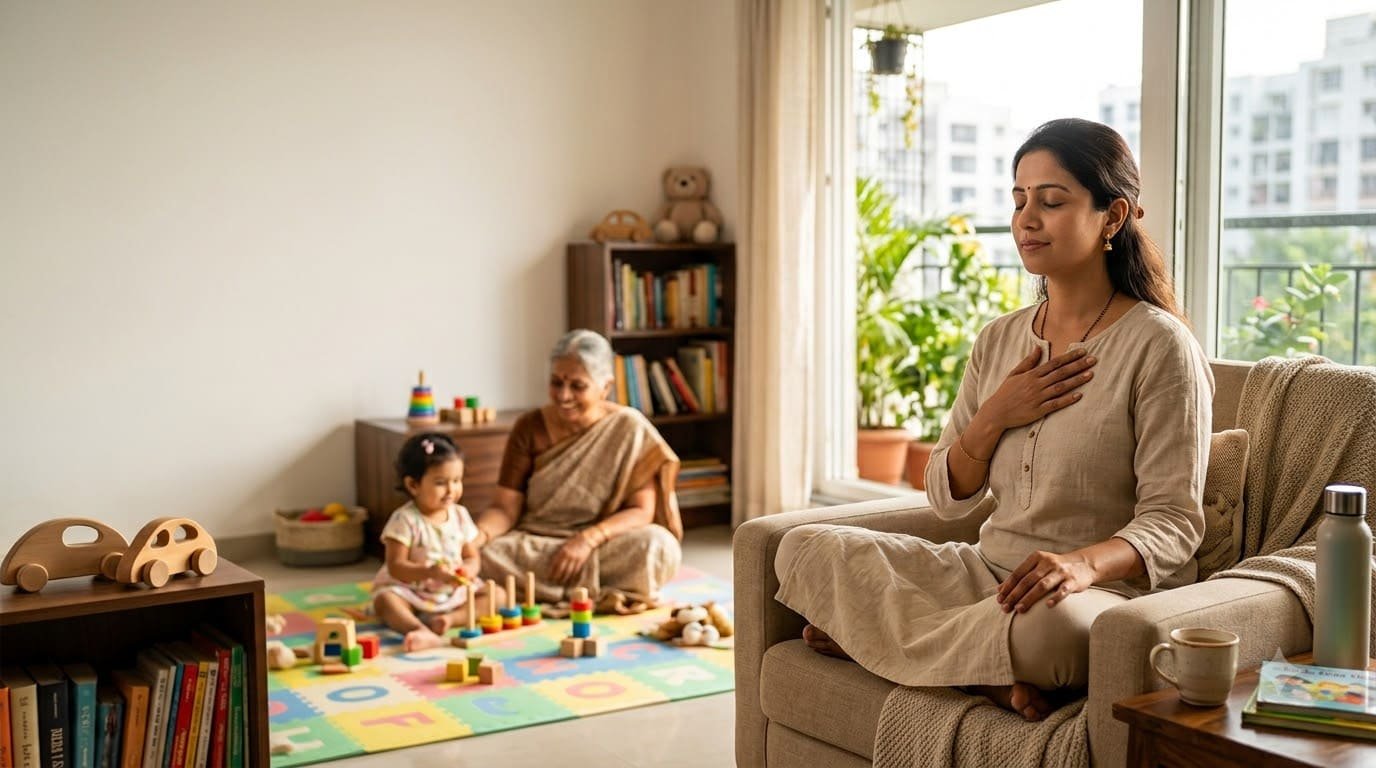
Parenting stress management India is something every Indian parent needs — but almost nobody talks about openly, because Indian parenting culture tends to treat parental stress as something to be hidden rather than addressed.
I was six months into parenthood when I told a friend I was struggling. Not struggling with the baby — she was healthy and thriving. I was struggling with myself. With the exhaustion that had no endpoint. With the identity shift that nobody had adequately warned me about. With the relentlessness of being responsible for another person every minute of every day.
My friend — a mother of two — said something I remember: “You’re allowed to find this hard. Finding it hard doesn’t mean you’re bad at it.”
That permission was the beginning of managing it. This guide covers parenting stress in India — why it’s particularly intense in the Indian context, what the evidence says about managing it, and ten practical approaches that actually work.
Parenting Stress Management India — Why It’s Particularly Hard Here
Parenting stress management India must acknowledge what makes parenting stress in India specific — because generic Western stress management advice doesn’t always map onto the Indian parenting experience.
According to the World Health Organization’s guidelines on mental health and parenting, parenting stress is a global phenomenon with documented effects on both parent and child wellbeing. The Indian Academy of Pediatrics recognises that Indian parents face specific stressors — joint family dynamics, cultural expectations of selfless parenting, limited access to mental health support, and economic pressures — that create a distinctive stress profile.
India-specific parenting stressors:
The “good parent” identity: Indian culture ties parental identity to child outcomes very tightly. A child who is not eating well, not meeting milestones, or behaving poorly is often experienced as a direct reflection of the parent’s worth. This intensifies normal parenting stress into something that feels existential.
Joint family expectations: Managing the expectations of multiple generations — in-laws, parents, siblings — while also managing a child creates a specific triangulated stress that nuclear family parents don’t experience.
Comparison culture: Indian families compare children — milestones, weight, grades, behaviour — constantly and openly. Every comparison is a potential source of parental anxiety.
No acknowledgement of struggle: Admitting that parenting is hard — that you’re exhausted, overwhelmed, or struggling — is often treated as ingratitude or inadequacy in Indian cultural contexts. The silence around parental struggle means parents don’t access support until crisis point.
Limited access to mental health care: India has a significant shortage of mental health professionals. Many Indian parents who could benefit from professional support don’t know where to find it or don’t believe their struggles warrant it.
10 Best Parenting Stress Management Tips India
1. Name It — “This Is Hard and That’s Normal”
The most important first step in managing parenting stress is acknowledging it — to yourself, and if possible to someone you trust.
Indian parenting culture often makes this the hardest step. The internal narrative is: “I should be grateful. Other parents manage. Something is wrong with me.” This narrative is wrong on all three counts.
The honest truth: Parenting a young child is genuinely one of the most demanding human experiences available. Sleep deprivation, constant responsibility, identity change, relationship strain, financial pressure — these are real stressors with real physiological effects. Having them does not indicate weakness or ingratitude. It indicates being human.
What naming stress does: Research consistently shows that naming an emotion — putting words to what you’re experiencing — reduces its intensity. “I’m overwhelmed and exhausted and I’ve been managing alone for six hours and I need a break” is more manageable than a formless, unacknowledged sense of drowning.
Who to tell: A partner. A friend who is also a parent. A sibling. Anyone who will receive it without judgment. Even writing it down privately is better than maintaining the silence.
2. Sleep — The Foundation of Everything
Every aspect of parenting stress is worse when you are sleep-deprived. Emotional regulation, patience, problem-solving, perspective — all of these are directly impaired by inadequate sleep. A parent who is chronically sleep-deprived is operating in a physiological state that makes stress management nearly impossible.
The Indian parenting sleep challenge: Newborn and infant care — particularly feeding, settling, and night wakings — significantly disrupts parental sleep. In Indian joint families, night care often falls entirely to the mother even when support is technically available.
Practical sleep strategies:
- Share night feeds with the partner when possible — both parents equally depleted is better than one parent completely depleted
- Accept family help for daytime baby care specifically to allow the mother rest — not to allow her to do housework
- Sleep when the baby sleeps — the household tasks genuinely can wait
- The 4-hour minimum: even in the worst newborn phase, prioritising one 4-hour uninterrupted sleep block per 24 hours is possible with planning and support
The conversation to have: “I need four hours of uninterrupted sleep tonight. Can you [partner/family member] take the baby from 9 PM to 1 AM?” This is a specific, reasonable request — not a complaint.
3. Reduce the Mental Load — Consciously
The mental load — the invisible cognitive work of tracking, planning, organising, and managing everything related to the child and household — falls disproportionately on mothers in most Indian households. This invisible load is a significant source of stress that is rarely acknowledged because it is not visible work.
What the mental load includes:
- Tracking feeding schedules, vaccination dates, paediatrician appointments
- Planning meals, managing supplies, ordering what is needed
- Knowing the child’s routine and what the child needs next
- Managing the social calendar — playdates, family visits
- Tracking developmental milestones
- Anticipating problems before they happen
The delegation problem: Delegating tasks is not the same as reducing mental load. “Can you give the baby a bath?” still leaves the mother holding the knowledge that the bath needs to happen, when, how, and what’s needed. True load reduction means transferring complete ownership of specific domains.
How to do it in an Indian household: Assign complete responsibility for specific tasks to the partner or family member — not just the execution but the tracking, planning, and follow-through. “Vaccination appointments are now yours to track and schedule.” Not “remind me when the next vaccination is.”
4. Find Your Village — The Indian Advantage
The Indian joint family and community structure, when functioning well, is the most effective parenting stress management system available — multiple people sharing the load, child care distributed across generations, practical support embedded in daily life.
Using the village deliberately: Identify specifically what help is most needed. Not “I need help” — but “I need someone to take the baby for two hours on Tuesday afternoon so I can sleep.” Specific, time-limited, practical requests are easier to fill than general requests for support.
Accept help that is offered, even if it’s not done exactly your way. A grandmother who settles the baby differently from how you would — but successfully — is providing help. The baby will be fine.
If joint family support is not available: Indian parenting communities — WhatsApp groups, RWA (Resident Welfare Association) groups, antenatal class groups — can provide peer support. Seeking out other parents of similarly-aged children in your area provides both practical support (shared childcare) and emotional validation (normalising the difficulty).
5. Protect Non-Parenting Identity Time
One of the most significant and least acknowledged sources of parenting stress is the loss of pre-parenting identity. The activities, relationships, and aspects of self that existed before the baby are often entirely suspended — indefinitely.
Why this matters: Parents who maintain some connection to their pre-parenting self — through an activity, a friendship, a professional identity, a creative outlet — manage parenting stress better than those who suspend all of it.
What “protecting identity time” looks like in India: Not a spa day or a foreign holiday — those are aspirational. It looks like:
- 45 minutes of walking, alone, with music
- A phone call with a friend who knew you before the baby — about things other than the baby
- Returning to a hobby in small increments — reading, music, cooking for pleasure rather than duty
- One morning per week, or one evening per week, that is yours
The permission problem: Many Indian mothers feel guilty taking time for themselves — it conflicts with the cultural expectation of total maternal self-sacrifice. The research is clear: a parent who maintains some personal wellbeing is a better parent than one who is depleted. Taking time for yourself is not indulgence. It is maintenance.
6. Manage the Comparison Spiral
Comparison is one of the most significant sources of unnecessary parenting stress in Indian culture. The WhatsApp group milestone updates. The relatives’ questions. The neighbour whose child is sleeping through the night at 8 weeks. The cousin’s baby who took first steps at 9 months.
The cognitive reframe: Other people’s children are not a benchmark for your child. Your child’s development is not a report card on your parenting. The child who walks at 9 months and the child who walks at 14 months are both within the normal range — and neither parent’s parenting is responsible for the difference.
Practical management: Mute WhatsApp groups that produce comparison anxiety. Limit conversations with relatives who consistently compare children. When someone makes a comparison — “Priya’s baby is already saying 10 words and yours is only saying 5” — a simple “Every baby develops at their own pace — our paediatrician is happy with [child’s name]’s progress” closes the conversation.
7. Move the Body — Even Briefly
Physical activity is one of the most well-evidenced interventions for stress and anxiety — and one of the most practically abandoned by new parents in India.
Why it’s abandoned: The combination of exhaustion, time constraints, and the Indian social norm that a new mother should rest rather than exercise means many Indian mothers stop all physical activity entirely for months after the baby.
What actually helps: It does not need to be a gym session. 20-30 minutes of walking — with the baby in a pram, or without the baby when someone else can watch — produces measurable reduction in cortisol (the stress hormone) and improvement in mood.
For mothers further postpartum: our postpartum weight loss India guide covers the safe, evidence-based return to exercise — the mental health benefits are equal to the physical ones.
The barrier to address: In joint family households, getting out for a walk requires someone to watch the baby. This is a specific, small ask that most family members will accommodate. “Can you watch the baby for 30 minutes while I walk?” is a reasonable request.
8. Limit Unsolicited Advice — Protect Your Decisions
Parenting stress in Indian joint families is significantly amplified by the constant unsolicited advice, contradictory instructions, and undermining of parenting decisions that many Indian parents experience.
Managing advice overload: Decide privately what your non-negotiables are — the decisions that genuinely matter to you. For everything else, acknowledge the advice without necessarily following it. “Thank you, I’ll think about that” closes most advice loops without conflict.
For medical decisions — sleep position, vaccination, feeding — cite your paediatrician. “Dr [Name] has specifically recommended we [do X]. We’re following his guidance.” Medical authority ends most debates in Indian families.
The emotional labour acknowledgement: Managing constant advice while also managing a baby is exhausting. Acknowledging this to your partner — “I need you to run interference with [family member] about [specific issue]” — shares the load rather than absorbing it alone.
9. Lower the Standard — Selectively
Indian parenting culture tends toward perfectionism — the cleanest house, the best-dressed baby, the most nutritious food, the most stimulating play. The pursuit of all of these simultaneously while managing a young child and sleep deprivation is a reliable route to burnout.
Deliberately lower the standard in areas that matter less: The house does not need to be immaculate. The baby does not need perfectly colour-coordinated outfits. Dinner can be simple. The WhatsApp group does not need immediate responses.
Protect the standards that actually matter: The baby’s safety. The baby’s nutrition. Basic hygiene. Your relationship with the baby.
The Indian grandmother benchmark: Most Indian grandmothers raised children with significantly fewer resources, less information, and more physical hardship than contemporary Indian parents — and their children largely thrived. This is not an argument against modern parenting knowledge — it is an argument against the perfectionistic standard that social media and comparison culture create.
10. Know When to Seek Professional Help
Parenting stress that is persistent, severe, or significantly affecting your functioning warrants professional support — not because something is wrong with you, but because professional tools are more effective than self-management for significant mental health challenges.
Signs that professional support is needed:
- Persistent low mood lasting more than two weeks
- Inability to experience pleasure in anything
- Intrusive thoughts about harm to yourself or the baby
- Significant anxiety that interferes with daily functioning
- Feeling unable to bond with the baby
- Feeling that the baby or family would be better off without you
Options in India: Government mental health resources — many district hospitals have psychiatry or psychology departments. Private therapists and counsellors — available in most Indian cities. Online therapy — iCall (TISS), Vandrevala Foundation helpline (1860-2662-345), and other platforms provide accessible mental health support.
The permission: You are allowed to need help. Seeking help is not weakness. It is the most responsible thing you can do — for yourself and for your child.
FAQ — Parenting Stress Management India
Q: I feel like I’m a bad parent for finding this hard. Is something wrong with me?
Nothing is wrong with you. Parenting a young child is genuinely one of the most demanding human experiences available. The parents who find it easiest are often those with the most support — not those who are inherently better at it. Finding it hard does not make you a bad parent. Continuing to show up for your child while finding it hard makes you a good one.
Q: My husband doesn’t understand why I’m struggling. He says I should be happy — we have a healthy baby. How do I explain?
“I am grateful for our healthy baby and I am also exhausted and overwhelmed. Both things are true at the same time. The exhaustion and overwhelm don’t cancel out the gratitude. I need practical support, not a reminder to be grateful.” If this conversation doesn’t land — couples counselling, with a professional who can facilitate the communication, is worth considering.
Q: My in-laws say I’m making parenting too complicated. Am I overthinking this?
Parenting in 2026 involves more information, more options, and more decisions than parenting in previous generations. This is both an advantage (better health outcomes) and a stress (more to manage). You are not “overthinking” — you are managing a genuinely complex task. The previous generation’s experience is not a template for yours — they had different resources, different knowledge, and different expectations.
Q: I feel like I’ve lost myself since having the baby. Is this normal?
Completely normal — and one of the most important things to address. The identity shift of becoming a parent is one of the least discussed aspects of new parenthood. You have not disappeared — you have changed. Finding the thread back to yourself — through any activity, relationship, or interest that connects you to who you were before — is not selfish. It is necessary.
Q: Where can I find mental health support in India?
iCall (TISS): 9152987821. Vandrevala Foundation: 1860-2662-345 (24 hours). Snehi: 044-24640050. Many private hospitals and clinics also offer psychiatry and psychology services. Online therapy is increasingly accessible — platforms like YourDOST, Wysa, and Lissun offer Indian-context mental health support.
More from MumPappaHub — Read These Next:
- Baby Blues vs Postpartum Depression
- Working Mom Tips India
- Positive Parenting Tips India
- Joint Family Parenting India
- Discipline Toddler India
- Toddler Behavior Problems India
- Toddler Sleep Problems India
- Postpartum Weight Loss India
- Screen Time Guidelines Children India
- Sibling Rivalry Tips India
- Baby Development Month by Month
- Postpartum Hair Loss Guide
About This Article
Written by the MumPappaHub Research Team — including a researcher who was six months into parenthood when she told a friend she was struggling. Her friend said: “You’re allowed to find this hard. Finding it hard doesn’t mean you’re bad at it.” That permission was the beginning of managing it. This guide is that permission, in writing.
Reviewed for accuracy against WHO guidelines on mental health and parenting and Indian Academy of Pediatrics guidance on parental wellbeing. This content is for general informational purposes only. If you are experiencing significant mental health difficulties, please seek professional support.
MumPappaHub — Real talk for real Indian parents. mumpappahub.com
