
Medical Disclaimer: This article is for informational purposes only. Sudden severe swelling of the face, hands, or feet — particularly in the third trimester — can be a sign of pre-eclampsia and requires immediate medical assessment. Always consult your gynaecologist if you have concerns about swelling in pregnancy.
Pregnancy swelling feet India is what most Indian pregnant women experience at some point — the feet and ankles that fit into sandals in the morning and are noticeably puffier by evening, the rings that come off easier before bed than they go on in the morning, and the general sense that the body is retaining water in ways it didn’t before.
My colleague developed noticeable foot swelling at Week 28. She mentioned it at a family dinner and received approximately six different remedies within ten minutes — elevation from her mother, less salt from her mother-in-law, coconut water from her sister, and from her father-in-law, an unsolicited but confident claim that she was “carrying wrong.”
She asked her gynaecologist at her next appointment. The gynaecologist confirmed it was normal oedema, checked her blood pressure (normal), checked for protein in urine (none), and said: “Elevation, cool water, less time standing. Come back immediately if the swelling is sudden and severe or involves your face.”
This guide covers normal pregnancy swelling — what causes it, what helps, and critically what distinguishes normal oedema from the swelling that requires immediate attention.
Why Pregnancy Swelling Happens
Pregnancy swelling feet India — medically called oedema — is caused by the normal physiological changes of pregnancy.
According to the World Health Organization’s guidelines on antenatal care, mild oedema of the ankles and feet is present in approximately 75% of pregnancies and is a normal physiological response. The Federation of Obstetric and Gynaecological Societies of India (FOGSI) distinguishes between physiological oedema (normal) and pathological oedema (a warning sign) — and the distinction is critical for Indian pregnant women to understand.
Why swelling happens normally:
Increased blood volume: During pregnancy, blood volume increases by 40-50%. This additional fluid can leak from blood vessels into surrounding tissues — causing oedema.
Hormonal changes: Pregnancy hormones — particularly progesterone — cause the body to retain sodium and water.
Increased pressure: The growing uterus presses on the vena cava (the large vein returning blood from the legs) and pelvic veins, reducing venous return from the legs and increasing fluid accumulation in the lower extremities.
Gravity: Fluid naturally pools in the lowest parts of the body — the feet and ankles — particularly after prolonged standing or sitting.
India-specific factors: India’s climate — hot and humid for much of the year — significantly worsens pregnancy oedema. The vasodilation (blood vessel widening) that the body uses to cool itself in heat increases fluid leakage into tissues. Indian pregnant women in summer and monsoon months typically experience more significant oedema than women in cooler climates.
Normal vs Concerning Swelling — The Critical Distinction
Normal physiological oedema:
- Gradual onset — builds through the day
- Affects feet, ankles, and lower legs
- Worse in the evening and in hot weather
- Reduces with rest and elevation
- Not accompanied by other symptoms
- Skin is soft and pits with pressure (pitting oedema)
Concerning swelling — see gynaecologist immediately:
🚨 Sudden, rapid onset swelling — particularly of the face, hands, or around the eyes 🚨 Swelling accompanied by severe headache 🚨 Swelling with visual disturbances 🚨 Swelling with upper right abdominal pain 🚨 Swelling with significantly reduced urine output 🚨 One leg significantly more swollen than the other — may indicate deep vein thrombosis
These patterns can indicate pre-eclampsia or deep vein thrombosis — medical emergencies. Never wait to see if they improve on their own.
10 Best Safe Remedies for Pregnancy Swelling Feet India
1. Elevation — The Most Effective Immediate Relief
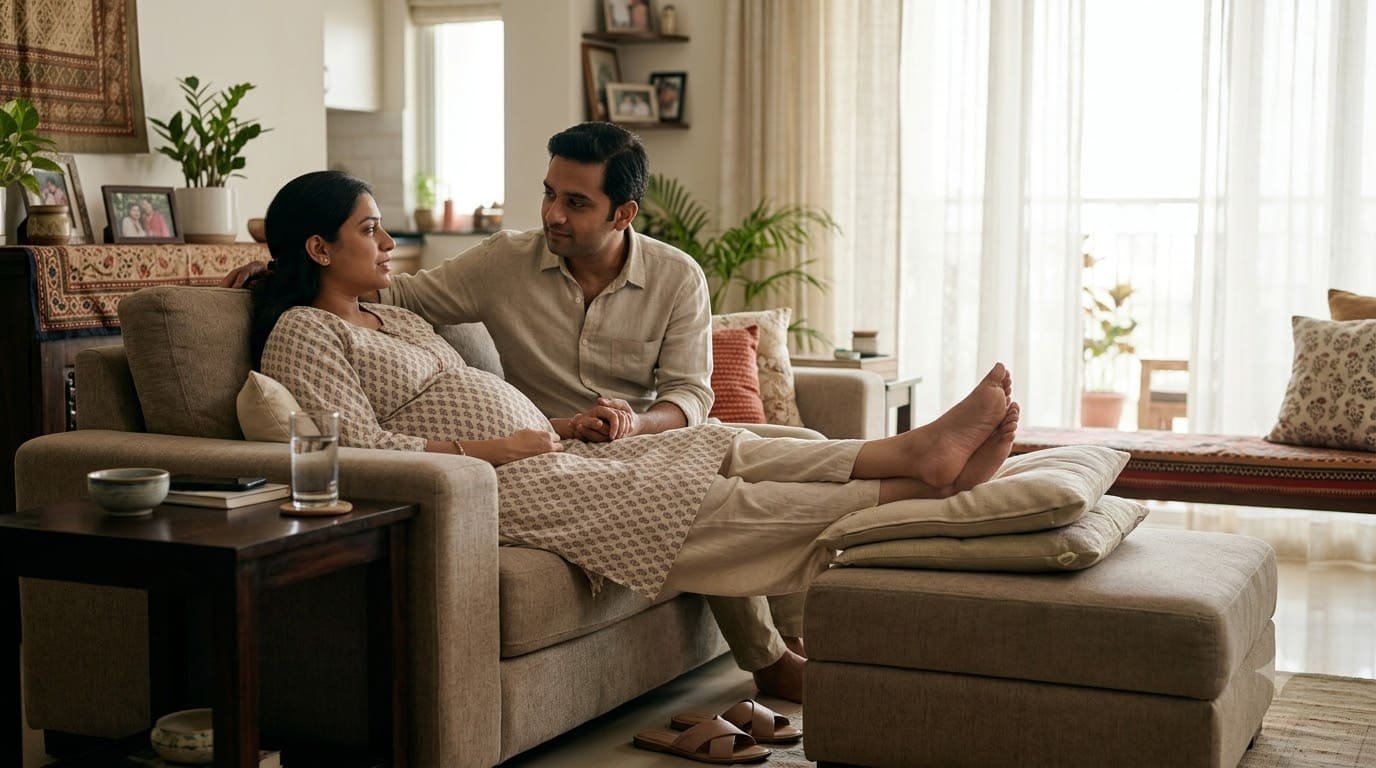
Elevating the feet above the level of the heart is the most effective immediate remedy for pregnancy foot swelling — gravity draws accumulated fluid back toward the central circulation.
How to elevate: Lie on your left side (the recommended pregnancy sleeping position — this position improves venous return from the legs and reduces uterine pressure on the vena cava) with feet propped on a pillow.
When sitting: Rest feet on a stool, footrest, or second chair at approximate hip height.
When lying down: A firm pillow under the ankles lifts them above hip level — more effective than just bending the knees.
Duration: 20-30 minutes of elevation 2-3 times daily provides meaningful relief. Many Indian women elevate while resting after lunch — a practical Indian habit that works well for oedema management.
The left-side advantage: Left-side lying specifically reduces pressure on the inferior vena cava — the main vein returning blood from the lower body — improving venous return and reducing pooling in the legs. Right-side lying or back lying does not provide this benefit.
2. Reduce Standing Time — The Prevention Strategy
Prolonged standing is one of the most significant oedema triggers — gravity + the weight of the uterus pressing on pelvic veins = maximum fluid pooling in the legs.
For Indian pregnant women who cook: Indian cooking involves significant standing time at the stove. A high stool at the kitchen platform height — allowing the pregnant woman to sit while cooking — dramatically reduces the standing-related oedema that many Indian pregnant women experience.
At work: Request a footrest if you sit at a desk. Alternate sitting and standing throughout the day rather than prolonged periods of either.
On public transport: If standing on buses or metro, prioritise the reserved seats for pregnant women — this is both your right and a medical recommendation.
3. Comfortable Footwear — The Overlooked Factor
The footwear Indian pregnant women typically wear — flat chappals, kolhapuris, thin-soled sandals — provides minimal support for the swollen foot and can worsen discomfort and circulation.
What helps: Footwear that adjusts as swelling changes — sandals with adjustable straps rather than fixed-size shoes. Cushioned, supportive soles — not hard flat soles. Wide toe box — swollen feet need width.
What to avoid: Tight-fitting shoes that restrict circulation further. High heels — worsen pelvic alignment and increase leg fatigue. Footwear that requires the foot to grip (which exhausts foot muscles).
When to put shoes on: In the morning before significant swelling has developed. Most Indian pregnant women find that footwear that fits in the morning becomes uncomfortable by evening — carry comfortable slippers for the end of the day.
4. Cool Water Immersion — Traditional Indian Relief
Immersing swollen feet in cool water is one of the most traditional and most effective immediate remedies for pregnancy foot swelling — and it is available to everyone.
How to do it: Fill a bucket or large tub with cool (not cold) water. Sit comfortably and soak the feet for 15-20 minutes.
The cooling mechanism: Cool water causes vasoconstriction (blood vessel narrowing), reduces local heat, and the hydrostatic pressure of the water compresses the tissues and assists fluid return from the legs.
Indian summer advantage: Cool water foot soaks are particularly pleasant and effective during Indian summer months when heat worsens swelling. Adding a few drops of peppermint oil to the water enhances the cooling sensation.
5. Hydration — Counterintuitive but Evidence-Based
It seems counterintuitive that drinking more water would reduce swelling — but dehydration actually worsens oedema.
Why hydration reduces oedema: When dehydrated, the body retains more sodium and water in tissues as a protective response. Adequate hydration signals the body that fluid is available and reduces this retention response.
Target: 2.5-3 litres of fluid daily during pregnancy in India — more in hot weather.
Indian practical options: Plain water — the most effective Coconut water — natural electrolytes and potassium that support fluid balance Nimbu paani with minimal salt Diluted chaas (buttermilk) — cooling, hydrating
What reduces: Chai and coffee in excess — caffeinated drinks have mild diuretic effects but the fluid they provide is quickly lost. Not harmful in moderate amounts but not the best hydration choice for oedema management.
6. Reduce Sodium Intake — Moderately
Excess sodium causes the body to retain more water. Reducing sodium intake — not eliminating it — can modestly reduce pregnancy oedema.
Indian sodium reduction:
- Reduce additional salt added at the table
- Reduce packaged and processed foods (very high sodium)
- Use less salt in cooking — season with spices, lemon, tamarind instead
What not to do: Eliminate salt entirely. Some sodium is essential for pregnancy — complete salt restriction is harmful and not recommended. Moderate reduction is appropriate.
Indian high-sodium foods to moderate: Pickle (achar) — very high sodium Papad — high sodium Packaged namkeen and chips — very high sodium Commercial ready-to-eat foods
7. Gentle Exercise and Walking
Gentle walking and movement — rather than complete rest — improves circulation and reduces oedema by activating the calf muscle pump (the calf muscles, when contracting during walking, squeeze the leg veins and actively push blood back toward the heart).
The calf pump: This mechanism is why prolonged sitting is as bad for oedema as prolonged standing — both stop the calf pump from working. Movement is the key.
Practical for Indian pregnant women: A 20-30 minute walk daily — preferably in the morning before significant swelling has developed. Calf raises while standing — rise onto tiptoes and lower 10-15 times. This activates the calf pump. Ankle circles while sitting — rotate each ankle 10 circles in each direction.
Swimming: If accessible, swimming is the most effective exercise for pregnancy oedema — the hydrostatic pressure of the water compresses the legs and assists venous return throughout the swim.
8. Magnesium-Rich Foods — Supporting Fluid Balance
Magnesium plays a role in regulating fluid balance in the body. Some research suggests that magnesium deficiency is associated with worse pregnancy oedema.
Indian magnesium-rich foods:
- Dark chocolate (in moderation — the 70%+ variety)
- Palak and dark leafy greens
- Nuts — almonds, cashews
- Seeds — pumpkin seeds (kaddu ke beej), sesame seeds (til)
- Banana — easy to eat, magnesium-rich
- Rajma and other legumes
Magnesium supplementation: Some gynaecologists recommend magnesium supplementation in the third trimester — discuss with your doctor before supplementing.
9. Compression Stockings — Effective But Underused in India
Medical-grade compression stockings — worn during the day and removed at rest — are one of the most evidence-based interventions for pregnancy oedema and are widely used in Western pregnancy care but underused in India.
How they work: Graduated compression — tighter at the ankle, less tight at the calf — squeezes the leg veins and actively assists venous return, preventing fluid from pooling.
Where to find in India: Medical supply shops, large pharmacies (Apollo, MedPlus), and online. Look for “graduated compression stockings 15-20 mmHg” or “anti-embolism stockings.”
How to wear: Put on in the morning before getting out of bed — before gravity has had a chance to pull fluid into the legs. Remove at bedtime.
Important: Consult your gynaecologist before using compression stockings — they are not appropriate for all types of swelling and should not be used if there is significant arterial circulation concern.
10. Massage — Lymphatic Drainage Technique
Gentle massage — specifically toward the heart — encourages lymphatic drainage and venous return, reducing oedema.
The technique: Long, firm strokes from the ankle toward the knee (not the other direction). Then from the knee toward the thigh. Always stroke toward the heart — never away from it.
Partner massage or self-massage: Sitting with feet elevated, use both hands to stroke firmly from ankle to knee. 5-10 strokes on each leg, twice daily.
Indian context: This is a modification of the traditional Indian oil massage that can be done by a partner or family member — framing it as part of the traditional care practice makes it easier to integrate.
When to Go to the Hospital Immediately
🚨 Sudden, severe swelling — particularly of face, hands, or around eyes 🚨 Severe headache that doesn’t respond to paracetamol 🚨 Visual disturbances — blurred vision, spots, flashing lights 🚨 Upper right abdominal pain 🚨 One leg significantly more swollen, red, warm, and painful than the other 🚨 Difficulty breathing 🚨 Significantly reduced urine output
These are signs of pre-eclampsia or deep vein thrombosis — both require emergency assessment.
FAQ — Pregnancy Swelling Feet India
Q: My feet are so swollen I can’t fit into my sandals. Is this normal?
Significant foot swelling by the end of the day — particularly in the third trimester — is common and usually normal. The key assessment is: is it gradual onset (building through the day), limited to feet and ankles, and does it reduce overnight with rest? If yes — this is physiological oedema. If the swelling is sudden, affects the face or hands, or doesn’t reduce with rest — see your gynaecologist.
Q: My mother-in-law says I should eat less salt to reduce swelling. Is she right?
Partially. Excess sodium does worsen oedema, so moderate reduction is appropriate. But complete salt elimination is not recommended in pregnancy — some sodium is necessary. Moderate reduction (less pickle, less namkeen, less additional table salt) alongside increased hydration is the balanced approach.
Q: The swelling is only in my right leg, not the left. Should I be worried?
Yes — unilateral (one-sided) swelling, particularly if the leg is also red, warm, and painful, warrants same-day medical assessment to rule out deep vein thrombosis (DVT). Pregnancy increases DVT risk significantly. Normal pregnancy oedema is bilateral (both legs) and painless.
Q: Can I take diuretics (water tablets) to reduce swelling?
No — diuretics are contraindicated in pregnancy unless specifically prescribed for a diagnosed condition. They reduce the plasma volume that the baby depends on and can cause fetal growth restriction. Never self-prescribe diuretics during pregnancy.
Q: Will the swelling go away after delivery?
Yes — in most cases, physiological pregnancy oedema resolves within the first week after delivery as hormones normalise and the body eliminates the extra fluid. Many women notice significant overnight sweating and increased urination in the days immediately after delivery — this is the body excreting the retained fluid.
More from MumPappaHub — Read These Next:
- High Risk Pregnancy India
- Pregnancy Back Pain India
- Pregnancy Insomnia India
- Pregnancy Diet Chart India
- Anemia in Pregnancy India
- Gestational Diabetes India
- Normal Delivery Tips India
- Prenatal Yoga Guide India
- Pregnancy Week by Week Third Trimester
- Hospital Bag Checklist India
- Newborn Care Tips
- Pregnancy Calendar Week by Week
About This Article
Written by the MumPappaHub Research Team — including a researcher whose colleague received six different swelling remedies at a family dinner at Week 28. Her gynaecologist confirmed normal oedema, checked blood pressure and urine protein, and said: “Elevation, cool water, less standing. Come back immediately if the swelling is sudden and severe or involves your face.” This guide is that conversation.
Reviewed for accuracy against WHO antenatal care guidelines and FOGSI clinical recommendations on oedema management in Indian pregnant women. This content is for general informational purposes only. Always consult your gynaecologist about swelling in pregnancy — particularly sudden or severe swelling.
MumPappaHub — Real talk for real Indian parents. mumpappahub.com

1 Comment