
Medical Disclaimer: This article is for informational purposes only and reviewed against WHO and FOGSI guidelines. If your back pain is severe, accompanied by leg numbness, or not improving with basic measures, consult your gynaecologist. Some back pain in pregnancy requires medical assessment to rule out more serious causes.
Pregnancy back pain India is one of the most searched pregnancy topics — because back pain affects approximately 50-80% of pregnant women, making it one of the most common discomforts of pregnancy, and Indian women have specific risk factors that make it particularly prevalent.
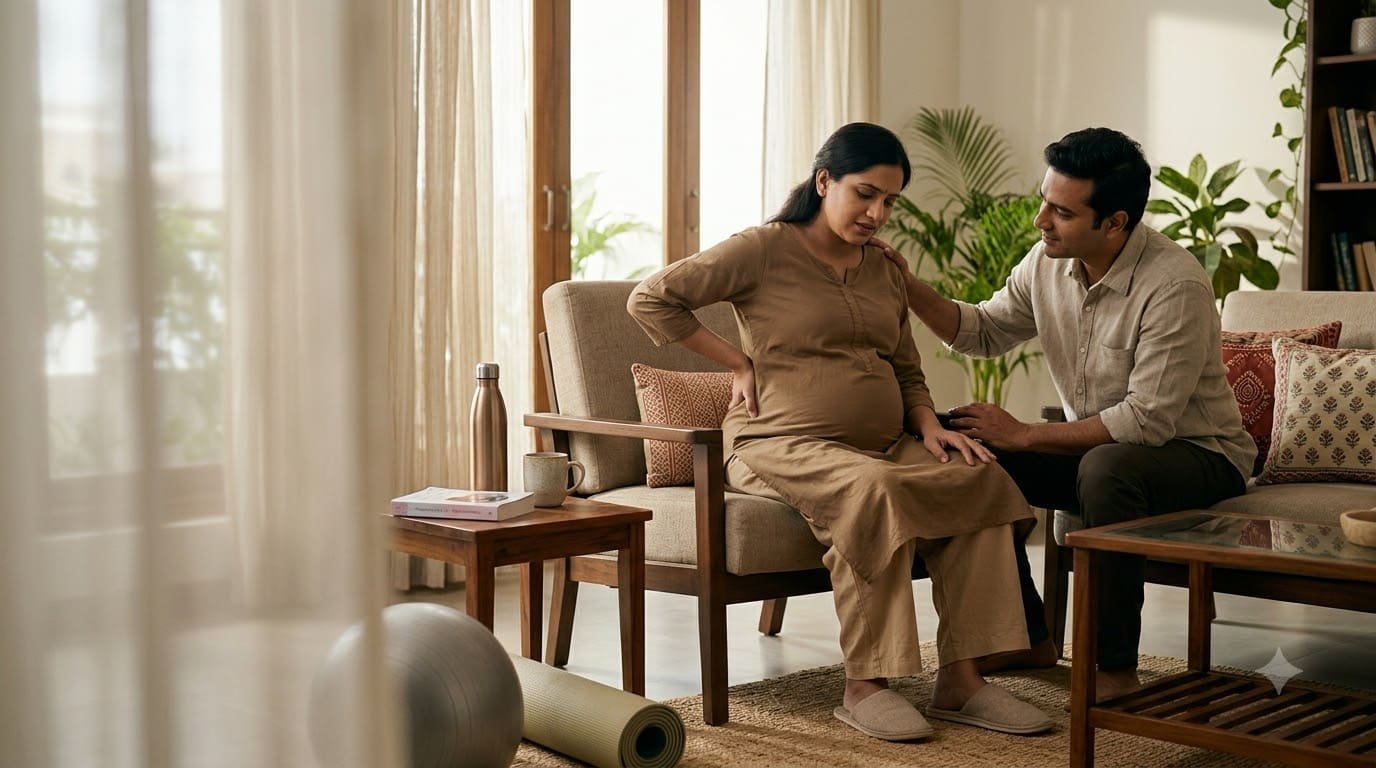
I had back pain from Week 20. Not dramatic, not debilitating — but a persistent ache in the lower back that was worst after standing in the kitchen for more than twenty minutes, that made the commute home from work genuinely miserable, and that woke me at 3 AM when I needed to turn over in bed.
My gynaecologist said three things: it was normal, it would get worse before it got better, and there were things I could do about it. She was right on all three counts. The things I could do about it — yoga, sleep positioning, the support belt — made a real difference. This guide covers those things.
Why Pregnancy Back Pain Is So Common in India
Pregnancy back pain India must acknowledge the India-specific factors that make back pain particularly prevalent among Indian pregnant women.
According to the World Health Organization’s guidelines on physical activity and health in pregnancy, musculoskeletal pain — including back pain — is one of the most common pregnancy complaints globally. The Federation of Obstetric and Gynaecological Societies of India (FOGSI) identifies several India-specific risk factors for pregnancy back pain.
Why back pain is particularly common in Indian pregnancy:
Floor-level activities: Indian households involve significant floor-level activity — sitting on the floor, working at low surfaces, sleeping on the floor in some households. Bending from standing to floor level repeatedly — for cooking, puja, household tasks — places significant strain on the lumbar spine.
Standing for cooking: Indian cooking typically involves extended standing at a stove or kitchen platform. Prolonged standing — particularly in the third trimester — is a significant back pain trigger.
The dupatta/saree: Traditional Indian clothing — particularly sarees — can affect posture and gait during pregnancy, sometimes contributing to pelvic instability.
Pre-existing conditions: Many Indian women have pre-existing vitamin D deficiency (associated with musculoskeletal pain), iron deficiency anaemia, and nutritional deficiencies that may contribute to muscle and bone vulnerability during pregnancy.
Previous pregnancies close together: Multiple pregnancies with short intervals between them leave less time for musculoskeletal recovery, increasing back pain risk in subsequent pregnancies.
Types of Pregnancy Back Pain
Lumbar pain (lower back): The most common type. Pain in the lower back, typically centred around the lumbar spine. Worsened by sitting or standing for extended periods. Caused by the shift in centre of gravity as the uterus grows, leading to increased lumbar lordosis (the inward curve of the lower back).
Pelvic girdle pain (PGP): Pain in the pelvic area — often at the pubic symphysis (front) or sacroiliac joints (back). May radiate to the thighs. Worsened by walking, climbing stairs, turning in bed. Caused by increased laxity in pelvic ligaments due to the hormone relaxin.
Posterior pelvic pain: Pain in the back of the pelvis — around the sacroiliac joints — that can be confused with sciatica. More common in pregnancy than true sciatica.
Understanding which type you have helps determine which remedies are most appropriate.
10 Best Safe Remedies and Prevention Tips
1. Pregnancy Yoga — Cat-Cow and Pelvic Tilts
Yoga is the most effective exercise-based intervention for pregnancy back pain — and cat-cow and pelvic tilts are specifically the most beneficial poses for lumbar back pain.
Cat-Cow (Marjaryasana-Bitilasana): On hands and knees. Inhale — belly drops, back arches, head lifts (cow). Exhale — spine rounds upward, head drops (cat). Move slowly and continuously with breath. 10-15 cycles, twice daily.
Why it helps: Cat-cow directly mobilises the lumbar spine and stretches the paraspinal muscles — the muscles alongside the spine that become shortened and tight as the pregnancy weight increases.
Pelvic tilts: Standing against a wall, knees slightly bent. Gently press the lower back toward the wall — pelvic tilt. Hold 5 seconds, release. 10-15 repetitions.
Why it helps: Pelvic tilts strengthen the deep abdominal and back muscles that support the lumbar spine — addressing the weakness that contributes to back pain.
For a complete safe prenatal yoga routine, our prenatal yoga guide India covers poses from Week 14 through delivery.
2. Correct Sleeping Position — The Left-Side Solution
Sleep position significantly affects pregnancy back pain — both as a cause and as a relief.
The recommended position: Left-side lying, with a pillow between the knees.
Why it helps: Left-side lying distributes the weight of the uterus away from the spine. A pillow between the knees maintains pelvic alignment and prevents the upper leg from rolling forward, which would twist the lumbar spine.
For lower back pain specifically: A small pillow or rolled towel placed in the natural curve of the waist provides additional lumbar support while lying on the side.
The 3 AM turning problem: Many Indian pregnant women wake at night needing to change position, which is painful with lumbar back pain. Keep a pillow in front and behind when lying on your side — it provides support in either direction and reduces the effort of repositioning.
3. Maternity Support Belt
A maternity support belt — a wide band worn around the lower abdomen and back — distributes the weight of the growing uterus and significantly reduces lumbar back pain for many women.
How it works: The belt provides mechanical support to the lower back and abdomen — reducing the load on the lumbar muscles and providing proprioceptive feedback that encourages correct posture.
Available in India: Maternity belts are available at baby stores and online (search “maternity support belt India” or “pregnancy belt”). Prices range from Rs 500-2000.
When to wear it: During activities that trigger pain — cooking, walking, commuting. Not during sleep.
When to avoid it: If the belt causes any pressure or discomfort on the abdomen — stop using it immediately.
4. Hot and Cold Therapy — Indian Kitchen Available
Heat and cold application are simple, immediately accessible interventions for pregnancy back pain.
Warm therapy: A warm (not hot) water bottle or heat pad applied to the lower back for 15-20 minutes. The warmth relaxes tight muscles and increases blood flow. A warm shower with the water directed at the lower back provides immediate relief.
Cold therapy: An ice pack wrapped in a cloth (never ice directly on skin) applied to the lower back for 10-15 minutes. Cold reduces inflammation — more appropriate for acute, sharp pain or after activity.
Indian kitchen option: A cloth bag filled with rice, heated in the microwave for 1-2 minutes — a safe, effective homemade heat pack.
Safety note: Avoid applying heat directly to the abdomen during pregnancy. Back application is safe.
5. Correct Posture — The Foundation of Prevention
Poor posture — particularly the pregnancy tendency to thrust the belly forward and let the lower back collapse into an exaggerated arch — is both a cause and perpetuator of pregnancy back pain.
The correct pregnancy posture:
- Stand with feet hip-width apart
- Gently draw the lower belly inward (engaging the deep abdominal muscles)
- Roll the shoulders back and down
- Lengthen the crown of the head toward the ceiling
- The natural curves of the spine should be present — but not exaggerated
For Indian household tasks: Cooking: Stand with feet hip-width apart, not together. A small footstool to rest one foot on alternately reduces lumbar strain during prolonged standing.
Floor activities: Reduce the frequency of deep bending from standing. When you must bend — bend the knees, not the back. Sitting on a low stool or chair for floor-level activities is better than prolonged squatting or bending.
6. Swimming or Water Exercise
Swimming and water-based exercise are particularly beneficial for pregnancy back pain — the buoyancy of water reduces the load on the spine while allowing full-range movement.
Why water exercise helps: Water buoyancy reduces effective body weight by approximately 75% — significantly reducing the spinal load that causes back pain. The resistance of water provides gentle strengthening without impact.
In India: Many urban areas have swimming pools that offer pregnancy swimming. Some hospitals offer hydrotherapy. Even standing or walking in a swimming pool provides significant relief.
Alternative: A bath with warm water — while limited for exercise — provides temporary buoyancy relief and warmth for the lower back.
7. Massage — Safe Techniques
Pregnancy massage — done correctly by a trained practitioner or with basic techniques at home — provides significant relief for pregnancy back pain.
Safe massage for pregnancy back pain: Lie on your side (left-side preferred). The partner applies gentle kneading pressure with the knuckles or thumbs alongside the spine — not directly on the spine itself. Long, smooth strokes from the mid-back downward. Circular pressure on tight muscle knots.
What to avoid: Deep pressure on the sacrum (the flat bone at the base of the spine) — this area has acupressure points associated with uterine stimulation. Avoid before 36 weeks.
Professional pregnancy massage: Available in many Indian cities — look specifically for practitioners trained in prenatal massage.
8. Vitamin D — Address the Deficiency
Vitamin D deficiency is extraordinarily common among Indian women — affecting 70-90% of the population by some estimates — and is associated with musculoskeletal pain including back pain.
What Vitamin D does: Vitamin D is essential for calcium absorption and bone health. Deficiency leads to muscle weakness and bone pain — which exacerbates the mechanical back pain of pregnancy.
Sources: Sunlight — 15-20 minutes of direct sun on arms and legs daily is the most effective source. India’s sunlight is adequate — but clothing coverage, indoor lifestyles, and skin pigmentation all reduce effective synthesis.
Dietary: Egg yolk, fatty fish, fortified milk. Limited in Indian diets.
Supplementation: Your gynaecologist can check your Vitamin D level and prescribe supplements if needed. Do not self-supplement with high-dose Vitamin D without testing.
9. Walking — The Safest Exercise
Regular walking — 20-30 minutes daily — strengthens the back and abdominal muscles that support the spine, without impact or positions that could worsen pain.
For back pain: Walk on flat surfaces. Wear supportive footwear — not chappals without arch support. Indian chappals, kolhapuris, and thin-soled footwear without arch support are significant contributors to back pain during pregnancy.
Footwear recommendation: Supportive, cushioned footwear with arch support is one of the simplest and most overlooked back pain interventions for Indian pregnant women.
The commute: Long commutes on public transport — standing on buses or metro — are particularly hard on pregnant backs. If possible, ask for the priority seat on public transport. Most Indian cities’ metro systems have reserved seats for pregnant women.
10. Physiotherapy — When Simple Measures Are Not Enough
For significant or persistent pregnancy back pain that is not improving with the above measures, a physiotherapist specialising in women’s health can provide:
- Specific assessment of what type of back pain you have
- Targeted exercises for your specific pain pattern
- Manual therapy techniques safe during pregnancy
- Advice on activity modification
In India: Women’s health physiotherapists (also called pelvic health physiotherapists) are available in most major Indian cities. Referral from your gynaecologist is the best route.
Warning Signs — Back Pain That Needs Immediate Medical Attention
🚨 Back pain accompanied by leg numbness, tingling, or weakness 🚨 Loss of bladder or bowel control 🚨 Severe, sudden onset back pain 🚨 Fever with back pain — possible kidney infection 🚨 Back pain that is rhythmic and regular — this may be contractions, particularly in the third trimester 🚨 Back pain with vaginal bleeding
These symptoms require same-day or emergency medical attention — they are not normal pregnancy back pain.
FAQ — Pregnancy Back Pain India
Q: Is it safe to use a heating pad on my back during pregnancy?
A warm (not hot) heat pad on the lower back is safe during pregnancy. The key word is warm — not hot. Avoid prolonged high heat on any part of the body during pregnancy, and never apply heat to the abdomen. A comfortable heat pad on the back for 15-20 minutes is safe and can be very helpful.
Q: My back pain is worse at night. What can I do?
Night back pain is extremely common in pregnancy. Ensure you are sleeping on your side (left-side preferred) with a pillow between your knees. A pregnancy pillow — a large body pillow that supports both the bump and the back simultaneously — makes a significant difference for many women. Gentle yoga or stretching before bed helps relax the back muscles.
Q: I’m 32 weeks pregnant and my back pain is making it hard to work. What should I do?
Discuss with your gynaecologist — this is a medical concern, not a normal inconvenience. Physiotherapy referral may be appropriate. Your employer has obligations under the Maternity Benefit Act to accommodate pregnancy-related health needs. A maternity support belt for work hours may provide significant relief.
Q: Can I take painkillers for back pain in pregnancy?
Paracetamol (Calpol) — in the correct dose — is the only painkiller appropriate for self-use during pregnancy for back pain. Ibuprofen and other NSAIDs are contraindicated in pregnancy. Never take any medication during pregnancy without confirming safety with your gynaecologist.
Q: My back pain started in the first trimester. Is this normal?
First trimester back pain is less common than second and third trimester pain but does occur. It can be related to the hormonal changes of early pregnancy (relaxin affecting ligament laxity) or simply to posture changes. If it is severe or accompanied by other symptoms — vaginal bleeding, cramping — see your gynaecologist.
More from MumPappaHub — Read These Next:
- Prenatal Yoga Guide India
- Normal Delivery Tips India
- Pregnancy Week by Week Third Trimester
- Pregnancy Diet Chart India
- Anemia in Pregnancy India
- Gestational Diabetes India
- C-Section Recovery India
- Pregnancy Insomnia India
- Hospital Bag Checklist India
- Postpartum Weight Loss India
- Newborn Care Tips
- Pregnancy Calendar Week by Week
About This Article
Written by the MumPappaHub Research Team — including a researcher who had back pain from Week 20 of pregnancy. It woke her at 3 AM. It made the commute miserable. Her gynaecologist said three things: it was normal, it would get worse before it got better, and there were things she could do. The things she could do — yoga, the support belt, sleep positioning — made a real difference.
Reviewed for accuracy against WHO guidelines on physical activity in pregnancy and FOGSI clinical recommendations on musculoskeletal pain management in Indian pregnant women. This content is for general informational purposes only. Always consult your gynaecologist for significant or persistent back pain in pregnancy.
MumPappaHub — Real talk for real Indian parents. mumpappahub.com

2 Comments