
Medical Disclaimer: This article is for informational and educational purposes only and reviewed against WHO, FOGSI, and IAP guidelines. Gestational diabetes requires medical management. Always follow your gynaecologist’s specific guidance. Do not make dietary or medication changes without consulting your doctor.
Gestational diabetes India is something every pregnant Indian woman should know about — because India has one of the highest rates of gestational diabetes in the world, and most women who have it feel completely fine, which is exactly why the screening test matters so much.
My colleague found out she had gestational diabetes at 26 weeks. She had felt perfectly well. No symptoms. She almost skipped the glucose test because her first pregnancy had been normal and she felt no different this time. Her gynaecologist insisted. The test came back positive.
“I cried for two days,” she told me. “I thought I had failed somehow. That I had done something wrong.”
She hadn’t failed anything. Gestational diabetes is not caused by eating too much sugar. It is not a punishment. It is a metabolic response to pregnancy hormones that Indian women are particularly susceptible to — and with appropriate management, outcomes for mother and baby are excellent.
She delivered a healthy baby at 38 weeks. Normal delivery. No complications.
What Is Gestational Diabetes India?
Gestational diabetes India — medically called Gestational Diabetes Mellitus (GDM) — is high blood sugar that develops during pregnancy in a woman who did not have diabetes before pregnancy. It occurs when the hormones produced by the placenta block the action of insulin, causing blood sugar to rise above normal levels.
According to the World Health Organization’s guidelines on gestational diabetes, GDM affects a significant proportion of pregnancies globally and is associated with risks for both mother and baby if unmanaged. The Federation of Obstetric and Gynaecological Societies of India (FOGSI) and the Indian Academy of Pediatrics both identify India as a high-risk country for GDM — with prevalence estimates ranging from 10-35% of Indian pregnancies depending on the population studied and diagnostic criteria used.
Why Indian women are at higher risk: South Asian genetic heritage is independently associated with higher GDM risk — Indian women develop insulin resistance at lower body weights and lower BMIs than Western populations. This means a lean Indian woman has higher GDM risk than a heavier Western woman.
Other risk factors:
- Family history of diabetes
- Previous GDM
- Previous large baby (over 4 kg)
- Overweight or obesity
- Age over 25
- PCOS
Why GDM Must Not Be Ignored
Unmanaged gestational diabetes affects both mother and baby:
For the baby:
- Macrosomia (large baby — over 4 kg) — increases delivery complications
- Birth injury from large size
- Low blood sugar at birth (neonatal hypoglycaemia)
- Breathing difficulties at birth
- Higher lifetime risk of obesity and diabetes
- Higher risk of stillbirth in severe cases
For the mother:
- Higher risk of caesarean section
- Pre-eclampsia
- Higher risk of developing Type 2 diabetes later in life (50% of Indian women with GDM develop Type 2 diabetes within 10 years)
- GDM in future pregnancies
With appropriate management: These risks are significantly reduced. GDM is one of the most manageable pregnancy complications — and early detection and treatment produce excellent outcomes.
The Screening Test — Who Gets It and When
Universal screening in India: FOGSI recommends that ALL pregnant Indian women be screened for GDM — not just those with risk factors. This is different from Western guidelines which use selective screening.
When: Between Week 24 and Week 28. If high risk factors are present, screening may be done earlier (Week 13-16) and repeated at Week 24-28.
The test: 75g OGTT (Oral Glucose Tolerance Test): The standard FOGSI-recommended test. Fasting overnight, then a blood draw. Then drink 75g of glucose solution. Blood drawn at 1 hour and 2 hours.
Diagnostic criteria (FOGSI/WHO):
- Fasting: 92 mg/dL or above
- 1 hour: 180 mg/dL or above
- 2 hours: 153 mg/dL or above
Any ONE of these values being met or exceeded = GDM diagnosis.
Don’t skip this test. You cannot feel gestational diabetes. The only way to know is to test.
10 Best Ways to Manage Gestational Diabetes India
1. Understand Your Numbers — Know Your Target Range
The first step in managing GDM is understanding what blood sugar levels you are aiming for. Your gynaecologist will give you specific targets — these are the general FOGSI-recommended targets:
Fasting (before breakfast): Below 95 mg/dL
After meals (1 hour): Below 140 mg/dL
After meals (2 hours): Below 120 mg/dL
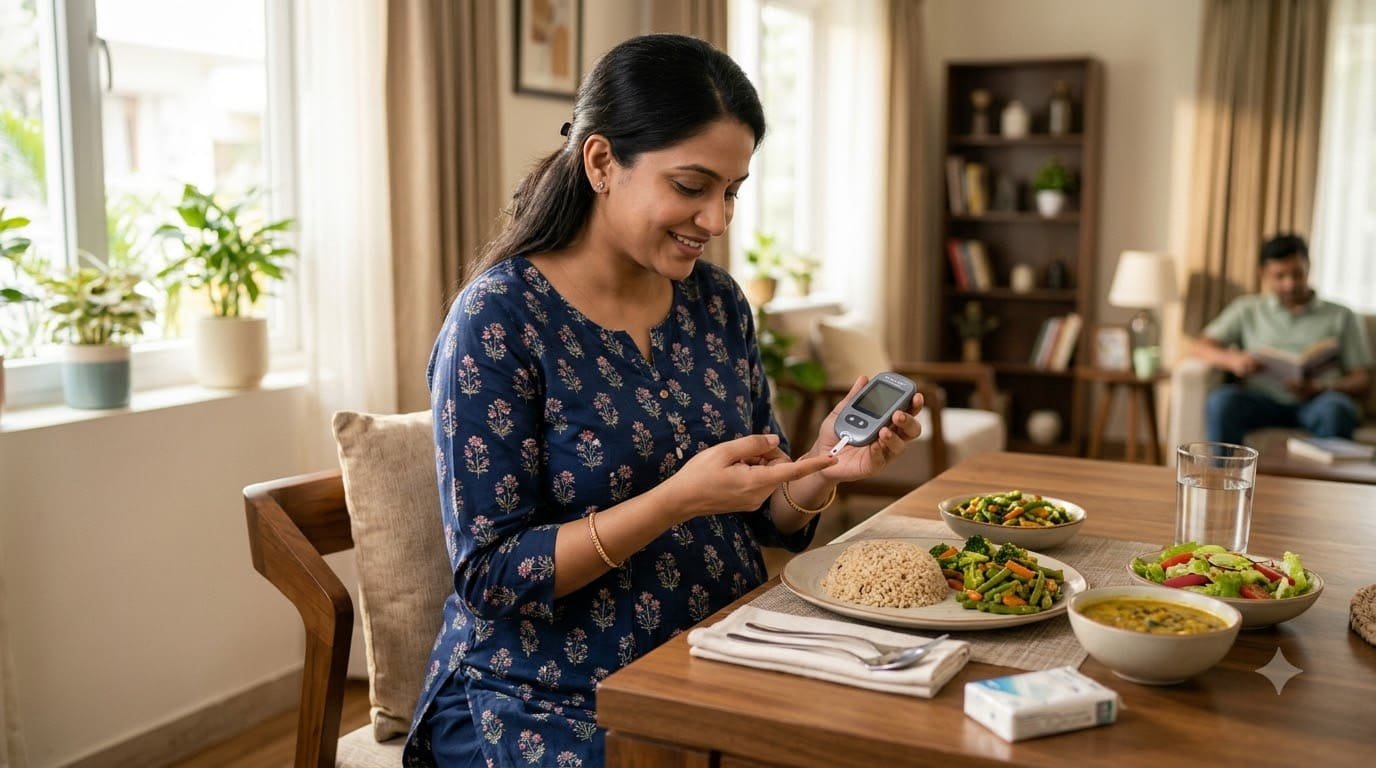
Home monitoring: A glucometer (blood glucose monitor) at home is essential for GDM management. Check at the times your doctor recommends — typically fasting and 1-2 hours after each main meal. Keep a log to share at each antenatal visit.
2. The Indian GDM Diet — What to Eat and What to Reduce
Diet is the primary treatment for most women with GDM. The goal is to maintain blood sugar within target range while providing adequate nutrition for the baby’s growth.
Principles:
Distribute carbohydrates through the day: Three main meals and 2-3 small snacks. Never skip meals — fasting causes blood sugar swings. Never eat a large carbohydrate-heavy meal — this causes spikes.
Choose complex carbohydrates over simple:
✅ Eat:
- Whole grain roti (jowar, bajra, ragi roti are better choices than plain wheat)
- Brown rice or small portions of white rice
- Dal — all varieties (excellent protein + moderate carbohydrate)
- Green vegetables — palak, methi, karela, lauki
- Low-glycaemic fruits — guava, jamun, amla, green apple, pear
- Curd (plain, unsweetened)
- Eggs — complete protein, minimal blood sugar impact
- Nuts — small amounts of almonds, walnuts (healthy fats, lower GI)
❌ Reduce significantly:
- White rice in large portions — replace with smaller portions + more dal/vegetables
- Maida (refined flour) — bread, biscuits, bakery products
- Sweet fruits — mango, banana, chikoo, grapes, pineapple in large quantities
- Fruit juice — even fresh juice raises blood sugar faster than whole fruit
- Sugar — in chai, in cooking
- Packaged snacks — biscuits, namkeen, chips
- Potatoes in large quantities
The Indian GDM plate: Half the plate: non-starchy vegetables (palak, bhindi, lauki, gobi) Quarter plate: protein (dal, paneer, curd, egg) Quarter plate: complex carbohydrate (small roti, small rice)
3. Karela (Bitter Gourd) — The Traditional GDM Vegetable
Karela (bitter gourd) has documented blood sugar lowering properties — it contains compounds that mimic insulin action and improve glucose uptake. It is one of the most validated traditional Indian foods for blood sugar management.
How to use: Karela sabzi (cooked vegetable) — 2-3 times weekly. Karela juice — small amounts, discuss with gynaecologist before taking concentrated juice during pregnancy.
Important: Karela is a food — not a medicine. It supports blood sugar management as part of a balanced diet but does not replace dietary management or medication if prescribed.
4. Walk After Every Meal — The Most Effective GDM Exercise
Physical activity after meals directly reduces the post-meal blood sugar spike that is the most significant challenge in GDM management.
The research: A 10-15 minute walk within 30 minutes after a meal significantly reduces post-meal blood sugar compared to sitting.
How to implement: After every main meal — breakfast, lunch, dinner — a gentle 10-15 minute walk. This does not need to be vigorous. A slow, comfortable walk around the house or neighbourhood is sufficient.
When this is not possible: Gentle in-place walking, marching on the spot, or even standing and doing light household tasks is better than sitting immediately after eating.
Important: Get gynaecologist clearance before starting or increasing exercise. Stop immediately if there is any pain, dizziness, or bleeding.
5. Blood Sugar Monitoring — Track and Respond
Regular home blood sugar monitoring is the most important self-management tool for GDM.
What to monitor:
- Fasting (before breakfast)
- 1-2 hours after each main meal
What to look for: Values above target consistently → discuss with gynaecologist — diet adjustment or medication may be needed. Values below target → note what you ate and replicate.
Keeping a log: A simple notebook with date, time, blood sugar reading, and what was eaten before the reading gives your gynaecologist the information needed to adjust management.
Glucometer in India: Available at pharmacies — Accu-Chek, OneTouch, Dr. Morepen are widely available. Test strips are the ongoing cost. Ask your gynaecologist which to use.
6. Meal Timing — Never Skip, Never Binge
GDM blood sugar management is as much about when you eat as what you eat.
Key rules:
Never skip breakfast: Fasting overnight then skipping breakfast causes the longest carbohydrate gap — leading to a significant blood sugar spike when you do eat. Breakfast should be eaten within 1 hour of waking.
Eat every 2-3 hours: Three main meals and 2-3 small snacks. The snacks prevent blood sugar from dropping too low between meals, which then causes excessive hunger and overeating at the next meal.
Small portions, more frequently: A smaller roti at lunch plus a snack at 4 PM is better for blood sugar management than a large lunch.
Bedtime snack: A small protein-rich snack before bed (a small bowl of curd, a handful of nuts) helps maintain overnight blood sugar stability and improves fasting readings.
7. Insulin — If Prescribed, Use It Without Fear
Some women with GDM require insulin injections when diet and exercise alone do not achieve blood sugar targets. In India, insulin is the preferred medication for GDM management during pregnancy.
Common fears: “Insulin means my diabetes is severe.” — Not true. It means your body needs extra support — which is common. “Insulin will harm my baby.” — Insulin does not cross the placenta. It is safe for the baby. “Injecting insulin will be painful.” — Modern insulin pens use very fine needles. Most women find it much less uncomfortable than expected. “I’ll need insulin forever.” — GDM-related insulin need typically resolves after delivery.
Using insulin correctly: Follow the exact dose and timing prescribed. Never adjust the dose without your gynaecologist’s guidance. Store insulin as directed (typically refrigerated but not frozen).
8. Antenatal Monitoring — Extra Scans and Tests
Women with GDM require more frequent antenatal monitoring than uncomplicated pregnancies:
Growth scans: More frequent ultrasound to monitor baby’s growth — macrosomia (large baby) is a GDM complication that affects delivery planning.
Fetal movement monitoring: From Week 28, monitor daily fetal movement — 10 movements in 2 hours during the baby’s active period.
Non-stress tests: If blood sugar is not well-controlled, additional fetal monitoring may be recommended.
More frequent antenatal visits: Weekly or fortnightly in the third trimester depending on how well-controlled GDM is.
Attend every scheduled appointment. GDM monitoring is specifically designed to catch complications early.
9. Delivery Planning With GDM
GDM affects delivery planning:
Timing: Most gynaecologists recommend delivery between Week 38-39 for women with GDM — not waiting until Week 40-42, because placental function can decline more quickly and the baby continues to grow (increasing delivery complications).
Mode of delivery: Well-controlled GDM with a normally-sized baby — vaginal delivery is typically planned. Macrosomia or poorly controlled GDM — caesarean section may be recommended.
Blood sugar during labour: Blood sugar is monitored during labour and managed carefully.
After delivery: Blood sugar typically normalises quickly after delivery. Breastfeeding is encouraged and has additional blood sugar benefits.
10. After Delivery — The Long-Term Picture
GDM does not end at delivery. It has important implications for long-term health:
Postpartum glucose test: At 6-12 weeks after delivery, a repeat glucose tolerance test should be done to confirm that blood sugar has returned to normal.
Long-term risk: Approximately 50% of Indian women with GDM develop Type 2 diabetes within 10 years of delivery. This risk is significantly reduced by:
- Maintaining a healthy weight
- Regular physical activity
- A balanced diet
- Annual blood sugar checks
Future pregnancies: GDM is likely to recur in future pregnancies. Screen early (first trimester) in subsequent pregnancies.
Breastfeeding: Reduces the long-term diabetes risk for both mother and baby. Breastfeeding after GDM has documented metabolic benefits.
FAQ — Gestational Diabetes India
Q: I had no symptoms. How can I have gestational diabetes?
Gestational diabetes typically causes no symptoms — this is why screening is essential. You cannot feel high blood sugar in the ranges seen in GDM. The glucose test is the only way to identify it.
Q: I ate too much sugar during pregnancy. Did I cause GDM?
No. GDM is not caused by eating sugar — it is caused by the hormonal changes of pregnancy creating insulin resistance. Women who eat very little sugar can develop GDM, and women who eat a lot of sugar may not. Your diet affects how well GDM is managed, not whether you develop it.
Q: My fasting reading is normal but my after-meal readings are high. What does this mean?
Post-meal blood sugar spikes are the most common pattern in GDM. Diet adjustments — reducing portion sizes of carbohydrates at meals, choosing lower-glycaemic carbohydrates, walking after meals — specifically target this pattern. Discuss with your gynaecologist.
Q: Can I eat rice and roti with GDM?
Yes — in modified portions. A small portion of white rice (1/3 to 1/2 katori) with plenty of dal and vegetables is typically acceptable. Jowar or bajra roti raises blood sugar more slowly than wheat roti. The total carbohydrate at each meal, and the accompaniments (dal, vegetables, curd), matter more than eliminating rice or roti entirely.
Q: Will my baby definitely be large?
Not necessarily — and not if GDM is well-controlled. Macrosomia (large baby) is a risk with poorly controlled GDM. With blood sugar maintained within target range, baby size is typically normal. Regular growth scans monitor this specifically.
More from MumPappaHub — Read These Next:
- Pregnancy Week by Week Third Trimester
- Pregnancy Week by Week Second Trimester
- Pregnancy Diet Chart India
- Foods to Avoid During Pregnancy India
- Normal Delivery Tips India
- Hospital Bag Checklist India
- Early Signs of Labour India
- Pregnancy Calendar Week by Week
- Baby Blues vs Postpartum Depression
- How to Increase Breast Milk Supply
- Newborn Care Tips
- Postpartum Weight Loss India
About This Article
Written by the MumPappaHub Research Team — including a researcher whose colleague cried for two days after her GDM diagnosis, convinced she had done something wrong. She hadn’t. She delivered normally at 38 weeks. Healthy baby. This guide is for every Indian woman who gets that diagnosis and needs to understand what it actually means.
Reviewed for accuracy against WHO gestational diabetes guidelines, FOGSI clinical recommendations on GDM management in India, and Indian Academy of Pediatrics guidance on neonatal outcomes with GDM. This content is for general informational purposes only and does not constitute medical advice. GDM requires medical management — always follow your gynaecologist’s specific guidance.
MumPappaHub — Real talk for real Indian parents. mumpappahub.com
