
Medical Disclaimer: This article is for informational purposes only. Always supervise babies while eating. If your baby has food allergies or specific health conditions, consult your paediatrician before introducing new foods.
Baby finger foods India is what Indian parents search when their baby starts grabbing at everything on the plate — reaching for the roti, trying to pick up the dal, and showing very clearly that they are done being fed from a spoon and want to do it themselves.
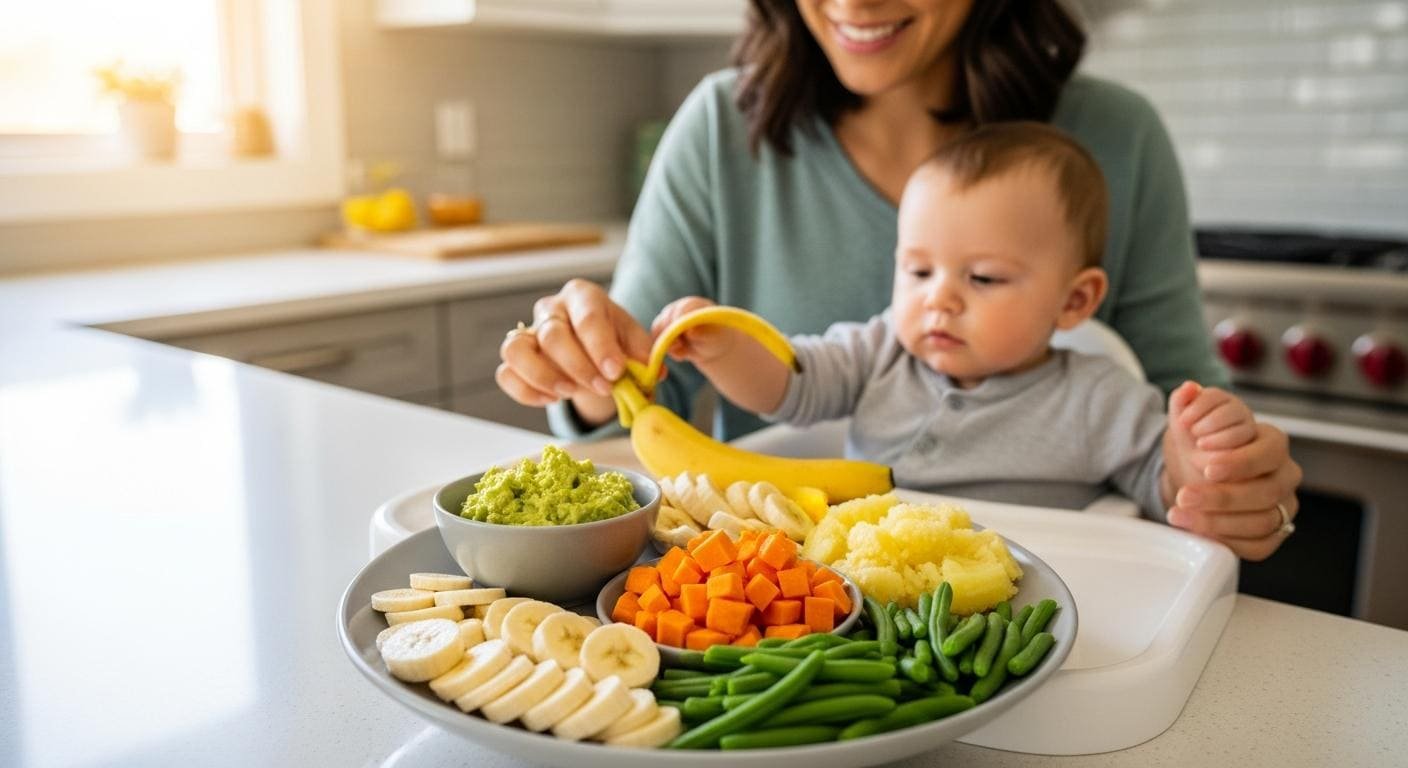
My daughter started reaching for food from our plates at around 8 months. She would watch us eat with intense concentration, then lunge for whatever was closest. The first time she picked up a small piece of soft banana herself and brought it to her mouth — the look on her face was extraordinary. She had done it. By herself.
Finger foods are not just a feeding convenience. They are a developmental milestone — the point at which the baby begins to understand that they have agency over what goes into their body, and builds the hand-eye coordination, pincer grasp, and chewing skills that support everything from feeding to writing.
What Are Finger Foods and Why Do They Matter?
Baby finger foods India refers to soft, appropriately sized pieces of food that a baby can pick up and feed themselves — moving beyond purees and spoon feeding toward self-directed eating.
According to the World Health Organization’s guidelines on complementary feeding, complementary feeding should progress from purees to soft lumps to finger foods as the baby develops chewing and self-feeding skills — typically from around 7-9 months. The Indian Academy of Pediatrics recommends introducing family foods in appropriate textures from 8 months onward, supporting the gradual transition toward eating with the family.
Why finger foods matter:
Fine motor development: Picking up small pieces of food is one of the richest fine motor activities available — developing the pincer grasp (thumb-forefinger) that is the most important manual skill of the first two years.
Oral motor development: Chewing soft finger foods develops the jaw muscles, tongue movements, and oral coordination that support both eating and speech development.
Autonomy and appetite regulation: Self-feeding babies control their own intake — eating until full and stopping. This supports healthy appetite regulation and reduces the risk of overfeeding.
Acceptance of textures: Babies who experience a variety of textures through finger foods typically become less picky eaters as toddlers.
Family meal participation: Finger foods allow babies to eat alongside the family rather than being fed separately — one of the most powerful positive influences on long-term eating habits.
When to Start — Readiness Signs
Most babies are ready for finger foods between 7-9 months. Readiness signs:
✅ Sits unsupported or with minimal support ✅ Brings objects to the mouth reliably ✅ Has emerging pincer grasp — uses thumb and forefinger (not whole fist) to pick up small objects ✅ Shows interest in watching others eat and reaching for food ✅ Has lost the tongue-thrust reflex (does not automatically push food out with the tongue)
Not a readiness requirement: Teeth. Babies do not need teeth to eat finger foods — their gums are remarkably strong and can mash soft foods effectively. Most Indian babies start finger foods before their first teeth appear.
Safety — Choking vs Gagging
The most common fear around baby finger foods is choking. Understanding the difference between gagging and choking is essential.
Gagging (normal and protective): Gagging is the baby’s natural protective reflex — the gag reflex in babies is positioned further forward in the mouth than in adults, making it easy to trigger. Gagging sounds dramatic — the baby retches, face reddens, eyes water — but the baby is managing the food independently. This is the system working correctly.
Do not intervene during gagging — the baby is managing it. Intervention (putting fingers in the mouth, turning the baby upside down) can push the food further back and create actual choking.
Choking (requires immediate action): Choking is silent — the baby cannot make sound, is not breathing, face turns blue or very red. This is a respiratory emergency.
Learning infant choking first aid is more important than avoiding finger foods. Paediatric first aid courses teaching the back-blow technique for infant choking are available in most Indian cities.
Choking prevention — food preparation: All finger foods for babies under 12 months should be soft enough to squash between thumb and forefinger. If you cannot squash it — it is not soft enough for a young baby.
12 Best Baby Finger Foods India
1. Ripe Banana — The Perfect First Finger Food
Ripe banana is the ideal introductory finger food for Indian babies — it is soft, naturally sweet, nutritious, widely available, and requires no cooking.
How to prepare: Cut into finger-length strips (not rounds — strips are safer as they are easier to manage). A ripe banana should be squashable between thumb and forefinger.
Age: From 7-8 months Nutrition: Potassium, vitamin B6, carbohydrates, natural sugars for energy Indian context: Banana (kela) is already a staple in Indian baby feeding and familiar in most households
2. Soft Steamed Carrot — First Vegetable Finger Food
Steamed until very soft — a carrot stick that can be squashed between thumb and forefinger — is one of the best vegetable finger foods.
How to prepare: Steam or boil carrot pieces until completely soft — far softer than you would cook for an adult. Cut into finger-length sticks or small chunks. Test softness: it should squash easily.
Age: From 7-8 months (well cooked), 10+ months (firmer) Nutrition: Beta-carotene (Vitamin A), fibre, natural sweetness
Indian kitchen advantage: Gajar is used widely in Indian cooking — soft-cooked gajar pieces from sabzi, khichdi, or soup are readily available.
3. Soft Cooked Sweet Potato (Shakarkandi) — Nutrient-Dense
Sweet potato is one of the most nutritious finger foods available — high in Vitamin A, potassium, and fibre, naturally sweet, and very easy to cook to the right soft texture.
How to prepare: Steam or boil until completely soft. Cut into finger-length strips or cubes. Can also be lightly roasted in a tiny bit of ghee — adds flavour and nutrition.
Age: From 7-8 months Nutrition: Vitamin A, potassium, fibre, complex carbohydrates Indian context: Shakarkandi is widely available in Indian markets particularly in winter — an excellent seasonal first finger food
4. Soft Roti Pieces — Indian Staple as Finger Food
Small, soft pieces of roti — particularly fresh, slightly thick roti that holds together without being too dry — are an excellent Indian finger food.
How to prepare: Tear fresh, soft roti into strips or small pieces. The roti should be soft enough to squash. Adding a tiny smear of ghee makes it more manageable and adds nutrition.
For young babies: Pieces should be finger-length strips, not too thin (may crumble and be inhaled).
Age: From 8-9 months Nutrition: Carbohydrates, some protein, iron (in whole wheat roti) Indian context: Roti is the most culturally natural first Indian finger food — the baby eating what the family eats
5. Soft Paneer Cubes — Protein-Rich Finger Food
Soft, fresh paneer cut into small cubes is one of the best protein-rich finger foods for Indian babies — and one of the most culturally appropriate.
How to prepare: Fresh or lightly cooked paneer, cut into cubes small enough for the baby to manage. Paneer should be soft — if it is rubbery and firm, it is not appropriate yet.
Age: From 7-8 months Nutrition: Protein (18-20g per 100g), calcium, fat Avoid: Paneer that is hard or rubbery — older or fried paneer is not appropriate for young babies
6. Soft Cooked Dal Balls — Indian Traditional Approach
Thick, well-cooked dal can be rolled into small balls — soft enough to squash — providing both texture experience and excellent nutrition.
How to prepare: Cook moong dal until very thick — thicker than you would serve as dal. Cool slightly. Roll into small balls approximately the size of a large marble. Offer on the baby’s tray.
Age: From 8-9 months Nutrition: Protein, iron, fibre Indian context: This is a traditional Indian approach to giving babies finger food — adapting already-prepared family food into a manageable form
7. Mango Pieces — Seasonal Favourite
Ripe, soft mango pieces are one of the most popular and successful Indian baby finger foods during mango season.
How to prepare: Choose a very ripe mango — the kind that is soft to touch. Cut into finger-length strips. The mango should be soft enough to squash and not stringy (some mango varieties are more fibrous — choose less fibrous varieties for young babies).
Age: From 7-8 months (very ripe, non-fibrous variety) Nutrition: Vitamin A, Vitamin C, natural sugars
8. Boiled Egg Pieces — Complete Protein
Boiled egg — both white and yolk — is one of the most nutritionally complete finger foods available. The IAP recommends introducing whole egg (including yolk) from 6 months.
How to prepare: Hard-boil the egg completely (not soft-boiled — the firm texture is safer and easier to pick up). Cut into quarters or strips. The egg should be fully cooked — no runny yolk.
Age: From 7-8 months (if no egg allergy) Nutrition: Complete protein (all essential amino acids), choline, Vitamin D, iron
Allergy note: Introduce egg for the first time as a very small amount in a pureed form before offering as a finger food — observe for reaction (rash, vomiting, swelling) for 20 minutes.
9. Soft Cooked Broccoli — Vegetable Exploration
Broccoli florets — steamed until soft — are excellent finger foods because the floret shape gives the baby something to hold while the soft top is chewed.
How to prepare: Steam broccoli florets until very soft — far softer than al dente. The baby holds the stalk part and chews the soft floret. Test: the floret should squash easily.
Age: From 7-8 months Nutrition: Vitamin C, Vitamin K, fibre, calcium
Availability in India: Broccoli is increasingly available in Indian cities year-round and is excellent value.
10. Soft Idli Pieces — South Indian Staple
Fresh, soft idli — a naturally fermented, protein-rich food — is one of the best Indian baby finger foods and one of the easiest to introduce.
How to prepare: Fresh, soft idli cut into pieces. It should be soft and slightly moist. Not day-old idli which may be harder.
Age: From 7-8 months Nutrition: Protein (from urad dal), carbohydrates, fermented (probiotic benefit) Indian context: Idli is already recommended as a first baby food in South India — as a finger food it is culturally embedded and highly appropriate
11. Avocado Pieces — Healthy Fats
While less traditionally Indian, avocado is increasingly available in Indian cities and is one of the best first finger foods — naturally soft, high in healthy fats, and easy to manage.
How to prepare: Ripe avocado cut into finger-length strips or cubes. A ripe avocado should be very soft — easily squashable.
Age: From 6-7 months Nutrition: Healthy monounsaturated fats, Vitamin E, potassium, folate
12. Soft Cooked Pasta — From 9 Months
Small, soft pasta pieces — well-cooked until very soft — are a useful addition to the finger food repertoire from around 9 months when the baby’s pincer grasp is more developed.
How to prepare: Small pasta shapes (penne, farfalle, small shells) cooked until very soft — far softer than al dente. Can be served with a small amount of soft cooked tomato or dal-based sauce.
Age: From 9-10 months Nutrition: Carbohydrates; if whole wheat pasta, some fibre and iron
Foods to Avoid as Finger Foods — Choking Hazards
Under 12 months — never offer: ❌ Whole grapes (cut into quarters minimum) ❌ Whole cherry tomatoes (cut into quarters) ❌ Whole nuts or large pieces of nut ❌ Raw hard vegetables (raw carrot sticks, raw apple) ❌ Large pieces of meat ❌ Hard, round-shaped foods ❌ Popcorn ❌ Honey in any form (botulism risk) ❌ Added salt or sugar
The round shape rule: Round foods that are approximately the size of a baby’s airway are the highest choking risk — whole grapes, whole cherry tomatoes, whole blueberries. Always cut these into quarters.
Starting Finger Foods — A Practical Week-by-Week Approach
Week 1: Banana strips and soft steamed carrot. One new food every 2-3 days. Sit with the baby. Expect most food to be squashed, dropped, and explored rather than eaten.
Week 2-3: Add sweet potato, roti pieces with ghee, soft paneer.
Week 4+: Add egg, idli, dal balls. Increase variety. Watch for preferences.
The mess: Finger feeding is messy. A large bib, a mat under the high chair, and acceptance that this is developmental — not disorder — makes the experience manageable.
What “eaten” looks like at this stage: Even if only a small percentage of the food offered actually makes it into the baby’s mouth, the session is successful. The exploration — touch, squash, smell, put to mouth, drop — is the learning.
FAQ — Baby Finger Foods India
Q: My 9-month-old only wants to play with finger foods and not actually eat them. Is this normal?
Completely normal. Finger food play — touching, squashing, smearing, dropping — is developmental exploration, not refusal. The baby is learning the properties of different foods before committing to eating them. Continue offering. Most babies begin eating meaningful amounts of finger food between 9-12 months.
Q: My mother-in-law is worried the baby will choke. How do I reassure her?
Learn and teach the difference between gagging (normal, loud, self-resolving) and choking (silent, requires intervention). The foods in this guide, prepared as described — soft enough to squash — have minimal choking risk when the baby is supervised. The Indian tradition of giving family food in soft forms to babies has been practised for generations — this is the same principle applied with modern safety knowledge.
Q: Should I give finger foods before or after milk feeds?
Offer finger foods 30-60 minutes after a milk feed — when the baby is not ravenously hungry (which leads to frustration with self-feeding) but also not so full that they are not interested. As finger food intake increases (typically 10-12 months), begin offering some finger food meals before the milk feed.
Q: My baby gags every time I offer finger foods. Should I stop?
Gagging is the protective reflex working correctly — it is not a sign to stop. Continue offering, ensuring the food is appropriately soft and sized. Most babies’ gag reflex becomes less sensitive as they gain experience. If gagging is very frequent or very distressing, mention it to your paediatrician — occasional babies have oral sensory sensitivities that benefit from professional assessment.
Q: How do I know if the food is soft enough?
The squash test: place the food between your thumb and forefinger and apply gentle pressure. If it squashes easily — it is appropriate. If it does not squash — it is not yet suitable for a baby under 10-12 months.
More from MumPappaHub — Read These Next:
- Starting Baby on Solid Foods India
- Baby Food Recipes India 6-12 Months
- Baby Led Weaning India
- Baby Led Weaning Safe First Foods
- Iron Rich Foods Babies Toddlers India
- Calcium Rich Foods for Baby India
- Protein Rich Foods for Toddlers India
- Toddler Nutrition India
- Picky Eater Tips India
- Baby Development Month by Month
- Indian Baby Weight Chart
- Fine Motor Skills Toddler India
About This Article
Written by the MumPappaHub Research Team — including a researcher whose daughter started reaching for food from plates at 8 months and watching adults eat with intense concentration. The first time she picked up a piece of soft banana herself and brought it to her mouth — the look on her face was extraordinary. She had done it. By herself. This guide is for every parent waiting for that look.
Reviewed for accuracy against WHO complementary feeding guidelines and Indian Academy of Pediatrics guidance on finger foods and self-feeding for Indian infants. This content is for general informational purposes only. Always supervise babies during mealtimes.
MumPappaHub — Real talk for real Indian parents. mumpappahub.com
