
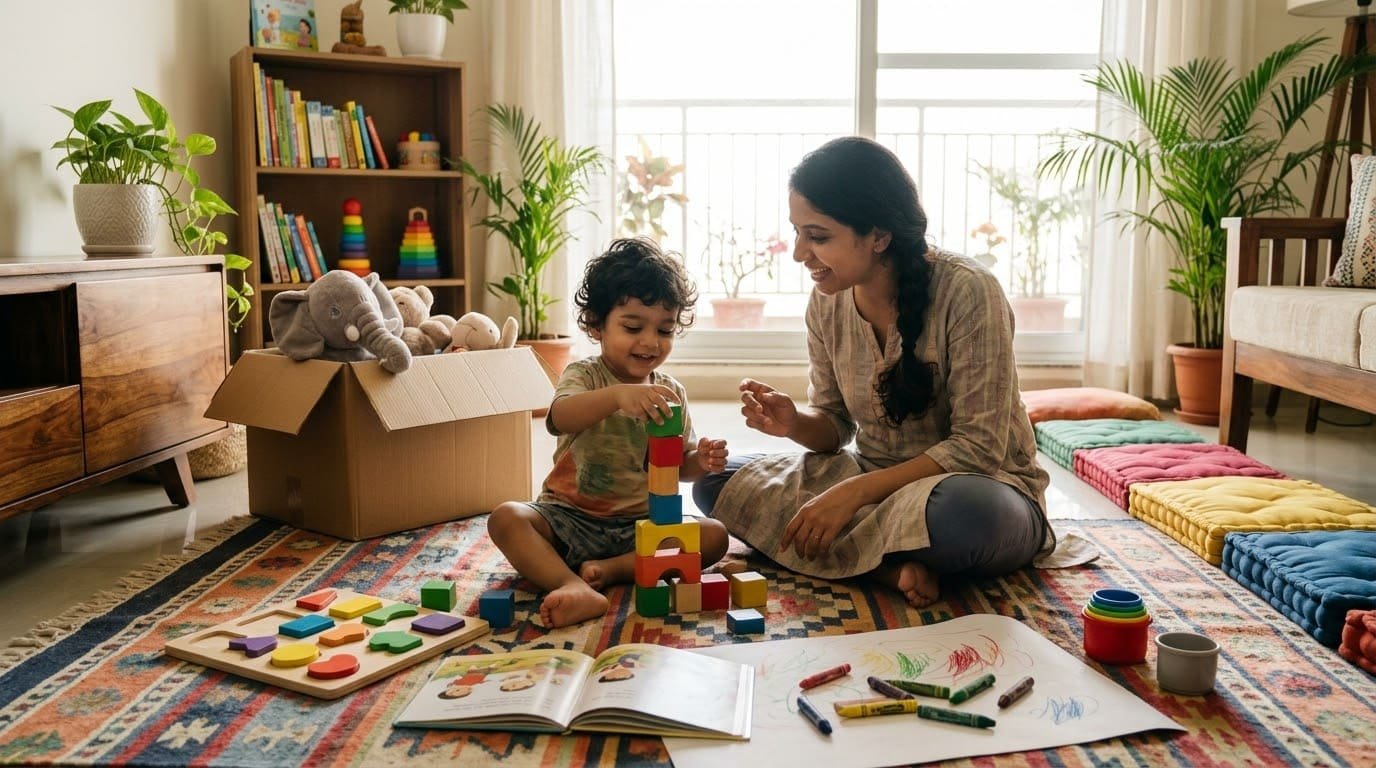
Indoor activities for toddlers India is what every Indian parent searches on days when the monsoon is keeping everyone inside, when summer heat makes outdoor play impossible, or when a toddler who has been active all morning suddenly needs something new to do and the screen is the obvious but not ideal answer.
My sister has a two-and-a-half-year-old and a four-year-old. She lives in a two-bedroom flat in a city without a garden. She has navigated two monsoon seasons, multiple summer months, and an extraordinary number of days when the children needed to be entertained inside without driving each other — or her — completely mad.
She taught me: the best indoor activities for Indian toddlers are not expensive, not elaborate, and largely already in the home. What they require is the willingness to make a mess and the knowledge of what to do.
This guide is that knowledge.
Why Screen-Free Indoor Activities Matter
The Indian Academy of Pediatrics recommends no screen time before 18 months and limited, high-quality screen time for children aged 18 months to 5 years — no more than one hour daily. The World Health Organization’s guidelines on physical activity for children recommend at least 180 minutes of varied physical activity daily for children under 5.
The challenge for Indian parents in urban apartments is meeting these activity needs during periods when outdoor play is not available. Screen-free indoor activities are not a luxury — they are a developmental necessity.
What screen-free indoor play provides that screens don’t:
- Physical movement and muscle development
- Sensory exploration
- Creative thinking and problem-solving
- Imagination and narrative development
- Language development through play talk
- Social skills through sibling and parent play
- Fine and gross motor development
12 Best Indoor Activities for Toddlers India
Activity 1 — The Indian Kitchen Sensory Bin
The single most effective, zero-cost, infinitely variable indoor activity for Indian toddlers is the kitchen sensory bin — a tray or container filled with dry kitchen ingredients for exploration.
Materials:
- A large steel thali or plastic tray
- Dry ingredients: rajma, moong, rice, atta, sooji, poha — whatever is available
What toddlers do: Pour between containers. Sort by type. Bury small toys and find them. Make “dal” and “roti” in play. Use hands, spoons, cups, and funnels.
Why it works: Multiple sensory inputs simultaneously — touch, sound, sight, smell. Open-ended — the child decides what to do. Develops fine motor skills, sensory discrimination, and concentration.
Age: 12-18 months (larger items, close supervision for mouthing), 18+ months (more independently)
The mess: Significant. Place a sheet or old bedsheet under the tray. Worth it.
Activity 2 — Atta Dough Play
Plain wheat flour dough — atta and water, kneaded to a soft, non-sticky consistency — is one of the most cognitively and physically engaging play materials available.
How to make: 1 cup atta + approximately 1/3 cup water. Knead until smooth and pliable. Add a few drops of food colouring for different colours.
What toddlers do: Squeeze, poke, roll, flatten, tear, shape, cut with a plastic knife, press objects into it to make prints.
Add tools: A child-safe rolling pin (a small steel belan), cookie cutters (available at kitchenware shops), small plastic toys to press prints.
Why it works: Works every major hand muscle. Builds fine motor skills. Supports pretend play — “making roti,” “making mithai.” Completely safe if tasted.
Age: 10 months+ (supervised), 18+ months (more independently)
Activity 3 — Water Play in the Bathroom
On hot days or days when a contained mess is needed, water play in the bathroom — or on the balcony — provides sensory stimulation, physical engagement, and genuine scientific exploration.
Setup: A large tub or bucket with 10-15cm of water. A selection of containers, cups, spoons, a small jug, a ladle. Optional: a few objects that float (a small ball, a leaf) and objects that sink (a stone, a coin).
What toddlers explore: Filling and emptying. Pouring and measuring. Floating and sinking. The sound and feel of water. Transfer between containers.
Indian summer advantage: Water play is particularly appropriate during Indian summer heat — cooling, refreshing, and genuinely educational.
Age: 18 months+ (supervised, shallow water, never leave alone)
Activity 4 — Blanket Fort and Pillow Mountain
The universal toddler classic — building a fort from blankets and pillows — provides proprioceptive input (pressure on the body), gross motor activity, and imaginative play all in one.
How to build: Drape blankets over chairs, the sofa, or low furniture. Weight the edges with books or cushions. Add pillows inside for a cosy base. A small torch creates atmosphere.
What toddlers do inside: Read books by torchlight. Have a picnic with snacks. Play pretend — “this is our house,” “this is a cave.” Simply enjoy the enclosed, private feeling of the space.
Why it works: The enclosed space is calming for many toddlers — it provides sensory input from the surrounding fabric and a sense of safe, private territory.
Age: 18 months+ (with parental help building), 3+ years (more independently)
Activity 5 — Indoor Obstacle Course
An indoor obstacle course using sofa cushions, pillows, rolled blankets, and household furniture provides gross motor activity on days when running outside is not possible.
How to set up:
- Cushions to jump over
- A rolled blanket to crawl through or over
- A low coffee table to crawl under
- A “balance beam” made from a strip of tape on the floor to walk along
- A pillow pit to jump into
What toddlers do: Run, jump, crawl, climb, balance — the fundamental gross motor activities they need daily.
Why it works: Meets the WHO’s 180-minute daily movement recommendation for under-5s in a contained indoor space. Tires toddlers out effectively without screens.
Age: 18 months+ (simpler course), 2+ years (more complex)
Activity 6 — Drawing and Painting
Art activities provide creative expression, fine motor development, and the deeply satisfying experience of making something.
Age-appropriate art:
18-24 months:
- Large chunky crayons on big paper
- Finger painting with non-toxic poster paints
- Stamping with potato or bottle cap stamps
2-3 years:
- Standard crayons, markers
- Watercolour painting
- Collage — sticking torn paper, leaves, fabric scraps
- Chalk on the balcony floor
3+ years:
- Drawing with pencils
- Mixing colours with watercolours
- Making greeting cards (Diwali cards, birthday cards)
Indian context: Old newspapers as a drop cloth. Watercolour paint available at most stationery shops. Post-Diwali is a good time for making cards with leftover craft supplies.
Activity 7 — Storytelling and Book Reading
Reading to children is one of the most evidence-based developmental activities available — building vocabulary, attention span, and the foundational understanding of narrative and literacy.
Making it active: Not just reading, but reading with participation:
- “Where is the dog? Point to the dog!”
- “What sound does the cow make?”
- “What do you think will happen next?”
- Acting out the story — roaring like a lion, jumping like a frog
Indian storytelling: Stories from Indian mythology simplified for toddlers — Ganesh’s broken tusk, Hanuman carrying the mountain, the story of Diwali — connect children to cultural roots while developing language and imagination.
Without books: Oral storytelling — making up stories featuring the child as the hero — is entirely appropriate and often more engaging. “Once upon a time, there was a little boy named Aryan who found a magical dal that…” This requires no materials at all.
Age: From birth (board books), all ages (storytelling)
Activity 8 — Music and Movement
Singing songs with accompanying movements, dancing freely to music, and making music with household objects provides physical activity, language development, and sensory stimulation.
Indian nursery rhymes with actions: “Machli Jal Ki Rani Hai” — with swimming arms “Chanda Mama” — with moon-pointing “Lakdi Ki Kathi” — with trotting movements “Ek Do Teen” — counting with fingers
Household percussion: A steel daba as a drum. Two spoons as rhythm sticks. A dabbas filled with rice as a shaker. These require no purchase — they are available in every Indian kitchen.
Dancing: Put on any music and let the toddler move freely. No instruction needed — movement to music is intrinsically appealing and develops coordination, rhythm, and body awareness.
Age: From birth (being danced with), 12+ months (beginning to move independently to music)
Activity 9 — Sorting and Matching Games
Sorting and matching — by colour, shape, size, or type — is one of the earliest mathematical activities and develops the classification skills that underlie later academic learning.
Indian household sorting materials:
- Different types of dal sorted into separate katoris
- Colour sorting: gathering all red objects, all yellow objects
- Size sorting: large and small buttons from a button tin
- Shape sorting with commercial shape sorters or homemade versions
Matching:
- Socks from the laundry (paired by colour and pattern)
- Matching lids to containers
- Matching pictures in simple memory card games (available at stationery shops)
Age: 18 months+ (simple two-category sorting), 2+ years (more categories), 3+ years (complex matching)
Activity 10 — Puppet Play and Dramatic Play
Simple puppets made from socks or paper bags, or dramatic play with household props, support language development, emotional expression, and imaginative thinking.
Sock puppets: An old sock pulled over the hand — add googly eyes (available at craft shops) or draw eyes with a marker. The puppet can have a name, a voice, and a story. Children who won’t talk to adults often talk freely to puppets.
Household dramatic play: A dupatta as a saree for dress-up. Old handbags and wallets for “going to market.” Kitchen utensils for “making food.” A stethoscope toy for “playing doctor.” These props support the pretend play that is one of the highest forms of toddler cognitive development.
Age: 18 months+ (simple puppet, watching), 2+ years (more active participation), 3+ years (elaborate dramatic play)
Activity 11 — Building and Construction
Stacking, building, and constructing — whether with wooden blocks, LEGO Duplo, steel katoris, or cardboard boxes — develops spatial reasoning, problem-solving, and persistence.
Indian household building:
- Steel katoris stacked in towers
- Empty boxes and containers collected over time (cardboard is endlessly buildable)
- Stacked books as building materials
- Toilet paper rolls for construction
Commercial options: Wooden blocks (available at most toy shops, long-lasting investment) LEGO Duplo (expensive but excellent quality, appropriate from 18 months) Magnetic tiles (increasing availability in India)
Age: 12+ months (simple stacking), 18+ months (beginning construction), 2+ years (intentional building with a plan)
Activity 12 — Cooking Together
Involving toddlers in age-appropriate kitchen activities provides sensory exploration, sequencing learning, and the deeply satisfying experience of contributing to something real.
Age-appropriate kitchen participation:
18-24 months: Washing vegetables (under supervision) Stirring cold ingredients Pouring pre-measured ingredients
2-3 years: Tearing bread or leafy vegetables Mashing cooked potato or banana Mixing dry ingredients Rolling balls of dough
3+ years: Measuring with cups and spoons Decorating biscuits or mithai Simple cutting with a child-safe knife
The value: The child made this. The child helped with dinner. This is genuinely meaningful — and the investment of 20 extra minutes of patience in the kitchen produces a more engaged, less screen-hungry toddler for the rest of the day.
Managing the Mess
The most common reason Indian parents avoid sensory and art activities is the mess. This is a genuine concern — but manageable.
The sheet method: Keep an old bedsheet designated as the “activity sheet.” Spread it under any messy activity. Roll up and shake out when done. Wash monthly.
The bath-time timing: Schedule messy activities (finger painting, atta dough, water play) before bath time. The cleanup is built in.
The kitchen location: Messy activities on the kitchen floor — easier to mop than carpet or living room floor.
The acceptance reframe: Mess is evidence of learning. A toddler who has been making atta dough for 45 minutes has been doing exactly what their developing brain needs. The mess is the cost of that. It is worth it.
FAQ — Indoor Activities for Toddlers India
Q: My toddler loses interest in everything within 5 minutes. What do I do?
This is completely normal — toddler attention spans are short. Plan for 5-8 activities in a morning session, each lasting 5-15 minutes, rather than one long activity. Rotate the sensory bin materials weekly to maintain novelty. Follow the child’s lead — when they move on, move on with them.
Q: We live in a small flat with no space. How do I manage?
Many of these activities work in very small spaces. Atta dough play at the kitchen table. Book reading and storytelling anywhere. Sock puppet play on the floor. Music and movement in a 2×2 metre cleared space. The blanket fort works in a single room. Space is less limiting than it seems.
Q: My in-laws think these activities are unnecessary. What do I do?
Frame it in terms of development: “The paediatrician says toddlers need active play for their brain development. These activities are what she’s recommended instead of screen time.” Most Indian grandparents respond to medical authority. If they want to be involved — invite them to join the activity. Grandparents who participate often become enthusiastic.
Q: How much of my time do these activities require?
Some activities are fully independent (the sensory bin, atta dough, building blocks) once set up. Others require parent presence and participation (storytelling, puppet play, cooking together). A mix of the two — independent activities for when you need to manage household tasks, participatory activities for dedicated play time — is the practical approach.
More from MumPappaHub — Read These Next:
- Diwali Craft Ideas for Kids India
- Navratri Activities for Kids India
- Sensory Play for Toddlers India
- Cognitive Development Activities India
- Fine Motor Skills Toddler India
- Screen Time Guidelines Children India
- Positive Parenting Tips India
- 2 Year Old Milestones India
- 3 Year Old Milestones India
- Baby Development Month by Month
- Discipline Toddler India
- Toddler Sleep Problems India
About This Article
Written by the MumPappaHub Research Team — including a researcher whose sister has a two-and-a-half-year-old and a four-year-old in a two-bedroom city flat. She has navigated two monsoon seasons and an extraordinary number of indoor days. Her lesson: the best activities are not expensive or elaborate. They are already in the home. What they require is the willingness to make a mess.
Reviewed for accuracy against WHO physical activity guidelines for children and Indian Academy of Pediatrics screen time recommendations. This content is for general informational and parenting purposes only.
MumPappaHub — Real talk for real Indian parents. mumpappahub.com

1 Comment