
Medical Disclaimer: This article is for informational purposes only. If your toddler has significant difficulty with fine motor tasks for their age, consult your paediatrician or an occupational therapist.
Fine motor skills toddler India is something Indian parents increasingly search — often prompted by a paediatrician mentioning that their child’s pencil grip or pincer grasp needs attention, or by noticing that another child of the same age handles small objects more adeptly.
My neighbour’s daughter, at two and a half, struggled to pick up individual raisins from a bowl. Her grasp was still mostly palmar — using the whole hand rather than the precise thumb-forefinger pinch that fine motor development requires. Her paediatrician recommended occupational therapy assessment and a set of home activities.
The activities — most using things already in the Indian household — made a real difference over three months. She was using a proper pencil grip by three. This guide covers what fine motor skills are, when they develop, and the ten best Indian household activities to support them.
What Are Fine Motor Skills?
Fine motor skills toddler India refers to the small muscle movements of the hands and fingers that enable precise, coordinated actions — picking up small objects, holding a pencil, cutting with scissors, fastening buttons, turning pages, and eventually writing.
Fine motor skills develop alongside gross motor skills (large body movements) but require a higher degree of neurological maturity — the brain-hand connection must be refined enough to coordinate very precise movements.
According to the World Health Organization’s guidelines on child development, fine motor development follows a predictable sequence that can be supported through appropriate play and activity. The Indian Academy of Pediatrics includes fine motor milestones in developmental screening at each well-baby visit.
Why fine motor development matters: Fine motor skills are the foundation of:
- Self-care independence (dressing, eating, toileting)
- Pre-writing and writing readiness
- Academic learning
- Creativity and art
- Daily task management
Fine Motor Milestone Guide — Birth to 3 Years
| Age | Fine Motor Milestone |
|---|---|
| 3 months | Holds rattle placed in hand briefly |
| 6 months | Transfers objects hand to hand |
| 9 months | Pincer grasp emerging — picks up objects with thumb and forefinger |
| 12 months | Mature pincer grasp — picks up small objects precisely |
| 15 months | Stacks 2 blocks; puts objects in container |
| 18 months | Stacks 3-4 blocks; scribbles with crayon |
| 24 months | Stacks 6 blocks; turns book pages; circular scribble |
| 30 months | Stacks 8+ blocks; draws vertical line; snips with scissors |
| 36 months | Draws circle; copies cross; holds crayon with tripod grip |
10 Best Fine Motor Activities for Toddlers India
Activity 1 — Picking Up Dal and Grains
The Indian kitchen provides the perfect fine motor tool — dry dal, rice, and grains that can be sorted, picked up, and transferred between containers.
Why it develops fine motor skills: Picking up individual moong beans, rajma, or rice grains requires the precise pincer grasp — the thumb-forefinger pinch that is the most important fine motor milestone of the first two years.
How to set up: A shallow tray or plate with a mixture of dry moong dal and rajma. Small containers — katoris or cups — to sort them into. Let the toddler pick up individual items and transfer them.
Age progression: 12-18 months: Picking up items with emerging pincer grasp 18-24 months: Sorting by type — “all the big ones here” 2+ years: Using a small spoon to transfer rather than fingers
Supervision: Always supervised — small grains are a choking hazard for babies under 18 months. Ensure the toddler doesn’t put them in their mouth.
Activity 2 — Atta Dough Play — Squeezing, Rolling, Pinching
Plain wheat flour dough (atta mixed with water to a soft, non-sticky consistency) is one of the richest fine motor play materials available in any Indian household.
Why it develops fine motor skills: Working with dough requires:
- Squeezing — strengthens hand muscles
- Pinching — develops pincer grasp precision
- Rolling — develops wrist rotation and bilateral hand coordination
- Tearing — strengthens finger grip
- Shaping — develops hand-eye coordination
Age-appropriate atta dough activities: 12-18 months: Squeezing, poking, tearing 18-24 months: Rolling balls, making “roti” 2-3 years: Making shapes, using cookie cutters, rolling pins 3+ years: Detailed shaping, making figures
The Indian kitchen connection: Children who watch their parents make roti naturally want to imitate — allowing them to work with their own ball of dough while the parent makes roti is one of the most culturally embedded fine motor activities available.
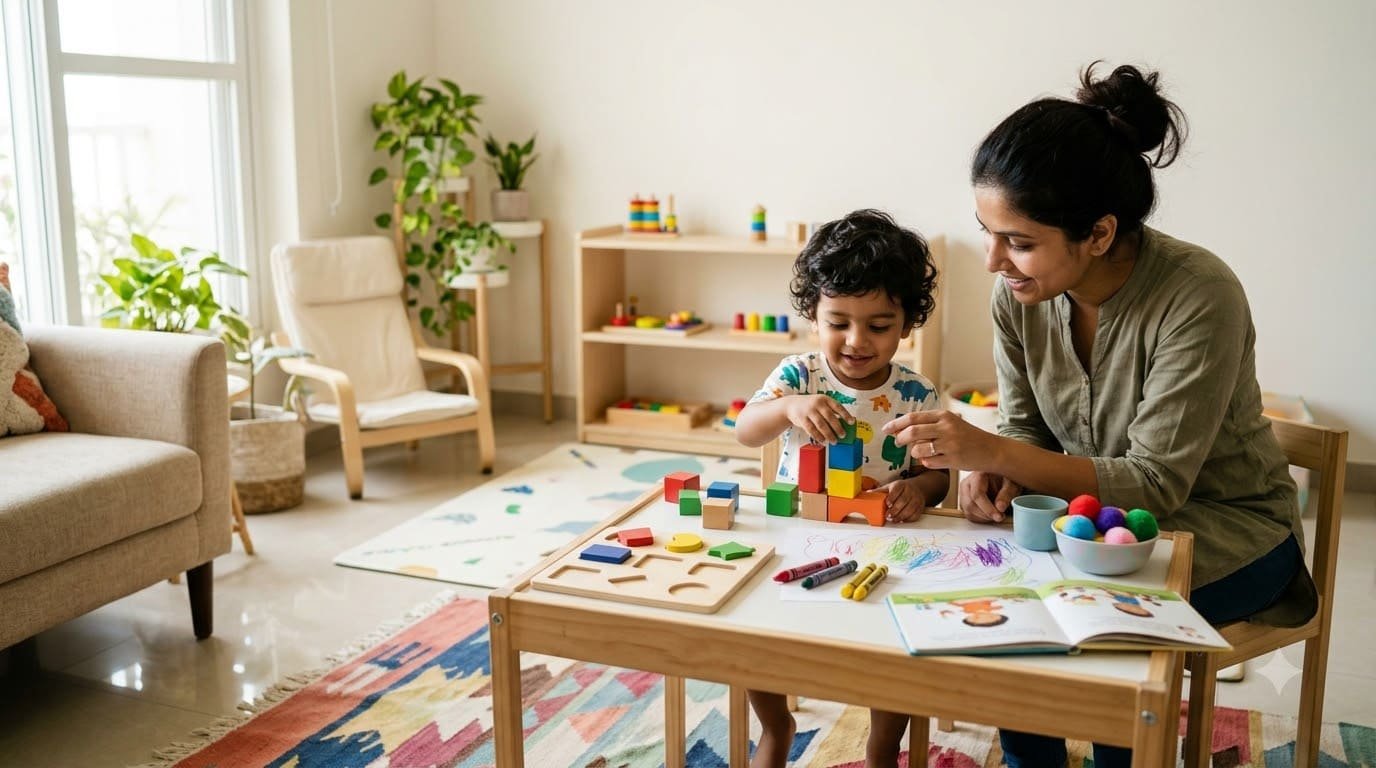
Activity 3 — Stacking Blocks and Katoris
Stacking — whether with wooden blocks or steel katoris from the kitchen — develops hand-eye coordination, bilateral hand use, and the precise placement that fine motor control requires.
Age progression: 12-15 months: Stacking 2 blocks 15-18 months: Stacking 3-4 blocks 18-24 months: Stacking 5-6 blocks 24-30 months: Stacking 8+ blocks or building simple structures
Steel katori stacks: A set of stainless steel katoris of different sizes provide both stacking and nesting opportunities — and the satisfying sound when they topple adds to the engagement.
The challenge: As the child progresses, increase the challenge — stack thinner objects, stack on unstable surfaces, stack with one hand. This progressive challenge develops the neural pathways that support fine motor refinement
Activity 4 — Threading and Lacing
Threading large beads, pasta, or pieces of straw onto a shoelace or piece of thick wool develops the precise hand-eye coordination and bilateral hand use (one hand holds the string, the other guides the bead) that fine motor control requires.
Indian household materials:
- Tubular pasta (penne, rigatoni) threaded onto a shoelace
- Large wooden or plastic beads from a toy shop
- Pieces of drinking straw cut into 3-4cm lengths, threaded on thick wool
Age: 18-24 months: Large beads with thick string and easy holes 2-3 years: Medium beads, thinner string 3+ years: Small beads, creating patterns
The progression: Move from large to small objects and from thick to thin string as the skill develops.
Activity 5 — Tearing and Scrunching Paper
Tearing newspaper, tissue paper, or old magazines develops grip strength and controlled finger movement. Scrunching paper into balls develops hand muscle strength.
How to use: Tearing newspaper into strips — then into smaller pieces Scrunching tissue paper into balls (for craft activities or just for motor practice) Tearing paper to make a collage — pieces stuck to a drawing with glue
Why it’s useful: Paper tearing requires asymmetric hand coordination — one hand stabilises while the other tears — and develops the finger strength that underlies all other fine motor skills.
Age: From 12 months (tearing with help), 18+ months (independent tearing)
Indian context: Old newspapers — widely available in Indian households — are perfect for this. No cost, readily available, appropriate for the purpose.
Activity 6 — Drawing and Colouring — With Correct Materials
Drawing and colouring are direct fine motor activities — but the materials matter significantly.
Age-appropriate drawing tools:
12-18 months: Thick chunky crayons — the fat, short crayons designed for toddlers. The palmar grasp at this age wraps around the thick crayon.
18-24 months: Standard crayons, thick markers, chalk on a blackboard or pavement.
24-30 months: Transitioning from palmar to tripod grasp — encourage holding the crayon with three fingers (thumb, index, middle) rather than the whole fist.
3+ years: Pencils, fine crayons, watercolour brushes.
What to draw on: Large paper at first — fine motor control develops from the shoulder inward, so large movements on large paper come before small precise marks on small paper.
Indian context: Chalk on the floor or pavement of a courtyard — a traditional Indian childhood activity — is an excellent large motor-to-fine motor transition activity. The large surface invites large arm movements; the precision of drawing specific things develops from these.
Activity 7 — Pouring and Transferring Water
Water play with pouring — transferring water between containers of different sizes — develops wrist rotation, bilateral coordination, and the controlled hand movement that is central to fine motor development.
How to set up: A tray or bucket of water. Containers of different sizes — small katori, larger bowl, plastic cup. A small jug or ladle for pouring.
The activities: Pouring water from one container to another without spilling Filling a container exactly to a line Using a spoon to transfer water (much harder — requires controlled wrist and hand movement) Using a turkey baster or medicine dropper to move water (excellent for older toddlers — requires precise squeeze control)
Age: 18 months+ (supervised, shallow water)
Indian summer advantage: Outdoor water play in warm weather is cooling, practical, and highly educational — one of the most natural Indian childhood activities.
Activity 8 — Puzzles and Shape Sorters
Puzzles and shape sorters require the precise placement, rotation, and insertion of objects that directly develop fine motor control and spatial reasoning.
Age progression: 12-15 months: Shape sorter (posting shapes into holes) 18-24 months: 2-3 piece inset puzzles 24-30 months: 4-6 piece flat puzzles 3+ years: 12+ piece puzzles, 3D puzzles
Indian available options: Wooden shape sorters — available at most toy shops Inset puzzles with large knobs — easy to grasp and place Commercial puzzle sets — available at stationery and toy shops
The learning: Each failed puzzle placement teaches something. Resist solving the puzzle for the child — the trial and error is the learning.
Activity 9 — Pasting and Cutting
Art activities involving glue and (for older toddlers) child-safe scissors develop the hand strength, precision, and bilateral coordination at the heart of fine motor development.
Pasting (18 months+): Applying glue with a brush or glue stick to paper Placing paper pieces, leaves, petals, or fabric scraps on the glued surface Pressing firmly — this develops controlled hand pressure
Cutting (2.5-3+ years): Child-safe scissors with rounded tips Start with cutting through playdough or thicker paper Progress to cutting along straight lines, then curves Eventually cutting out shapes
The bilateral coordination requirement: Cutting requires one hand to hold and feed the paper while the other operates the scissors — a sophisticated bilateral coordination that develops gradually from age 3.
Activity 10 — Dressing and Self-Care Activities
Self-care activities — dressing, fastening, and feeding — are the most functional fine motor activities available, and they develop in parallel with play-based fine motor skills.
Dressing fine motor progression: 12-18 months: Pulls off socks, hats, shoes 18-24 months: Pulls pants down and up (for toilet training) 2-3 years: Large buttons and zippers (with help) 3+ years: Independent large buttons, beginning small buttons
Encourage independence: Allow enough time for the child to attempt dressing themselves. The 10 minutes it takes a toddler to put on their own shoes is 10 minutes of fine motor practice. Doing it for them — because it’s faster — bypasses this development.
Feeding: Spoon feeding (from 9 months with help, 12 months beginning independence) Fork from 18 months Drinking from a cup (from 12 months) Pouring from a small jug (from 2 years)
When to Seek Assessment
These patterns warrant a paediatrician or occupational therapist referral:
🚨 No pincer grasp by 12-13 months 🚨 Not stacking 2 blocks by 15 months 🚨 Not scribbling with a crayon by 18 months 🚨 Not using a spoon with some accuracy by 24 months 🚨 Not drawing a circle by 36 months 🚨 Significant regression in previously acquired fine motor skills 🚨 Significant preference for one hand before 18 months — this can indicate weakness in the other hand
Occupational therapy is the specialist assessment and treatment for fine motor delays — available in most Indian cities, often at government hospitals and private rehabilitation centres.
FAQ — Fine Motor Skills Toddler India
Q: My 2-year-old holds crayons with her whole fist. Is this normal?
Yes — the palmar grasp (whole fist around a crayon) is normal up to approximately 2-2.5 years. The transition to tripod grip (three-finger hold) happens gradually between 2.5 and 3.5 years. Offer thick crayons, encourage without forcing, and model the correct grip yourself. Do not force a child’s hand into a tripod grip — this creates anxiety around drawing without improving the grip.
Q: My son is 18 months and still not picking up small objects with his fingers. Should I see a doctor?
By 12-13 months, most babies have a mature pincer grasp. If at 18 months your son is still not using a thumb-forefinger pinch for small objects — yes, this warrants a paediatrician assessment. Bring specific observations: can he pick up a small piece of food from his tray? Can he pick up a small block?
Q: How much screen time is affecting my toddler’s fine motor development?
Passive screen time (watching a screen) does not develop fine motor skills. Interactive touchscreen play has some fine motor benefit but is significantly less beneficial than physical manipulation of real objects. Replacing screen time with the activities in this guide produces more fine motor benefit. The IAP recommends no screen time before 18 months and limited screen time thereafter — and this recommendation has fine motor development implications alongside the more discussed cognitive ones.
Q: My toddler has no interest in any of these activities. What do I do?
Embed the activities in daily life rather than presenting them as separate “activities.” Let the toddler help with cooking — handling dal, stirring, pouring. Give them the opportunity to dress themselves. Chalk on the pavement during a walk. Picking up pebbles or flowers outdoors. The best fine motor activities are ones that feel like play or participation — not structured exercises.
More from MumPappaHub — Read These Next:
- Cognitive Development Activities India
- Baby Development Month by Month
- Child Development Milestones
- 2 Year Old Milestones India
- 3 Year Old Milestones India
- Toddler Language Development
- Autism Early Signs Toddler India
- Sensory Play for Toddlers India
- Screen Time Guidelines Children India
- Positive Parenting Tips India
- Indian Baby Weight Chart
- Baby Fever Guide India
About This Article
Written by the MumPappaHub Research Team — including a researcher whose neighbour’s daughter struggled to pick up raisins at two and a half. The paediatrician recommended activities. Most used things already in the Indian household. Three months later she had a proper pencil grip. The solution was in the kitchen the whole time.
Reviewed for accuracy against WHO child development guidelines and Indian Academy of Pediatrics fine motor milestone guidance for Indian children. This content is for general informational purposes only. Consult your paediatrician or occupational therapist for specific fine motor concerns.
MumPappaHub — Real talk for real Indian parents. mumpappahub.com
