
Medical Disclaimer: This article is for informational purposes only. For specific concerns about your child’s emotional wellbeing or family dynamics, consult a child psychologist or family therapist.
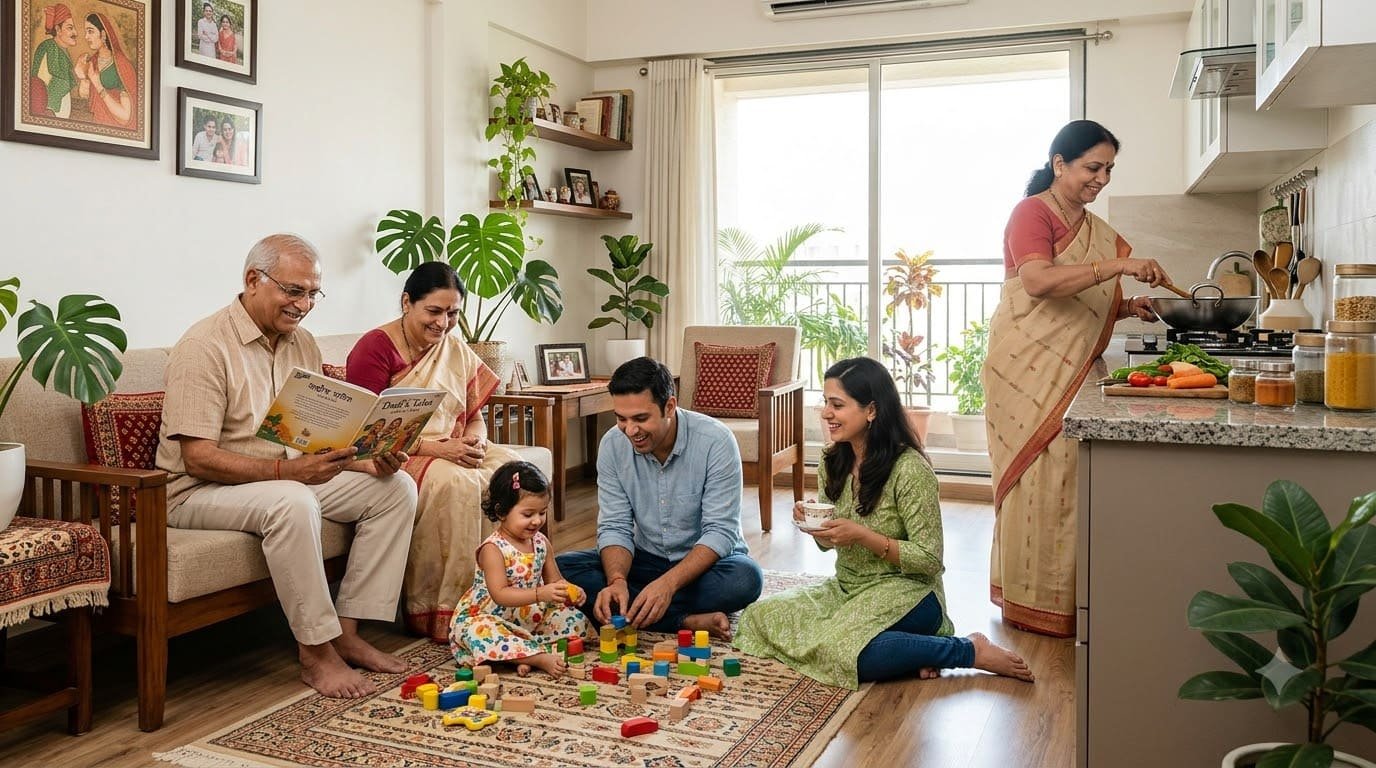
Joint family parenting India is something that most Indian parenting resources don’t address directly — and yet it is the reality for millions of Indian families who are raising children not in a nuclear household of two parents, but in the complex, warm, chaotic, deeply human world of a joint family.
I grew up in one. My grandmother was the undisputed authority on everything from when we should sleep to what we should eat. My father’s siblings had opinions about how we were disciplined. My mother navigated it all with a patience I only began to appreciate as an adult — holding her own judgments quietly, picking her battles carefully, and somehow producing children who knew they were loved by an entire household.
It is not the Western parenting model. It is not the model most parenting books describe. And it produces both extraordinary advantages and specific challenges that Indian parents need actual guidance on — not advice written for nuclear families and transplanted without context.
Joint Family Parenting India — The Reality
Joint family parenting India must begin with honest acknowledgement of what makes it different — because the advantages are real, and so are the challenges.
According to the World Health Organization’s guidelines on child development and family environments, children thrive with multiple secure attachment relationships — not just with parents. The extended family environment that joint families naturally provide is genuinely beneficial for child development when it is warm, consistent, and coordinated. The Indian Academy of Pediatrics recognises that Indian children in joint families have access to multiple caregivers, cultural transmission, and social learning that nuclear family children may not have — and that the joint family context has specific considerations for child health and development.
The genuine advantages of joint family parenting: ✅ Multiple loving adults — the child has a larger attachment network ✅ Cultural transmission — language, traditions, values passed directly ✅ Practical support — childcare sharing enables parental recovery and work ✅ Built-in socialization — siblings, cousins, varying ages ✅ Grandparent wisdom alongside parental energy ✅ Financial sharing — reduces economic pressure on the nuclear couple
The genuine challenges: ⚠️ Multiple authorities with different rules — inconsistency for the child ⚠️ Boundary conflicts between parents and grandparents ⚠️ Parental authority undermined in front of the child ⚠️ Comparison between children — siblings, cousins ⚠️ Privacy limitations for the couple and the child ⚠️ Traditional practices conflicting with modern medical guidance
10 Best Joint Family Parenting Tips India
1. Establish Parental Authority — Privately and Respectfully
The most important structural requirement for joint family parenting is clarity about parental authority — specifically, that the parents are the primary decision-makers for their child, even within a joint family where elders have significant traditional authority.
This is not about disrespecting elders. It is about the child having clarity about whose rules govern their life — which is essential for security and consistent development.
How to establish this:
Private conversations with key family members — grandparents, in-laws — before conflicts arise. Not “we’re going to do things differently” but “we wanted to talk to you about how we’re planning to handle [specific issue] with [child’s name]. We’d love your thoughts.”
Framing decisions as paediatrician guidance: “Dr [Name] has specifically recommended that we [do/not do X]. We’re going to follow that.” Medical authority is respected in most Indian families and provides a frame that doesn’t position parents as rejecting traditional wisdom.
Ensuring that when a grandparent and parent disagree in front of the child, the parent’s decision stands in the moment — with the private conversation happening later. Children need to see parental authority as clear, not contested.
2. Brief the Grandparents — Clearly and Kindly
Grandparents who are primary caregivers during the day need to know the child’s routines, health information, and the key rules that parents want consistently followed.
What to brief grandparents on:
- Feeding schedule and what the child eats (and doesn’t eat)
- Sleep routine — when nap time is, what the settling routine looks like
- Screen time limits
- Key health information — allergies, medications, any conditions
- What to do if the child is unwell (paediatrician contact, what medicines are in the house)
- Emergency contacts
How to do it: Write it down — a simple one-page summary in whatever language works best. Go through it together, asking if there are any questions. Treat it as practical information-sharing, not instruction.
What not to do: Assume the grandparent knows. Assume the grandparent will remember. Brief them the same way you’d brief a hired caregiver — with specificity and warmth.
3. One Rule at a Time — Choose Your Battles
In a joint family, there will be differences in approach between parents and grandparents — on discipline, on food, on screen time, on sleep, on clothing, on almost everything. The parents who try to win every disagreement end up in constant conflict. The parents who pick nothing end up with no influence.
How to decide which battles to pick:
Non-negotiable: Safety — sleep position (always back for babies), car seat use, not giving honey to babies under 12 months, not applying kajal to newborn eyes, not giving medicines without paediatrician guidance. These are medical safety issues and worth holding firmly.
Important but negotiable: Screen time limits, sleep schedule consistency, discipline approach, food variety. Worth discussing and seeking alignment on, but with some flexibility.
Let go: Which specific food is given first in a meal, which song is sung at bedtime, whether the child wears a hat or not, precisely how the bath is given. These things vary without significant consequence.
The parents who hold firmly on medical safety and negotiate kindly on everything else have the most sustainable joint family parenting experience.
4. Protect the Marital Relationship Within the Joint Family
Joint family life can absorb the couple’s relationship entirely — the household demands, the navigation of family dynamics, the exhaustion of parenting, all happening in an environment with minimal privacy.
Why this matters for parenting: The quality of the parents’ relationship is one of the strongest predictors of child outcomes. A couple who maintain their connection — who talk, who laugh, who support each other — parent better than a couple who have become strangers who share a household.
Practical in a joint family: Regular brief time together — even 20 minutes after the child sleeps, when phones are away and conversation is about something other than the household.
A shared position on major parenting decisions — discussed privately, presented consistently to the extended family.
Not involving the wider family in marital disagreements — handling couple conflicts privately.
Support for each other when one parent is being undermined or overruled by extended family.
5. Manage the Comparison Culture
Comparison between children — siblings, cousins, neighbours’ children — is woven into Indian joint family life and is one of the most significant sources of harm to child wellbeing in this context.
The comparison trap: “Priya already knows her alphabets — why doesn’t he?” “Your cousin is so much more obedient.” “Look how much Ravi eats — why is your child so fussy?”
What comparison does to children: It directly damages self-esteem, creates sibling/cousin rivalry, and teaches children that they are valued for performance relative to others rather than for who they are.
What to do:
With grandparents and other family members: “We’re trying not to compare the children — we’ve found it makes them feel bad about themselves. Can you help us by commenting on each child individually?”
With your own child: Consistently refer the child to their own progress — “You’re doing so well at X — look how much better than last month!” Not to another child.
6. Give Each Child Individual One-on-One Time
In a joint family household with multiple children — the parent’s own child plus nephews, nieces, cousins living together — the parent’s child may not get adequate individual parental attention amid the noise and activity of the household.
Why this matters: Every child needs to feel individually seen, known, and valued by their parents — not just part of a group. This individual connection is what builds secure attachment and emotional resilience.
Practical implementation: 15-20 minutes daily of completely individual time with your child — away from the household activity. A story before bed. A brief walk. A quiet activity together. Phone away. No other children. Just your child and you.
This does not need to be elaborate or expensive. It needs to be consistent and undivided.
7. Coordinate on Discipline — Across Caregivers
Inconsistent discipline is one of the most significant joint family parenting challenges. A toddler who is disciplined by the parents in one way and immediately rescued or contradicted by grandparents learns quickly that the rules are negotiable and that grandparents are the better option.
The conversation to have: “We’re working on [specific behaviour — hitting, tantrums, food refusal]. The approach we’re using is [specific approach]. It would really help if we could all respond the same way when [specific situation] happens. Would you be willing to try this with us?”
What consistent discipline looks like: When a grandparent sees the child misbehave — a brief, calm response consistent with what the parents use. Not ignoring the behaviour and not a dramatically different response.
When a grandparent contradicts discipline publicly: Address privately later. “When [child] hit his cousin and I said he needed to sit quietly, and then [name] immediately picked him up and gave him a biscuit — it made it harder for him to understand what the rule is. Could we talk about how to handle that next time?”
8. Handle Traditional Practices — Respectfully But Clearly
Joint families often involve traditional practices around child health and care that conflict with current medical guidance. Kajal on newborn eyes. Mustard oil massage for eczema babies. Honey before 12 months. Force-feeding. Not allowing the baby outdoors in the first month.
The approach that works:
Distinguish between tradition that is harmless (which songs are sung, how the bath is given, the specific foods offered within safe categories) and tradition that is medically harmful (kajal, honey before 12 months, sleeping on the stomach).
For medically harmful practices: “Our paediatrician has specifically said [X] because [brief reason]. We need to follow this.” Do not debate traditional wisdom — simply cite medical authority. “The doctor has said” ends most conversations in Indian families.
For harmless tradition: be genuinely flexible. A grandmother singing old Hindi lullabies, insisting on a specific traditional food, following a puja practice around the child — these can be honoured without medical concern.
9. Teach the Child to Navigate Multiple Authorities
One of the gifts a joint family can give a child is the ability to navigate relationships with multiple adults, each with their own personality and expectations. This is a social skill that nuclear family children develop more slowly.
Support this by: Helping the child understand different adults’ preferences without undermining any adult. “Dadi likes you to sit quietly at meals. That’s her rule when we’re at her house.”
Not making the child a messenger between conflicting adults. Do not send the child to tell a grandparent something the parent should say directly.
Teaching the child that different adults have authority in different contexts — and that respecting this is not weakness, it is social intelligence.
10. Protect Private Space and Routines
Even within a joint family, certain spaces and times should be clearly the nuclear family’s own — not open to drop-in or commentary.
What to protect:
- Bedtime routine — parents put the child to sleep, without extended family participation except when specifically invited
- Feeding times — parents feed the child, grandparents don’t add food or commentary at each meal
- Couple time — even brief
- Medical decisions — information shared, but decisions made by parents
This is not about excluding family. It is about the child having a predictable, parent-anchored experience within the larger household — which provides security even amid the warmth and chaos of joint family life.
The Genuine Advantage — Lean Into It
All of the above addresses the challenges. But the genuine advantage of joint family parenting should not be lost in the navigation of those challenges.
Your child is being raised with the love of people who have known your family for generations. They are learning multiple languages naturally. They are developing the social intelligence that comes from navigating complex relationships. They have grandparents who are present — not occasionally visiting, but daily present — which is a relationship that modern children in nuclear families often miss entirely.
A 2-year-old who is loved by grandparents, aunts, uncles, and cousins alongside parents is not a child being raised by a committee. They are a child who is deeply embedded in a family and a community — and that is something genuinely worth protecting, even while managing its complexity.
FAQ — Joint Family Parenting India
Q: My mother-in-law overrules my parenting decisions in front of my child. How do I handle this?
This requires a private, direct conversation — not in the moment when it happens (which escalates in front of the child) but later, calmly. “When you change the decision I’ve made in front of [child], it makes it hard for him to understand who makes the rules. I’d love for us to be aligned. If you disagree with something I’ve decided, can we talk about it when he’s not there?” Frame it as wanting alignment, not as criticism. Most grandparents respond to the child’s wellbeing framing.
Q: My parents and my in-laws have completely different approaches to parenting. How do I manage?
You will not make both sets of grandparents happy simultaneously. Choose your non-negotiables (medical safety, the few things that genuinely matter to you), discuss these clearly with both sets, and accept variation on everything else. The child is adaptable — slightly different approaches in different grandparent contexts is not harmful as long as the parents are a consistent anchor.
Q: My child behaves very differently with grandparents vs with us. Is this a problem?
No — this is entirely normal and expected. Children learn very quickly who responds in which way and adjust their behaviour accordingly. It does not mean they are manipulative or that something is wrong. It means they are socially intelligent. If the behaviour difference is so extreme that it is affecting the child’s overall wellbeing, a conversation about aligning approaches is appropriate.
Q: We want to move to a nuclear family but feel guilty about leaving the joint family. What do you advise?
This is a deeply personal decision with no single right answer. Nuclear family living gives parents more autonomy and consistency in parenting. Joint family living gives children more relationships and parents more support. Many families find a middle path — living separately but with frequent, structured extended family engagement. Whatever decision you make should be based on what genuinely works for your child and family, not on guilt in either direction.
Q: My child clearly prefers Nani/Dadi over me. Should I be worried?
This is one of the most common and most anxiety-producing joint family parenting experiences — and almost always temporary. Children often go through phases of preferring one caregiver over others. This does not indicate a weak bond with you; it often reflects that the grandparent provides a different kind of engagement or has fewer limit-setting expectations. Continue your daily individual time, maintain your routines, and trust that the parental bond is robust. It is.
More from MumPappaHub — Read These Next:
- Positive Parenting Tips India
- Discipline Toddler India
- Toddler Behavior Problems India
- Sibling Rivalry Tips India
- Toddler Tantrums Tips India
- Toddler Sleep Problems India
- Working Mom Tips India
- Screen Time Guidelines Children India
- Bedtime Routine for Baby India
- Child Development Milestones
- Baby Development Month by Month
- Baby Blues vs Postpartum Depression
About This Article
Written by the MumPappaHub Research Team — including a researcher who grew up in a joint family where her grandmother was the undisputed authority and her mother navigated it all with a patience that only became visible decades later. The joint family is not a problem to be solved. It is a context to be navigated — with honesty, warmth, and the right tools.
Reviewed for accuracy against WHO guidelines on child development and family environments and Indian Academy of Pediatrics guidance on child health in Indian family contexts. This content is for general informational purposes only and does not constitute medical or psychological advice.
MumPappaHub — Real talk for real Indian parents. mumpappahub.com
