
Medical Disclaimer: This article is for informational purposes only. If your toddler is significantly underweight, always consult your paediatrician before making dietary changes.
Every list of toddler weight gain foods India parents get handed usually skips the part where a relative has just called your child “kamzor” at a family gathering.
My son was fourteen months old the first time a relative said this at a family gathering. By the end of that afternoon, six different people had commented on how thin he looked. My mother-in-law pressed three different food items into my hands before we left, each with specific instructions about how and when to give them.
I drove home feeling like I had failed some fundamental test of Indian motherhood.
He was not underweight. He was tracking steadily along the 25th percentile — slender, like his father, like his grandfather, like apparently every man on that side of the family going back several generations. His paediatrician had not once expressed concern. But the “kamzor” comments had done their work, and I spent the next three months in a mild panic about his weight.
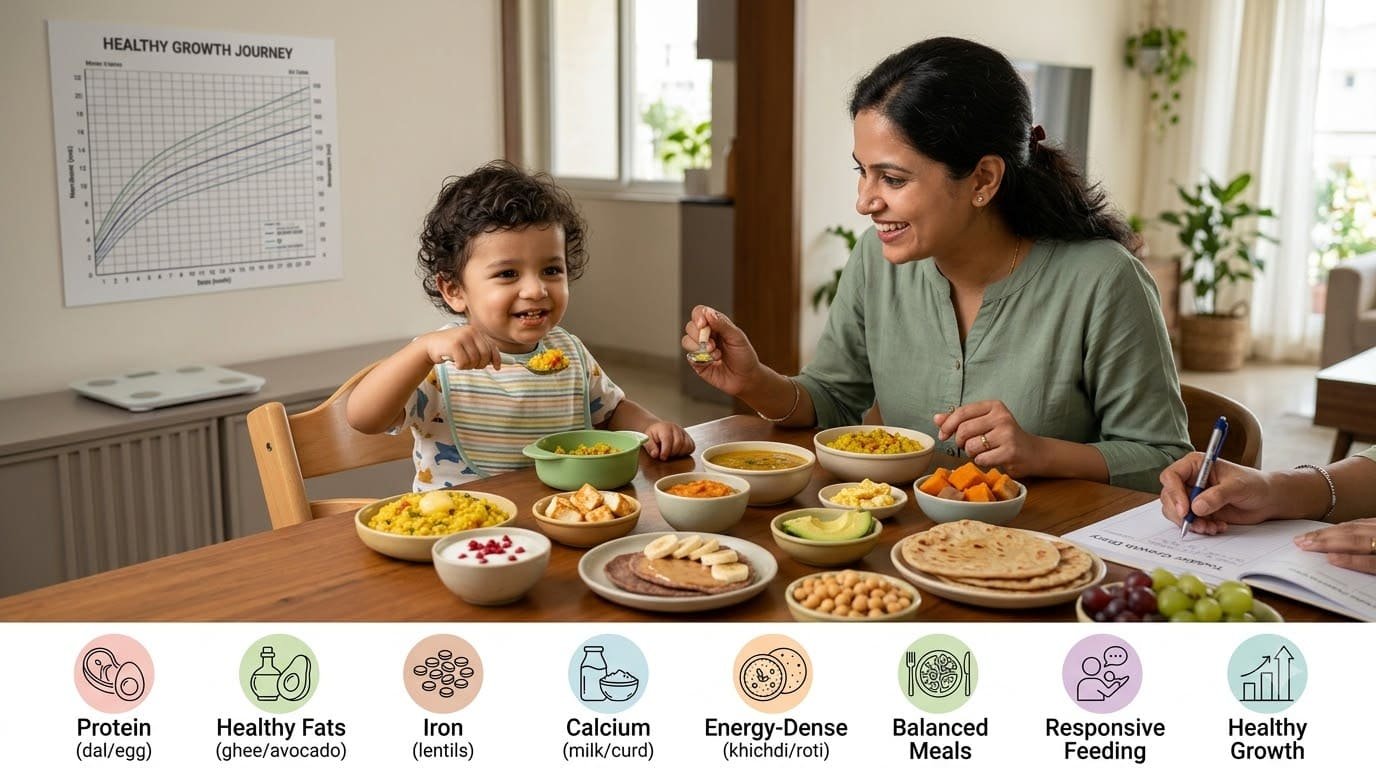
If you’re reading this because someone — a relative, a neighbour, possibly your own anxiety — has made you worried about your toddler’s weight, start here: check the growth chart first. A toddler who is following their own consistent curve, however low on the percentile that curve runs, is a healthy toddler. The goal is not the 50th percentile. The goal is steady, appropriate growth for your specific child.
If your paediatrician has confirmed that your child genuinely needs to gain weight — this guide has exactly what you need. Fifteen high-calorie Indian foods that actually work, a sample meal plan, and the feeding strategies that make the difference.
First — Is Your Toddler Actually Underweight?
Before adding high-calorie foods, confirm that there’s actually a problem.
A toddler is considered clinically underweight if their weight is consistently below the 3rd percentile on the WHO growth chart — not the 25th, not the 10th. Below the 3rd.
More importantly: a toddler who has dropped significantly across percentile lines — who was at the 40th percentile at 6 months and is now at the 10th at 18 months — needs assessment regardless of where they currently sit on the chart. The trajectory matters more than the number.
According to the World Health Organization’s child growth standards, growth assessment in young children requires looking at the pattern over time — not a single weight measurement. The Indian Academy of Pediatrics recommends regular growth monitoring at every well-child visit precisely because this pattern is more informative than any single data point.
For the complete Indian baby and toddler weight chart with normal ranges, our baby weight chart India guide has the full age-by-age numbers.
Why Toddler Weight Gain Foods India Need to Be Different
Toddlers are not small adults. Their stomachs are small — roughly the size of their fist. They cannot eat large portions. They go through neophobic phases where they reject foods they previously accepted. They are distracted, opinionated, and inconsistent.
This means that adding weight for a toddler is not about eating more — it’s about eating foods that are more calorie-dense in the same small portions.
A toddler who eats 150ml of khichdi made with dal, rice, and ghee gets significantly more calories than one who eats the same volume of plain rice. Same portion size. Very different nutritional result.
The strategy: add nutrition to what they already eat, rather than fighting to add new foods. This is the principle behind every effective toddler weight gain approach.
Calorie Reference — What Your Toddler Needs
| Age | Daily Calorie Requirement |
|---|---|
| 1–2 years | 900–1000 kcal/day |
| 2–3 years | 1000–1200 kcal/day |
| 3–4 years | 1200–1400 kcal/day |
These seem small because they are small. A toddler’s total daily calorie need is less than a single adult meal at many restaurants. The challenge isn’t quantity — it’s getting those calories from nutrient-dense sources.
15 Toddler Weight Gain Foods India — With Calories
1. Ghee — The Most Calorie-Dense Addition
One teaspoon of ghee contains approximately 45 calories. Add it to almost any food without changing the taste significantly. Dal, rice, roti, khichdi, sabzi — a teaspoon of ghee on each meal adds 135 calories daily with zero effort.
Ghee is not the villain it’s been made out to be in health-conscious urban circles. For a growing toddler, the healthy saturated fats in cow’s milk ghee support brain development, fat-soluble vitamin absorption, and provide exactly the kind of calorie density that underweight toddlers need.
How to use: Add after cooking to preserve the nutritional value. One teaspoon per meal for toddlers 1 year and older.
Calories: 45 kcal per teaspoon
2. Full-Fat Curd (Dahi)
Full-fat curd provides protein, calcium, healthy fats, and probiotics — all in a form that most toddlers accept readily because of its mild taste and smooth texture.
The key is full-fat. Low-fat curd, which many adults switch to for their own health reasons, has significantly fewer calories. For an underweight toddler, full-fat is specifically what you want.
How to use: Plain with a little jaggery powder. Mixed into rice (curd rice is one of the most calorie-dense, easy-to-eat toddler meals available). As a base for fruit smoothies.
Calories: 60 kcal per 100g (full-fat)
3. Paneer — High Protein, High Fat, High Calorie
Paneer is one of the best toddler weight gain foods in the Indian kitchen. It provides protein for muscle building, calcium for bone development, and fat for calorie density — all in a mild, soft texture that toddlers generally accept.
20 grams of paneer contains approximately 54 calories. Add 40–50 grams to a meal and you’ve added over 100 calories from a single ingredient.
How to use: Small soft cubes as finger food. Crumbled into dal or khichdi. Paneer bhurji mixed into rice. Paneer paratha. Hidden in idli or dosa batter.
Calories: 265 kcal per 100g
4. Eggs — The Complete Toddler Food
A single whole egg contains approximately 70–80 calories, complete protein with all essential amino acids, healthy fats, choline for brain development, and vitamin D. It’s one of the most nutritionally complete foods available at the lowest cost.
For underweight toddlers, eggs are a non-negotiable if the child tolerates them. Two eggs per day adds 140–160 calories of high-quality nutrition.
How to use: Scrambled with ghee. Egg bhurji with vegetables. Boiled and mashed with curd. Egg paratha. Hidden in pancakes and dosas.
Calories: 70–80 kcal per egg
5. Ragi (Finger Millet) — Calorie-Dense and Nutritious
Ragi is one of the most calorie-dense grains available in India and has been used specifically for weight gain in babies and toddlers for generations, particularly in South India. It’s rich in calcium, iron, and complex carbohydrates that provide sustained energy.
Ragi porridge made with full-fat milk and jaggery provides protein, calcium, iron, and complex carbohydrates in one bowl. For underweight toddlers, this is an ideal breakfast or evening snack.
How to use: Ragi porridge with full-fat milk and jaggery. Ragi dosa. Ragi ladoo. Ragi roti.
Calories: 336 kcal per 100g (dry)
6. Banana — Nature’s Energy Bar
Bananas are one of the most calorie-dense fruits available, and most toddlers love them. A medium banana provides approximately 90 calories along with potassium, vitamin B6, and natural sugars for quick energy.
They’re also convenient — no preparation required. A banana with a smear of peanut butter or mixed into a milk smoothie is one of the fastest high-calorie snacks you can give a toddler.
How to use: Plain, mashed into porridge, blended into milkshakes, or mixed with curd.
Calories: 89 kcal per 100g
7. Peanut Butter / Groundnut Chikki
Peanut butter is extraordinarily calorie-dense — 100 grams contains nearly 600 calories. Even a tablespoon (15g) adds 90 calories to anything you add it to.
For Indian families more comfortable with traditional options, groundnut chikki (peanut brittle made with jaggery) provides similar nutrition in a traditional form that grandparents will recognise and approve.
Important: Introduce peanuts from around 6 months as per current guidelines (early introduction reduces allergy risk). If there’s a family history of peanut allergy, ask your paediatrician first.
How to use: Thin smear on roti or bread. Stirred into porridge. Blended into banana smoothies.
Calories: 588 kcal per 100g (peanut butter)
8. Dry Fruits Powder — The Traditional Secret
Soaked and dried almonds, cashews, walnuts, and dates — ground into a fine powder — can be added to almost any food without detection. This is the traditional Indian approach to adding nutrition and calories to children’s food, and it works very well.
A tablespoon of dry fruit powder added to morning porridge or milk adds approximately 60–80 calories along with healthy fats, protein, and micronutrients.
How to make it: Dry roast almonds, cashews, and walnuts separately. Cool completely. Grind to a fine powder with a pinch of cardamom. Store in an airtight container for up to 2 weeks.
Calories: ~600 kcal per 100g
9. Sweet Potato — Nutritious Calories Toddlers Love
Sweet potato is naturally sweet, soft, and easy to eat — making it one of the most toddler-accepted high-calorie vegetables. It provides complex carbohydrates for sustained energy, beta-carotene for immunity and vision, and fibre for digestion.
Mashed sweet potato with ghee is one of the best early weight-gain foods for babies transitioning to solids, and continues to be valuable through the toddler years.
How to use: Mashed with ghee. Roasted fingers as finger food. Added to khichdi or dal.
Calories: 86 kcal per 100g (cooked)
10. Full-Fat Milk and Milk-Based Drinks
Full-fat cow’s milk provides protein, calcium, fat, and vitamin D in a form that most toddlers accept. For underweight toddlers, milk should be full-fat — not toned, not double-toned.
Enhancing milk further: add a tablespoon of dry fruit powder, a teaspoon of ghee, or a tablespoon of ragi flour to each glass of warm milk. These additions increase calorie density significantly without large volume increase.
How to use: Warm milk morning and evening. Ragi malt. Milkshakes with banana and dates.
Calories: 61 kcal per 100ml (full-fat)
11. Dal — Protein and Calorie Together
Dal is protein-rich, iron-rich, and when made with ghee, genuinely calorie-dense. Moong dal khichdi made with rice, dal, ghee, and vegetables is one of the most complete and calorie-dense meals you can give a toddler.
The key is the ghee. Plain dal has good protein but moderate calories. Dal with a teaspoon of ghee added after cooking is a different proposition entirely.
How to use: Dal-chawal with ghee. Moong dal khichdi. Dal paratha. Dal stuffed roti.
Calories: ~116 kcal per 100g cooked (with ghee)
12. Avocado — The Healthy Fat Bomb
Avocado is becoming more available in Indian cities and is one of the most calorie-dense fruits available — 100g provides 160 calories, almost entirely from healthy monounsaturated fats. The texture is smooth and mild, making it easy for toddlers.
If avocados are available in your city, they’re worth including for an underweight toddler. Mashed with a little lemon juice is the simplest preparation.
How to use: Mashed and spread on roti. Mixed into rice. As a dip for soft vegetable sticks.
Calories: 160 kcal per 100g
13. Curd Rice — The Comfort Meal That Builds Weight
Curd rice — cooked rice mixed with full-fat curd, tempered with mustard, curry leaves, and a small amount of ghee — is one of the most calorie-dense, digestible, and accepted toddler meals in the Indian tradition.
It provides carbohydrates from rice, protein and fat from curd, and additional calories from ghee — all in a soft, mild format that even the most reluctant eaters usually accept.
Calories: Approximately 150-180 kcal per bowl
14. Banana Sheera / Halwa
Banana sheera — made with semolina (sooji), banana, full-fat milk, ghee, and jaggery — is one of the most calorie-dense traditional preparations for young children. It’s warm, sweet, soft, and deeply familiar in Indian households.
A small bowl of banana sheera can contain 200–250 calories — making it one of the most efficient calorie deliveries available in a small volume.
How to make: Roast sooji in ghee until fragrant. Add warm milk and mashed banana. Stir until thick. Add jaggery to taste. Serve warm.
Calories: ~200 kcal per small bowl
15. Khichdi with Ghee — The Complete Meal
Khichdi — dal, rice, vegetables, and ghee combined — is nutritionally the most complete toddler meal available in the Indian kitchen. It provides protein (dal), carbohydrates (rice), vitamins and minerals (vegetables), and calorie-dense fat (ghee) in one soft, digestible preparation.
For an underweight toddler, khichdi made with a generous amount of ghee and full-fat curd on the side is the gold standard meal — easy to eat, easy to digest, and packed with everything the body needs.
Calories: 180–220 kcal per bowl (with ghee)
Sample Day Meal Plan — Toddler Weight Gain India
This plan is designed for toddlers aged 1–3 years who need additional calorie density.
| Time | Meal | Approximate Calories |
|---|---|---|
| 7 AM | Warm full-fat milk (150ml) + 1 tbsp dry fruit powder | 130 kcal |
| 8 AM | Ragi porridge with full-fat milk, jaggery, 1 tsp ghee | 180 kcal |
| 10 AM | Banana + 1 tbsp peanut butter | 170 kcal |
| 12 PM | Khichdi (dal + rice + vegetables) + 1 tsp ghee + curd | 250 kcal |
| 2 PM | Full-fat curd with mashed banana or mango | 130 kcal |
| 4 PM | Paneer cubes (30g) + soft roti with ghee | 180 kcal |
| 6 PM | Warm full-fat milk (150ml) + dry fruit powder | 130 kcal |
| 7:30 PM | Dal + rice + ghee + soft vegetable sabzi | 230 kcal |
| Total | ~1,400 kcal |
Adjust portions to what your toddler will actually eat. The goal is calorie density at each meal — not forcing large volumes.
Feeding Strategies That Actually Make a Difference
Small portions, more often. Three meals and three snacks spread across the day work better than three large meals. A toddler’s small stomach handles smaller volumes more comfortably, and frequent eating means more total calories across the day.
Add calories to every meal. A teaspoon of ghee on dal. Full-fat curd instead of toned. Dry fruit powder in milk. Paneer crumbled into rice. These additions don’t fight the toddler’s preferences — they work with what the toddler already accepts.
Don’t fight battles. A stressed, forced mealtime produces less eating, not more. A calm, pressure-free meal where the toddler eats at their own pace — even if that means less than you hoped — is more effective than anxiety-driven insistence.
Screen-free mealtimes. Distracted toddlers eat less. A screen-free, calm mealtime where your toddler is focused on food and interaction with you produces better intake than eating in front of a tablet.
Eat together. Toddlers eat more when they see adults eating the same food with visible enjoyment. Shared mealtimes with the whole family consistently produce better toddler intake than isolated toddler meals.
What Not to Do
Don’t add biscuits, chips, or maida-based snacks for weight gain. These add empty calories without nutrition. An underweight toddler needs calorie-dense nutrition — not calorie-dense junk.
Don’t force feed. Forced feeding creates feeding aversions that make the weight problem worse over time. Pressure at mealtimes is counterproductive.
Don’t give large milk volumes at the expense of solid food. Toddlers who drink too much milk — more than 400–500ml per day — often eat fewer solids, reducing their overall nutrition and iron intake. Milk is valuable but not at the expense of solid food.
Don’t give commercial health drinks like Bournvita, Horlicks, or similar products as a primary weight-gain strategy. These are high in sugar and do not substitute for the protein, healthy fats, and micronutrients from real food.
For more on toddler nutrition and managing picky eating, our toddler nutrition guide covers the complete picture of feeding a toddler who won’t eat.
FAQ — Toddler Weight Gain Foods India
Q: My 18-month-old is below the 3rd percentile. What should I do first?
See your paediatrician before changing the diet. Below the 3rd percentile consistently needs medical assessment to rule out underlying causes — thyroid issues, coeliac disease, metabolic conditions — before nutrition alone is addressed. Once medical causes are ruled out, the food strategies above are appropriate.
Q: How quickly can a toddler gain weight with diet changes?
Healthy weight gain for a toddler is slow — approximately 1–2 kg over several months is realistic. Rapid weight gain in a short period is not the goal and is not healthy. Consistent, gradual gain following the strategies above is what to work toward.
Q: My toddler refuses everything except milk. How do I add calories?
Add dry fruit powder and full-fat cream to milk to increase its calorie density without changing the volume. Gradually introduce solid foods alongside — not instead of — milk. A feeding therapist or paediatric dietitian can help if solid food refusal is significant.
Q: Is ghee actually safe for toddlers?
Yes — ghee is safe and beneficial for toddlers. The traditional Indian practice of adding ghee to children’s food has genuine nutritional basis. Ghee provides healthy fats, fat-soluble vitamins, and calorie density that growing toddlers need. There is no reason to restrict ghee for a healthy toddler.
Q: Should I give health drinks like Bournvita for weight gain?
No — commercial health drinks contain significant sugar and do not replace the protein, healthy fats, and micronutrients from real food. Dry fruit powder in warm full-fat milk provides better nutrition with less sugar and is far more effective for healthy weight gain.
Q: Everyone says my toddler looks “kamzor.” How do I know if they’re actually underweight?
Check the WHO growth chart for your baby’s age and gender. If your toddler is above the 3rd percentile and following a consistent growth curve — they are not clinically underweight regardless of how they look to relatives. Body type runs in families. A slender toddler from a slender family is not a malnourished toddler.
More from MumPappaHub — Read These Next:
- Indian Baby Weight Chart 0-12 Months
- Superfoods for Toddler Brain Development
- Toddler Nutrition and Picky Eating
- Picky Eater Strategies That Actually Work
- Starting Baby on Solid Foods
- How to Increase Breast Milk Supply
- Baby Development Month by Month
- Baby Teething: Signs & Home Remedies
- Baby Vaccination Schedule India 2026
- Baby Fever Guide
- Newborn Sleep Tips
- Baby First Year Milestones
About This Article
Written by the MumPappaHub editorial team — including a mother whose son was called “kamzor” six times at a single family gathering while his paediatrician had never once expressed concern. He was at the 25th percentile. He was fine. The relatives were not dietitians.
Reviewed for accuracy against WHO child growth standards and Indian Academy of Pediatrics nutrition guidelines. This content is for general informational purposes only and does not constitute medical advice. Always consult your paediatrician if you have concerns about your toddler’s weight or growth.
MumPappaHub — Real talk for real parents. mumpappahub.com

5 Comments