
Baby teething India parents deal with usually starts around the same age as everywhere else, but the home remedies that actually work can look a little different here.
Medical Disclaimer: This article is for informational purposes only. Always consult your paediatrician if you are unsure whether your baby’s symptoms are from teething or another cause.
My son’s first tooth appeared on a Tuesday morning in his seventh month.
I know this because I had been checking his gums every single day for three weeks beforehand. He had been drooling through four bibs a day, chewing on everything within reach including my shoulder, my phone, and once memorably the corner of a library book I had borrowed. He was waking twice a night when he’d been sleeping through. He was fussier than usual in the evenings.
Every one of these things could have been teething. Some of them were. Some of them — the night waking, the evening fussiness — were almost certainly not teething and were happening for entirely separate developmental reasons. This is the thing about teething: it gets blamed for everything, and it actually causes less than most parents think.
This guide sorts through what teething genuinely does, when to expect it, which home remedies are safe and which ones to skip, and how to tell the difference between teething discomfort and something that needs a doctor.
When do babies start teething in India?
Most babies get their first tooth between four and seven months, with six months being the most common age for the first tooth to appear.
But the range is wide. Some babies get their first tooth as early as three months — which is early but normal. Some don’t get their first tooth until twelve months or even later — which is also normal. A baby with no teeth at ten months is not delayed. A baby with two teeth at four months is not advanced. Both are within normal variation.
According to the World Health Organization’s child development guidelines, tooth eruption timing varies considerably between individuals and is influenced by genetics, nutrition, and other factors. The Indian Academy of Pediatrics notes that the primary dentition (baby teeth) is complete by approximately age three, and that timing variation within a wide range is normal.
Family patterns matter: If you or your partner were late teethers, your baby probably will be too. Ask your parents when you got your first tooth — the answer is often illuminating.
The teething order — which tooth comes first
Teeth generally erupt in a specific order, though there’s variation. Here’s the typical sequence:
| Order | Teeth | When (Typical) |
|---|---|---|
| 1st | Lower central incisors (bottom front 2) | 6–10 months |
| 2nd | Upper central incisors (top front 2) | 8–12 months |
| 3rd | Upper lateral incisors (top, beside front) | 9–13 months |
| 4th | Lower lateral incisors (bottom, beside front) | 10–16 months |
| 5th | First molars (upper and lower) | 13–19 months |
| 6th | Canines/cuspids (the pointy ones) | 16–23 months |
| 7th | Second molars | 23–33 months |
Total: 20 primary teeth by approximately age 3.
The molars — which come after the front teeth — cause significantly more discomfort than the incisors. If your baby seemed fine through their front teeth and is now more distressed at 13–15 months, the first molars are likely the reason. They have a larger surface area pushing through the gum and can’t slice through as cleanly as the narrow incisors.
What teething actually causes — and what it doesn’t
This is where a lot of confusion happens. Teething gets blamed for symptoms it genuinely doesn’t cause — and when parents treat “teething fever” at home, they sometimes miss an actual illness that needs attention.
What teething genuinely causes
Drooling — dramatically increased. The most reliable sign. Teething stimulates saliva production significantly. Four bibs a day is not unusual. A teething rash around the mouth and chin — from the constant contact with saliva — is common and normal.
Gum swelling and sensitivity. The gum over the erupting tooth becomes red, swollen, and tender. You may be able to see or feel the outline of the tooth beneath the surface.
Chewing everything. Counter-pressure on the gum from chewing provides relief from the pressure of the erupting tooth. Babies chew on anything within reach — fingers (yours and theirs), toys, furniture, clothing.
Mild fussiness and irritability. Particularly in the day or two immediately before a tooth breaks through the gum, when the pressure is most intense.
Slight sleep disruption. Mild, related to discomfort. Usually not dramatic unless the molars are coming through.
A slight temperature rise. Teething can produce a very mild temperature increase — usually not above 37.5°C. Not a true fever.
What teething does NOT cause
Fever above 38°C. A temperature of 38°C or higher is not teething. It’s something else — a viral infection, bacterial illness, vaccination reaction. A baby with a high fever who is also teething has a fever from a different cause. Treat the fever and identify the cause.
Diarrhoea. This is one of the most persistent and most thoroughly debunked teething myths. Research consistently finds no causal relationship between teething and diarrhoea. A teething baby with diarrhoea has diarrhoea from something else — a gut infection, a dietary change, a virus. Take it seriously as its own thing.
Vomiting. Not caused by teething.
Severe, inconsolable crying. Teething causes discomfort and fussiness. It does not cause prolonged, severe crying that can’t be soothed. A baby who is crying severely and can’t be comforted needs assessment for other causes.
Ear pulling from teething. Ear pulling is sometimes attributed to referred pain from teething — the jaw and ear share nerve pathways. Mild, occasional ear touching during teething may be this. Frequent ear pulling, particularly with fever or cold symptoms, needs an ear infection ruled out.
Signs your baby is teething — the real list
Beyond drooling, here’s what to watch for:
Gum changes: Red, swollen gum over one area. You may see a white or blue-grey area just below the surface where the tooth is about to emerge. Occasionally a small blood blister forms — called an eruption cyst — which looks alarming but resolves on its own without treatment.
Bite changes: Babies start biting firmly on objects. They apply counter-pressure instinctively.
Sleep changes: Mild disruption, particularly during the worst days of a tooth coming through. The discomfort is often worse at night when there’s nothing else to distract from it.
Feeding changes: Some babies feed more during teething — the sucking motion provides comfort. Others feed less because the gum pressure is uncomfortable. Both are normal.
Cheek rubbing: Particularly during molar teething. The referred pain from the molar area can be felt in the cheek and jaw.
Safe home remedies for teething India
1. Cold — the most effective and safest remedy
Cold numbs the gum tissue and reduces inflammation. It’s the most consistently effective teething relief and uses nothing you need to buy.
Cold cloth: Wet a clean muslin cloth or small towel, wring it out, and refrigerate (not freeze) for fifteen minutes. Let your baby chew on it. The texture and cold together are very soothing. You can tie knots in the cloth to give it more interesting texture.
Cold teething ring: Refrigerate (not freeze) a teething ring. Frozen teething rings are too cold and can actually damage the delicate gum tissue — refrigerator temperature is right.
Cold food: For babies who have started solids — a cold piece of cucumber, carrot, or bread crust to chew on provides counter-pressure and cold simultaneously. Always supervise for choking risk.
2. Gum massage
A clean finger rubbed firmly along the gum provides counter-pressure that relieves the discomfort of the erupting tooth. Wash hands thoroughly. Apply firm, steady pressure along the gum — not just the spot where the tooth is emerging, but along the whole ridge.
Some babies love this. Some hate being touched on the gums when they’re sore. Follow your baby’s response.
3. Ginger — the Indian traditional remedy that works
Raw ginger has genuine anti-inflammatory properties. Take a small piece of fresh ginger root and rub the end gently along the baby’s gum. Don’t apply ginger juice directly — the concentration is too high. Just the light contact from rubbing the root is enough.
This is an old Indian remedy with some real pharmacological basis. The gingerols in ginger have documented anti-inflammatory effects. Use sparingly — small amounts only.
4. Clove oil — with important caveats
Clove oil contains eugenol, a natural anaesthetic. It’s been used in dentistry for pain relief for centuries and is genuinely effective.
However — clove oil must be significantly diluted before applying to a baby’s gums. Undiluted clove oil is too concentrated and can irritate or burn the gum tissue. If you want to use it: mix one drop of clove essential oil into one tablespoon of coconut oil. Apply a tiny amount — less than a pea-size — to the gum with a clean finger.
Don’t use clove oil on babies under six months. Use sparingly.
5. Coconut oil
Virgin coconut oil has mild anti-inflammatory properties and is safe to apply to the gums. It also keeps the gum tissue moisturised, which can reduce the dryness and cracking that sometimes accompanies teething.
Apply a very small amount with a clean finger, gently massaging along the gum line. Safe from the time solid foods are introduced.
6. Extra feeding and comfort
Not a remedy in the traditional sense — but genuinely effective. Breastfeeding during teething provides comfort, the sucking motion applies gentle pressure, and the closeness is soothing. Formula feeding has the same comfort effect.
Extra cuddles, being held, distraction — all of these reduce the perceived discomfort of teething because teething discomfort is real but not severe. Comfort matters.
Safe teething products — what to look for
Silicone teethers: Soft, easy to clean, can be refrigerated. Look for food-grade silicone without BPA or phthalates. Single-piece design is safer than multiple parts.
Wooden teethers (neem or beech): Traditional Indian option. Natural, easy to grip, provides good counter-pressure. Ensure they’re untreated — no paints, varnishes, or chemical finishes.
Muslin teether cloths: Wet and refrigerate. Excellent texture for gum massage.
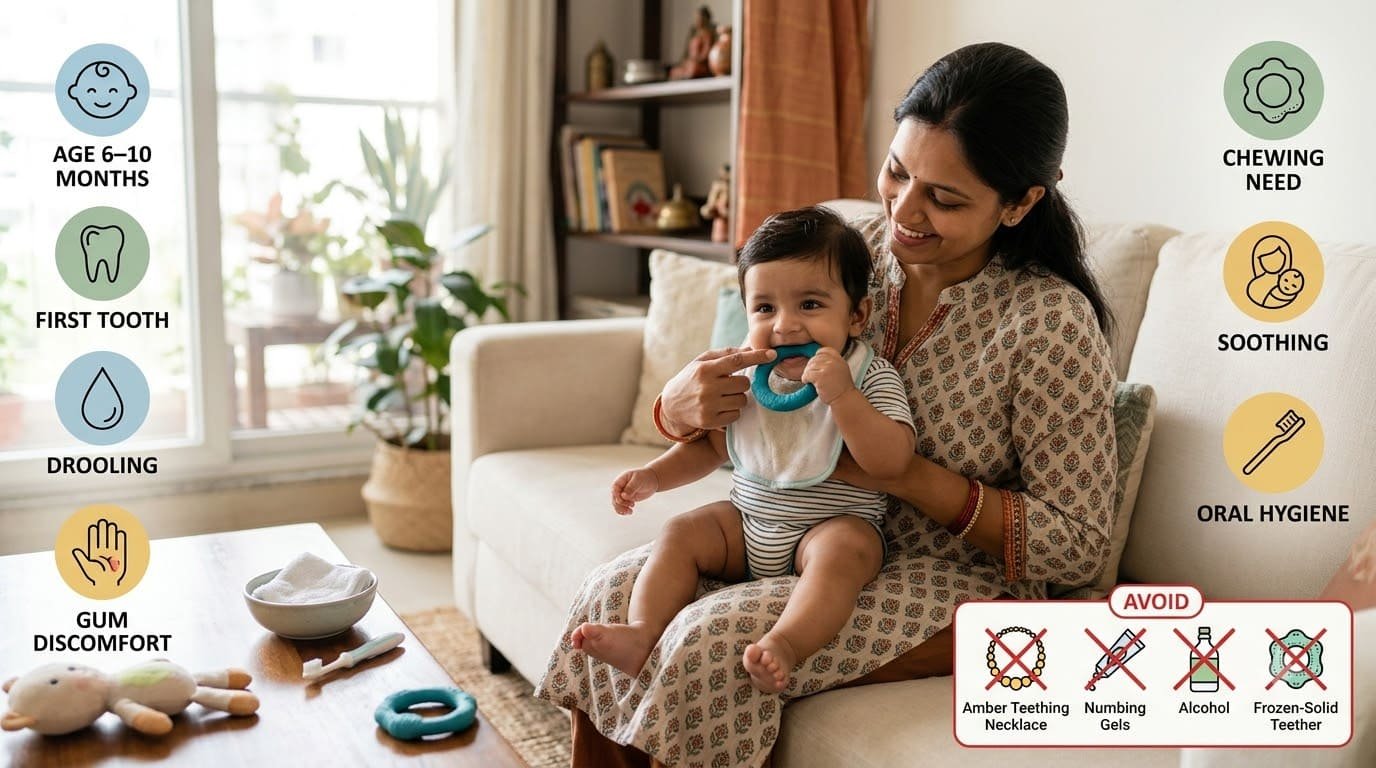
What to avoid: Amber teething necklaces — these pose a serious strangulation and choking hazard and have no evidence of effectiveness. Not safe. Teething gels containing benzocaine — not recommended for babies by international paediatric bodies, as benzocaine can cause a rare but serious condition called methemoglobinemia.
Dangerous remedies to avoid completely
Amber teething necklaces: The belief that amber releases succinic acid when warmed by the skin, providing pain relief, has no scientific basis. The necklace is a strangulation risk and a choking hazard. Multiple infant deaths have been linked to amber teething necklaces internationally. Do not use.
Teething gels with benzocaine: Products like Orajel contain benzocaine, a local anaesthetic. Major paediatric bodies including the American Academy of Pediatrics recommend against using benzocaine-containing products in babies under two years old. The gum absorption is unpredictable and the rare side effect (methemoglobinemia) is serious.
Frozen teething rings: Too cold. Can damage the delicate gum tissue. Refrigerator temperature — not freezer.
Whiskey or alcohol on the gums: A traditional remedy in some families that is genuinely dangerous. Alcohol is toxic to babies in even small amounts. The fact that “it was done for generations” does not make it safe.
Aspirin: Never give aspirin to a baby or child for any reason. Associated with Reye’s syndrome, a rare but serious brain and liver condition.
When to give paracetamol for teething
Paracetamol (Calpol, Crocin) is appropriate for teething discomfort when:
- The baby is clearly in significant discomfort
- Other comfort measures haven’t helped
- The baby is over 3 months old
Always dose by weight, not age. Follow the dosing on the packaging for your baby’s weight, or ask your paediatrician.
Ibuprofen can be used from six months for more significant discomfort — it has the added benefit of reducing inflammation as well as pain. Ask your paediatrician about alternating the two for severe teething days.
Oral hygiene during teething — start now
The moment the first tooth appears, oral care begins.
Before teeth: Wipe the gums with a clean, damp cloth after each feed. This removes milk residue and gets your baby used to oral care before teeth arrive.
First tooth: Switch to a soft baby toothbrush with a rice-grain-sized amount of fluoride toothpaste. Brush gently twice daily — morning and before bed.
Why fluoride matters: The Indian Academy of Pediatrics recommends fluoride toothpaste from the first tooth. Fluoride strengthens the enamel and prevents decay. The amounts in a rice-grain-sized application are safe even if swallowed.
Avoid: Putting a baby to sleep with a bottle of milk or juice. The pooling of milk around the teeth during sleep causes “bottle tooth decay” — rapid decay of the upper front teeth that is one of the most preventable dental problems in Indian children.
For more on baby development milestones including tooth development, our baby development month by month guide covers what to expect at each stage.
When the baby seems unwell alongside teething
Teething discomfort is real. But teething doesn’t cause serious illness. When a baby who is teething also:
- Has a temperature above 38°C
- Has diarrhoea or vomiting
- Is refusing all feeds
- Is unusually lethargic or difficult to rouse
- Has ear discharge or is pulling the ear and has fever
- Has a rash beyond the normal drool rash around the mouth
— these symptoms need medical assessment. They are not teething. They are happening alongside teething but from a separate cause.
For guidance on fever management, our baby fever guide covers temperatures, when to worry, and what to give.
FAQ — Baby Teething India
About timing
Q: My baby is 10 months and has no teeth. Should I be worried?
A: No — ten months with no teeth is completely within the normal range. The upper limit of normal for the first tooth is twelve months, and some babies get their first tooth even later without any underlying problem. If there are still no teeth by fifteen months, mention it to your paediatrician at that point. Before then — it’s likely genetics. Ask your parents when you got your first tooth.
Q: My baby got teeth at 3 months. Is this too early?
A: Three months is early but not abnormal. Occasionally babies are born with a tooth already present — called a natal tooth — which is rare but not harmful. Early teething doesn’t cause any problems. The primary concern with very early first teeth is that the enamel may be softer — maintain good oral hygiene from the moment the tooth appears.
Q: My baby is teething but the tooth hasn’t come through for three weeks. Is this normal?
A: Yes. The process of a tooth moving from below the gum to breaking through takes weeks. The symptoms often start long before the tooth is visible. The most intense discomfort is usually in the day or two immediately before and after the tooth breaks through the gum surface.
About symptoms
Q: My baby has a temperature of 38.5°C and is also teething. What do I do?
A: Treat the fever as a separate issue — give paracetamol at the correct dose for your baby’s weight, ensure adequate fluids, and call your paediatrician. A temperature of 38.5°C is not caused by teething. Something else is happening alongside the teething and it needs assessment.
Q: My baby has diarrhoea and is teething. Are they related?
A: Research consistently shows that teething does not cause diarrhoea. They may be occurring at the same time — babies are frequently teething during the period when they’re also encountering new foods, new environments, and new germs — but one is not causing the other. Manage the diarrhoea with ORS and appropriate care, and consult your paediatrician if it’s severe or persistent.
Q: The teething rash on my baby’s chin is very red and raw. What should I do?
A: Apply a thin barrier cream — petroleum jelly or zinc oxide — to the chin and around the mouth after every feed and nap to protect the skin from the constant moisture. Change bibs frequently. The rash itself is from saliva contact, not infection, and resolves when the drooling reduces. If it looks infected — weeping, crusted, spreading — see your paediatrician.
About remedies
Q: Can I use clove oil on my baby’s gums?
A: Yes, but diluted. One drop of clove essential oil in one tablespoon of coconut or olive oil. Apply a very small amount with a clean finger. Do not use undiluted clove oil — it’s too concentrated and can irritate. Not for babies under six months.
Q: Is it safe to use amber teething necklaces?
A: No. Amber teething necklaces have no evidence of effectiveness and carry real risks of strangulation and choking. Multiple infant deaths have occurred internationally. Please don’t use them.
Q: My mother-in-law says to rub alcohol on the gums. Is this safe?
A: No — alcohol is toxic to babies in any amount. Even a small quantity rubbed on the gums is absorbed and can cause harm. This is a traditional practice that is genuinely dangerous. A firm “the doctor says not to” is the most useful response to this suggestion.
More from MumPappaHub — Read These Next:
- Baby Development Month by Month
- Indian Baby Weight Chart 0-12 Months
- Baby Fever Guide: When to Worry
- Newborn Sleep Tips
- Baby First Year Milestones
- Starting Baby on Solid Foods
- Superfoods for Toddler Brain Development
- Baby Blues vs Postpartum Depression
- 4 Month Sleep Regression
- Sensory Play for Toddlers India
- Newborn Care Tips
- Toddler Fever Guide
About This Article
Written by the MumPappaHub editorial team — including a mother who checked her son’s gums every single day for three weeks before his first tooth appeared, blamed teething for everything including the rainy weather, and eventually learned to distinguish actual teething from the many things it doesn’t cause. The library book corner survived.
Reviewed for accuracy against WHO child development guidelines, Indian Academy of Pediatrics recommendations, and current paediatric dental guidelines. This content is for general informational purposes only and does not constitute medical advice. Always consult your paediatrician if you have concerns about your baby’s teething or symptoms.
MumPappaHub — Real talk for real parents. mumpappahub.com

4 Comments