
Medical Disclaimer: This article is for informational purposes only. Always get clearance from your doctor, midwife, or women’s health physiotherapist before beginning any postpartum exercise programme. If you had a C-section or complications during delivery, get explicit clearance before attempting any exercises.
Postpartum exercises to rebuild core safely aren’t the same as generic ab workouts — I learned that the hard way. Six weeks after my second baby, I rolled out a yoga mat, got into position for a crunch, felt something deeply wrong, and stopped.
The “something wrong” was not pain exactly. More like a pressure — a doming sensation in the centre of my stomach that my body was clearly telling me to pay attention to. I sat up and Googled it. Diastasis recti. A separation of the abdominal muscles that affects up to two-thirds of women during pregnancy, and that makes traditional crunches, sit-ups, and even some yoga poses actively counterproductive during early recovery.
Nobody had told me this. My six-week clearance appointment had lasted eight minutes and ended with “you can exercise now.” What I actually needed — and didn’t get — was guidance on which exercises are safe, which ones can make things worse, and how to actually rebuild a core that has been stretched, separated, and hollowed out by nine months of pregnancy and the physical event of birth.
This guide covers all of it. Not just a list of five exercises, but how the postpartum core actually works, how to check for diastasis recti before you start, specific modifications for C-section recovery, a week-by-week progression, and the warning signs that mean stop and seek assessment.
Why the postpartum core is different from what you think
Most people think of the core as the visible abdominal muscles — the six-pack. The real core is a canister of muscles that work together to manage pressure in the abdomen and support the spine, pelvis, and organs.
The canister has four components: the diaphragm at the top, the pelvic floor at the bottom, the multifidus (deep spinal muscles) at the back, and the transverse abdominis at the front and sides. These four work together in a coordinated system.
According to the World Health Organization’s guidelines on postnatal care, the postpartum period is a critical recovery window during which appropriate physical rehabilitation significantly affects long-term outcomes for women. The Indian Academy of Pediatrics similarly emphasises that postpartum maternal health is directly linked to the wellbeing of the infant — a mother who is physically recovered is better placed to care for her baby.
Pregnancy stretches and compresses this entire canister system. The growing baby pushes the transverse abdominis outward. The pelvic floor bears increasing load for months. The diaphragm gets pushed upward. The deep spinal muscles are disrupted by postural changes. Birth — whether vaginal or caesarean — then adds its own specific disruptions.
What this means practically: the postpartum core cannot simply be “exercised” back into shape with crunches and sit-ups. The coordination between the components needs to be re-established first. That’s what these exercises do.
Check for diastasis recti before you start
Diastasis recti — the separation of the rectus abdominis muscles along the midline — affects up to 60-70% of women during pregnancy. For most women, there is some natural improvement in the first 8-12 weeks postpartum. For some, the gap remains significant.
Before doing any core exercises beyond breathing, it’s worth checking whether you have significant diastasis recti — because some exercises that are fine without it can worsen it.
How to self-check:
Lie on your back with knees bent. Place two fingers horizontally across your midline at the navel. Slowly lift your head as if starting a crunch — just enough to feel your muscles engage. Feel for a gap or softness between two ridge-like muscle edges.
A gap of one to two finger widths is common and doesn’t necessarily need treatment beyond the exercises in this guide. A gap of two or more finger widths, particularly if it feels deep or soft, is worth mentioning to a women’s health physiotherapist before progressing.
Also check for “doming” or “coning” — a ridge or peak appearing at the midline when you do any abdominal exercise. This is the internal organs pushing through a gap in the fascia. If you see doming during any exercise — stop that exercise and do a gentler version.
When to start — by week
The old “wait six weeks and then you can do anything” guidance has been replaced by a more nuanced approach that distinguishes between what’s appropriate in different recovery phases.
Days 1–7: Breathe and walk
Diaphragmatic breathing can begin on day one after an uncomplicated vaginal delivery, as soon as you feel ready. Short, gentle walks — as tolerated — support circulation and recovery. Nothing that creates pressure or strain.
After C-section — the same breathwork is appropriate from day one. Walking begins when comfortable and when the medical team advises. No core engagement exercises beyond breathing until cleared.
Weeks 2–6: Gentle reconnection
Pelvic floor exercises, pelvic tilts, and gentle glute work are appropriate for most women after a vaginal delivery during this phase. Listen for any signals — pressure, heaviness in the pelvis, pain, leaking — that indicate you’re doing too much.
After C-section — this phase extends to weeks 4–8 before adding any resistance or challenge. The incision is healing during this period. External pressure on the abdomen needs to be avoided.
Weeks 6–12: Building
After doctor clearance, more active exercises can begin — progressing the movements in this guide, adding resistance, beginning to challenge the core more dynamically. Still avoiding traditional sit-ups, crunches, full planks, and double leg lifts, which create excessive intra-abdominal pressure.
After 12 weeks: Return to full exercise
For most women with uncomplicated recovery, a gradual return to full exercise — including impact activities like running — is appropriate after 12 weeks. For C-section recovery, this timeline often extends to 16–20 weeks. Always follow your specific medical guidance.
The 5 exercises — with real detail
Exercise 1: Diaphragmatic Breathing — the most important one
Breathwork is not a warm-up to skip. It is the foundation. Everything else in postpartum core recovery builds on the coordination between breath, diaphragm, and pelvic floor.
Why it matters: The diaphragm and pelvic floor move together. On the inhale, both soften and expand. On the exhale, both lift and engage. This coordination was disrupted during pregnancy and birth. Reestablishing it is the first step of genuine core recovery.
How to do it: Lie on your back with knees bent and feet flat. One hand on the chest, one on the belly. Inhale slowly through the nose — feel the belly rise first, then the chest slightly. As you exhale through the mouth — feel the belly fall, and notice a gentle natural lift in the pelvic floor and a soft drawing-in of the lower belly.
The drawing-in on the exhale is the transverse abdominis engaging. This is your deep core waking up. Not a crunch. Not sucking in. A gentle, natural response to the breath.
Start with: 10 slow breaths, 2-3 times daily. This can begin within days of delivery.
Progress to: Adding the breath pattern as a foundation beneath all subsequent exercises.
What you should NOT feel: Pressure downward into the pelvic floor. Straining. Your belly coning or doming. Pain.
Exercise 2: Pelvic Floor Activation and Release
The pelvic floor after birth is frequently either too weak (especially after vaginal delivery with perineal tearing) or too tight (a protective spasm response common after both vaginal and caesarean delivery). Both need attention.
The lift: On the exhale, gently lift the pelvic floor — imagine lifting a marble with the vagina. Hold for 3–5 seconds. Release fully on the inhale.
The release: Equally important. Many postpartum pelvic floors are tight rather than weak. Consciously soften and release completely after each contraction. If the lift is difficult or uncomfortable, focus on the release first and let the strength come naturally.
Start with: 10 repetitions, twice daily. From day one after uncomplicated vaginal delivery. After C-section — same timing, as the pelvic floor was still loaded throughout pregnancy regardless of delivery mode.
Build to: Holding for longer, doing quick pulses, integrating with breathing.
When to see a women’s health physiotherapist: If the lift is impossible, if you experience pain during the exercise, if you consistently leak urine during exercise, or if you feel pressure or heaviness in the pelvis. These are signs the pelvic floor needs professional assessment, not more repetitions.
🛒 Helpful for pelvic floor recovery:
Exercise 3: Pelvic Tilts
Pelvic tilts address lower back pain — one of the most common postpartum complaints — while gently activating the deep abdominals in a safe, controlled way.
How to do it: Lie on your back, knees bent, feet flat. In this position, there’s a natural small curve under your lower back — a gap between the floor and the spine. On the exhale, gently tilt the pelvis backward — use the lower abdominals to flatten that gap, pressing the lower back gently into the floor. Hold for a breath. Inhale to release back to neutral.
What you’re feeling: A gentle engagement of the lower transverse abdominis and a release of lower back tension. No gripping, no bracing, no breath-holding.
Start with: 10 repetitions, once daily from week 2.
Progress: Over weeks, you can add more repetitions or hold each tilt slightly longer. The movement remains small and controlled.
What it’s NOT: A lower ab crunch. There should be no coning, no strain, no breath-holding.
Exercise 4: Glute Bridges
The glutes — the largest muscles in the body — take on a significant supportive role when the core is recovering. Strengthening them during early postpartum recovery gives the pelvis and lower back support while the core heals.
How to do it: Lie on your back, knees bent, feet hip-width apart and flat. Set your breath — exhale first. Then, pressing through the heels, lift the hips toward the ceiling by squeezing the glutes. The spine lifts naturally — don’t overarch the lower back. Hold for 2–3 seconds at the top, then lower slowly on the inhale.
The key detail: Drive the movement from the glutes and hamstrings, not from arching the lower back. If the lower back is working hard, the feet may be too close to the hips — move them slightly further away.
Start with: 8–10 repetitions from week 2–3 after vaginal delivery. Week 4–6 after C-section, ensuring there’s no pulling sensation at the incision site.
Progress: Add a 2-second hold at the top. Then add a resistance band just above the knees. Then try single-leg bridges (one leg extended while the other drives the bridge).
🛒 Helpful for bridge progression:
Exercise 5: Bird-Dog
Bird-dog is a stability exercise that challenges the core to maintain a neutral spine while the limbs move. It builds the deep stabiliser muscles — the multifidus and transverse abdominis working together — in a way that is functional and safe for postpartum recovery.
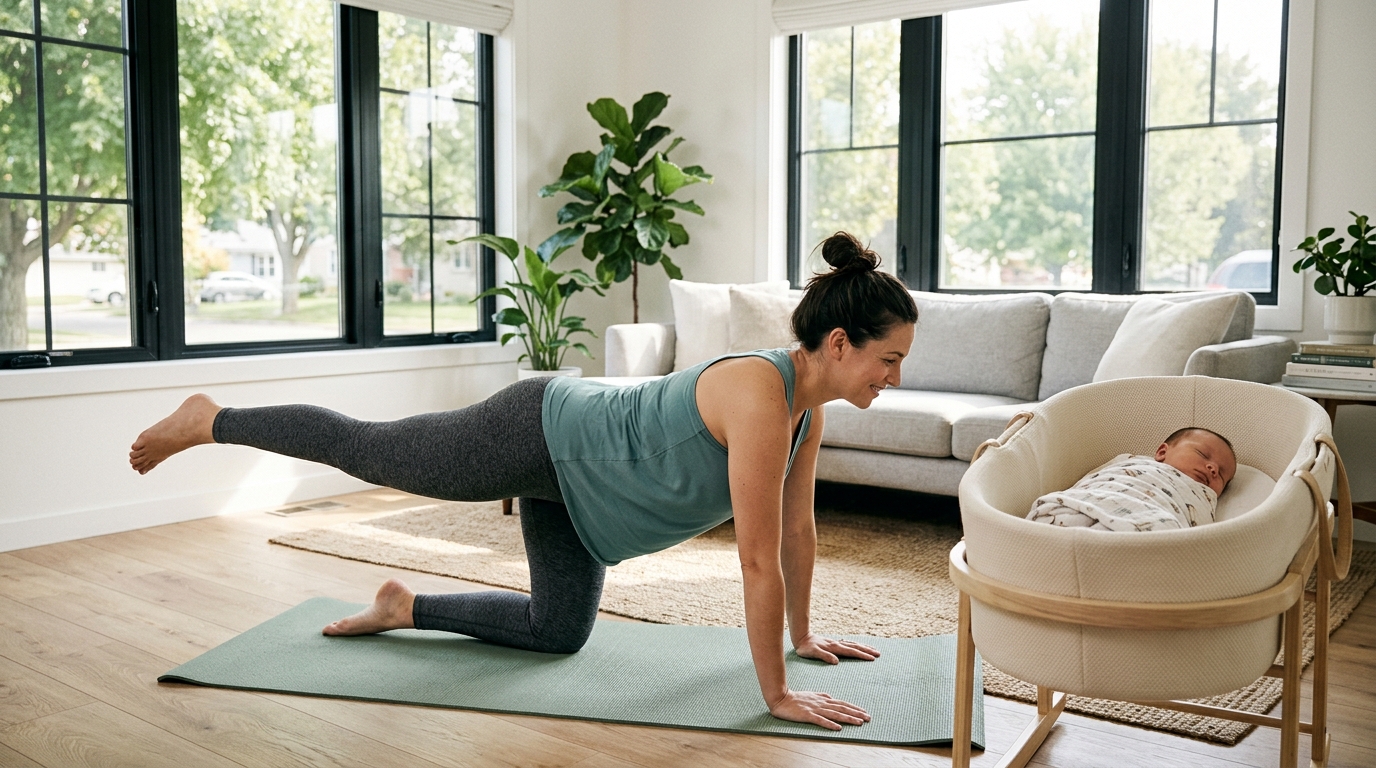
How to do it: Start on hands and knees — wrists under shoulders, knees under hips, spine neutral. This is “tabletop” position. Set the breath. On the exhale, extend the right arm forward and the left leg back simultaneously — keeping the hips level. The movement is small and controlled. Hold for 2–3 seconds. Return to tabletop on the inhale. Switch sides.
The detail that matters: The hips must stay level. Imagine a glass of water on your lower back that you cannot spill. If the hip drops or the back arches when you extend the leg — reduce the range of movement until you can maintain the level pelvis.
Modification: Start by just extending one leg at a time while keeping both hands on the floor. Add the opposite arm only when you can maintain a level pelvis consistently.
Start with: 6–8 repetitions per side from week 4–6 after clearance.
What to watch for: Any doming or coning at the midline. If you see this — reduce the challenge, return to breathing, and rebuild from there.
C-section specific modifications
A C-section is major abdominal surgery. The incision goes through multiple layers of tissue — skin, fascia, muscle, uterus. Recovery from this surgery is genuinely different from vaginal birth recovery, and a lot of generic postpartum exercise advice doesn’t reflect this.
What’s different:
- The abdominal wall has been cut through, not just stretched
- Scar tissue forms at the incision site and can affect the movement of the fascia beneath
- Direct pressure on the abdomen — including anything that creates intra-abdominal pressure — should be avoided longer
- Core exercise progression is slower — typically 8-12 weeks minimum before adding load or challenge
What IS appropriate early: Breathing — from day one. Pelvic floor activation — from day one. Gentle walking — when comfortable.
What needs to wait: Pelvic tilts — wait until the incision area is comfortable with movement, typically week 4–6. Glute bridges — week 6–8, checking that the incision site doesn’t feel pulled or strained. Bird-dog — week 8–10.
Scar management: From about 6–8 weeks, once the incision is fully healed externally, gentle massage of the scar tissue helps prevent adhesions — where the scar tissue sticks to underlying layers and restricts movement. A women’s health physiotherapist can teach this properly.
🛒 Helpful for C-section recovery:
Signs to stop — know these before you start
These are signals from your body that the exercise is too much, too soon, or wrong for your specific situation. Don’t push through them.
Stop immediately and reduce the exercise if:
- You feel pressure or heaviness in the pelvis or vagina during or after exercise — this can indicate pelvic organ prolapse
- You leak urine during the exercise
- You see or feel doming or coning at the midline
- You have pain at or near the C-section incision
- Pain anywhere during the exercise
- The exercise causes diastasis recti to feel worse or more pronounced
Stop and see a women’s health physiotherapist if:
- Any of the above are consistent across multiple sessions
- Lower back pain worsens rather than improves with exercise
- You feel “something coming down” in the pelvis
- You cannot perform even the gentlest exercise without discomfort
These symptoms are common — much more common than they should be, given that they’re treatable. They’re not things to live with or push through. They’re signals that professional assessment will make recovery faster and more complete.
Building a routine that fits real postpartum life
The theory of a regular exercise routine and the reality of newborn life are two completely different things.
Here’s what actually works:
Attach exercises to things you’re already doing. Breathing exercises during night feeds. Pelvic floor contractions while waiting for the kettle. Pelvic tilts before getting out of bed in the morning. This isn’t laziness — it’s sustainability.
Five minutes counts. A five-minute routine done consistently every day produces more recovery than a forty-minute routine done once a week. Don’t wait until you have time for a full session. Do what you can when you can.
Walking is exercise. Don’t underestimate it. A thirty-minute walk with the pram activates the glutes, mobilises the hips, and supports cardiovascular recovery. In the early weeks especially, this is enough.
Rest is recovery. The postpartum body is healing around the clock. Sleep deprivation increases cortisol, which slows recovery and reduces the body’s capacity to heal and strengthen. Rest is not the opposite of recovery. It is part of it.
For a complete postpartum yoga sequence that complements these exercises, our postpartum yoga poses guide covers restorative poses that work alongside this core programme. And for the full recovery timeline and expectations, our postpartum recovery guide covers what to expect at each stage.
FAQ — Postpartum Core Exercises
About when to start
Q: My doctor cleared me to exercise at six weeks but I don’t feel ready. Do I have to start?
A: No. Six-week clearance is a minimum threshold, not a starting gun. Your body tells you when it’s ready — and if it doesn’t feel ready, it probably isn’t. The exercises in this guide start very gently and you can begin with just breathing for as long as you need to. There’s no timeline that supersedes how your body actually feels.
Q: I had a C-section four weeks ago. Can I do any of these exercises?
A: Breathing and pelvic floor activation are appropriate from day one after C-section. Pelvic tilts and glute bridges depend on how your incision is healing — most women can begin these around weeks 4–6 if there’s no discomfort at the incision site. Bird-dog typically waits until 8–10 weeks. Always follow your surgeon’s specific advice.
Q: How long until I feel like my core is “normal” again?
A: This varies significantly. For most women with consistent, appropriate exercise, meaningful improvement in core function is noticeable by 3–4 months postpartum. Full recovery — feeling genuinely strong and functional — often takes 6–12 months. This isn’t a failure of effort. It’s the actual timeline of the tissue healing that needs to happen.
About diastasis recti
Q: I checked and I have a gap of about three fingers. Is this serious?
A: A gap of three finger widths is significant enough to warrant an assessment from a women’s health physiotherapist before progressing to more challenging exercises. The exercises in this guide — breathing, pelvic floor, pelvic tilts, gentle bridges — are generally appropriate even with significant diastasis. What to avoid: traditional crunches, sit-ups, double leg lifts, full planks, and anything that causes doming.
Q: Will diastasis recti close on its own?
A: For many women, there is significant natural improvement in the first 8–12 weeks postpartum as hormones rebalance and tissue regains tension. Whether the gap closes completely varies by individual. What matters more than gap size is functional recovery — can the core manage load and pressure effectively? This is what the exercises in this guide address.
Q: My stomach still looks “pouchy” months after delivery even though I’m exercising. Is this diastasis?
A: It might be. The characteristic look of unresolved diastasis recti is a persistent soft bulge along the midline — sometimes called the “mummy tummy” or “mommy pouch.” If this persists despite consistent appropriate exercise, a women’s health physiotherapist assessment is worthwhile. They can assess the gap size and provide targeted guidance.
About specific situations
Q: I leak urine when I exercise. Should I push through?
A: No. Urinary leakage during exercise is a sign that the pelvic floor isn’t managing the pressure of the exercise — pushing through doesn’t train the pelvic floor, it reinforces the pattern. Reduce the exercise to a level where leaking doesn’t occur, and mention it to a women’s health physiotherapist. Stress urinary incontinence after birth is common and very treatable — it’s not something to just accept.
Q: Can I do these exercises while breastfeeding?
A: Yes. These exercises are compatible with breastfeeding. Some women find it helpful to feed or pump before exercising to reduce breast discomfort. Staying well hydrated is important when combining exercise with breastfeeding. If you notice any change in milk supply when you start exercising — which is not typical but occasionally reported — mention it to your lactation consultant.
More from MumPappaHub — Read These Next:
- Postpartum Yoga Poses for New Moms
- Postpartum Recovery Guide
- Postpartum Hair Loss: Why It Happens & What Helps
- Baby Blues vs Postpartum Depression
- How to Increase Breast Milk Supply
- Hospital Bag Checklist India
- Early Signs of Labor
- Pregnancy Insomnia: What Actually Helps
- Newborn Care Tips
- Newborn Sleep Tips
- Baby First Year Milestones
- Baby Fever Guide
About This Article
Written by the MumPappaHub editorial team — including a mother who started a crunch at six weeks postpartum, felt something wrong, stopped, and spent the next hour down a diastasis recti rabbit hole. The eight-minute clearance appointment had not mentioned any of this. She wishes it had.
Reviewed for accuracy against WHO postnatal care guidelines, current women’s health physiotherapy guidelines on postpartum exercise, and published research on diastasis recti recovery. This content is for general informational purposes only and does not constitute medical advice. If you have concerns about your recovery, please consult your doctor or a women’s health physiotherapist.
MumPappaHub — Real talk for real parents. mumpappahub.com

6 Comments