
Medical Disclaimer: This article is for informational purposes only. Postpartum depression is a medical condition requiring professional diagnosis and treatment. If you think you or someone you know has postpartum depression, please consult a doctor or mental health professional. If there is any risk of harm to self or baby, seek emergency help immediately — call iCall: 9152987821 or Vandrevala Foundation: 1860-2662-345.
Postpartum depression India is spoken about far less than it should be — because Indian culture around new motherhood is built on an expectation that this is the happiest time of a woman’s life, and the mother who does not feel that happiness is often too ashamed, confused, or isolated to say so.
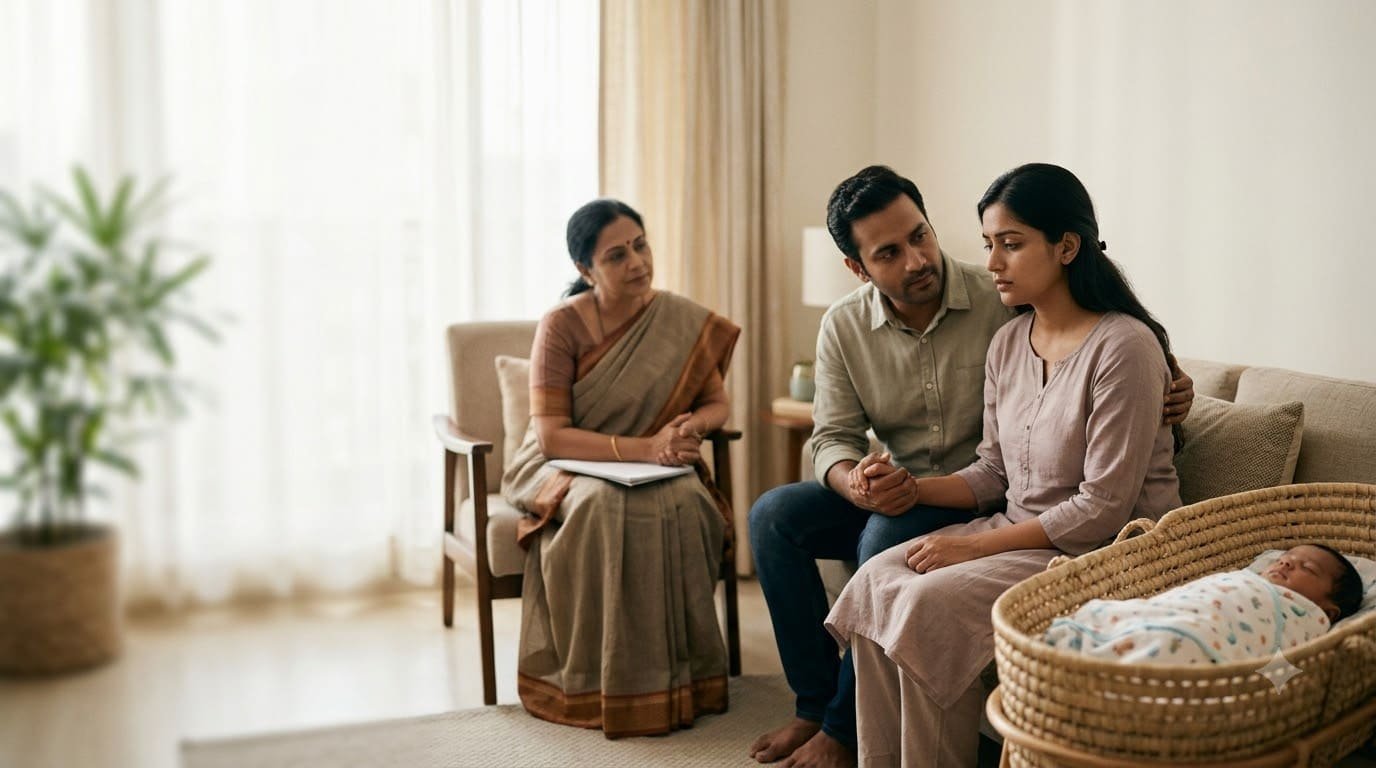
My cousin delivered her first baby in January. She had planned the pregnancy, wanted the baby desperately, and had an uncomplicated delivery. By Week 6, something was clearly wrong. She was not the sad, crying kind of wrong — she was the flat, distant, going-through-the-motions kind. She fed the baby. She handed the baby to family members. She sat for hours looking at nothing. She told me months later that she had felt nothing — not love, not joy, not pain. Just nothing.
Her mother-in-law said she was tired. Her husband said she needed more rest. Her mother said it was baby blues that would pass. Nobody said: this is an illness that needs treatment.
It was postpartum depression. She was not diagnosed for four months. She recovered fully — but those four months were lost to her, and to her baby, because nobody recognised what was happening.
What Is Postpartum Depression India?
Postpartum depression India — PPD — is a moderate-to-severe depressive illness that occurs in the weeks or months following childbirth. It is distinct from the “baby blues” — the mild, transient emotional volatility that affects up to 80% of new mothers in the first two weeks after delivery.
According to the World Health Organization’s guidelines on perinatal mental health, postpartum depression affects approximately 10-15% of mothers globally — and in India, studies suggest rates of 11-23% depending on the population studied. The Indian Academy of Pediatrics recognises postpartum depression as a significant public health concern that affects not only the mother but the baby’s development and family functioning.
Baby Blues vs Postpartum Depression:
| Baby Blues | Postpartum Depression | |
|---|---|---|
| Onset | Days 2-5 after delivery | 2 weeks to 12 months postpartum |
| Duration | Resolves within 2 weeks | Persists — weeks to months |
| Severity | Mild — tearfulness, mood swings | Moderate-severe — significant impairment |
| Function | Able to care for baby | May struggle to function |
| Treatment | Rest, support, reassurance | Professional treatment needed |
Postpartum psychosis — a rare but serious condition involving hallucinations, delusions, and confusion — is a psychiatric emergency requiring immediate hospital admission. It is different from PPD.
Why Postpartum Depression Is Underdiagnosed in India
India has specific cultural and structural factors that make PPD particularly likely to go unrecognised and untreated.
The happiness expectation: New motherhood is framed as the fulfillment of a woman’s primary purpose in Indian culture. A mother who does not feel joyful is seen as ungrateful, inadequate, or selfish — not as a person who is ill.
The joint family dynamics: In a joint family household, a new mother who is struggling emotionally may have her baby taken by family members — which can feel like help but removes the mother-baby bonding opportunity and can deepen the mother’s sense of inadequacy and disconnection.
Mental health stigma: In India, mental illness — including depression — carries significant stigma. Seeking help is interpreted as weakness or “pagalpan” (madness). Many women prefer to suffer in silence rather than risk the family’s judgment.
The “she just needs rest” response: The most common Indian family response to a struggling new mother is to offer practical help — taking the baby, managing the household — without recognising that the struggle is psychological, not practical.
Limited mental health access: India has a severe shortage of psychiatrists and psychologists, particularly outside metropolitan areas. Even when a woman recognises she needs help, accessing it may be difficult.
10 Best Ways to Recognise and Get Help
1. Know the Real Symptoms — Not Just Sadness
The most common misconception about postpartum depression is that the primary symptom is crying. Many Indian women with PPD do not cry excessively. The symptom picture is broader and more varied.
PPD symptoms — what to actually look for:
Emotional:
- Persistent low mood — feeling empty, hopeless, or numb
- Loss of interest or pleasure in activities previously enjoyed
- Feeling like a bad mother or that the baby would be better off without you
- Difficulty feeling love or connection with the baby (this is not failure — it is a symptom)
- Excessive worry or anxiety about the baby’s health
- Irritability and anger — sometimes more prominent than sadness
Physical:
- Significant fatigue beyond normal new baby tiredness
- Changes in sleep — inability to sleep even when the baby sleeps
- Changes in appetite — eating too much or too little
- Headaches, stomach problems, muscle pain without clear cause
Cognitive:
- Difficulty concentrating or making decisions
- Memory problems
- Intrusive thoughts — unwanted thoughts that frighten the mother (most common: thoughts of harm coming to the baby, not thoughts of causing harm — but both require professional assessment)
Duration: These symptoms persisting for more than 2 weeks after delivery, or appearing after the first 2 weeks, are not baby blues. They warrant assessment.
2. Understand the Risk Factors
Any woman can develop PPD, but certain factors increase the risk significantly.
PPD risk factors in Indian women:
- History of depression or anxiety before pregnancy
- Difficult or traumatic delivery experience
- Baby admitted to NICU
- Lack of partner support
- Difficult relationship with mother-in-law or family conflict
- Financial stress
- Previous pregnancy loss
- Unwanted or unplanned pregnancy
- Breastfeeding difficulties
- Baby with health problems or difficult temperament
- Social isolation — particularly in a new city away from family
- History of domestic violence or abuse
The India-specific risk: Studies in India have identified lack of social support, gender preference for a male child (particularly after a girl is born), domestic violence, and financial stress as particularly significant risk factors for PPD in Indian women.
3. Use a Screening Tool — The Edinburgh Scale
The Edinburgh Postnatal Depression Scale (EPDS) is a validated 10-question screening tool — used worldwide and validated in India in multiple Indian languages — that can identify women at risk of PPD.
The 10 questions cover mood, ability to enjoy things, self-blame, anxiety, fear and panic, feeling overwhelmed, sleep difficulties, sadness, tearfulness, and thoughts of self-harm.
How to access it: Many paediatricians and obstetricians use the EPDS at the 6-week postnatal visit. Ask your gynaecologist specifically: “Can I do the Edinburgh Depression Scale today?”
If your provider does not use a screening tool — the EPDS is freely available online in Hindi, Tamil, Telugu, Bengali, and other Indian languages. Search “Edinburgh Postnatal Depression Scale Hindi.”
Score interpretation: A score of 13 or above suggests PPD and warrants professional assessment. A score below 13 with persistent symptoms still warrants assessment.
4. Talk to Your Gynaecologist or Paediatrician
The 6-week postnatal visit to the gynaecologist and the baby’s regular paediatrician visits are the most accessible entry points into PPD assessment and treatment.
What to say: “I haven’t been feeling like myself since the baby. I feel [describe specific symptoms]. Can you check if this is postpartum depression?”
Many Indian women do not bring this up because they believe the gynaecologist is only for physical recovery. Mental health is within the gynaecologist’s scope — particularly perinatal mental health.
If dismissed: Some Indian doctors may attribute symptoms to tiredness or dismiss them as normal adjustment. If you feel dismissed but your symptoms are real and persistent — seek a second opinion or ask specifically for a referral to a psychiatrist or psychologist.
5. Understand Treatment — What Actually Helps
PPD is a medical condition with effective treatments. It is not a character flaw, a failure of motherhood, or something to push through alone.
Evidence-based treatments:
Talking therapy (psychotherapy): Cognitive Behavioural Therapy (CBT) — the most well-evidenced psychological treatment for PPD. Addresses the negative thought patterns that maintain depression. Interpersonal therapy — addresses relationship and role transition issues. Available in India from psychologists and counsellors in major cities and increasingly via online platforms.
Medication: Antidepressants — specifically SSRIs (selective serotonin reuptake inhibitors). Several are safe during breastfeeding. A psychiatrist prescribes after assessment. Medication is not weakness — it is treatment for a brain chemistry condition that does not resolve with willpower.
Both together: Combination of therapy and medication is more effective than either alone for moderate-severe PPD.
Recovery timeline: Most women with treated PPD begin to feel meaningfully better within 4-8 weeks. Full recovery typically occurs within 6-12 months.
6. For Fathers and Family — How to Actually Help
The people closest to a woman with PPD often want to help but don’t know how — or inadvertently make things worse.
What helps: Take the condition seriously. “You just need rest” is not appropriate for a medical illness. Take practical burdens consistently — not as a temporary measure, but as sustained support. Encourage professional help without judgment. Say: “I can see you are struggling. This is not your fault. Let’s get you some help.” Be present — sit with her, not just for the baby.
What does not help: “You should be grateful — you have a healthy baby.” “Other mothers manage — why can’t you?” “It’s just hormones — it will pass.” Comparing her to other mothers or to her pre-baby self. Taking over baby care completely — this can deepen the mother’s sense of failure and disconnection from her baby.
For fathers specifically: Paternal postpartum depression is also real — affecting approximately 10% of new fathers. Fathers who are struggling also need support and assessment.
7. Mother-Baby Bonding — When It Doesn’t Feel Natural
One of the most distressing PPD symptoms for Indian mothers — and the one most hidden because of shame — is difficulty feeling love or connection with the baby.
What mothers need to hear: Difficulty bonding with the baby is a symptom of PPD, not evidence of being a bad mother. The love that feels absent or blocked will return as the depression is treated. Many mothers with PPD provide adequate, safe care for their babies while feeling nothing — and their babies attach to them normally.
What helps bonding: Skin-to-skin contact when possible. Breastfeeding — if it is working, it promotes bonding through oxytocin. Talking to the baby during care activities — even when it feels mechanical, the connection builds. Treatment of the depression — bonding typically improves as depression lifts.
8. Online and Phone Mental Health Support in India
For women who cannot access in-person mental health care — geographic, financial, or social barriers:
Free helplines:
- iCall (TISS): 9152987821 — Monday to Saturday, 8 AM to 10 PM
- Vandrevala Foundation: 1860-2662-345 — 24 hours
- Snehi: 044-24640050
- Fortis Stress Helpline: 8376804102
Online therapy platforms (paid, more accessible than in-person):
- YourDOST
- Wysa
- Lissun
- MindPeers
Postpartum support communities: Online communities of Indian mothers with PPD provide peer support that reduces isolation and shame — search for “postpartum depression India” support groups on Facebook and Instagram.
9. Postpartum Anxiety — Equally Common, Less Recognised
Postpartum anxiety is as common as PPD and sometimes more distressing — yet less discussed.
Postpartum anxiety symptoms:
- Excessive worry about the baby’s safety — unable to leave the baby alone, checking breathing constantly
- Intrusive frightening thoughts — “what if the baby falls?” “what if I drop her?”
- Racing heart, difficulty breathing, panic attacks
- Inability to sleep even when exhausted — mind racing
- Feeling constantly on edge
The distinction from normal new parent worry: All new parents worry about their baby. Postpartum anxiety is when the worry is excessive, out of proportion, and interfering with functioning — preventing sleep, preventing normal daily activity, causing significant distress.
Postpartum anxiety responds well to the same treatments as PPD — therapy (particularly CBT) and medication when needed.
10. Recovery — What It Looks Like
Recovery from PPD is real, complete, and common. The mother who feels nothing today will feel again. The mother who cannot look at her baby’s face without terror will look at that face with love.
What recovery looks like: Not a single moment but a gradual return — first better days, then better weeks, then the depression becoming background rather than foreground. Most women report that the experience of PPD, while terrible, gave them a depth of understanding of mental health and an ability to seek help that became part of who they are.
After recovery: PPD does not predict PPD in a subsequent pregnancy — though the risk is somewhat increased. Women who have had PPD and plan another pregnancy should discuss this with their gynaecologist before or early in the next pregnancy, so monitoring and support are in place from the start.
FAQ — Postpartum Depression India
Q: I feel like a terrible mother for not feeling love for my baby. Does this mean I am one?
No — it means you are ill and need treatment. Difficulty bonding with your baby is a symptom of postpartum depression, not a measure of your character or your fitness as a mother. The love is there — it is blocked by the illness. Treatment removes the block. This is one of the most important things to understand about PPD.
Q: My husband says I just need rest and it will pass. How do I explain that this is different?
Share this article with him. The most direct explanation: “Baby blues pass within two weeks. What I have has been going on for [X weeks/months]. It is not getting better with rest — it is getting worse. I need medical help, not rest.” If he remains dismissive — see your gynaecologist or paediatrician yourself and ask for a PPD assessment. You do not need his permission to get help.
Q: Will I be judged or have my baby taken away if I tell the doctor I’m struggling?
Seeking help for PPD demonstrates that you are a responsible, caring mother who wants to be well for her baby. Doctors do not remove babies from mothers who seek PPD treatment. The only circumstances where baby safety becomes a concern is when there is immediate, specific risk of harm — in which case, getting help protects the baby. Telling your doctor you are struggling is the right thing to do.
Q: Can PPD affect my baby’s development?
Untreated PPD can affect mother-baby bonding and the responsiveness that supports infant brain development. This is a reason to seek treatment — not a reason for guilt. Treated PPD, with mother recovering, has excellent outcomes for both mother and baby. Early treatment is in the baby’s interest.
Q: I had PPD with my first baby. Will I definitely get it again with my second?
Not definitely — but your risk is higher than average (approximately 50% chance of recurrence). Discuss this with your gynaecologist before or early in your next pregnancy. A monitoring plan, early screening, and social support in place from the start significantly reduces the impact of recurrence if it does occur. Some women with a history of severe PPD choose to start treatment prophylactically — this is a decision made with the psychiatrist.
More from MumPappaHub — Read These Next:
- Baby Blues vs Postpartum Depression
- Postpartum Weight Loss India
- Postpartum Recovery Guide
- Postpartum Yoga Poses for New Moms
- Postpartum Exercises to Rebuild Core
- Parenting Stress Management India
- Working Mom Tips India
- Joint Family Parenting India
- Newborn Care Tips
- Newborn Sleep Tips
- Breastfeeding Problems India
- Pregnancy Calendar Week by Week
About This Article
Written by the MumPappaHub Research Team — including a researcher whose cousin had postpartum depression that went undiagnosed for four months. She felt nothing — not love, not pain, just nothing. Her mother-in-law said tired. Her husband said rest. Her mother said baby blues. Nobody said: this is an illness that needs treatment. She recovered fully. But those four months were lost. This guide is so that fewer months are lost.
Reviewed for accuracy against WHO perinatal mental health guidelines and Indian Academy of Pediatrics guidance on postpartum depression recognition and management in Indian mothers. This content is for general informational purposes only. Postpartum depression requires professional diagnosis and treatment — please seek help.
MumPappaHub — Real talk for real Indian parents. mumpappahub.com
