
Medical Disclaimer: This article is for informational purposes only and does not replace professional medical advice. If you have concerns about your child’s speech development, consult your paediatrician or a certified speech-language pathologist.
My cousin’s son didn’t say a single clear word until he was almost two and a half — a classic sign of speech delay in toddlers that had everyone around her worried. Everyone around her had an opinion.
She finally took him for an evaluation at two years and eight months. Turned out he had a mild expressive language delay, caught early enough that a few months of speech therapy made a real difference. He’s in school now, chatting away like any other kid his age.
I bring this up because speech delay is one of those topics where every parent gets a different opinion, and most of those opinions aren’t actually based on anything. This article is an attempt to cut through that — what’s genuinely normal, what’s worth watching, and when it’s time to actually see someone.
What Counts as “Normal” Speech Development, Roughly
Every child develops at their own pace, and there’s a real range of normal here — wider than most people assume. Still, there are rough milestones worth knowing.
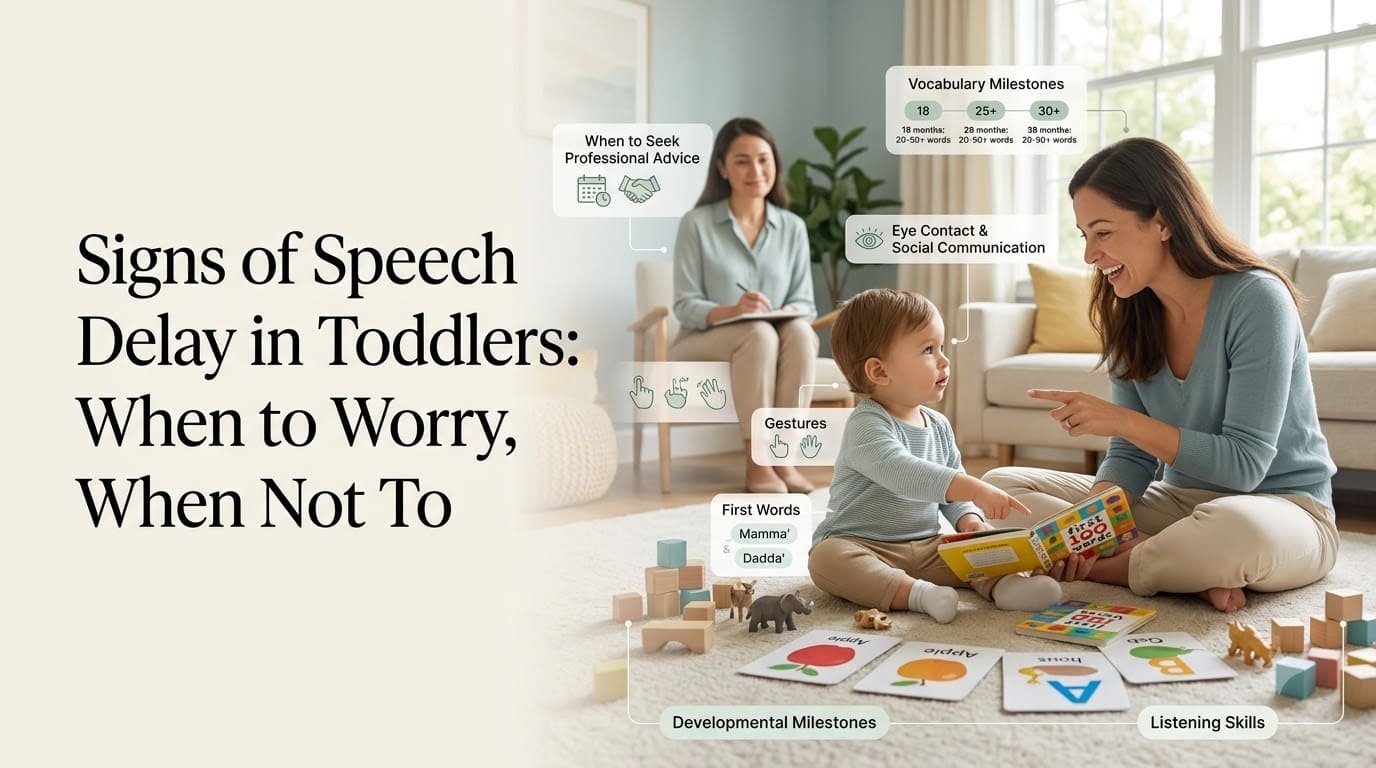
Most babies say at least one or two words by 12 months, even if unclear, and respond to their name. Somewhere between 10 and 50 words is typical by 18 months, along with the ability to point to a few familiar objects when asked. Two-word combinations usually show up by age 2 — “more milk,” “mama go” — and vocabulary tends to grow quickly around this point, even if pronunciation is still rough. By age 3, most children speak in short sentences that strangers can mostly understand, even if the grammar isn’t perfect yet.
The World Health Organization notes that early childhood development, including language, is shaped by a wide combination of genetics, environment, and individual variation — which is really just a formal way of saying that “normal” covers a lot of ground.
Signs That Are Genuinely Worth Paying Attention To
Not every quiet toddler has a problem. But certain signs do warrant a proper look, rather than just waiting it out indefinitely.
No babbling by 12 months. Babbling — even nonsense sounds like “bababa” or “dadada” — is an important precursor to real words. Its complete absence is worth mentioning to your paediatrician.
Absence of single words by 16-18 months. Not perfect words. Just something consistent that clearly means the same thing every time, even if it’s a simplified version like “ba” for bottle.
Missing two-word combinations by 24 months. Things like “want juice” or “daddy up.” This is one of the more commonly cited markers paediatricians look at.
Loss of previously learned words or skills. A toddler who used to say certain words and has stopped, especially alongside other changes in behaviour, needs prompt evaluation — this pattern is taken seriously regardless of age.
Difficulty understanding simple instructions. By around 18-24 months, most toddlers can follow basic one-step instructions like “bring me the ball.” Ongoing difficulty here is worth flagging.
Very limited eye contact or lack of interest in communicating at all, whether through words, gestures, or pointing. This is different from a shy or quiet temperament — it’s about a general lack of interest in connecting.
Family history of speech or language disorders. Not a red flag by itself, but a reason to keep a closer eye and mention it during routine check-ups.
Signs That Are Usually Not a Cause for Worry
This part matters just as much, because unnecessary anxiety helps no one.
A toddler who understands everything but says relatively few words is often fine — receptive language (understanding) typically develops ahead of expressive language (speaking). Late talking with no other developmental concerns, especially in boys, is common and often resolves on its own with time and exposure. Being raised bilingual or multilingual can cause a temporary lag in one or both languages — this is well-documented and not itself a red flag. Mispronouncing sounds like “r,” “th,” or “s” is completely normal well into the preschool years. A toddler who’s otherwise social, curious, and communicates through gestures and expressions, even without many words, is generally developing typically in the ways that matter most.
If your child falls into this category, it’s still worth mentioning to your paediatrician at a routine visit, mostly for peace of mind and to keep an eye on progress over the following months.
What Can Cause Speech Delay
Speech delay has a range of possible causes, and in many cases, no single clear cause is ever identified.
Hearing difficulties are one of the most common and most overlooked causes — even mild, intermittent hearing loss from repeated ear infections can affect speech development significantly. Developmental conditions, including autism spectrum disorder, can present with speech delay as one of several signs. Oral-motor issues, affecting the muscles used for speech, sometimes play a role. General developmental delays affecting multiple areas, not just speech, are another possibility. In many cases, it’s simply individual variation — some children are naturally later talkers with no underlying issue at all.
The Indian Academy of Pediatrics recommends a hearing evaluation as one of the first steps when speech delay is suspected, since hearing issues are both common and highly treatable when caught early.
When to See a Doctor
If your toddler shows two or more of the concerning signs above, or if your gut is telling you something feels off, it’s worth scheduling an evaluation rather than waiting indefinitely for things to resolve.
Start with your paediatrician. They’ll typically do a basic screening and may refer you to a speech-language pathologist, an audiologist for a hearing test, or a developmental specialist depending on what they observe.
Early intervention makes a genuine difference. Speech and language therapy tends to be significantly more effective the earlier it starts, particularly before age three, when the brain’s language-learning capacity is at its most flexible.
You don’t need to wait for a “big enough” concern to ask. A quick conversation with your paediatrician costs you nothing and either puts your mind at ease or gets the ball rolling on support your child might benefit from.
For more on tracking your child’s overall growth, our guide on child development milestones covers what to expect across different areas, not just speech, and our toddler language development guide goes deeper into how language builds over the toddler years.
How to Support Speech Development at Home
Whether or not there’s an actual delay, these habits genuinely help every toddler’s language development.
Talk to your child constantly, even about mundane things — narrate what you’re doing while cooking, dressing them, or walking around the house. Read together daily, even if it’s the same book on repeat for weeks. Repetition helps far more than variety at this age.
🛒 Check Toddler Picture & Word Books on Amazon →
Get down to their level and make eye contact when talking, rather than speaking from across the room. Limit screen time, particularly passive screen time without interaction, since research consistently links excessive screen exposure to slower language development in toddlers. Respond to their attempts to communicate, even gestures or sounds, rather than only responding to clear words — this encourages them to keep trying. Avoid finishing their sentences for them or anticipating every need before they express it, since this reduces their motivation to communicate verbally.
Flashcards with simple images and first words, and interactive talking toys designed for language development, can also make daily practice feel like play rather than a drill.
🛒 Check Language Development Flashcards on Amazon →
🛒 Check Talking & Learning Toys on Amazon →
For age-appropriate activities that also support communication skills, our sensory play for toddlers guide offers ideas that naturally encourage talking and interaction during play.
FAQ — Speech Delay in Toddlers
Q: Is it true that boys talk later than girls?
There’s some research suggesting a slight average difference, but it’s small and shouldn’t be used as a reason to dismiss genuine concerns. If your son shows several of the warning signs above, gender isn’t a good reason to wait it out.
Q: My toddler understands everything but barely talks. Should I be worried?
Not necessarily. Strong understanding with limited speech is actually a reasonably common and often reassuring pattern — it usually means the underlying language system is developing, and expressive speech tends to catch up. Still worth mentioning at a routine check-up.
Q: Can too much screen time actually cause speech delay?
Research links excessive passive screen time to slower language development, though it’s typically one contributing factor rather than a sole cause. Reducing screen time and increasing direct interaction is a reasonable step regardless of the underlying cause.
Q: We speak two languages at home. Could that be causing the delay?
Bilingual exposure can cause a temporary lag, particularly in one of the two languages, but it doesn’t cause genuine speech delay on its own. If your toddler shows other warning signs beyond simply mixing or lagging in one language, it’s worth a proper evaluation rather than assuming bilingualism explains everything.
Q: What happens during a speech evaluation?
A speech-language pathologist typically observes your child, asks about developmental history, and may use specific assessment tools appropriate for their age. It’s not invasive or stressful for most toddlers — often it looks more like structured play than a formal test.
More from MumPappaHub — Read These Next:
- Toddler Language Development
- Child Development Milestones
- Sensory Play for Toddlers
- When Do Babies Start Walking
- Screen-Free Play Ideas
- Baby First Year Milestones
About This Article: Written by the MumPappaHub editorial team. Reviewed for accuracy against current paediatric developmental guidelines. This content is for general informational purposes only and does not constitute medical advice. Always consult your paediatrician for concerns about your child’s development.
MumPappaHub — Real talk for real parents. mumpappahub.com

3 Comments